Refordez-novopharm
Ukraine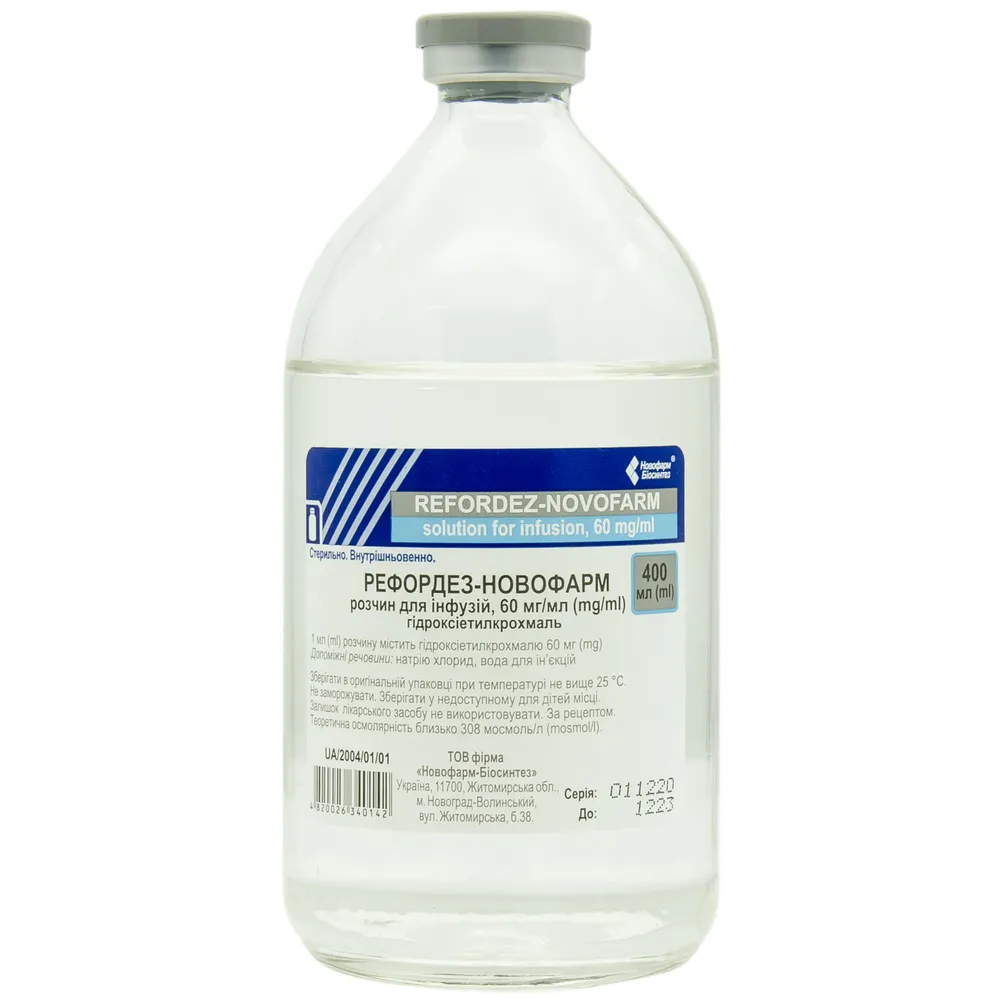
Table of Contents
INSTRUCTION FOR MEDICAL USE OF THE MEDICINAL PRODUCT REFORDEZ-NOVOFARM (REFORDEZ-NOVOFARM)
Composition:
Active substance: hydroxyethyl starch;
1 ml of solution contains 60 mg of hydroxyethyl starch;
Excipients: sodium chloride, water for injections.
Pharmaceutical form. Infusion solution.
Main physico-chemical properties: clear, colorless or slightly opalescent liquid; theoretical osmolarity approximately 308 mosmole/L.
Pharmacotherapeutic group. Plasma substitutes and perfusion solutions. Hydroxyethylated starch preparations. ATC code B05A A07.
Pharmacological properties.
Pharmacodynamics.
Refordes-NovoPharm is a colloidal plasma substitute containing 6% hydroxyethyl starch (HES) in an isotonic (0.9%) sodium chloride solution. The average molecular weight (MW) of the colloid is 200,000 daltons, and the molar substitution (MS) degree is 0.5. Refordes-NovoPharm is an iso-oncotic solution, meaning that the increase in blood plasma volume is almost equivalent to the infused volume of the medicinal product.
The duration of plasma volume expansion primarily depends on the MS degree and, to a lesser extent, on the MW. Following intravenous administration, HES polymers undergo continuous hydrolysis, generating smaller molecules. These smaller molecules, in turn, exert oncotic activity before being eliminated by the kidneys.
During infusion of the medicinal product, hematocrit and blood plasma viscosity decrease. When administered to patients with hypovolemia, circulating blood volume is normalized, and hemodynamics as well as cardiac function are improved. Blood volume is maintained for at least 6 hours.
Pharmacokinetics.
After parenteral administration, the bioavailability of the components of the medicinal product is 100%. Hydroxyethyl starch does not behave as a conventionally molecularly homogeneous substance but rather, probably, as a mixture of several different substances differing in substitution degree and molecular weight. Therefore, conventional pharmacokinetic principles apply to hydroxyethyl starch only with significant limitations, as the behavior of HES continuously changes over time.
For patients receiving this medicinal product, the most important factor in assessing circulating blood volume replacement is the duration of maintenance of the volume-expanding effects achieved by hydroxyethyl starch. Therefore, the duration of the plasma substitute's presence in the body can be used to compare medicinal products. This parameter can be mathematically expressed as the "initial" half-life t½, provided that the testing conditions—namely, circulation, infusion doses, and measurement intervals—do not differ.
Depending on the rate of administration and the type of infusion, the initial half-life from blood serum is approximately 5–7 hours.
HES molecules smaller than the renal elimination threshold are rapidly excreted by the kidneys via glomerular filtration. After a single 500 ml dose, approximately 50% of the administered medicinal product is found in urine within 24 hours.
Clinical characteristics.
Indications.
Treatment of hypovolemia caused by acute blood loss in cases where the use of crystalloids alone is considered insufficient.
Contraindications.
- Hypersensitivity to the active substance or to any other component of the medicinal product;
- sepsis;
- burns;
- renal failure or renal replacement therapy;
- intracranial or cerebral hemorrhage;
- critical condition of patients;
- severe liver dysfunction;
- severe coagulopathy;
- congestive heart failure;
- hyperhydration, including pulmonary edema;
- dehydration states requiring correction of water-electrolyte balance;
- hypervolemia;
- hypokalemia, severe hyperchloremia, severe hypernatremia;
- post-organ transplantation state;
- pediatric age;
- 1st trimester of pregnancy. In the 2nd and 3rd trimesters of pregnancy, the medicinal product should be used only if life-saving indications are present.
Special safety precautions.
The medicinal product may be used only if the bottle is undamaged. Use only clear, colorless or slightly opalescent solutions. The medicinal product should be used immediately after opening the bottle. Under no circumstances should an opened bottle of the medicinal product be stored for subsequent infusion. Unused portions of the medicinal product solution and other materials used must be disposed of in accordance with the legislation of Ukraine.
Interaction with other medicinal products and other types of interactions.
When mixing with infusion solutions, concentrates for preparation of infusion solutions, injection solutions, powders or dry substances for preparation of injection solutions, compatibility/mixability of medicinal products must always be carefully checked, at least visually. However, chemical or therapeutic incompatibility, invisible to the eye, is possible.
When used concomitantly with aminoglycoside antibiotics, hydroxyethyl starch may enhance their nephrotoxicity.
Special precautions for use.
Due to the risk of allergic (anaphylactic) reactions, the patient's condition must be carefully monitored, and the infusion should be administered at a low rate.
Surgical procedures and trauma.
Currently, there are no reliable data on the long-term safety of HES use in patients after surgical interventions or in patients with trauma. Before prescribing HES to such patients, the expected benefit must be carefully weighed against the uncertainty regarding long-term safety, and alternative treatment options should be considered.
Indications for volume replacement when using HES must be carefully evaluated, and hemodynamic monitoring is required to control volume and dosing.
Volume overload due to overdose or excessively rapid infusion must always be avoided. Dose adjustment should be carefully performed in patients with lung disease or impaired cardiac circulation. Careful monitoring of serum electrolyte levels, fluid balance, and renal function is necessary. Adequate fluid intake must be ensured.
Patients with renal impairment or those receiving renal replacement therapy.
HES preparations are contraindicated in patients with renal impairment or those undergoing renal replacement therapy. HES administration must be immediately discontinued at the first signs of kidney injury. The need for renal replacement therapy has occurred within 90 days after HES infusion. Therefore, renal function must be monitored in patients for at least 90 days following HES administration.
Particular caution is required when treating patients with impaired liver function and those with coagulation disorders. When treating patients with hypovolemia, excessive hemodilution, which may occur with high doses of HES solutions, should also be avoided.
HES administration must be immediately discontinued at the first signs of coagulopathy. In case of repeated administration, blood coagulation parameters should be carefully monitored.
HES preparations are not recommended for patients undergoing open-heart surgery associated with cardiopulmonary bypass due to the risk of excessive bleeding.
Elderly patients.
Elderly patients, who have a higher likelihood of cardiac insufficiency and renal impairment, require careful monitoring throughout treatment, and dosing should be adjusted accordingly to avoid cardiovascular and renal complications due to hypervolemia.
Effect on laboratory test parameters.
After administration of HES solutions, a transient increase in alpha-amylase levels may occur. This should not be interpreted as an indication of pancreatic damage. The medicinal product may affect the results of the following clinical and biochemical tests: blood glucose levels; blood protein levels; erythrocyte sedimentation rate; biuret test; levels of free fatty acids, cholesterol, and sorbitol dehydrogenase in blood; urine specific gravity.
Use during pregnancy or breastfeeding.
The safety of HES during pregnancy has not been studied. The infusion solution is contraindicated during the first trimester of pregnancy. In the second and third trimesters, the medicinal product may be used only for life-saving indications when, in the physician's opinion, the potential benefit to the mother outweighs the potential risk to the fetus.
Since there is no information on whether HES passes into breast milk, caution should be exercised when prescribing this medicinal product to breastfeeding women.
Ability to affect reaction rate while driving or operating machinery.
No data available.
Method of administration and dosage
Dosing recommendations for the prevention and treatment of hypovolemia and hypovolemic shock.
HEC should be administered at the lowest effective dose for the shortest possible duration. Treatment must be accompanied by hemodynamic monitoring and should be discontinued immediately after achieving appropriate hemodynamic parameters.
Unless otherwise indicated, the drug should be administered as a drip infusion according to the required blood volume replacement. Due to the possibility of anaphylactic reactions, the first 10–20 mL of Refordex-NovoFarm should be administered slowly, with careful observation of the patient's condition. Risk of circulatory overload due to too rapid administration or excessive dosage should be considered. Daily dosage and infusion rate depend on the extent of blood loss and hematocrit level. For young patients without risk of cardiovascular or pulmonary complications, a hematocrit of 30% is considered the threshold value indicating the need for a colloidal plasma substitute.
Maximum daily dose.
The therapeutic limit should be determined based on the hemodilution effect.
Guideline value: maximum approximately 2 g of hydroxyethyl starch/kg body weight (corresponding to approximately 33 mL/kg body weight). Typically, infuse 500 to 1000 mL per day.
Maximum infusion rate.
Depending on hemodynamic status, up to 20 mL/kg body weight per hour.
Dosing recommendations for blood dilution for therapeutic purposes (hemodilution). Hemodilution can be performed under conditions of isovolemic (accompanied by bloodletting) or hypervolemic (without bloodletting) conditions.
Daily dose and infusion rate.
Low dose: 1 × 250 mL/day over 0.5–2 hours.
Medium dose: 1 × 500 mL/day over 4–6 hours.
High dose: 2 × 500 mL/day over 8–24 hours.
Method and duration of administration.
Route of administration – intravenous infusion. Duration of treatment depends on the patient's condition and degree of hypovolemia.
During treatment with Refordex-NovoFarm, it is necessary to ensure that the patient receives adequate fluid intake.
Note: An association between dose and the frequency of itching has been reported in otoneurological disorders such as sudden hearing loss and tinnitus. In such conditions, to reduce the incidence of itching, it is recommended to limit the dose to 500 mL/day.
Children. The drug should not be used in children.
Overdose.
Acute overdose may lead to hypervolemia. In such cases, infusion should be stopped immediately, and if deemed necessary by the physician, a diuretic should be administered. In cases of overdose, an increased risk of bleeding cannot be excluded.
Side effects.
The frequency of adverse reactions is defined as follows:
very common: ≥ 1/10;
common: from ≥ 1/100 to < 1/10;
uncommon: from ≥ 1/1000 to < 1/100;
rare: from ≥ 1/10000 to < 1/1000;
very rare: < 1/10000;
unknown: cannot be estimated from available data.
Blood and lymphatic system disorders.
Very common: decreased hematocrit and plasma protein concentration due to hemodilution.
Common (dose-dependent): relatively high doses of hydroxyethyl starch may cause dilution of coagulation factors and thus may affect blood coagulation. Bleeding time may be prolonged. However, no effect on platelet function has been observed, and clinically significant bleeding has not occurred. Rapid administration or administration of a large dose of the drug may lead to a rapid increase in circulating blood volume.
Hepatobiliary disorders.
Frequency unknown: liver damage.
Skin and subcutaneous tissue disorders.
Uncommon: prolonged use of hydroxyethyl starch may cause pruritus, which may occur after completion of treatment, persist for several months, and lead to very unpleasant sensations.
Additional investigations.
Very common: after infusion of the drug, serum amylase levels increase significantly. This should not be interpreted as a sign of pancreatic disorder. Hyperamylasemia is caused by the formation of a hydroxyethyl starch-amylase complex, which is excreted slowly by the kidneys.
Renal and urinary disorders.
Rare: cases of renal pain have been reported. In such cases, infusion should be discontinued, adequate fluid intake should be ensured, and serum creatinine levels should be carefully monitored.
Frequency unknown: kidney damage.
Immune system disorders.
Very rare: anaphylactic reactions of varying severity. Detailed information is provided below.
Anaphylactic reactions. Isolated cases of anaphylactic reactions to hydroxyethyl starch have been reported. In most cases, such reactions manifest as vomiting, slight fever, chills, pruritus, and urticaria. Enlargement of submandibular and parotid salivary glands, mild flu-like symptoms such as headache, myalgia, arthralgia, and peripheral edema of the lower extremities may occur. Severe hypersensitivity reactions accompanied by shock and life-threatening symptoms (cardiac and respiratory arrest) are exceptionally rare. If a hypersensitivity reaction occurs, infusion should be stopped immediately and standard emergency measures should be initiated simultaneously.
Symptoms of anaphylaxis. Symptoms of anaphylaxis may appear within minutes. Symptoms that should raise concern include intense pruritus and skin redness (flushing). Sometimes the patient may experience dyspnea and a sensation of a lump in the throat. The next stage is characterized by nausea and abdominal cramps, tachycardia, and a sharp drop in blood pressure, which may lead to loss of consciousness, cardiac arrest, and respiratory arrest.
Treatment of anaphylactic shock. At the first signs (skin reactions, nausea), infusion should be discontinued, but the cannula should remain in the vein or venous access should be maintained. The patient should be placed in a horizontal position with the head lowered, and airways should be cleared. Adrenaline should be administered intravenously immediately (1 ml of adrenaline solution 1:1000 diluted to 10 ml). Initially, 1 ml of the resulting solution (containing 0.1 mg of adrenaline) should be administered, with monitoring of pulse and blood pressure. For volume expansion, intravenous administration of 5% human albumin is recommended. Intravenous administration of 250–1000 mg of prednisolone or an equivalent dose of another glucocorticoid is also recommended. Prednisolone may be administered several times. For children, the dosage of adrenaline and prednisolone should be adjusted according to age and body weight. Other measures such as artificial ventilation, oxygen therapy, and administration of antihistamines are recommended. Treatment of such patients should be carried out in an intensive care unit.
Shelf life. 3 years.
Storage conditions. Store in the original packaging at a temperature not exceeding 25 °C. Do not freeze. Keep out of reach of children.
Packaging. 200 ml, 250 ml, 400 ml, or 500 ml in glass bottles.
Prescription status. Prescription only.
Manufacturer. Limited liability company "Novopharm-Biosyntez".
Manufacturer's address and location of business activity.
Ukraine, 11700, Zhytomyr Oblast, Novohrad-Volynskyi, Zhytomyrska St., b. 38.