Redi-to-use enema
Ukraine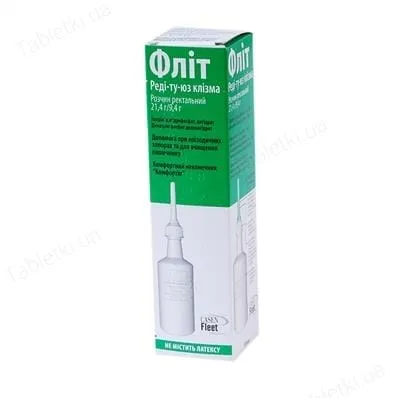
Table of Contents
INSTRUCTIONS FOR MEDICAL USE OF THE MEDICINAL PRODUCT REDY-TO-USE ENEMA
Composition:
Active substances: sodium dihydrogen phosphate dihydrate and disodium phosphate dodecahydrate;
One dose (118 mL) administered contains: sodium dihydrogen phosphate dihydrate – 21.4 g (18.1% w/v), disodium phosphate dodecahydrate – 9.4 g (8.0% w/v);
Excipients: edetate disodium, benzalkonium chloride, purified water;
Lubricant: white soft paraffin.
Pharmaceutical form. Rectal solution.
Main physicochemical properties: clear, colorless solution, free from sediment and turbidity.
Pharmacotherapeutic group. Laxatives. Enemas. ATC code A06AG20.
Pharmacological properties.
Pharmacodynamics.
Ready-to-use enema, when administered rectally, acts as a saline laxative. Accumulation of fluid in the lower part of the intestine causes distension and promotes intestinal peristalsis and motility, resulting in evacuation of the rectum, sigmoid colon, and part or all of the descending colon.
Pharmacokinetics.
Absorption in the colon is minimal; however, it has been reported that approximately 25% of individuals with normal renal function developed asymptomatic hyperphosphatemia—2 to 3 times higher than the normal phosphorus level—after oral administration of bowel preparations containing sodium phosphate. Data regarding rectal solutions come from a limited open-label study conducted by the company involving healthy volunteers who were monitored after administration of 250 mL (large volume) and 133 mL enemas containing sodium phosphate. This study confirmed a transient increase in serum phosphate levels above the upper limit of normal in 30% of subjects, followed by a subsequent decrease in average phosphorus levels within 10 minutes. Under normal conditions, the most significant absorption of phosphorus occurs in the small intestine, which rectally administered agents do not reach.
Clinical characteristics.
Indications.
- Occasional constipation.
- Situations requiring cleansing of the colon, such as prior to and following surgical procedures on the colon, around childbirth, prior to proctoscopy, sigmoidoscopy or colonoscopy, and prior to radiological examination of the colon.
Contraindications.
-
Hypersensitivity to the active substances or to any other ingredient of the medicinal product.
-
Conditions causing increased absorption capacity or reduced elimination capacity, for example, in the presence of intestinal obstruction or decreased intestinal motility:
- enlargement of the colon (megacolon);
- anorectal stenosis;
- narrowing or incomplete opening of the anus or rectum;
- Hirschsprung’s disease;
- suspected intestinal perforation or obstruction;
- paralytic ileus;
- ileostomy.
-
Undiagnosed gastrointestinal pathology:
- symptoms indicating appendicitis; perforation, injury, or obstruction of the intestine; active inflammatory bowel disease (e.g., Crohn’s disease or ulcerative colitis);
- undiagnosed rectal bleeding.
-
Severe or moderate renal impairment.
-
Symptomatic heart failure.
-
Dehydration.
-
Pediatric age.
-
Uncontrolled arterial hypertension.
Do not use concomitantly with other medicinal products containing sodium phosphate.
Interaction with other medicinal products and other forms of interactions.
Patients should inform their physician if they have recently used any other medicinal products, whether prescription or over-the-counter, particularly:
- medications for the treatment of arterial hypertension or angina (calcium channel blockers);
- diuretics;
- certain medications used in psychiatric disorders (lithium);
- any other medications that may cause dehydration or affect electrolyte levels (potassium, sodium, phosphates, or water) in the body.
Use with caution in patients taking the above-mentioned medications, as they may develop hyperphosphatemia, hypocalcemia, hypokalemia, hypernatremic dehydration, and acidosis.
Since hypernatremia is associated with low lithium levels, concomitant use of Ready-to-Use Enema and lithium therapy may lead to decreased serum lithium levels and reduced efficacy.
Special precautions for use.
Do not use Ready-to-Use enema in the presence of nausea, vomiting, or abdominal pain without prior physician's recommendation.
If bowel movements occur following administration of this medicinal product, patients should drink plenty of fluids to prevent dehydration, especially in conditions that may lead to dehydration or in patients taking medicinal products that may reduce glomerular filtration rate, such as diuretics, angiotensin-converting enzyme inhibitors (ACE inhibitors, e.g., enalapril, ramipril, lisinopril), angiotensin receptor blockers (ARBs, e.g., losartan, candesartan, eprosartan, irbesartan, olmesartan, telmisartan, valsartan), or nonsteroidal anti-inflammatory drugs (NSAIDs).
Since Ready-to-Use enema contains sodium phosphates, there is a risk of increased serum concentrations of sodium and phosphate, and decreased concentrations of calcium and potassium, which may lead to hypernatremia, hyperphosphatemia, hypocalcemia, and hypokalemia with clinical signs resembling tetany and renal failure. Electrolyte imbalances are of particular concern in children suffering from megacolon or any other condition involving retention of enema fluid, and in patients with concomitant diseases. Therefore, Ready-to-Use enemas should be used with caution in elderly or debilitated patients; in patients receiving lithium therapy; in patients with ascites, cardiac disease, rectal mucosal lesions (ulcers, fissures), colostomy, those taking diuretics or other medicinal products affecting electrolyte balance, drugs that may prolong the QT interval (e.g., amiodarone, arsenic trioxide, astemizole, azithromycin, erythromycin, clarithromycin, chlorpromazine, cisapride, citalopram, domperidone, terfenadine, procainamide), or in patients with a history of electrolyte imbalance, as hypocalcemia, hypokalemia, hyperphosphatemia, or hypernatremia may occur. Use with caution in patients taking medications affecting renal perfusion, kidney function, or hydration. In cases where electrolyte imbalance is suspected or in patients with a history of hypophosphatemia, electrolyte levels should be monitored before and after administration of Ready-to-Use enema.
The product should be used with caution in patients with impaired renal function, only when the benefits outweigh the risk of hyperphosphatemia.
Repeated and prolonged use of Ready-to-Use enema is not recommended, as it may lead to dependence. Administration of more than one enema within 24 hours may be harmful. Ready-to-Use enema should not be used for more than 6 consecutive days.
Ready-to-Use enema may be used after reading the instructions for use and proper administration techniques. Patients should be advised to stop administration immediately if resistance is felt, as forceful insertion may cause local injury. Rectal bleeding after use of Ready-to-Use enema may indicate a serious condition. In such cases, further use of the product should be discontinued and medical advice should be sought.
Defecation usually occurs approximately 5 minutes after administration of Ready-to-Use enema; therefore, retention of the enema for longer than 5 minutes is not recommended. If defecation does not occur after administration or if retention lasts longer than 10 minutes, serious adverse effects may occur. In such cases, further use of the product should be discontinued and medical advice should be sought; the physician may decide to order laboratory tests to detect possible electrolyte abnormalities and minimize the risk of severe hyperphosphatemia.
This medicinal product contains 4.4 g of sodium per dose (118 mL). Caution is advised when administering to patients on a sodium-restricted diet.
Contains 80 mg of benzalkonium chloride per dose (118 mL). Benzalkonium chloride may cause irritation and may lead to skin reactions.
Does not contain latex.
Use during pregnancy or breastfeeding.
There are insufficient data to assess the potential risk of fetal malformations or embryotoxic effects associated with the use of Ready-to-Use enema; therefore, the product should not be used during pregnancy or if pregnancy is suspected.
Ready-to-Use enema may be used only under physician's prescription during or after childbirth.
Since the active ingredients in Ready-to-Use enema may pass into breast milk, it is recommended to express and discard breast milk for 24 hours after administration of Ready-to-Use enema and not to use it for breastfeeding during this period.
Effect on ability to drive and use machines.
Ready-to-Use enema has no direct effect on the ability to drive or operate machinery. However, due to the nature of the product, patients should remain near a toilet after administration.
Method of Administration and Dosage
The medicinal product Ready-to-Use Enema is intended for rectal use only.
The recommendations below should be followed unless otherwise directed by a physician.
Adults and elderly patients:
1 bottle (administered dose – 118 mL) no more than once daily for no more than 6 consecutive days.
Dose adjustment in patients with hepatic impairment is not required.
For more comfortable administration, the anatomically shaped tip is lubricated with paraffin.
Procedure for administering the medicinal product:
- Lie on your left side with both knees bent, arms relaxed (see Fig. 1).
Fig. 1
- Remove the orange protective cap: carefully pull off the cap while holding the bottle vertically and firmly gripping the threaded ribbed cap with your fingers (see Fig. 2).
Fig. 2
- Gently and evenly insert the bottle tip into the rectum, directing it toward the navel.
- Squeeze the bottle until all its contents have been delivered into the bowel.
Stop administration immediately if any resistance is felt. Forcible insertion may cause injury.
Note: It is not necessary to completely empty the bottle. The bottle contains more solution than needed to achieve the desired effect; therefore, a small residual amount of liquid is acceptable.
- Carefully withdraw the tip from the rectum. Some leakage of liquid from the bottle may occur.
- Remain in the same position (see Fig. 1) until a strong urge for bowel evacuation is felt, which usually occurs within 2–5 minutes.
- After use, place the used bottle back into the cardboard box for proper disposal.
If signs of rectal bleeding are observed, consult a physician immediately.
Be prepared for the urge to defecate within 5 minutes after using Ready-to-Use Enema. After defecation, it is advisable to remain near a toilet until the effect of the product subsides.
If no urge to defecate occurs within the expected time, consult a physician. Do not use another dose of Ready-to-Use Enema until advised by a physician.
Children. Do not use in pediatric practice.
Overdose.
Fatal cases have been reported when Ready-to-Use Enema was used in excessive doses or for prolonged periods, or when administered to children or patients with intestinal obstruction.
In cases of overdose or prolonged use, hyperphosphatemia, hypocalcemia, hypernatremia, hypovolemia, dehydration, hypokalemia, acidosis, and tetany may occur.
Recovery from toxic effects is usually achieved through rehydration. In severe cases, correction of electrolyte imbalances should include administration of calcium and magnesium salts (10% calcium gluconate), along with enhanced elimination of exogenous phosphorus, and dialysis may be considered.
If more than the recommended amount of Ready-to-Use Enema has been used, or if the product has been accidentally swallowed (ingested), contact a physician immediately. If possible, bring the bottle or cardboard packaging to show the physician.
Adverse reactions
Ready-to-use enema is well tolerated when used according to the instructions. Adverse effects associated with the use of the enema have been reported rarely. In some cases, adverse effects were caused by incorrect administration of the enema.
Within each frequency group, adverse effects are listed in decreasing order of severity.
According to the MedDRA system organ classification and frequency of occurrence, the table below lists the reported adverse reactions: very common (≥ 1/10); common (≥ 1/100 to < 1/10); uncommon (≥ 1/1000 to < 1/100); rare (≥ 1/10000 to < 1/1000); very rare (< 1/10000); and frequency not known (when the frequency of the reaction cannot be estimated from the available data).
| Immune system disorders |
Uncommon: hypersensitivity reactions |
| Skin and subcutaneous tissue disorders |
Uncommon: blister, pruritus, burning sensation |
| Metabolism and nutrition disorders |
Uncommon: dehydration, hyperphosphatemia, hypocalcemia, hypokalemia, hypernatremia, metabolic acidosis |
| Gastrointestinal disorders |
Uncommon: nausea, vomiting, abdominal pain, abdominal spasm, diarrhea, gastrointestinal pain, anal discomfort, proctalgia |
| General disorders and administration site conditions |
Uncommon: rectal irritation, pain, burning sensation, chills |
If any adverse reactions occur, treatment should be discontinued and medical advice should be sought immediately.
Reporting of suspected adverse reactions
Reporting suspected adverse reactions after authorization of the medicinal product is important. It allows continuous monitoring of the benefit-risk balance of the medicinal product. Medical and pharmaceutical professionals, as well as patients or their legal representatives, should report all cases of suspected adverse reactions and lack of efficacy via the Automated Pharmacovigilance Information System at the following link: https://aisf.dec.gov.ua.
Shelf life. 3 years. Do not use after the expiry date stated on the packaging.
Storage conditions. Store at temperatures not exceeding 25 °C. Do not freeze. Keep out of reach and sight of children.
Packaging. Rectal solution, 21.4 g / 9.4 g in 118 ml (administered dose), 133 ml in a plastic bottle with an anatomically shaped nozzle, 1 bottle in a cardboard box.
Availability. Over-the-counter (without prescription).
Manufacturer.
Kasen Recordati, S.L. /
Casen Recordati, S.L.
Manufacturer's address.
Autovia de Logrono, km. 13,300, 50180 Utebo, Zaragoza, Spain /
Autovia de Logrono, km. 13,300, 50180 Utebo, Zaragoza, Spain.