Pulmozyme
Ukraine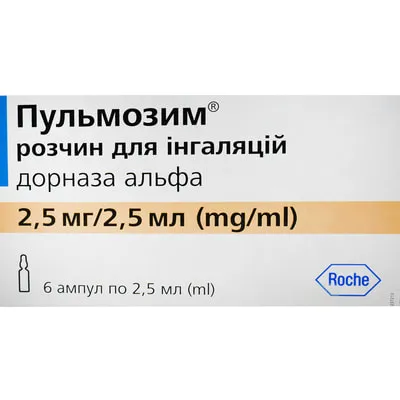
Table of Contents
INSTRUCTIONS FOR MEDICAL USE OF THE MEDICINAL PRODUCT PULMOZYME® (Pulmozyme®)
Composition:
Active substance: dornase alfa;
1 ampoule (2.5 mL) of solution for inhalation contains dornase alfa1 2.5 mg;
Excipients: sodium chloride; calcium chloride dihydrate; water for injections.
- 1 mg of dornase alfa corresponds to 1000 IU.
Pharmaceutical form. Solution for inhalation.
Main physicochemical properties: clear, colorless or slightly yellowish solution.
Pharmacotherapeutic group. Mucolytic agents. Dornase alfa (deoxyribonuclease).
ATC code R05C B13.
Pharmacological Properties.
Pharmacodynamics.
Recombinant human DNase (dornase alfa) is a genetically engineered variant of the human enzyme that cleaves extracellular DNA.
Accumulation of viscous purulent secretions in the airways leads to impaired respiratory function and exacerbation of the infectious process. Purulent secretions contain very high concentrations of extracellular DNA—a viscous polyanion released from lysing leukocytes and accumulating in response to infection. In vitro, dornase alfa hydrolyzes DNA in sputum and significantly reduces sputum viscosity in cystic fibrosis.
Pharmacokinetics.
Absorption.
Studies of inhalation administration in rats and primates demonstrated low systemic absorption of dornase alfa: <15% in rats and <2% in monkeys. Based on these animal studies, dornase alfa administered as an aerosol inhalation to patients shows low systemic exposure. Absorption of dornase alfa from the gastrointestinal tract after oral administration in rats is negligible. DNase is normally present in human serum. Inhalation of dornase alfa at doses up to 40 mg for up to 6 days did not result in a significant increase in serum DNase concentration compared to normal endogenous levels. Serum concentrations of DNase did not exceed 10 ng/mL. After administration of dornase alfa at 2500 IU (2.5 mg) twice daily for 24 weeks, mean serum concentrations of DNase did not differ from pre-treatment levels (3.5 ± 0.1 ng/mL), indicating minimal systemic absorption or accumulation.
Distribution.
Studies in rats and monkeys showed that after intravenous administration, dornase alfa is rapidly eliminated from blood serum. The initial volume of distribution was similar to serum volume in these studies.
In patients with cystic fibrosis, the mean concentration of dornase alfa in sputum 15 minutes after inhalation of 2500 IU (2.5 mg) is approximately 3 µg/mL. After inhalation, serum concentrations of dornase alfa decrease rapidly.
Metabolism.
Dornase alfa is expected to be metabolized by proteases present in biological fluids.
Excretion.
Studies in rats and monkeys showed that after intravenous administration, recombinant human DNase is rapidly eliminated from serum. Studies of intravenous administration in humans indicate that the serum half-life is 3–4 hours.
Studies in rats indicate that after aerosol administration, the half-life of dornase alfa in the lungs is 11 hours. DNase levels in sputum decrease to below half of the level observed immediately after administration within 2 hours, although the effect on sputum rheological properties persists for up to 12 hours.
Children.
Pulmozyme® was administered at a dose of 2.5 mg once daily by inhalation for 2 weeks in 98 children aged from 3 months to 9 years (65 children aged from 3 months to <5 years, 33 children aged from 5 to 9 years). Bronchoalveolar lavage fluid was collected within 90 minutes after the first dose. The reusable Pari Baby nebulizer (used with a face mask instead of a mouthpiece) was applied in patients unable to demonstrate the ability to inhale or exhale through the mouth for the entire treatment period (54/65 (83%) of younger patients and 2/33 (6%) of older patients). DNase concentrations with a wide range of variability (from 0.007 to 1.8 µg/mL) were detected in all children in the bronchoalveolar lavage fluid. On average, after 14 days of inhalations, serum DNase concentrations (mean ± standard deviation) increased by 1.1 ± 1.6 ng/mL in the group of children aged from 3 months to <5 years and by 0.8 ± 1.2 ng/mL in the group of children aged from 5 to 9 years. The incidence of fever was higher in younger children compared to older children (41% and 24%, respectively). Fever is a known complication of bronchoscopy.
Clinical characteristics.
Indications.
Treatment of patients aged 5 years and older with cystic fibrosis and a forced vital capacity (FVC) greater than 40% of predicted, with the goal of improving lung function.
Contraindications.
Hypersensitivity to dornase alfa or to any component of the medicinal product.
Interaction with other medicinal products and other forms of interaction.
Pulmozyme**®** can be effectively and safely used in combination with standard medications for the treatment of cystic fibrosis, such as antibiotics, bronchodilators, pancreatic enzymes, vitamins, inhaled and systemic corticosteroids, and analgesics.
Special precautions for use.
To ensure improved monitoring of the Pulmozyme**®** product, the trade name and batch number of the administered dornase alfa should be clearly documented in the patient's medical record (documentation).
Use during pregnancy or breastfeeding.
Pregnancy
The safety of dornase alfa in pregnant women has not been established.
Animal studies indicate no direct or indirect harmful effects on pregnancy or embryofetal development. Dornase alfa should be used with caution in pregnant women.
Breastfeeding
According to recommended dosing guidelines, dornase alfa shows minimal systemic absorption. Therefore, measurable concentrations of dornase alfa in human breast milk are not expected. However, caution should be exercised when administering dornase alfa to breastfeeding women.
Ability to influence reaction rate while driving or operating machinery.
Pulmozyme**®** has no or negligible effect on the ability to drive or operate machinery.
Method of Administration and Dosage
2.5 mg of deoxyribonuclease (corresponding to the content of 1 ampoule – 2.5 mL of undiluted solution, 2500 IU) should be administered by inhalation once daily using a nebulizer system.
In some patients aged 21 years and older, better therapeutic effect may be achieved by administering the drug twice daily.
In most patients, optimal efficacy is achieved with continuous daily use of Pulmozyme**®. Studies in which Pulmozyme®** was administered intermittently have shown that improvements in lung function disappear after discontinuation of therapy. Therefore, patients should be advised to take the medication daily without interruption.
Patients should continue regular comprehensive treatment, including standard chest physiotherapy regimens.
During exacerbations of respiratory tract infections, administration of Pulmozyme**®** can be continued without risk to the patient.
Safety and efficacy of the drug have not been established in patients with FEV₁ less than 40% of predicted.
Instructions for Handling the Medication
The contents of one single-use ampoule of Pulmozyme**®**, 2.5 mg (2500 IU), a sterile inhalation solution, should be administered by inhalation once daily using a nebulizer.
Pulmozyme**®** must not be mixed with other medicinal products or solutions in the nebulizer (see section "Incompatibilities").
- Transfer the contents of one ampoule into the chamber of a jet nebulizer/compressor system such as the Pari TurboBOY N, which consists of the Pari LC Plus nebulizer and the Pari Turbo Boy N compressor.
Patients unable to breathe through the mouth throughout the entire inhalation period may use the Pari JuniorBOY N nebulizer system, which includes the Pari LC Plus Junior nebulizer, Pari LC Plus, Pari BABY face mask, and a compressor suitable for pediatric use.
- Pulmozyme**®** can be used with a jet nebulizer/compressor system such as Hudson T Up-draft II/Pulmo-Aide, Airlife Misty/Pulmo-Aide, individual Respirgard/Pulmo-Aide, or AcornII/Pulmo-Aide.
- Pulmozyme**®** can also be used with reusable jet nebulizer/compressor systems such as Pari LL/Inhalierboy, Pari LC/Inhalierboy or Master, Aiolos/2 Aiolos, Side Stream/CR50 or MobilAire, or Porta-Neb.
- The general-purpose electronic vibrating membrane nebulizer Pari eFlow Rapid may also be used. In vitro and in vivo studies have demonstrated equivalence between the eFlow Rapid electronic nebulizer and the LC Plus jet nebulizer. The mean aerosol droplet size distribution of the eFlow Rapid nebulizer is comparable to that of the LC Plus jet nebulizer, as shown below, when using an adult breathing simulation profile. The mass median aerodynamic diameter (MMAD) was 4.8 ± 0.4 µm (n=16) for eFlow Rapid and 4.6 ± 0.4 µm (n=12) for LC Plus. The geometric standard deviation (GSD) was 1.80 ± 0.11 for eFlow Rapid and 2.14 ± 0.04 for LC Plus. The drug delivery rate was 380 ± 60 µg/min (n=88) for eFlow Rapid and 93 ± 16 µg/min (n=40) for LC Plus. The total amount of delivered drug was 567 ± 62 µg for eFlow Rapid and 570 ± 80 µg for LC Plus. The Pari eFlow Rapid nebulizer should be used with Pari EasyCare cleaning accessories, and cleaning should be performed every seventh nebulization cycle (a cycle is defined as nebulization of one ampoule of Pulmozyme**®**, followed by cleaning and disinfection according to the instructions for use of the PARI eFlow Rapid nebulizer system). Using the eFlow Rapid nebulizer without EasyCare cleaning accessories may lead to reduced and variable dose delivery.
- Ultrasonic nebulizers may be unsuitable for administering Pulmozyme**®**, as they may inactivate the drug or have unacceptable aerosol delivery characteristics.
The manufacturer's instructions for operation and maintenance of the nebulizer and compressor must be strictly followed.
Children.
The safety and efficacy of Pulmozyme**®** have been established in children aged 5 years and older (see section "Side Effects"). Safety of Pulmozyme**®, 2.5 mg by inhalation, has been studied with daily administration over 2 weeks in 65 patients with cystic fibrosis aged from 3 months to <5 years (see section "Side Effects"). Although clinical data on use in children under 5 years of age are limited, consideration should be given to using Pulmozyme®** in children with cystic fibrosis who may derive potential benefit in terms of lung function or in children at risk of developing respiratory tract infections.
Overdose.
Symptoms of overdose with Pulmozyme**®** have not been established.
In clinical trials, patients with cystic fibrosis received up to 20 mg of Pulmozyme**®** by inhalation twice daily (16 times the recommended daily dose) for 6 days, and 10 mg twice daily (8 times the recommended daily dose) on an intermittent schedule (two weeks on, two weeks off) for 168 days. Six adult patients without cystic fibrosis received a single intravenous dose of dornase alfa at 125 µg/kg, followed by subcutaneous administration of dornase alfa at 125 µg/kg seven days later, repeated over two consecutive 5-day periods. No neutralizing antibodies to dornase alfa or any changes in antibodies to double-stranded DNA in blood serum were detected. All such doses were well tolerated.
Systemic toxicity of Pulmozyme**®** has not been observed and is not expected due to minimal systemic absorption and the short half-life of dornase alfa. Therefore, systemic treatment for overdose is unlikely to be necessary (see section "Pharmacokinetics").
Adverse reactions.
Experience from clinical trials
Since clinical trials are conducted under quite different conditions, the frequency of adverse reactions observed in clinical trials of a medicinal product cannot be directly compared with that in clinical trials of another medicinal product and may not reflect the frequency of adverse reactions observed in clinical practice.
The data described below reflect exposure to Pulmozyme® in 902 patients receiving daily treatment for 2 weeks to 6 months, administered once or twice daily. Pulmozyme® was studied in placebo-controlled and uncontrolled trials (n=843 and n=98, respectively). Placebo-controlled trials included patients with forced vital capacity (FVC) ≥ 40% of predicted (n=643) or those with more advanced lung disease with FVC < 40% of predicted (n=161). The patient population in the uncontrolled trial included 98 children aged from 3 months to 10 years with cystic fibrosis. More than half of the patients received Pulmozyme® 2.5 mg by inhalation once daily (n=581); the remaining patients (n=321) received Pulmozyme® 2.5 mg by inhalation twice daily.
Placebo-controlled trials
Study 1 was a randomized, placebo-controlled clinical trial involving patients with forced vital capacity ≥ 40% of predicted. In this trial, over 600 patients received Pulmozyme® once or twice daily for 6 months. The most common adverse reaction (risk difference ≥ 5%) was voice alteration. The frequency of the most common adverse events was similar in patients receiving Pulmozyme® and those receiving placebo, likely reflecting consequences of the underlying lung disease. In most cases, the observed reactions were mild, transient in nature, and did not require dose adjustment. In individual patients, adverse reactions led to permanent discontinuation of Pulmozyme®. The discontinuation rate was similar for placebo (2%) and Pulmozyme® (3%).
Study 2 was a randomized, placebo-controlled trial involving patients with more advanced lung disease (forced vital capacity < 40% of predicted), who received treatment for 12 weeks. In this study, the safety profile of Pulmozyme® was similar to that observed in patients with less advanced lung disease (forced vital capacity ≥ 40% of predicted).
Adverse reactions during treatment with Pulmozyme® occur rarely (< 1/1000), are mostly of mild severity, transient, and do not require dose adjustment.
Eye disorders: Conjunctivitis.
Respiratory, thoracic and mediastinal disorders: Dysphonia, dyspnea, pharyngitis, laryngitis, rhinitis (non-infectious etiology).
Gastrointestinal disorders: Dyspepsia.
Skin and subcutaneous tissue disorders: Rash, urticaria.
General disorders: Chest pain (pleural/non-cardiac), fever.
Investigations: Decreased respiratory function.
Mortality rates in controlled trials were similar in patients receiving placebo and those receiving Pulmozyme®. Causes of death reflected progression of cystic fibrosis and included respiratory failure, cardiac arrest, cardiopulmonary arrest, cor pulmonale, heart failure, massive hemoptysis, pneumonia, pneumothorax, and respiratory insufficiency.
Uncontrolled trial
Study 3. The safety of Pulmozyme® 2.5 mg by inhalation was evaluated in 98 patients with cystic fibrosis aged from 3 months to 10 years (65 patients aged 3 months to < 5 years, 33 patients aged 5 to ≤ 10 years), treated daily for 2 weeks. The reusable PARI BABY™ nebulizer (using a face mask instead of a mouthpiece) was used for patients unable to inhale or exhale through the mouth during the entire treatment period (54/65, 83% of younger patients and 2/33, 6% of older patients). Overall, the nature of adverse reactions was similar to that observed in placebo-controlled trials. The number of patients reporting cough was higher in the younger age group compared to the older age group (29/65, 45% vs. 10/33, 30%), and a greater number of patients reported moderate or severe cough (24/65, 37% vs. 6/33, 18%). The number of patients reporting rhinitis was higher in the younger age group compared to the older age group (23/65, 35% vs. 9/33, 27%), and a higher number of patients reported rash (4/65, 6% vs. 0/33).
Allergic reactions
There were no reports of anaphylaxis associated with the use of Pulmozyme®. Mild to moderate urticaria and mild skin rashes, which were transient, were observed. In all studies, a small percentage (on average 2–4%) of patients receiving Pulmozyme® developed serum antibodies to the drug. None of these patients developed anaphylaxis. The clinical significance of the presence of serum antibodies to Pulmozyme® is unknown.
Patients experiencing adverse events consistent with symptoms of cystic fibrosis can generally continue treatment with Pulmozyme® safely, as evidenced by the high percentage of patients who completed participation in Pulmozyme® clinical trials.
In clinical trials, adverse events leading to complete discontinuation of dornase alfa occurred in a very small number of patients, and the rate of treatment discontinuation was similar with placebo (2%) and dornase alfa (3%).
Following initiation of therapy with dornase alfa, as with any aerosol, lung function may transiently decrease and sputum production may increase.
Antibodies to dornase alfa were detected in less than 5% of patients, but none of these antibodies were of the IgE class. Improvement in lung function was observed even after the development of antibodies to dornase alfa.
Post-marketing experience
Spontaneous post-marketing reports and prospectively collected observational study safety data confirm that the safety profile is consistent with that observed in clinical trials.
Shelf life.
3 years.
Storage conditions.
Keep out of reach of children. Store protected from light at a temperature of 2 to 8 °C. A single, short-term exposure to elevated temperatures (up to 30 °C for ≤ 24 hours) does not affect the stability of the product.
Incompatibilities.
Pulmozyme® is an aqueous solution without buffering capacity and should not be diluted or mixed with other medicinal products or solutions in the nebulizer chamber. Mixing this solution may result in undesirable structural and/or functional changes to Pulmozyme® or to other components of the mixture.
Packaging.
2.5 ml of solution in colorless plastic ampoules manufactured by thermoforming. 6 ampoules in a protective container made of multilayer aluminum foil.
1 container in a cardboard package.
Prescription status.
Prescription only.
Manufacturer.
F. Hoffmann-La Roche Ltd
Manufacturer's location and address of place of business.
Wurmisweg, 4303 Kaiseraugst, Switzerland