Pulmolor®
Ukraine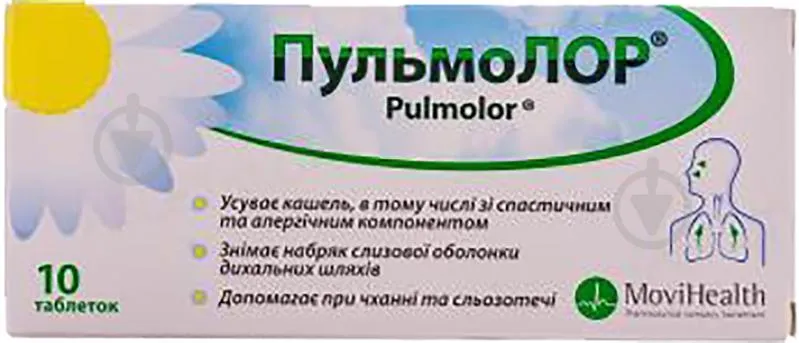
Table of Contents
- INSTRUCTIONS FOR MEDICAL USE OF THE MEDICINAL PRODUCT PULMOLOR® (PULMOLOR®)
- Composition:
- Pharmacological properties.
- Clinical characteristics.
- Special precautions for use
- Method of Administration and Dosage.
- Side effects.
- Composition:
- Pharmacological Properties.
- Clinical characteristics.
- Special precautions for use
- Method of Administration and Dosage.
- Side effects
INSTRUCTIONS FOR MEDICAL USE OF THE MEDICINAL PRODUCT PULMOLOR® (PULMOLOR®)
Composition:
Active substances: ambroxol hydrochloride, loratadine;
1 tablet contains ambroxol hydrochloride 60 mg, loratadine 5 mg;
Excipients: lactose monohydrate, maize starch, microcrystalline cellulose, povidone, magnesium stearate, colloidal anhydrous silicon dioxide, sodium starch glycolate (type A).
Pharmaceutical form. Tablets.
Main physicochemical properties: flat cylindrical tablets of almost white color with a score line on one side.
Pharmacotherapeutic group.
Medicinal products used in cough and common cold conditions. Expectorants, excluding combination products containing antitussives.
ATC code R05C.
Pharmacological properties.
Pharmacodynamics.
Pulmolor® exerts a pronounced expectorant effect, soothes and relieves dry cough, eases breathing, normalizes bronchial mucus secretion, improves sputum expulsion, reduces inflammation of the respiratory tract, exerts an anti-exudative effect, alleviates bronchial smooth muscle spasm and tissue edema, including mucous membranes of the nose, throat, paranasal sinuses and respiratory tract, reduces capillary permeability, decreases nasal congestion, runny nose, lacrimation, sneezing, itching of the palate and nose, and eye redness.
Ambroxol hydrochloride – a synthetic secretolytic and secretomotor agent. It has a pronounced expectorant effect and a slight antitussive effect. It stimulates serous cells of bronchial mucosal glands, increases the amount of mucous secretion, and thus corrects the disturbed ratio between serous and mucous components. This leads to normalization of sputum rheological properties by reducing its viscosity and adhesive characteristics. Ambroxol directly stimulates ciliary activity of bronchial epithelium, prevents ciliary agglutination, and improves mucociliary clearance of sputum. It increases surfactant content in the lungs and prevents its destruction in pneumocytes. As a mucolytic and expectorant, ambroxol improves external respiration function. The drug reduces bronchial muscle hyperreactivity in asthmatic patients. Ambroxol has anti-inflammatory and antioxidant properties, stimulates local immunity and regeneration of the natural surfactant layer. With ambroxol administration, patient complaints of cough and sputum production significantly decrease according to treatment intensity. Ambroxol hydrochloride increases antibiotic concentrations in lung tissue, thereby improving the course of respiratory diseases in bacterial lung infections.
Desloratadine – a selective, long-acting blocker of peripheral H1-histamine receptors without central sedative effects. It exerts an antiallergic effect, reduces bronchial smooth muscle spasm, decreases bronchial sensitivity to histamine, eliminates dry cough of allergic origin, reduces capillary permeability, alleviates tissue edema, rhinorrhea, lacrimation, sneezing, itching of the palate and nose, and eye redness. It prevents development and alleviates the course of allergic reactions. Its action occurs via competitive blockade of H1-receptors on effector cells by inhibiting calcium influx into cells (membrane-stabilizing function), inhibition of histamine release, and suppression of eosinophil chemotaxis and their accumulation in the mucosa. The antihistaminic effect of desloratadine begins within 1–3 hours after administration, reaches maximum within 8–12 hours, and lasts up to 24 hours. No tolerance development has been observed after 28 days of desloratadine use.
Clinical characteristics.
Indications.
Symptomatic treatment of acute and chronic respiratory tract diseases with spastic and allergic components associated with impaired bronchial secretion and weakened mucus clearance. Indicated in acute and chronic bronchitis, chronic obstructive pulmonary diseases, pneumonia, and conditions accompanied by bronchial hyperreactivity.
In otorhinolaryngological practice, for the purpose of secretion thinning and edema reduction, indicated in rhinitis, including allergic rhinitis, and as part of combination therapy for sinusitis and otitis.
Contraindications.
Hypersensitivity to any component of the drug.
Interaction with other medicinal products and other forms of interaction.
Concomitant administration of Pulmolor® with antibiotics is advantageous compared to antibiotic use alone. Pulmolor® increases antibiotic concentrations in the lungs and thus facilitates the course of respiratory tract diseases in bacterial lung infections.
The use of this drug should not be combined with alcohol consumption.
Do not take simultaneously with antitussive agents that hinder expectoration.
Potential interaction may occur when using known inhibitors of CYP3A4 or CYP2D6, leading to increased loratadine levels, which in turn may increase the frequency of adverse reactions.
In controlled studies, increased plasma concentrations of loratadine have been reported after concomitant administration with ketoconazole, erythromycin, and cimetidine, without clinically significant changes (including on ECG).
Special precautions for use
Before performing skin sensitivity tests, the use of the drug should be discontinued 48 hours prior.
There have been isolated reports of severe skin reactions (such as erythema multiforme, Stevens-Johnson syndrome, toxic epidermal necrolysis (Lyell's syndrome), and acute generalized exanthematous pustulosis) occurring in temporal association with the use of ambroxol hydrochloride. In most cases, these reactions could be explained by the severity of the underlying disease in patients and concomitant use of other medications. Additionally, in the early stages of Stevens-Johnson syndrome or Lyell's syndrome, patients may present with nonspecific, flu-like symptoms such as fever, malaise, rhinitis, cough, and sore throat. These nonspecific, flu-like symptoms may lead to inappropriate symptomatic treatment with cough and cold remedies. Therefore, if new skin lesions or mucosal involvement occur, medical attention should be sought immediately and treatment with ambroxol hydrochloride should be discontinued.
Since ambroxol may enhance mucus secretion, the drug should be used with caution in patients with impaired bronchial motility and increased mucus secretion (e.g., in rare conditions such as primary ciliary dyskinesia).
The drug should be used with caution in patients with renal impairment or severe hepatic insufficiency (i.e., the dosing interval should be prolonged or the dose reduced). In patients with severe renal impairment, accumulation of metabolites formed in the liver may be expected.
Excipients
The drug contains lactose; therefore, patients with known sugar intolerance should consult their physician before taking this medicinal product.
Use during pregnancy or breastfeeding
Since experience with use of the drug in pregnant women is limited, its use during pregnancy is not recommended.
As the drug passes into breast milk, its use during breastfeeding is not recommended.
Ability to influence reaction rate while driving or operating machinery
Generally, the drug does not affect reaction speed while driving or operating machinery. However, patients should be informed about the very rare occurrence of drowsiness, which may affect the ability to drive or operate machinery.
Method of Administration and Dosage.
For use in adults and children aged 12 years and older: take 1 tablet twice daily.
Take after meals with sufficient amount of liquid.
Treatment duration – up to 14 days. Consult a physician if symptoms persist or worsen after 14 days.
The drug should not be used for longer than 4–5 days without consulting a physician.
Children.
Do not use in children under 12 years of age.
Overdose.
Symptoms: tachycardia, headache, drowsiness, nausea, vomiting, diarrhea, decreased arterial blood pressure.
Treatment. In case of overdose, symptomatic and supportive therapy is recommended. Standard measures for removal of the unabsorbed drug from the stomach are advised: gastric lavage, administration of crushed activated charcoal with water.
Loratadine is not removed by hemodialysis; it is also unknown whether loratadine is removed by peritoneal dialysis.
After emergency treatment, the patient should remain under medical supervision.
Side effects.
The drug is usually well tolerated.
Skin reactions: alopecia.
Immune system reactions: hypersensitivity reactions, including rash, urticaria, pruritus, anaphylactic reactions (including anaphylactic shock), angioneurotic edema; serious skin reactions (erythema multiforme, Stevens–Johnson syndrome, toxic epidermal necrolysis (Lyell’s syndrome), and acute generalized exanthematous pustulosis).
Nervous system reactions: dysgeusia (taste disturbance), dizziness, seizures, headache, nervousness, fatigue, somnolence, insomnia.
Gastrointestinal reactions: nausea, decreased oral sensitivity, vomiting, diarrhea, dyspepsia, abdominal pain, dryness of mouth and throat, constipation, salivation, gastritis.
Respiratory system reactions: rhinorrhea, dyspnea (as a symptom of hypersensitivity reaction).
Hepatobiliary system reactions: liver function abnormalities.
Cardiovascular system reactions: tachycardia, palpitations.
Urinary system reactions: dysuria.
General disorders: fever, weight gain, increased appetite, mucosal reactions.
Reporting suspected adverse reactions
Reporting of suspected adverse reactions after registration of the medicinal product is of great importance. It allows continuous monitoring of the benefit-risk balance of the use of this medicinal product. Healthcare and pharmaceutical professionals, as well as patients or their legal representatives, should report all suspected adverse reactions and lack of efficacy through the Automated Pharmacovigilance Information System at the following link: https://aisf.dec.gov.ua.
Shelf life.
3 years.
Storage conditions.
Store in the original packaging, out of reach of children, at a temperature not exceeding 25 °C.
Packaging.
10 tablets per blister, 1 or 2 blisters per cardboard box.
Availability.
Over-the-counter (without prescription).
Manufacturer.
MediTop Pharmaceutical Ltd.
Manufacturer's address and location of operations.
Edi Endre u. 1., Pilisborosjenő, 2097, Hungary.
Marketing Authorization Holder.
Movi Health GmbH.
Address of the Marketing Authorization Holder.
Blechistrasse 25, 6340 Baar, Switzerland.
Date of last review.
| APPROVED Order of the Ministry of Health of Ukraine
Registration Certificate No UA/10378/02/01 |
INSTRUCTIONS
for medical use of the medicinal product
PULMOLOR®
(PULMOLOR®)
Composition:
Active substances: ambroxol hydrochloride, loratadine;
One tablet contains ambroxol hydrochloride 60 mg, loratadine 5 mg;
Excipients: lactose monohydrate, corn starch, microcrystalline cellulose, povidone, magnesium stearate, colloidal anhydrous silicon dioxide, sodium starch glycolate (type A).
Pharmaceutical form. Tablets.
Main physicochemical properties: flat cylindrical tablets of almost white color with a score on one side.
Pharmacotherapeutic group.
Preparations used for cough and colds. Expectorants, excluding combination products containing antitussives.
ATC code R05C.
Pharmacological Properties.
Pharmacodynamics.
Pulmolor® exerts a pronounced expectorant effect, softens and soothes dry cough, facilitates breathing, normalizes bronchial mucus secretion, improves sputum clearance, reduces inflammation of the respiratory tract, exerts anti-exudative action, relieves spasm of bronchial smooth muscles and tissue edema, including mucous membranes of the nose, throat, paranasal sinuses and respiratory tract, reduces capillary permeability, alleviates nasal congestion, runny nose, lacrimation, sneezing, itching of the palate and nose, and eye redness.
Ambroxol hydrochloride – a synthetic secretolytic and secretomotor agent. It has a pronounced expectorant effect and a slight antitussive effect. It stimulates serous cells of bronchial mucosal glands, increases the amount of serous secretion, thereby correcting the disturbed ratio between serous and mucous components. This leads to normalization of sputum rheological properties by reducing its viscosity and adhesiveness. Ambroxol directly stimulates the ciliary activity of bronchial epithelium, prevents ciliary clumping, and enhances mucociliary clearance of sputum. Ambroxol increases surfactant content in the lungs and prevents its destruction in pneumocytes. As a mucolytic and expectorant agent, ambroxol improves external respiration function. The drug reduces bronchial muscle hyperreactivity in asthmatic patients. Ambroxol has anti-inflammatory effects, antioxidant properties, stimulates local immunity and restores the natural surfactant layer. With ambroxol administration, patient complaints regarding cough and sputum production significantly decrease depending on the intensity of treatment. Ambroxol hydrochloride increases antibiotic concentration in lung tissue, thus improving the course of respiratory tract diseases in bacterial lung infections.
Desloratadine – a selective, long-acting peripheral H1-histamine receptor blocker without central sedative effects. It exerts antiallergic action, reduces spasm of bronchial smooth muscles, decreases bronchial sensitivity to histamine, eliminates allergic-origin dry cough, reduces capillary permeability, alleviates tissue edema, rhinorrhea, lacrimation, sneezing, itching of the palate and nose, and eye redness. It prevents the development and alleviates the course of allergic reactions. Its action occurs through competitive blockade of H1-receptors on effector cells by inhibiting calcium influx into cells, inhibition of histamine release (membrane-stabilizing function), and inhibition of eosinophil chemotaxis and their accumulation in the mucosa. The antihistamine effect of desloratadine begins within 1–3 hours after administration, reaches maximum effect within 8–12 hours, and lasts up to 24 hours. No tolerance development is observed after 28 days of desloratadine use.
Clinical characteristics.
Indications.
Symptomatic therapy in acute and chronic respiratory tract diseases with spastic and allergic components associated with impaired bronchial secretion and reduced mucus clearance. Indicated in acute and chronic bronchitis, chronic obstructive pulmonary diseases, pneumonia, and conditions associated with bronchial hyperreactivity.
In otorhinolaryngological practice, for the purpose of secretion thinning and reduction of edema, indicated in rhinitis, including allergic rhinitis, and as part of combination therapy for sinusitis and otitis.
Contraindications.
Hypersensitivity to any component of the drug.
Interaction with other medicinal products and other forms of interaction.
Concomitant use of Pulmolor® with antibiotics is advantageous compared to antibiotic use alone. Pulmolor® increases antibiotic concentrations in the lungs and thus facilitates the course of respiratory tract diseases in bacterial lung infections.
The use of the drug should not be combined with alcohol consumption.
Do not take simultaneously with antitussive agents that impair expectoration.
Potential interaction may occur when using known inhibitors of CYP3A4 or CYP2D6, leading to increased loratadine levels, which in turn may increase the frequency of adverse reactions.
In controlled studies, increased plasma concentrations of loratadine have been reported after concomitant administration with ketoconazole, erythromycin, and cimetidine, without clinically significant changes (including on ECG).
Special precautions for use
Skin sensitivity tests should be preceded by discontinuation of the drug 48 hours prior.
There have been isolated reports of severe skin reactions (such as erythema multiforme, Stevens-Johnson syndrome, toxic epidermal necrolysis (Lyell's syndrome), and acute generalized exanthematous pustulosis) occurring in temporal association with the use of hydrochloride ambroxol. In most cases, these reactions could be explained by the severity of the underlying disease in patients and concomitant use of other medications. Additionally, early stages of Stevens-Johnson syndrome or Lyell's syndrome may present with nonspecific, flu-like symptoms such as fever, malaise, rhinitis, cough, and sore throat. Symptomatic treatment with cough and cold remedies may be mistakenly used in such cases with nonspecific, flu-like symptoms. Therefore, if new skin lesions or mucosal involvement occur, immediate medical attention should be sought and treatment with hydrochloride ambroxol should be discontinued.
Since ambroxol may enhance mucus secretion, the drug should be used with caution in patients with impaired bronchial motility and increased mucus secretion (e.g., in rare conditions such as primary ciliary dyskinesia).
The drug should be used with caution in patients with renal impairment or severe hepatic insufficiency (i.e., the dosing interval should be prolonged or the dose reduced). In patients with severe renal insufficiency, accumulation of metabolites formed in the liver may be expected.
Excipients
The drug contains lactose; therefore, patients with known sugar intolerance should consult their physician before taking this medicinal product.
Use during pregnancy or breastfeeding
As experience with use of the drug during pregnancy is limited, its use during pregnancy is not recommended.
Since the drug passes into breast milk, its use during breastfeeding is not recommended.
Ability to influence reaction rate while driving or operating machinery
Generally, the drug does not affect reaction speed while driving or operating machinery. However, patients should be informed about the very rare occurrence of somnolence, which may affect the ability to drive or operate machinery.
Method of Administration and Dosage.
For use in adults and children aged 12 years and older: take 1 tablet orally twice daily.
Take after meals with sufficient amount of liquid.
Treatment duration – up to 14 days. Consult a physician if symptoms persist or worsen after 14 days.
The drug should not be used for longer than 4–5 days without consulting a physician.
Children.
Do not use in children under 12 years of age.
Overdose.
Symptoms: tachycardia, headache, drowsiness, nausea, vomiting, diarrhea, decreased blood pressure.
Treatment. In case of overdose, symptomatic and supportive therapy is recommended. Standard measures for removal of the unabsorbed drug from the stomach are advised: gastric lavage, administration of crushed activated charcoal with water.
Loratadine is not removed by hemodialysis; it is also unknown whether loratadine is removed by peritoneal dialysis.
After emergency treatment, the patient should remain under medical supervision.
Side effects
The drug is usually well tolerated.
Skin reactions: alopecia.
Immune system reactions: hypersensitivity reactions, including rash, urticaria, pruritus, anaphylactic reactions (including anaphylactic shock), angioneurotic edema; serious skin adverse reactions (multiform erythema, Stevens–Johnson syndrome, toxic epidermal necrolysis (Lyell’s syndrome), and acute generalized exanthematous pustulosis).
Nervous system reactions: dysgeusia (taste disturbance), dizziness, seizures, headache, nervousness, fatigue, somnolence, insomnia.
Gastrointestinal reactions: nausea, oral hypogeusia, vomiting, diarrhea, dyspepsia, abdominal pain, dry mouth and throat, constipation, hypersalivation, gastritis.
Respiratory system reactions: rhinorrhea, dyspnea (as a symptom of hypersensitivity reaction).
Hepatobiliary system reactions: liver function abnormalities.
Cardiovascular system reactions: tachycardia, palpitations.
Urinary system reactions: dysuria.
General disorders: fever, increased body weight, increased appetite, mucosal reactions.
Reporting suspected adverse reactions
Reporting suspected adverse reactions after drug registration is important. It allows continuous monitoring of the benefit-risk balance of the drug. Healthcare and pharmaceutical professionals, as well as patients or their legal representatives, should report all cases of suspected adverse reactions and lack of drug efficacy via the Automated Pharmacovigilance Information System at the following link: https://aisf.dec.gov.ua.
Shelf life
3 years.
Storage conditions
Store in the original packaging, out of reach of children, at a temperature not exceeding 25 °C.
Packaging
10 tablets per blister pack, 1 or 2 blister packs per cardboard box.
Availability category
Over-the-counter (without prescription)
Manufacturer
Sava Helskea Ltd.
Manufacturer's address and location of operations
GIDC Estate, 507-B-512, Vadhavan City - 363 035, Surendranagar, India.
Marketing Authorization Holder
Movi Health GmbH.
Address of the Marketing Authorization Holder
Blegistrasse 25, 6340 Baar, Switzerland.