Psotriol
Ukraine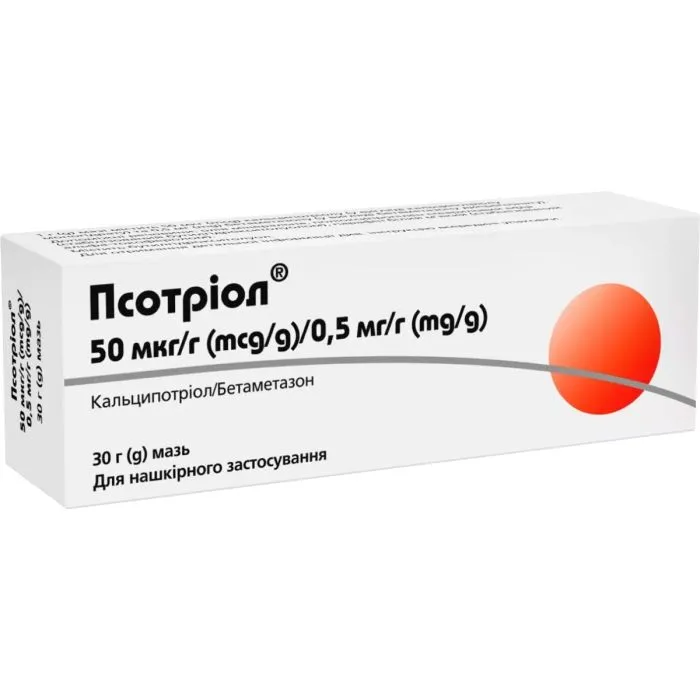
Table of Contents
INSTRUCTIONS FOR MEDICAL USE OF THE MEDICINAL PRODUCT PSOTRIOL® (PSOTRIOL)
Composition:
Active substances: betamethasone, calcipotriol;
1 g of ointment contains 50 mcg of calcipotriol (as calcipotriol monohydrate) and 0.5 mg of betamethasone (as betamethasone dipropionate);
Excipients: polyoxyl stearate (stabilized with butylhydroxytoluene), white soft paraffin (stabilized with alpha-tocopherol), mineral oil.
Pharmaceutical form. Ointment.
Main physicochemical properties: shiny, homogeneous ointment from white to yellowish color, free from foreign particles.
Pharmacotherapeutic group.
Antipsoriatic agents for topical use. Other topical antipsoriatic agents. Calcipotriol combinations.
ATC code D05AX52.
Pharmacological Properties
Pharmacodynamics
Calcipotriol is a vitamin D analogue. In vitro studies indicate that calcipotriol inhibits keratinocyte proliferation and promotes their morphological differentiation. This is likely the mechanism of its action in psoriasis. Like other topical corticosteroids, betamethasone dipropionate has anti-inflammatory, antipruritic, vasoconstrictive, and immunosuppressive properties, but it does not treat the underlying disease. The use of occlusive dressings enhances the therapeutic effect by increasing penetration into the stratum corneum of the epidermis. However, this may also increase the frequency of adverse reactions. Overall, the exact mechanism of the anti-inflammatory activity of topical corticosteroids is not fully understood.
In a safety study involving 634 psoriasis patients, repeated treatment courses with ointment containing calcipotriol + betamethasone dipropionate applied once daily according to recommendations—either as monotherapy or alternated with ointment containing calcipotriol—were evaluated over a period of up to 52 weeks, compared to treatment with calcipotriol ointment monotherapy for 48 weeks following an initial course of calcipotriol + betamethasone dipropionate ointment. Adverse drug reactions were reported in 21.7% of patients in the calcipotriol + betamethasone dipropionate ointment treatment group, in 29.6% of patients in the group alternating calcipotriol + betamethasone dipropionate ointment with calcipotriol ointment, and in 37.9% of patients in the calcipotriol ointment treatment group. Adverse drug reactions observed in more than 2% of patients in the calcipotriol + betamethasone dipropionate ointment group were pruritus (5.8%) and psoriasis (5.3%). Adverse drug reactions possibly related to long-term corticosteroid use (e.g., skin atrophy, folliculitis, depigmentation, furuncles, and purpura) were reported in 4.8% of patients in the calcipotriol + betamethasone dipropionate ointment group, 2.8% in the group alternating calcipotriol + betamethasone dipropionate ointment with calcipotriol ointment, and 2.9% in the calcipotriol ointment group.
Adrenal response to adrenocorticotropic hormone (ACTH) was assessed by measuring serum cortisol levels in patients with extensive psoriasis, including scalp involvement and psoriasis on other body areas, using up to 106 g per week of a combination of gel and ointment containing calcipotriol + betamethasone dipropionate. A borderline reduction in cortisol excretion in response to ACTH stimulation was observed at 30 minutes after 4 weeks of treatment in 5 out of 32 patients (15.6%), and in 2 out of 11 patients (18.2%) who continued treatment up to 8 weeks. In all cases, serum cortisol levels were within normal limits at 60 minutes after ACTH stimulation. No signs of altered calcium metabolism were observed in these patients. Thus, regarding suppression of the hypothalamic-pituitary-adrenal (HPA) axis, this study provided some evidence that very high doses of the gel and ointment containing calcipotriol + betamethasone dipropionate may have a slight effect on HPA axis function.
Pediatric patients
Adrenal response to ACTH stimulation was evaluated in an uncontrolled 4-week study in 33 adolescents aged 12–17 years with body psoriasis, who used up to 56 g per week of ointment containing calcipotriol + betamethasone dipropionate. No cases of HPA axis suppression were reported. No cases of hypercalcemia were observed, but one patient showed increased urinary calcium levels, possibly related to treatment.
Pharmacokinetics
Clinical studies using radiolabeled ointment indicate that systemic absorption of calcipotriol and betamethasone is less than 1% of the applied dose (2.5 g) when applied to healthy skin (625 cm²) for 12 hours. Application to psoriatic plaques or under occlusive dressings may increase absorption of topical corticosteroids. Absorption through damaged skin is approximately 24%.
Following systemic exposure, both active ingredients—calcipotriol and betamethasone dipropionate—are rapidly and extensively metabolized. The drug is approximately 64% protein-bound. The plasma half-life of the drug after intravenous administration is 5–6 hours. Due to depot formation in the skin, elimination of the drug from the skin after topical application occurs over several days.
Betamethasone is primarily metabolized in the liver, but also in the kidneys, forming glucuronides and sulfated esters. The main route of elimination for calcipotriol is via feces (in rats and minipigs), while for betamethasone dipropionate it is via urine (in rats and mice). Tissue distribution studies in rats using radiolabeled calcipotriol and betamethasone dipropionate showed that the kidneys and liver had the highest levels of radioactivity.
Levels of calcipotriol and betamethasone dipropionate were below the lower limit of quantification in all blood samples from 34 patients treated for 4 or 8 weeks with either the gel or ointment containing calcipotriol + betamethasone dipropionate for extensive psoriasis affecting both the body and the scalp. One metabolite of calcipotriol and one metabolite of betamethasone dipropionate were quantifiable in some patients.
Clinical characteristics.
Indications.
Local treatment of stable plaque psoriasis amenable to local therapy in adults.
Contraindications.
Hypersensitivity to the active substances or to any of the excipients listed in the section "Composition".
Use of the medicinal product PsoTriol®, ointment, is contraindicated in patients with psoriatic erythroderma, exfoliative and pustular psoriasis.
Due to the presence of calcipotriol, PsoTriol®, ointment, is contraindicated in patients with known disorders of calcium metabolism (see section "Special precautions for use").
Due to the presence of corticosteroid, PsoTriol®, ointment, is contraindicated in the following conditions: viral skin infections (e.g., herpes or varicella), fungal or bacterial skin infections, parasitic skin infections, cutaneous manifestations of tuberculosis, perioral dermatitis, skin atrophy, striae atrophicae, increased vascular fragility, ichthyosis, common acne, rosacea acne, rosacea, ulcers and wounds (see section "Special precautions for use").
Interaction with other medicinal products and other forms of interaction.
No studies on interactions with PsoTriol®, ointment, have been conducted.
Special precautions for use.
Effect on the endocrine system
Psoriatrol®, ointment, contains a potent steroid of group III. Concomitant treatment with other steroids should be avoided. Adverse reactions associated with systemic corticosteroid therapy, such as suppression of adrenal cortex function or effects on metabolic control of diabetes mellitus, may also occur during treatment with topically applied corticosteroids due to systemic absorption. Application of the medicinal product under occlusive dressing should be avoided, as this increases systemic absorption of corticosteroids.
Application of the medicinal product to large areas of damaged skin, mucous membranes, or skin folds should also be avoided, as this increases systemic absorption of corticosteroids (see section "Adverse reactions").
In a study involving patients with both extensive scalp psoriasis and extensive psoriasis of other body areas, who received a combination of a gel containing calcipotriol + betamethasone dipropionate at high doses (application to hairy scalp areas) and an ointment containing calcipotriol + betamethasone dipropionate at high doses (application to other body areas), borderline reduction in cortisol excretion in response to ACTH stimulation was observed in 5 out of 32 patients after 4 weeks of treatment (see section "Pharmacodynamics").
Effect on calcium metabolism
Due to the presence of calcipotriol, hypercalcemia may develop if the maximum daily dose (15 g) is exceeded. Serum calcium levels return to normal upon discontinuation of treatment. The risk of hypercalcemia is minimal when recommendations regarding calcipotriol are followed. The medicinal product should not be applied to areas exceeding 30% of the body surface area (see section "Dosage and administration").
Local adverse reactions
Psoriatrol®, ointment, contains a potent steroid of group III. Concomitant treatment with other steroids on the same area should be avoided. Facial and genital skin is highly sensitive to corticosteroids; therefore, the medicinal product should not be applied to these areas. Patients should be informed about proper use of the medicinal product to prevent application or accidental contact with the face, mouth, or eyes. Hands should be washed after each application to prevent accidental contact with these body areas.
Skin infections
If skin lesions are complicated by secondary infection, antibacterial therapy should be initiated. However, if infection worsens, corticosteroid treatment should be discontinued (see section "Contraindications").
Withdrawal of therapy
When treating psoriasis with topical corticosteroids, there is a risk of generalized pustular psoriasis or rebound phenomena upon discontinuation of the medicinal product. Therefore, continued monitoring by a physician after stopping treatment is necessary.
Long-term use of the medicinal product
Long-term use of corticosteroids increases the risk of local or systemic adverse reactions. Treatment should be discontinued if adverse reactions associated with prolonged corticosteroid use occur (see section "Adverse reactions").
Uses not studied
There is no experience with the use of Psoriatrol®, ointment, in patients with guttate psoriasis.
Concomitant therapy and UV irradiation
To date, data on the use of this medicinal product on the hairy scalp are limited.
The ointment containing calcipotriol + betamethasone dipropionate for treatment of psoriatic lesions on the body has been used in combination with the gel containing calcipotriol + betamethasone dipropionate for treatment of psoriatic lesions on the hairy scalp. However, experience with combining the medicinal product containing calcipotriol + betamethasone dipropionate with other topical antipsoriatic agents applied to the same area, with systemic antipsoriatic agents, or with phototherapy is limited.
Patients using Psoriatrol®, ointment, should be advised to limit or avoid excessive exposure to natural or artificial light. Topical calcipotriol should not be used with UV irradiation unless the physician and patient consider that the expected benefit outweighs the potential risk.
Visual disturbances
Visual disturbances may occur during treatment with systemic corticosteroids or topical corticosteroids. If a patient experiences symptoms such as blurred vision or other visual disturbances, they should be referred to an ophthalmologist for evaluation of possible causes, which may include cataract, glaucoma, or rare conditions such as central serous chorioretinopathy (CSCR), which has been reported after use of systemic and topical corticosteroids.
Adverse reactions to excipients
Psoriatrol®, ointment, contains butylhydroxytoluene as an excipient, which may cause local skin reactions (e.g., contact dermatitis) or irritation of the eyes and mucous membranes.
Use during pregnancy or breastfeeding.
Pregnancy
There are currently insufficient data on the use of Psoriatrol®, ointment, in pregnant women. Animal studies with glucocorticosteroids have shown reproductive toxicity; however, in several epidemiological studies (fewer than 300 pregnancy outcomes), no congenital anomalies were observed in infants whose mothers used corticosteroids during pregnancy. The potential risk in humans has not yet been established. Therefore, Psoriatrol®, ointment, should be used during pregnancy only if the expected benefit outweighs the potential risk.
Breastfeeding period
Betamethasone passes into breast milk, but adverse reactions in the infant are unlikely when the medicinal product is used at therapeutic doses. There are no clinical data on the excretion of calcipotriol into breast milk. Psoriatrol®, ointment, should be prescribed to breastfeeding women with caution. Patients should not apply Psoriatrol®, ointment, to the breasts during breastfeeding.
Fertility
Studies in rats with oral administration of calcipotriol or betamethasone dipropionate showed no reduction in fertility in males or females.
Ability to affect reaction speed when driving or operating machinery.
Psoriatrol®, ointment, has no effect or a negligible effect on the ability to drive or operate machinery.
Method of Administration and Dosage
Dosage
Psotrіol®, ointment, should be applied to affected skin areas once daily.
The recommended treatment period is 4 weeks. There is experience with repeated courses of Psotrіol®, ointment, administered for up to 52 weeks. If treatment needs to be continued or resumed after 4 weeks, this should only be done following consultation with a physician and under regular medical supervision. When using medicinal products containing calcipotriol, the maximum daily dose should not exceed 15 g. The total skin area treated with medicinal products containing calcipotriol should not exceed 30% of body surface area (see section "Special Warnings and Precautions for Use").
Method of Administration
Psotrіol®, ointment, should be applied to affected skin areas. Taking a shower or bath immediately after application of Psotrіol®, ointment, is not recommended in order to achieve optimal effect.
Special Patient Populations
Patients with Renal or Hepatic Impairment
The safety and efficacy of Psotrіol®, ointment, in patients with severe renal insufficiency or severe hepatic disease have not been established.
Children
Pediatric Patients
The safety and efficacy of Psotrіol®, ointment, in children under 18 years of age have not been established. Current data on use in patients aged 12 to 17 years are described in the sections "Pharmacodynamics" and "Adverse Reactions", but no dosage recommendations can be provided.
Overdose.
Administration of the medicinal product in doses exceeding the recommended dose may lead to elevated serum calcium levels, which resolve upon discontinuation of treatment. Symptoms of hypercalcemia include polyuria, constipation, muscle weakness, confusion, and coma.
Prolonged excessive use of topical corticosteroids may suppress the hypothalamic-pituitary-adrenal (HPA) axis, leading to secondary adrenal insufficiency, which is usually reversible. In such cases, symptomatic treatment is indicated.
In cases of chronic toxicity, a gradual withdrawal of corticosteroids should be implemented.
There have been reports of improper use of the medicinal product in a patient with widespread erythrodermic psoriasis who received treatment with 240 g of ointment containing calcipotriol + betamethasone dipropionate weekly (corresponding to a daily dose of approximately 34 g) for 5 months (the maximum recommended daily dose is 15 g). This resulted in Cushing's syndrome during treatment and subsequent pustular psoriasis following abrupt discontinuation of therapy.
Adverse Reactions
The assessment of the frequency of adverse reactions is based on a pooled analysis of clinical study data, including post-marketing safety studies and spontaneous reports.
The most commonly reported adverse reactions during treatment are various skin reactions, such as pruritus and skin desquamation.
Cases of pustular psoriasis and hypercalcemia have been reported.
Adverse reactions are listed by MedDRA system organ class (SOC) and by frequency of occurrence. Within each frequency group, reactions are presented in order of decreasing severity.
| Infections and infestations |
|
| Uncommon (≥1/1,000, <1/100) |
Skin reactions*, folliculitis |
| Rare (≥1/10,000, <1/1,000) |
Boil |
| Immune system disorders |
|
| Rare (≥1/10,000, <1/1,000) |
Increased sensitivity |
| Metabolism and nutrition disorders |
|
| Rare (≥1/10,000, <1/1,000) |
Hypercalcaemia |
| Eye disorders |
|
| Frequency not known (cannot be estimated from the available data) |
Blurred vision (see also section "Special precautions for use") |
| Skin and subcutaneous tissue disorders |
|
| Common (≥1/100, <1/10) |
Scaling, pruritus |
| Uncommon (≥1/1,000, <1/100) |
Skin atrophy, psoriasis exacerbation, dermatitis, erythema, rash**, purpura or ecchymosis, burning sensation of skin, skin irritation |
| Rare (≥1/10,000, <1/1,000) |
Pustular psoriasis, striae, photosensitivity reactions, acne, dry skin |
| General disorders and administration site conditions |
|
| Uncommon (≥1/1,000, <1/100) |
Pigmentation changes at the application site, pain at the application site *** |
| Rare (≥1/10,000, <1/1,000) |
Rebound effect |
* Skin infections have been reported, including bacterial, fungal, and viral skin infections.
** Various types of rashes have been reported, such as exfoliative rash, papular rash, and pustular rash.
*** Burning sensation at the application site is included under pain at the application site.
Pediatric population
In an uncontrolled open-label study, 33 adolescents aged 12–17 years with plaque psoriasis received treatment with ointment containing calcipotriol + betamethasone dipropionate for 4 weeks up to a maximum dose of 56 g per week. No new adverse reactions or concerns regarding systemic effects of corticosteroids were identified. However, the size of this study does not allow definitive conclusions regarding the safety profile of Psotriol® ointment when used in children and adolescents.
The adverse reactions listed below are considered to be related to the pharmacological classes of calcipotriol and betamethasone, respectively.
Calcipotriol
Adverse reactions include application site reactions, pruritus, skin irritation, burning and stinging sensations, dryness of skin, erythema, rash, dermatitis, eczema, exacerbation of psoriasis, photosensitization, and hypersensitivity reactions, which may very rarely include angioneurotic edema and facial swelling.
Very rarely, systemic reactions may occur following topical application, leading to hypercalcemia or hypercalciuria (see section "Special precautions for use").
Betamethasone (as dipropionate)
Application site reactions may occur following topical use, especially during prolonged treatment, including skin atrophy, telangiectasia, striae, folliculitis, hypertrichosis, perioral dermatitis, allergic contact dermatitis, depigmentation, and granuloma gluteale infantum.
When treating psoriasis with topical corticosteroids, there may be a risk of generalized pustular psoriasis developing.
Systemic reactions associated with topical corticosteroids in adults are rare but may be severe. Such reactions may include adrenal suppression, cataract, infections, impaired metabolic control of diabetes, and increased intraocular pressure, particularly after prolonged use of the medicinal product. Systemic reactions occur more frequently when occlusive dressings (plastic, skin folds) are used, when the product is applied over large areas, or during prolonged treatment (see section "Special precautions for use").
Reporting suspected adverse reactions
Reporting suspected adverse reactions after marketing authorization is very important. It allows continued monitoring of the benefit/risk balance of the medicinal product. Healthcare professionals should report any suspected adverse reactions.
Shelf life. 3 years. After first opening – 1 year.
Storage conditions.
Store at a temperature not exceeding 25°C. Do not store in the refrigerator. Keep out of the reach of children.
Packaging.
30 g in a tube; 1 tube in a carton.
Prescription category. Prescription only.
Manufacturer. mibe GmbH Arzneimittel.
Manufacturer's address.
Muenchenstrasse 15, Brehna, Saxony-Anhalt, 06796, Germany.