Progeta
Ukraine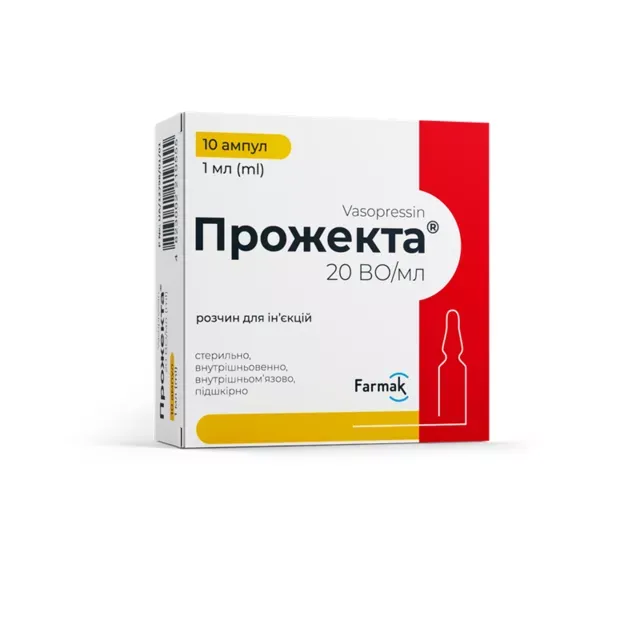
Table of Contents
INSTRUCTION FOR MEDICAL USE OF THE MEDICINAL PRODUCT PROJECTA® (PROGECTA)
Composition:
Active substance:
1 ml of solution contains vasopressin, calculated as 100 % substance, 20 VO (vasopressor units);
Excipients: acetic acid, water for injections.
Pharmaceutical form. Solution for injection.
Main physicochemical characteristics: transparent, colorless solution.
Pharmacotherapeutic group.
Hormonal preparations for systemic use. Posterior pituitary hormones. Vasopressin and its analogues. ATC code H01BA01.
Pharmacological properties.
Pharmacodynamics.
The antidiuretic effect of the drug is due to increased water reabsorption by the renal tubules. Projeсta® may cause contraction of smooth muscles of the gastrointestinal tract, gallbladder, urinary bladder, and all segments of the vascular system, especially capillaries, arterioles, and venules. The effect on large veins is less pronounced.
Pharmacokinetics.
After subcutaneous administration, the duration of the antidiuretic effect ranges from 2 to 8 hours. Most of the drug is metabolized and rapidly destroyed in the liver and kidneys. The elimination half-life is 10–20 minutes. Approximately 5% of the drug is excreted unchanged in urine within 4 hours after administration.
Clinical characteristics.
Indications.
- Treatment of diabetes insipidus (except nephrogenic diabetes insipidus);
- Control of bleeding from esophageal varices.
Contraindications.
- Hypersensitivity to vasopressin or to any of the excipients;
- Anaphylactic reaction to vasopressin or to any of the excipients;
- Ischemic heart disease and/or patients receiving halogenated anesthetics;
- Vascular diseases (especially coronary artery disease);
- Chronic nephritis with retention of nitrogenous waste products (until normalization of blood urea nitrogen levels).
Interaction with other medicinal products and other forms of interaction.
Concomitant use with the following drugs may enhance the antidiuretic effect of Prophyl®: carbamazepine, chlorpropamide, clofibrate, fludrocortisone, urea, or tricyclic antidepressants.
Concomitant use with the following drugs may reduce the antidiuretic effect of Prophyl®: demeclocycline, norepinephrine, lithium, heparin, and alcohol.
Ganglionic blockers may increase sensitivity to the pressor effect of Prophyl®.
Special precautions for use.
The medicinal product should be prescribed with special caution to patients with pronounced arterial hypertension and vascular diseases, especially coronary artery diseases. In such patients, even small doses of the drug may cause chest pain, while higher doses may lead to myocardial infarction. In patients with peripheral vascular diseases, skin should be monitored due to the possible development of ischemia.
The drug may cause fluid retention, the first symptoms of which include drowsiness, apathy, and headache; in severe cases, coma and seizures may occur.
Use with caution in patients with epilepsy, migraine, asthma, heart failure, as well as in any condition where an increase in extracellular fluid may be dangerous and lead to fluid overload.
Dosage adjustment should be performed immediately after hypophysectomy, according to urine osmolarity values.
In patients with chronic nephritis, monitoring of blood urea nitrogen (BUN) levels should be conducted to ensure maintenance of adequate levels.
Use during pregnancy or breastfeeding.
Pregnancy. Reproductive studies in animals have not been conducted.
There have been reports of oxytocin effects in the third trimester of pregnancy.
Vasopressin has been successfully used during pregnancy for the treatment of diabetes insipidus without negative effects on the fetus. However, use during pregnancy should be avoided, taking into account the potential benefit to the mother and the possible risk to the fetus.
Breastfeeding. When administered to women during breastfeeding, the medicinal product has not shown negative effects on the infant.
Fertility. No data available.
Ability to influence reaction rate when driving or operating machinery.
The medicinal product may cause dizziness, which should be taken into account when driving vehicles or operating machinery.
Method of Administration and Dosage
The medicinal product should be administered to adults subcutaneously, intravenously, or intramuscularly.
Diabetes insipidus:
Projeсta® is administered in a dose of 0.25 ml to 1 ml (5–20 IU) by subcutaneous or intramuscular injection every 4 hours.
Bleeding from esophageal varices:
Projeсta® is administered intravenously by infusion at a dose of 20 IU in 100 ml of 5% glucose solution over 15 minutes.
Elderly patients (aged 65 and older): There are no clinical and pharmacokinetic data available regarding use in elderly patients. However, the drug is successfully used in the elderly at standard doses.
Patients with renal impairment: The drug should not be administered to patients with chronic nephritis accompanied by retention of nitrogenous metabolic products.
Children: Use of the medicinal product in children (under 18 years of age) is not recommended.
Overdose.
In case of overdose, fluid retention occurs. Fluid intake should be restricted. In extremely severe cases, administration of hypertonic saline solutions may be indicated. In cerebral edema — administration of osmotic diuretics. The most effective dehydration agents are urea and mannitol. In case of cardiac pain — sublingual nitroglycerin or inhalation of amyl nitrite.
Side effects.
The following adverse reactions have been observed during the use of the medicinal product Progecta® (frequency unknown—cannot be estimated from the available data):
Immune system disorders: hypersensitivity, anaphylaxis.
Metabolism and nutrition disorders: hyperhydration / water intoxication.
Nervous system disorders: headache, dizziness, tremor.
Cardiac disorders: chest pain due to angina, cardiac arrest.
Vascular disorders: pallor, peripheral ischemia, hypertension.
Respiratory, thoracic and mediastinal disorders: bronchospasm.
Gastrointestinal disorders: flatulence, nausea, vomiting, diarrhea, abdominal pain.
Skin and subcutaneous tissue disorders: sweating, gangrene, urticaria.
Renal and urinary disorders: fluid retention.
General disorders: non-cardiac pain.
Reporting of suspected adverse reactions
Reporting of suspected adverse reactions after registration of the medicinal product is important. It allows ongoing monitoring of the benefit-risk balance of the medicinal product. Healthcare and pharmacy professionals, as well as patients or their legal representatives, should report all suspected adverse reactions and lack of efficacy of the medicinal product via the automated pharmacovigilance information system at: https://aisf.dec.gov.ua/.
Shelf life.
2 years.
Do not use the medicinal product after the expiry date stated on the packaging.
Storage conditions.
Store in a light-protected place at a temperature of 2 to 8 °C. Do not freeze.
Keep out of the reach of children.
Packaging.
1 ml or 2 ml in an ampoule; 10 ampoules in a carton;
1 ml or 2 ml in an ampoule; 5 ampoules in a blister pack; 2 blisters in a carton.
Prescription status. Prescription only.
Manufacturer.
JSC "Farmak".
Manufacturer's name and address of the place of business.
74, Kyrylivska Street, Kyiv, 04080, Ukraine.