Proserin
Ukraine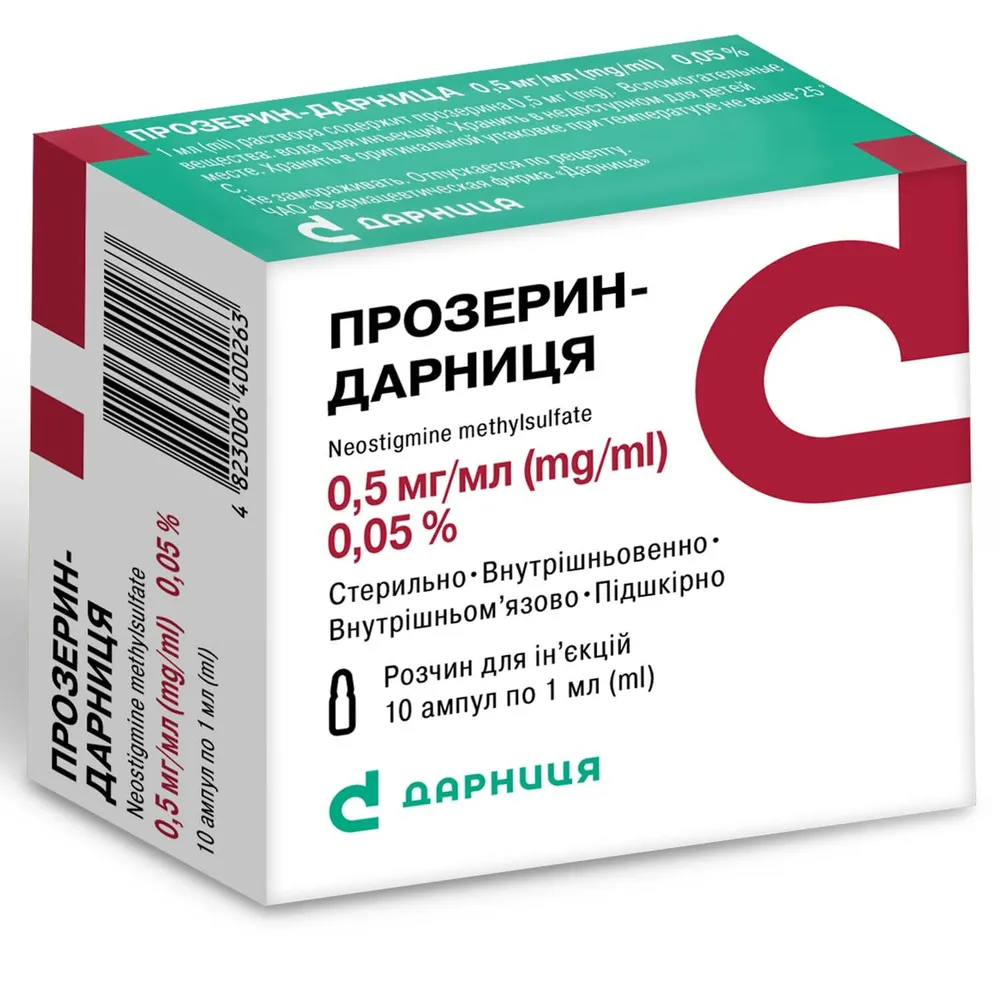
Table of Contents
INSTRUCTION FOR MEDICAL USE OF THE MEDICINAL PRODUCT PROZERIN
Composition:
Active substance: neostigmine;
1 ml of solution contains neostigmine methylsulfate – 0.5 mg;
Excipient: water for injections.
Pharmaceutical form. Injection solution.
Main physicochemical properties: clear, colorless liquid.
Pharmacotherapeutic group. Anticholinesterase agents. ATC code N07AA01.
Pharmacological Properties.
Pharmacodynamics.
Proserin is a synthetic reversible cholinesterase inhibitor. It exhibits high affinity for acetylcholinesterase due to its structural similarity to acetylcholine. Like acetylcholine, proserin initially interacts with the catalytic site of cholinesterase; however, unlike acetylcholine, it subsequently forms, via its carbamino group, a stable complex with the enzyme. The enzyme temporarily (from several minutes to several hours) loses its specific activity. After this period, due to the slow hydrolysis of proserin, cholinesterase is released from the inhibitor and regains its activity. This action leads to the accumulation and enhancement of acetylcholine effects at cholinergic synapses. Proserin exerts pronounced muscarinic and nicotinic effects and has a direct stimulating effect on skeletal muscles.
It causes a reduction in heart rate, increases secretion of exocrine glands (salivary, bronchial, sweat, and gastrointestinal tract), promotes hypersalivation, bronchorrhea, increases gastric juice acidity, constricts the pupil, induces accommodation spasm, reduces intraocular pressure, enhances smooth muscle tone of the intestine (increases peristalsis and relaxes sphincters) and of the urinary bladder, causes bronchial spasm, and increases skeletal muscle tone.
Pharmacokinetics.
The bioavailability of proserin after parenteral administration is high – 0.5 mg of proserin administered parenterally is equivalent to 15 mg taken orally. Bioavailability increases with increasing dose of the drug. Time to reach maximum plasma concentration after intramuscular administration is 30 minutes. Protein binding (to albumin) in blood plasma is 15–25%. The drug poorly penetrates the blood-brain barrier and does not exert central effects. It is metabolized via two pathways: hydrolysis at the site of binding to cholinesterase and by hepatic microsomal enzymes. In the liver, inactive metabolites are formed. 80% of the administered dose is excreted by the kidneys within 24 hours (of which 50% is excreted unchanged and 30% as metabolites). Elimination half-life after intramuscular administration is 51–90 minutes; after intravenous administration, it is 53 minutes.
Clinical characteristics.
Indications. Myasthenia, acute myasthenic crisis; motor disorders following brain injury; paralysis; recovery period after meningitis, poliomyelitis, encephalitis; neuritis, optic nerve atrophy; intestinal atony, urinary bladder atony; elimination of residual effects after blockade of neuromuscular transmission by non-depolarizing muscle relaxants.
Contraindications. Hypersensitivity to the active substance or to other components of the drug. Epilepsy; hyperkinesia; vagotomy; ischemic heart disease; angina pectoris; arrhythmias; bradycardia; bronchial asthma; pronounced atherosclerosis; thyrotoxicosis; peptic ulcer of the stomach and duodenum; peritonitis; mechanical obstruction of the gastrointestinal tract and urinary passages; prostatic hyperplasia accompanied by dysuria; acute phase of infectious disease; intoxications in severely weakened children; concomitant use with depolarizing muscle relaxants.
Interaction with other medicinal products and other types of interactions. When used concomitantly with other medicinal products, the following interactions are possible:
with local anesthetics and certain general anesthetics, antiarrhythmics, organic nitrates, tricyclic antidepressants, anticonvulsants, antiparkinsonian agents, guanethidine – reduced efficacy of proserin;
with m-cholinoblockers – weakening of m-cholinomimetic effects of proserin;
with depolarizing muscle relaxants – prolonged and enhanced effect of the latter;
with anti-depolarizing muscle relaxants – reduced effect of the latter. Proserin can be used as an antidote in case of overdose of anti-depolarizing muscle relaxants;
with other anticholinesterase agents – increased toxicity;
with m-cholinomimetics – gastrointestinal dysfunction, toxic effects on the nervous system;
with β-adrenoblockers – enhanced bradycardia;
with ephedrine – potentiation of proserin's effect.
Use with caution concomitantly with neomycin, streptomycin, kanamycin.
In myasthenia, administer in combination with aldosterone antagonists, glucocorticoids, and anabolic hormones.
Special precautions for use
Dosages of the drug should be carefully determined, taking into account the possibility of high individual sensitivity to it.
Use with caution in patients with arterial hypotension, cardiac arrhythmias—especially bradycardia—increased n. vagus tone, hyperthyroidism, Addison's disease, peptic ulcer of the stomach and duodenum when using anticholinergic agents, children with myasthenia gravis who are receiving antibacterial drugs with antidepolarizing effects (neomycin, streptomycin, kanamycin), local and general anesthetics, antiarrhythmic drugs that interfere with cholinergic transmission.
When large doses of Proserin are used, atropine should be administered either prior to or concurrently.
Use with caution in elderly patients.
If a myasthenic crisis (due to insufficient therapeutic dose) or cholinergic crisis (due to overdose) occurs during treatment, further use of the drug requires careful differential diagnosis due to the similarity of clinical symptoms.
Before any medical or dental treatment or surgical intervention, the physician must be informed about Proserin use.
The drug should be prescribed with particular caution to patients after surgery on the intestine or urinary bladder, and to patients with parkinsonism.
Use during pregnancy or breastfeeding. The drug is contraindicated during pregnancy. If use of the drug is necessary, breastfeeding should be discontinued.
Ability to affect reaction speed when driving or operating machinery. During treatment, driving vehicles or operating machinery is contraindicated.
Method of Administration and Dosage
Adults. Administer the drug subcutaneously in a dose of 0.5–2 mg (1–4 mL) 1–2 times daily. The maximum single dose for adults is 2 mg; the maximum daily dose is 6 mg. The duration of treatment course (except for myasthenia, myasthenic crisis, postoperative intestinal and bladder atony, and overdose of myorelaxants) is 25–30 days. If a repeated course is necessary, it should be initiated after 3–4 weeks. The larger part of the total daily dose should be administered during daytime, when the patient is most fatigued.
Myasthenia: administer the drug subcutaneously or intramuscularly at a dose of 0.5 mg (1 mL) daily. The treatment course is prolonged, with alternating routes of administration.
Myasthenic crisis (with impaired respiration and swallowing): administer the drug intravenously at a dose of 0.25–0.5 mg (0.5–1 mL), followed by subcutaneous administration at short intervals.
Postoperative intestinal and bladder atony, prevention of postoperative urinary retention, including: administer the drug subcutaneously or intramuscularly at a dose of 0.25 mg (0.5 mL), as early as possible after surgery, and repeat every 4–6 hours for 3–4 days.
As an antidote in case of myorelaxant overdose (after prior intravenous administration of atropine sulfate 0.6–1.2 mg, until pulse rate increases to 80 beats/min): administer the drug slowly intravenously at a dose of 0.5–2 mg every 0.5–2 minutes. If necessary, repeat injections (including atropine in case of bradycardia), with a total dose not exceeding 5–6 mg (10–12 mL) within 20–30 minutes. Artificial ventilation of the lungs should be ensured during the procedure.
Children (only under inpatient conditions).
Myasthenia gravis:
- Newborns: initially administer the drug at a dose of 0.1 mg via intramuscular injection. Subsequently, individualize dosing, typically 0.05–0.25 mg or 0.03 mg/kg body weight of the drug intramuscularly every 2–4 hours. Due to the specific nature of the disease in newborns, the daily dose may be reduced or even discontinued completely;
- Children under 12 years of age: administer the drug at a dose of 0.2–0.5 mg via injection as needed. Dosage should be adjusted according to the patient's response.
As an antidote in case of myorelaxant overdose (after prior intravenous administration of atropine sulfate at a dose of 0.02–0.03 mg/kg body weight, until pulse rate increases to 80 beats/min): administer the drug slowly intravenously at a dose of 0.05–0.07 mg/kg body weight over 1 minute. The maximum recommended dose in children is 2.5 mg.
Other indications: administer the drug in a dose of 0.125–1 mg via injections. Doses may be adjusted according to individual patient needs.
Children. The drug should be administered to children only under inpatient conditions.
Overdose.
Symptoms: related to overstimulation of cholinergic receptors (cholinergic crisis): tachycardia, bradycardia, hypersalivation, dysphagia, miosis, bronchospasm, respiratory distress, nausea, vomiting, increased peristalsis, diarrhea, increased urinary frequency, impaired coordination, tongue and skeletal muscle twitching, cold sweat, progressive development of generalized weakness, paralysis, decreased arterial blood pressure, anxiety, panic. Very high doses may cause agitation and restlessness. Fatal outcome may result from cardiac arrest or respiratory paralysis, pulmonary edema. In patients with myasthenia gravis, in whom overdose is more likely, muscle twitching and parasympathomimetic effects may be absent or mild, making differential diagnosis between overdose and myasthenic crisis difficult.
Treatment: reduce the dose or discontinue administration of the drug. If necessary, administer atropine (1 mL of 0.1% solution), metacine. Further treatment is symptomatic.
Adverse reactions.
Cardiovascular system: arrhythmia, brady- or tachycardia, atrioventricular block, nodal rhythm, non-specific ECG changes, cardiac arrest, decreased arterial pressure (mainly with parenteral administration).
Nervous system: headache, dizziness, fainting, weakness, drowsiness, tremor, convulsions, spasms and twitching of skeletal muscles, including muscles of the tongue and larynx, numbness of legs, dysarthria.
Eye disorders: miosis, visual disturbances.
Respiratory system, thoracic organs and mediastinum: dyspnea, respiratory depression up to respiratory arrest, bronchospasm, increased bronchial secretion.
Gastrointestinal tract: hypersalivation, spastic contractions and increased intestinal peristalsis, nausea, vomiting, flatulence, diarrhea, involuntary defecation.
Urinary system: increased frequency of urination, involuntary urination.
Immune system, skin and subcutaneous tissue: hypersensitivity reactions, including rash, pruritus, hyperemia, urticaria, allergic reactions, including anaphylactic shock.
General disorders and administration site reactions: increased sweating, sensation of heat, lacrimation, arthralgia, reactions at the injection site, including hyperemia, pruritus, skin swelling.
To manage adverse effects, reduce the dose or discontinue the drug. If necessary, administer atropine, metacin, or other anticholinergic agents.
Shelf life. 4 years.
Storage conditions. Store at a temperature not exceeding 25 °C in the original packaging.
Keep out of reach of children.
Incompatibility. Proserin should not be mixed in the same syringe with alkaline solutions or oxidizing agents, as this leads to its degradation.
Packaging. 1 ml in ampoules, pack of 10 in a box; 10 in a blister pack in a box.
Prescription category. Prescription only.
Manufacturer.
Limited Liability Company "Experimental Plant "GNCLS".
LIMITED LIABILITY COMPANY "CORPORATION "ZDOROVIYA".
Manufacturer's address and place of business.
8 Vorobiova Street, Kharkiv, Kharkiv Region, Ukraine.
(Limited Liability Company "Experimental Plant "GNCLS")
22 Shevchenka Street, Kharkiv, Kharkiv Region, 61013, Ukraine.
(LIMITED LIABILITY COMPANY "CORPORATION "ZDOROVIYA")