Protecon®
Ukraine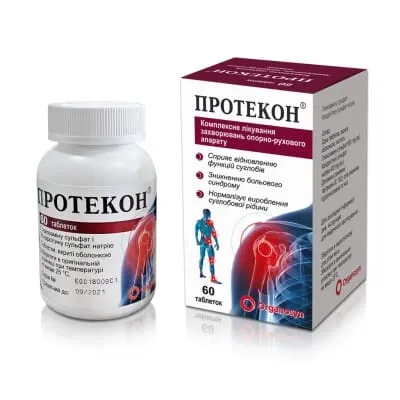
Table of Contents
INSTRUCTION FOR MEDICAL USE OF THE MEDICINAL PRODUCT PROTECON® (PROTECHON)
Composition:
Active substances: chondroitin, glucosamine;
One coated tablet contains sodium chloride glucosamine sulfate equivalent to glucosamine sulfate 500 mg, sodium chondroitin sulfate 400 mg;
Excipients: microcrystalline cellulose, anhydrous colloidal silicon dioxide, talc, sodium croscarmellose, hypromellose, polyethylene glycol (PEG-6000), titanium dioxide (E 171), tartrazine (E 102), hydrogenated castor oil.
Pharmaceutical form. Coated tablets.
Main physico-chemical properties: yellow, oval-shaped, biconvex coated tablets with a score line on one side.
Pharmacotherapeutic group.
Agents used in disorders of the musculoskeletal system.
ATC code M09A X.
Pharmacological Properties.
Pharmacodynamics.
Glucosamine is a substrate for joint cartilage formation and stimulates regeneration of cartilage tissue. Glycosaminoglycans and proteoglycans are components of the complex matrix from which cartilage is composed.
Glucosamine is part of endogenous glycosaminoglycans in cartilage tissue and stimulates the production of proteoglycans and enhances sulfate uptake by articular cartilage. Thus, glucosamine replenishes endogenous glucosamine deficiency. It participates in the biosynthesis of proteoglycans and hyaluronic acid, thereby counteracting the progression of degenerative processes in joints, spine, and surrounding soft tissues. It stimulates the formation of chondroitin sulfate, normalizes calcium deposition in bone tissue, and promotes restoration of joint function and relief from pain syndrome.
Chondroitin is a high-molecular-weight mucopolysaccharide that exerts chondroprotective, anti-inflammatory, and analgesic effects. It also stimulates regeneration of cartilage tissue and influences calcium-phosphate metabolism within it. Chondroitin slows down bone resorption and reduces calcium loss, and decelerates degenerative processes in cartilage tissue. It prevents compression of connective tissue and provides lubrication of joint surfaces, normalizing the production of synovial fluid.
Pharmacokinetics.
After oral administration, glucosamine is rapidly and completely absorbed from the gastrointestinal tract, with bioavailability of 25–26%. Approximately 90% of orally administered glucosamine, in the form of glucosamine salt, is absorbed from the small intestine and enters the liver via the portal circulation. It is metabolized in the liver to urea, water, and carbon dioxide. About 30% of the administered dose persists in connective tissue for a prolonged period. It is excreted primarily by the kidneys, and to a very minor extent through the intestine.
After oral administration, the bioavailability of chondroitin is 13–15%. Maximum plasma concentration (Cmax) is reached within 3–4 hours, and in synovial fluid within 4–5 hours (after single administration). It accumulates predominantly in cartilage tissue (maximum concentration in articular cartilage is achieved within 48 hours); the synovial membrane does not impede its penetration into the joint cavity. It is excreted by the kidneys within 24 hours.
Clinical characteristics.
Indications.
Degenerative-dystrophic diseases of joints and spine; primary and secondary osteoarthritis, osteochondrosis, periarthritis of the shoulder and scapula; fractures (to accelerate formation of bone callus).
Contraindications.
Hypersensitivity to the active substances or to other components of the medicinal product; tendency to bleeding; thrombophlebitis; diabetes mellitus; renal/liver function insufficiency in the decompensation stage, phenylketonuria.
Do not use in patients with hypersensitivity (allergy) to seafood.
Interaction with other medicinal products and other types of interactions.
The medicinal product is compatible with nonsteroidal anti-inflammatory drugs and corticosteroids.
When glucosamine is used concomitantly with warfarin, an increased international normalized ratio (INR) and risk of bleeding may occur. Therefore, when used concomitantly, blood coagulation parameters should be monitored.
Possible interactions when used concomitantly with other medicinal products:
with indirect anticoagulants, antiplatelet agents, fibrinolytics — enhancement of the effects of the latter; coagulation parameters should be monitored when used concomitantly;
with nonsteroidal anti-inflammatory drugs, corticosteroids — reduced need for these drugs, as well as for analgesics;
with tetracycline group drugs — increased absorption of the latter;
with penicillins, chloramphenicol — decreased absorption of the latter.
The effectiveness of treatment with the drug is enhanced by enriching the diet with vitamins A, C, and salts of manganese, magnesium, copper, zinc, and selenium.
Glucosamine may affect cyclosporine blood concentration.
Special precautions for use
Do not exceed the recommended doses when using the medication.
The drug may be used as part of combination therapy with corticosteroids and nonsteroidal anti-inflammatory agents, if necessary.
Patients with diabetes mellitus should monitor their blood glucose levels more frequently, especially at the beginning of treatment. The drug should be used with caution in patients with bronchial asthma, as worsening of symptoms may occur. The condition of such patients should be monitored, and they should be warned about the possibility of complications.
In rare cases, edema and/or water retention have been observed in patients with cardiac or renal insufficiency. This may be related to the osmotic effect of chondroitin sulfate.
One tablet contains 3.978 mmol (91.47 mg of sodium). This should be taken into account by patients on a controlled sodium (low-sodium/low-salt) diet.
The presence of castor oil in the formulation may cause gastrointestinal disturbances and diarrhea.
The excipients include the colorant tartrazine (E 102), which may cause hypersensitivity and allergic reactions.
The drug should be used with caution in patients with impaired liver and/or kidney function.
Use during pregnancy or breastfeeding
Safety and efficacy have not been established; therefore, the drug should not be used during pregnancy or breastfeeding. If use of the drug is necessary, breastfeeding should be discontinued.
Ability to affect reaction speed while driving or operating machinery
Studies on the effect of the drug on reaction speed while driving or operating machinery have not been conducted. If drowsiness, fatigue, dizziness, and/or visual disturbances occur during treatment, patients should refrain from driving or operating machinery.
Method of administration and dosage.
The drug should be administered to adults for the first 3 weeks at a dose of 1 tablet three times a day, then 1 tablet twice a day. The duration of treatment is 2–3 months. The course should be repeated 2–3 times a year.
Children.
Safety and efficacy have not been established; therefore, the drug should not be used in children.
Overdose.
Cases of overdose have not been reported. Overdose may enhance the manifestations of adverse reactions. Based on the results of acute and chronic toxicity studies, no toxic symptoms are expected, even with the use of high doses. In case of overdose symptoms, symptomatic therapy is recommended.
Adverse Reactions
Available data indicate that glucosamine and chondroitin sulfate, at the doses usually prescribed (1500 mg/day and 1200 mg/day, respectively), are non-toxic and predominantly do not cause adverse reactions.
The adverse effects described below were reported during the post-marketing period of the medicinal product use. Since the information was voluntarily reported from a population of undefined size, it is not always possible to reliably determine the frequency of these reactions.
Nervous system disorders: dizziness, somnolence, headache, insomnia, fatigue, weakness, visual disturbances.
Cardiovascular system disorders: extrasystoles (according to literature data).
Gastrointestinal disorders: moderate to mild epigastric pain, flatulence, diarrhea, constipation, nausea, vomiting, dyspepsia.
Immune system, skin and subcutaneous tissue disorders: hypersensitivity reactions, including rash, pruritus, erythema, urticaria, angioneurotic edema; dermatitis, eczema, alopecia. If allergic reactions occur, treatment should be discontinued and medical advice should be sought.
Other: edema.
All manifestations are generally mild and resolve after discontinuation of the medicinal product.
Reporting of adverse reactions after marketing authorization is of great importance. It enables continuous monitoring of the benefit-risk balance of the medicinal product. Healthcare professionals and pharmacists, as well as patients or their legal representatives, are encouraged to report all suspected adverse reactions and lack of efficacy via the automated pharmacovigilance information system at: https://aisf.dec.gov.ua
Shelf life. 3 years.
Storage conditions.
Store in the original packaging at a temperature not exceeding 25 °C, in a place inaccessible to children.
Packaging.
10 tablets in a blister; 3 blisters in a cardboard box;
10 tablets in a blister; 3 blisters in a cardboard box; 3 boxes in an outer cardboard carton;
30, 60 or 120 tablets in containers; 1 container in a cardboard box.
Availability category. Over-the-counter.
Manufacturer.
Evertogen Life Sciences Limited / Evertogen Life Sciences Limited.
Saga Lifesciences Limited / Saga Lifesciences Limited
Manufacturer's location and address of business premises.
Plot No: S-8, S-9, S-13/P & S-14/P TSIIC, Pharma SEZ, Green Industrial Park, Polepally (V), Jadcherla (M), Mahabubnagar, Telangana, IN-509 301, India.
Survey No. 198/2 & 198/3, Chachrawadi Vasna, Ta Sannand District, Ahmedabad, Gujarat, 382210, India.