Prostazan uroplus
Ukraine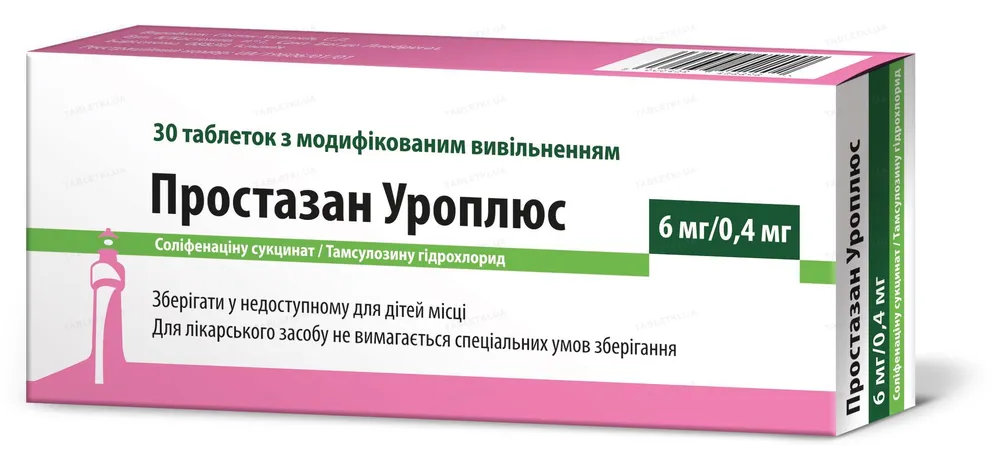
Table of Contents
- INSTRUCTIONS FOR MEDICAL USE OF THE MEDICINAL PRODUCT PROSTAZAN UROPLUS (PROSTAZAN UROPLUS)
- Composition:
- Pharmacological Properties.
- Clinical characteristics.
- Special precautions for use.
- Method of Administration and Dosage.
- Adverse reactions
- The table includes characteristic adverse reactions of solifenacin and tamsulosin reported in the summary of product characteristics for these medicinal products.
INSTRUCTIONS FOR MEDICAL USE OF THE MEDICINAL PRODUCT PROSTAZAN UROPLUS (PROSTAZAN UROPLUS)
Composition:
Active substances: solifenacin succinate, tamsulosin hydrochloride;
1 tablet contains 6 mg of solifenacin succinate and 0.4 mg of tamsulosin hydrochloride;
Excipients: microcrystalline cellulose 200, polyethylene oxide 7000000, magnesium stearate, microcrystalline cellulose, calcium hydrogen phosphate, colloidal anhydrous silicon dioxide, sodium croscarmellose, iron oxide red (E 172);
Film coating: Opadry Red 03F250016: hypromellose, iron oxide red (E 172), macrogol, titanium dioxide (E 171).
Pharmaceutical form. Modified-release tablets.
Main physicochemical properties: red film-coated, round-shaped tablets with embossed marking.
Pharmacotherapeutic group. Drugs used in urology. Alpha-adrenoblockers. ATC code G04CA53.
Pharmacological Properties.
Pharmacodynamics.
Prostasan Uroplus is a combination medicinal product containing two active substances – solifenacin and tamsulosin. These active substances have independent and complementary mechanisms of action for the treatment of lower urinary tract symptoms (LUTS) in benign prostatic hyperplasia (BPH), particularly in the presence of bladder storage symptoms. Solifenacin is a selective competitive antagonist of muscarinic receptors and has no affinity for other receptors, enzymes, or ion channels. Solifenacin has the highest affinity for muscarinic M3 receptors and lower affinity for muscarinic M1 and M2 receptors.
Tamsulosin is an alpha1-adrenoceptor blocker. Tamsulosin selectively and competitively binds to postsynaptic alpha1-adrenoceptors, particularly subtypes alpha1A and alpha1D, which are responsible for relaxation of the smooth musculature of the lower urinary tract.
Solifenacin alleviates bladder storage symptoms (irritative symptoms) associated with acetylcholine action, which activates M3-cholinergic receptors in the bladder. Acetylcholine stimulates the contractile function of the bladder wall, manifesting as urgent urination or urinary incontinence.
Tamsulosin improves voiding symptoms by increasing maximum urinary flow rate, reduces obstructive symptoms by relaxing smooth muscles of the prostate gland, bladder neck, and urethra, and also improves bladder filling.
Pharmacokinetics.
Bioavailability studies after repeated administration showed that the pharmacokinetics of the medicinal product are comparable to those observed with concomitant administration of solifenacin and tamsulosin.
Absorption.
After repeated administration, the time to reach maximum plasma concentration (tmax) of solifenacin ranged between 4.27 and 4.76 hours across different studies, and for tamsulosin between 3.47 and 5.65 hours, respectively. Maximum plasma concentration (Cmax) of solifenacin varied between 26.5 ng/mL and 32.0 ng/mL, and for tamsulosin between 6.56 ng/mL and 13.3 ng/mL. Area under the concentration-time curve (AUC) values for solifenacin ranged from 528 ng·h/mL to 601 ng·h/mL, and for tamsulosin from 97.1 ng·h/mL to 222 ng·h/mL. Absolute bioavailability of solifenacin is approximately 90%, whereas tamsulosin is absorbed at 70–79% of the administered dose.
A study was conducted on the medicinal product after single-dose administration taken simultaneously with food, including low-fat meals, low-calorie breakfast, and high-fat, high-calorie breakfast. After intake with a high-fat, high-calorie breakfast, Cmax for tamsulosin increased by 54% compared to fasting conditions, and AUC increased by 33%. The pharmacokinetics of solifenacin are not altered when taken with low-fat meals, low-calorie breakfast, or high-fat, high-calorie meals. Concomitant administration of solifenacin and tamsulosin results in a 1.19-fold increase in tamsulosin Cmax and a 1.24-fold increase in tamsulosin AUC compared to tamsulosin monotherapy. There is no evidence of tamsulosin affecting the pharmacokinetics of solifenacin.
Elimination.
After single-dose administration, the elimination half-life (t1/2) of solifenacin ranged from 49.5 to 53 hours; for tamsulosin, from 12.8 to 14 hours. Repeated administration of verapamil 240 mg concomitantly with the medicinal product increases Cmax and AUC of solifenacin by 60% and 63%, respectively, while Cmax and AUC of tamsulosin increase by 115% and 122%, respectively. These changes in Cmax and AUC are not clinically significant.
Analysis of pharmacokinetic data from three phases of clinical trials indicates variability in tamsulosin pharmacokinetics depending on patient age, height, and plasma concentration of α1-acid glycoprotein. Increased AUC is associated with elevated α1-acid glycoprotein levels and increasing age, while decreased AUC is associated with reduced height. Additionally, elevated gamma-glutamyl transferase levels are linked to higher AUC values. These AUC changes are not clinically significant. Information on the pharmacokinetics of the active substances supplements the pharmacokinetic profile of the medicinal product Prostasan Uroplus.
Solifenacin.
Absorption.
Time to maximum concentration (tmax) is dose-independent and ranges from 3 to 8 hours after multiple dosing. Cmax and AUC increase proportionally with dose in the range of 5 to 40 mg. Absolute bioavailability is approximately 90%.
Distribution. Volume of distribution of solifenacin after intravenous administration is approximately 600 L. About 98% of solifenacin is plasma protein-bound, primarily to α1-acid glycoprotein.
Metabolism. Solifenacin is slowly metabolized and has a low first-pass effect. It is actively metabolized in the liver, primarily by CYP3A4. However, alternative metabolic pathways may also influence solifenacin metabolism. Systemic clearance of solifenacin is approximately 9.5 L/h. After oral administration, one pharmacologically active metabolite (4R-hydroxysolifenacin) and three inactive metabolites (N-glucuronide, N-oxide, and 4R-hydroxy-N-oxide of solifenacin) were detected in plasma, in addition to unchanged solifenacin.
Elimination. After single oral dose of 10 mg 14C-labeled solifenacin, approximately 70% of radioactivity was recovered in urine and 23% in feces over 26 days. In urine, approximately 11% of radioactivity was excreted unchanged, about 18% as the N-oxide metabolite, 9% as the 4R-hydroxy-N-oxide metabolite, and 8% as the 4R-hydroxy metabolite (active metabolite).
Tamsulosin.
Absorption. For tamsulosin, tmax ranges from 4 to 6 hours after multiple doses of 0.4 mg/day. Cmax and AUC increase proportionally with dose in the range of 0.4 to 1.2 mg. Absolute bioavailability is approximately 57%.
Distribution. Volume of distribution of tamsulosin after intravenous administration is approximately 16 L. About 99% of tamsulosin is plasma protein-bound, primarily to α1-acid glycoprotein.
Metabolism. Tamsulosin has a low first-pass effect and is slowly metabolized. It is actively metabolized in the liver, primarily by CYP3A4 and CYP2D6. Systemic clearance of tamsulosin is approximately 2.9 L/h. Most of the administered tamsulosin is present in plasma as unchanged active substance. None of the metabolites are more active than the parent compound.
Elimination. After single 0.2 mg dose of 14C-labeled tamsulosin, approximately 76% of radioactivity was excreted in urine and 21% in feces within one week. In urine, approximately 9% of radioactivity was excreted as unchanged tamsulosin, about 16% as o-desethylated tamsulosin sulfate, and 8% as o-ethoxyphenoxyacetic acid.
Elderly Patients.
In clinical pharmacology and bioavailability studies, patient age ranged from 19 to 79 years. After administration, the highest plasma concentrations were observed in elderly patients, although individual values largely overlapped with those in younger patients. The medicinal product can be used in elderly patients.
Renal Impairment.
Prostasan Uroplus can be administered to patients with mild to moderate renal impairment; however, caution is advised in patients with severe renal impairment. The pharmacokinetics of Prostasan Uroplus have not been studied in patients with renal impairment. The data provided below reflect information specific to each active substance in the context of renal impairment.
Solifenacin.
AUC and Cmax of solifenacin in patients with mild to moderate renal impairment do not differ significantly from those in healthy volunteers. In patients with severe renal impairment (creatinine clearance ≤ 30 mL/min), solifenacin exposure is substantially higher: Cmax increases by approximately 30%, AUC by more than 100%, and t1/2 by more than 60%. A statistically significant relationship between creatinine clearance and solifenacin clearance has been observed. Pharmacokinetics in patients undergoing hemodialysis have not been studied.
Tamsulosin.
Pharmacokinetics of tamsulosin were compared in 6 patients with mild to moderate renal impairment (30 mL/min/1.73 m² ≤ creatinine clearance < 70 mL/min/1.73 m²) or moderate to severe renal impairment (< 30 mL/min/1.73 m²) and 6 healthy volunteers (creatinine clearance > 90 mL/min/1.73 m²). Changes in total plasma concentration of tamsulosin occurred due to altered binding to α1-acid glycoprotein; however, the free (active) concentration of tamsulosin hydrochloride and intrinsic clearance remained relatively stable. Pharmacokinetics of tamsulosin in patients with end-stage renal disease (creatinine clearance < 10 mL/min/1.73 m²) have not been studied.
Hepatic Impairment.
Prostasan Uroplus may be used in patients with mild to moderate hepatic impairment but is contraindicated in patients with severe hepatic impairment.
The pharmacokinetics of Prostasan Uroplus have not been studied in patients with hepatic impairment.
The data provided below reflect information specific to each active substance in the context of hepatic impairment.
Solifenacin.
In patients with moderate hepatic impairment (Child-Pugh score 7–9), Cmax remains unchanged, AUC increases by 60%, and t1/2 doubles.
Pharmacokinetics in patients with severe hepatic impairment have not been studied.
Tamsulosin.
Pharmacokinetics of tamsulosin were compared in 8 patients with moderate hepatic impairment (Child-Pugh score 7–9) and 8 healthy volunteers. Changes in total plasma concentration of tamsulosin occurred due to altered binding to α1-acid glycoprotein; however, the free concentration of tamsulosin hydrochloride did not change significantly, and intrinsic clearance of inactive tamsulosin changed moderately (by 32%). Pharmacokinetics of tamsulosin in patients with severe hepatic impairment have not been studied.
Clinical characteristics.
Indications.
Treatment of moderate to severe storage lower urinary tract symptoms (urgent need to urinate, increased urinary frequency) and voiding symptoms (obstructive symptoms) associated with benign prostatic hyperplasia (BPH) in men for whom monotherapy has been ineffective.
Contraindications.
- Hypersensitivity to the active substances or to any of the excipients.
- Hemodialysis.
- Severe hepatic impairment.
- Severe renal impairment when strong cytochrome P450 (CYP) 3A4 inhibitors (e.g. ketoconazole) are used.
- Moderate hepatic impairment when strong CYP3A4 inhibitors (e.g. ketoconazole) are used.
- Severe gastrointestinal disorders (including toxic megacolon), myasthenia gravis or closed-angle glaucoma, or presence of risk factors for these conditions.
- History of orthostatic hypotension.
Interaction with other medicinal products and other forms of interaction.
Concomitant use of Prostasan Uroplus with other medicinal products having anticholinergic activity may result in enhanced therapeutic effects and adverse reactions. The interval between administration of such medicinal products should be approximately one week. The therapeutic effect of solifenacin may be reduced when used concomitantly with cholinergic receptor agonists.
Interactions with CYP3A4 and CYP2D6 inhibitors.
Concomitant administration of solifenacin with ketoconazole (a strong CYP3A4 inhibitor) at a dose of 200 mg/day resulted in a 1.4- and 2.0-fold increase in Cmax and AUC of solifenacin, respectively, while ketoconazole at 400 mg/day led to a 1.5- and 2.8-fold increase in Cmax and AUC of solifenacin.
When tamsulosin was administered concomitantly with ketoconazole at 400 mg/day, a 2.2- and 2.8-fold increase in Cmax and AUC of tamsulosin was observed, respectively. Since concomitant use with strong CYP3A4 inhibitors such as ketoconazole, ritonavir, nelfinavir, and itraconazole may lead to increased exposure to both solifenacin and tamsulosin, Prostasan Uroplus should be used with caution in combination with strong CYP3A4 inhibitors. Prostasan Uroplus should not be used concomitantly with strong CYP3A4 inhibitors in patients who are poor metabolizers of CYP2D6 or in patients already receiving strong CYP2D6 inhibitors.
Concomitant administration of Prostasan Uroplus with verapamil (a moderate CYP3A4 inhibitor) resulted in approximately a 2.2-fold increase in Cmax and AUC of tamsulosin and approximately a 1.6-fold increase in Cmax and AUC of solifenacin. Prostasan Uroplus should be used with caution in combination with moderate CYP3A4 inhibitors.
When tamsulosin was administered concomitantly with cimetidine, a weak CYP3A4 inhibitor (400 mg every 6 hours), a 1.44-fold increase in AUC of tamsulosin was observed, while Cmax was not significantly altered. Prostasan Uroplus may be used concomitantly with weak CYP3A4 inhibitors.
Concomitant administration of tamsulosin with paroxetine, a strong CYP2D6 inhibitor (20 mg daily), resulted in a 1.3- and 1.6-fold increase in Cmax and AUC of tamsulosin, respectively. The medicinal product may be used concomitantly with CYP2D6 inhibitors. The effect of enzyme inducers on the pharmacokinetic properties of solifenacin and tamsulosin has not been studied. Since both solifenacin and tamsulosin are metabolized via CYP3A4, pharmacokinetic interactions with CYP3A4 inducers (e.g. rifampicin) are possible, which may reduce plasma concentrations of solifenacin and tamsulosin.
Other interactions.
Solifenacin.
Solifenacin may reduce the effect of medicinal products that stimulate gastrointestinal motility, such as metoclopramide and cisapride. In vitro studies with solifenacin have shown that, at therapeutic concentrations, solifenacin does not inhibit CYP1A1/2, 2B6, 2C8, 2C9, 2C19, 2D6, 2E1, or 3A4; therefore, no interactions between solifenacin and medicinal products metabolized by these CYP enzymes are expected. Administration of solifenacin does not alter the pharmacokinetics of R-warfarin or S-warfarin or their effect on prothrombin time. It has been demonstrated that solifenacin administration has practically no effect on the pharmacokinetics of digoxin.
Tamsulosin.
Concomitant use of tamsulosin with other alpha1-adrenoreceptor blockers may lead to hypotensive effects. In vitro studies have shown that the free fraction of tamsulosin in human plasma is not altered by concomitant administration of diazepam, propranolol, trichlormethiazide, chlormadinone, amitriptyline, diclofenac, glipizide, simvastatin, or warfarin. Tamsulosin does not alter the free fraction of diazepam, propranolol, trichlormethiazide, or chlormadinone. However, diclofenac and warfarin may increase the elimination rate of tamsulosin. Concomitant administration with furosemide leads to a reduction in plasma levels of tamsulosin, but since tamsulosin levels remain within the therapeutic range, concomitant use of tamsulosin and furosemide is acceptable. In vitro studies with tamsulosin have shown that, at therapeutic concentrations, tamsulosin does not practically inhibit CYP1A2, 2C9, 2C19, 2D6, 2E1, or 3A4. Therefore, no interactions between tamsulosin and medicinal products metabolized by these CYP enzymes are expected. No interaction cases have been reported with concomitant use of tamsulosin and atenolol, enalapril, or theophylline.
Special precautions for use.
The medicinal product Prostazan Uroplus should be used with caution in patients with severe renal impairment, risk of urinary retention, gastrointestinal obstructive disorders, risk of developing reduced gastrointestinal motility, with hiatal hernia/gastroesophageal reflux and/or when taking concomitantly medicinal products that may cause or exacerbate esophagitis (e.g., bisphosphonates). Before initiating therapy with Prostazan Uroplus, other possible causes of frequent urination (heart failure or kidney disease) should be evaluated. If urinary tract infection is present, appropriate antibacterial treatment should be prescribed.
In patients with risk factors for QT interval prolongation, such as previously diagnosed long QT syndrome and hypokalemia, QT interval prolongation and ventricular fibrillation/torsades de pointes have been reported during treatment with solifenacin succinate.
Angioedema with airway obstruction has been reported in some patients receiving solifenacin succinate and tamsulosin. If angioedema occurs, Prostazan Uroplus should be discontinued immediately, and the patient should not take this medicinal product again. Appropriate measures should be taken and necessary treatment initiated.
Anaphylactic reactions have been reported in some patients receiving solifenacin succinate. If anaphylactic reactions occur, administration of Prostazan Uroplus should be discontinued and appropriate measures taken, including initiation of necessary treatment.
As with other alpha1-adrenoceptor blockers, a decrease in blood pressure may occur during tamsulosin treatment, rarely leading to syncope. Patients starting treatment with Prostazan Uroplus should be advised to sit or lie down at the first signs of orthostatic hypotension (dizziness, weakness) until symptoms resolve. In some patients who received tamsulosin hydrochloride during cataract or glaucoma surgery, or who had prior treatment with tamsulosin hydrochloride, intraoperative floppy iris syndrome (IFIS, a variant of miosis) has been observed. IFIS may increase the risk of ophthalmological complications during and after surgery. Therefore, initiating treatment with Prostazan Uroplus is not recommended in patients scheduled for cataract or glaucoma surgery. Discontinuation of Prostazan Uroplus two weeks before cataract or glaucoma surgery is theoretically considered beneficial, although the actual benefit has not been definitively established. Prior to surgery, surgeons and ophthalmologists planning cataract or glaucoma surgery should inquire whether patients are currently taking or have previously taken Prostazan Uroplus to ensure appropriate measures are taken to manage potential IFIS during surgery. Prostazan Uroplus should be used with caution when co-administered with moderate and strong CYP3A4 inhibitors (see section "Interaction with other medicinal products and other forms of interaction"), and should not be prescribed in combination with strong CYP3A4 inhibitors, such as ketoconazole, in patients who are poor metabolizers of CYP2D6 or in patients taking strong CYP2D6 inhibitors, such as paroxetine.
The medicinal product contains mannitol and therefore may have a mild laxative effect.
Use during pregnancy or breastfeeding.
Prostazan Uroplus is not indicated for use in women.
Fertility.
The effect of Prostazan Uroplus on fertility has not been evaluated. Animal studies with solifenacin or tamsulosin did not reveal any adverse effects on fertility or early embryonic development.
Ejaculation disorders were observed in short- and long-term clinical trials of tamsulosin. In the post-marketing period, ejaculation disorders, retrograde ejaculation, and ejaculatory failure have been reported.
Ability to affect reaction speed when driving or operating machinery.
No studies have been conducted on the effect of Prostazan Uroplus on the ability to drive or operate machinery. However, patients should be informed about the possible occurrence of adverse reactions such as dizziness, blurred vision, fatigue, and (rarely) increased somnolence, which may negatively affect the ability to drive or operate machinery (see section "Adverse reactions").
Method of Administration and Dosage.
Adult men, including elderly patients.
Take orally 1 tablet of Prostasan Uroplus (6 mg/0.4 mg) once daily, independent of food intake.
The maximum daily dose of Prostasan Uroplus is 1 tablet (6 mg/0.4 mg).
Tablets should be swallowed whole, without chewing or crushing.
Patients with renal impairment.
The effect of renal impairment on the pharmacokinetics of Prostasan Uroplus has not been studied. However, the effect on the pharmacokinetics of individual active substances of the drug is well studied (see section "Pharmacokinetic Properties"). Prostasan Uroplus can be prescribed to patients with mild to moderate renal impairment (creatinine clearance > 30 mL/min). In patients with severe renal impairment (creatinine clearance ≤ 30 mL/min), the drug should be used with caution and the maximum daily dose should not be exceeded (see section "Special Warnings and Precautions for Use").
Patients with hepatic impairment.
The effect of hepatic impairment on the pharmacokinetics of Prostasan Uroplus has not been studied. However, the effect on the pharmacokinetics of individual active substances of the drug is well studied (see section "Pharmacokinetic Properties"). Prostasan Uroplus can be prescribed to patients with mild hepatic impairment (Child-Pugh score ≤ 7). In patients with moderate hepatic impairment (Child-Pugh score 7–9), the drug should be used with caution and the maximum daily dose should not be exceeded. Prostasan Uroplus is contraindicated in patients with severe hepatic impairment (Child-Pugh score > 9). Moderate and strong inhibitors of cytochrome P450 3A4. Prostasan Uroplus should be used with caution in patients who are concurrently receiving moderate or strong CYP3A4 inhibitors (such as verapamil, ketoconazole, ritonavir, nelfinavir, itraconazole).
Children.
The drug is not intended for use in children and adolescents (under 18 years of age).
Overdose.
Symptoms.
Overdose with the combination of solifenacin and tamsulosin may potentially lead to severe anticholinergic effects, including acute arterial hypotension. The highest doses accidentally administered during clinical trials were 126 mg solifenacin succinate and 5.6 mg tamsulosin hydrochloride. These doses were well tolerated, with only mild dry mouth observed during 16 days of treatment.
Treatment.
In case of overdose, activated charcoal should be administered. Gastric lavage may be beneficial if performed within the first hour after drug intake; however, vomiting should not be induced.
Symptoms of solifenacin overdose, as with other anticholinergic drugs, may be managed as follows:
- severe central nervous system anticholinergic effects, hallucinations, or other pronounced disturbances: treatment with physostigmine or carbachol;
- seizures or pronounced agitation: treatment with benzodiazepines;
- respiratory insufficiency: treatment with artificial ventilation;
- tachycardia: symptomatic treatment if necessary. Beta-blockers should be used with caution, as concomitant tamsulosin overdose may potentially cause severe arterial hypotension;
- urinary retention: catheterization.
As with other antimuscarinic agents, in cases of overdose, special attention should be paid to patients with established risk factors for QT interval prolongation (e.g., hypokalemia, bradycardia, and concomitant use of drugs that may prolong the QT interval) and pre-existing cardiac conditions (e.g., myocardial ischemia, arrhythmia, heart failure). Acute hypotension, which may occur with tamsulosin overdose, should be treated symptomatically. Since tamsulosin is highly protein-bound, hemodialysis is unlikely to be effective.
Adverse reactions
The medicinal product may cause mild to moderate anticholinergic adverse reactions.
The most common adverse reactions were dry mouth (9.5%), constipation (3.2%), and dyspepsia (including abdominal pain, 2.4%). Other frequently observed adverse reactions included dizziness (1.4%), blurred vision (1.2%), fatigue (1.2%), and ejaculation disorders (including retrograde ejaculation, 1.5%).
The most serious adverse reaction observed during treatment with solifenacin succinate/tamsulosin hydrochloride in clinical studies was acute urinary retention (0.3%, uncommon).
The frequency of adverse reactions is defined as follows: very common (≥ 1/10); common (≥ 1/100 to < 1/10); uncommon (≥ 1/1,000 to < 1/100); rare (≥ 1/10,000 to < 1/1,000); very rare (< 1/10,000); not known (cannot be estimated from the available data).
| System organ classes |
Frequency of adverse reactions observed during clinical studies of solifenacin succinate, tamsulosin hydrochloride |
Frequency of adverse effects of individual active substances |
|
| Solifenacin 5 mg and 10 mg # |
Tamsulosin 0.4 mg # |
||
| Infections and infestations |
|||
| Urinary tract infections |
Uncommon |
||
| Cystitis |
Uncommon |
||
| Immune system disorders |
|||
| Anaphylactic reactions |
Unknown* |
||
| Metabolism and nutrition disorders |
|||
| Decreased appetite |
Unknown* |
||
| Hyperkalemia |
Unknown * |
||
| Psychiatric disorders |
|||
| Hallucinations |
Very rare* |
||
| Confusion |
Very rare* |
||
| Delirium |
Unknown* |
||
| Nervous system disorders |
|||
| Dizziness |
Common |
Rare* |
Common |
| Somnolence |
Uncommon |
||
| Dysgeusia |
Uncommon |
||
| Headache |
Rare* |
Uncommon |
|
| Syncope |
Rare |
||
| Eye disorders |
|||
| Blurred vision |
Common |
Common |
Unknown* |
| Intraoperative floppy iris syndrome (IFIS, variant of miosis syndrome) |
Unknown** |
||
| Dry eyes |
Uncommon |
||
| Glaucoma |
Unknown* |
||
| Visual disturbances |
Unknown* |
||
| Cardiac disorders |
|||
| Palpitations |
Unknown* |
Uncommon |
|
| Flutter/fibrillation of heart ventricles (torsade de pointes) |
Unknown* |
||
| QT interval prolongation on electrocardiogram |
Unknown* |
||
| Atrial fibrillation |
Unknown* |
Unknown* |
|
| Arrhythmia |
Unknown* |
||
| Tachycardia |
Unknown* |
Unknown* |
|
| Vascular disorders |
|||
| Orthostatic hypotension |
Uncommon |
||
| Respiratory, thoracic and mediastinal disorders |
|||
| Rhinitis |
Uncommon |
||
| Dry nose |
Uncommon |
||
| Dyspnea |
Unknown * |
||
| Dysphonia |
Unknown * |
||
| Nosebleed |
Unknown* |
||
| Gastrointestinal disorders |
|||
| Dry mouth |
Common |
Very common |
|
| Dyspepsia |
Common |
Common |
|
| Constipation |
Common |
Common |
Uncommon |
| Nausea |
Common |
Uncommon |
|
| Abdominal pain |
Common |
||
| Gastroesophageal reflux |
Uncommon |
||
| Diarrhea |
Uncommon |
||
| Dry throat |
Uncommon |
||
| Vomiting |
Rare* |
Uncommon |
|
| Intestinal obstruction |
Rare |
||
| Rectal obstruction |
Rare |
||
| Non-obstructive intestinal obstruction |
Unknown* |
||
| Abdominal discomfort |
Unknown* |
||
| Hepatobiliary disorders |
|||
| Liver disease |
Unknown* |
||
| Pathological changes in liver function tests |
Unknown* |
||
| Skin and subcutaneous tissue disorders |
|||
| Pruritus |
Uncommon |
Rare* |
Uncommon |
| Dry skin |
Uncommon |
||
| Rash |
Rare* |
Uncommon |
|
| Urticaria |
Very rare* |
Uncommon |
|
| Quincke's edema |
Very rare* |
Rare |
|
| Stevens-Johnson syndrome |
Very rare |
||
| Multiform erythema |
Very rare* |
Unknown* |
|
| Exfoliative dermatitis |
Unknown* |
Unknown* |
|
| Photosensitivity |
Unknown* |
||
| Musculoskeletal and connective tissue disorders |
|||
| Muscle weakness |
Unknown* |
||
| Renal and urinary disorders |
|||
| Urinary retention *** |
Uncommon |
Rare |
|
| Difficulty urinating |
Uncommon |
||
| Renal failure |
Unknown* |
||
| Reproductive system and breast disorders |
|||
| Ejaculation disorders, including retrograde ejaculation and ejaculation failure |
Common |
Common |
|
| Priapism |
Very rare |
||
| General disorders and administration site conditions |
|||
| Fatigue |
Common |
Uncommon |
|
| Peripheral edema |
Uncommon |
||
| Asthenia |
Uncommon |
||
The table includes characteristic adverse reactions of solifenacin and tamsulosin reported in the summary of product characteristics for these medicinal products.
* Based on post-marketing experience. Since these events were reported spontaneously during the post-marketing period, the frequency of events and causal relationship cannot be reliably established.
** Based on post-marketing experience; observed during surgery for cataract and glaucoma.
*** See section "Special precautions for use".
Safety of long-term therapy with solifenacin succinate/tamsulosin hydrochloride.
The adverse reaction profile observed during treatment for up to 1 year was similar to the reported reactions observed during the 12-week study.
Elderly patients.
The medicinal product Prostasan Uroplus is indicated for the treatment of moderate to severe storage lower urinary tract symptoms (urgent need to urinate, frequent urination) and voiding symptoms (obstructive symptoms) associated with benign prostatic hyperplasia (BPH) in elderly patients. Clinical studies were conducted in patients aged 45 to 91 years, with a mean age of 65 years. Adverse reactions in elderly patients are similar to those in younger populations.
Reporting of suspected adverse reactions.
Reporting suspected adverse reactions after medicinal product authorization is important. It allows continued monitoring of the benefit-risk balance of the medicinal product. Healthcare professionals are required to report any suspected adverse reactions through the national reporting system.
Shelf life. 3 years.
Storage conditions. Store at temperatures not exceeding 25°C.
Keep out of the reach of children.
Packaging. 10 tablets in a blister. 3 or 9 blisters in a carton.
Prescription status. Prescription only.
Manufacturer.
Synthon Hispania S.L. / Synthon Hispania S.L.
Manufacturer's address and place of business.
C/Castello, no1, Sant Boi de Llobregat, Barcelona, 08830, Spain / C/Castello, no1, Sant Boi de Llobregat, Barcelona, 08830, Spain