Promedol kalceks
Ukraine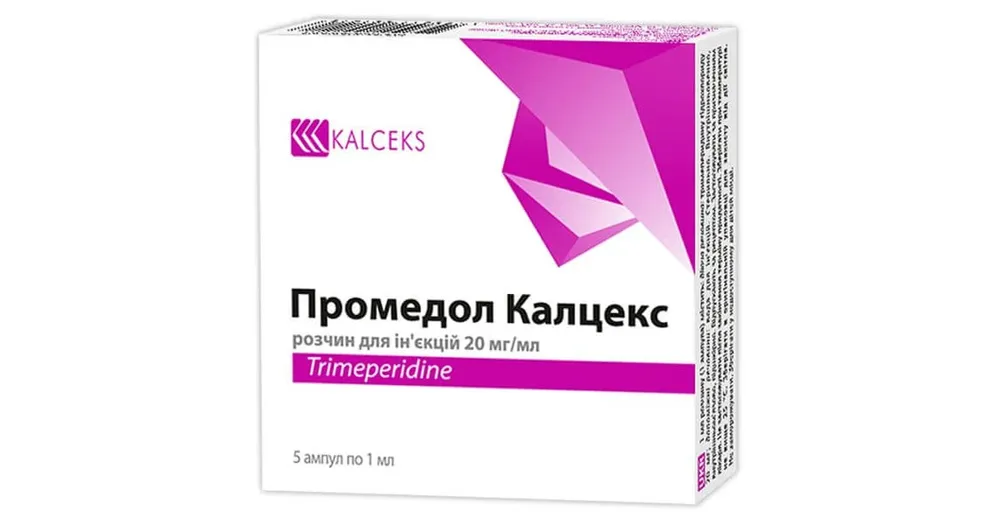
Table of Contents
INSTRUCTIONS FOR MEDICAL USE OF THE MEDICINAL PRODUCT PROMEDOLKALCEKS (PROMEDOLKALCEKS)
Composition:
Active substance: trimeperidine;
1 ml of solution (1 ampoule) contains 20 mg of trimethperidine hydrochloride;
Excipient: water for injections.
Pharmaceutical form. Injection solution.
Main physicochemical properties: clear, colorless or slightly yellow liquid.
Pharmacotherapeutic group.
Analgesics. Opioids. ATC code N02AX.
Pharmacological Properties.
Pharmacodynamics.
Trimethperidine primarily affects the central nervous system (CNS) and also influences the smooth musculature of internal organs. By slowing down CNS activity, trimethperidine suppresses pain perception as well as the respiratory, cough, and vomiting centers. Among the centers stimulated by trimethperidine are the vagus nerve center (resulting in decreased heart rate), the oculomotor nerve center (causing pupil constriction), and also the vomiting center during the initial phase of drug action (nausea may also occur). Trimethperidine enhances the effects of anesthetic agents and also facilitates the onset of sleep in cases where it is hindered by pain. In terms of CNS effects, trimethperidine is weaker than morphine. Regarding its effect on the smooth musculature of internal organs, trimethperidine differs significantly from morphine, as it relaxes muscles, thus exerting a spasmolytic action. Trimethperidine promotes regular uterine contractions in cases of dis-coordinated labor activity, thereby accelerating the delivery process and reducing labor pain. Due to its euphoric effect and ability to cause withdrawal symptoms, trimethperidine may lead to psychological and physical dependence, consequently resulting in drug addiction.
Pharmacokinetics.
After subcutaneous and intramuscular administration, trimethperidine is rapidly absorbed into the bloodstream. Its effects begin within 10–20 minutes and, after a single dose, last more than 3–4 hours. Plasma protein binding is approximately 40%. Trimethperidine is metabolized in the liver and is primarily excreted in urine. Following intravenous administration, the elimination half-life is 1–2 hours. The drug crosses the placental barrier and also penetrates into breast milk.
Clinical characteristics.
Indications.
- For reduction of severe pain in injuries, bone fractures, burns, myocardial infarction, acute pancreatitis, renal, hepatic and intestinal colic, in malignant tumors, as well as after surgical operations.
- For reduction of labor pain and facilitation of labor in case of cervical dysfunction, when epidural anesthesia cannot be administered and if delivery is not expected within the next 2 hours.
- Premedication before surgery.
Contraindications.
- Hypersensitivity to the active substance.
- Respiratory depression.
- Obstructive respiratory tract diseases, including bronchial asthma attacks.
- Paralytic ileus or risk of its development.
- Abdominal pain of unclear origin.
- Increased intracranial pressure or head trauma.
- Alcohol intoxication.
- Seizures.
- Comatose state.
- Pheochromocytoma.
- Trimethperidine hydrochloride must not be administered concomitantly with monoamine oxidase inhibitors (MAOIs), as well as within 2 weeks after discontinuation of MAOI therapy.
- Age under 2 years.
- Age over 65 years.
- Pregnancy.
- Breastfeeding.
- General exhaustion.
Interaction with other medicinal products and other types of interactions.
Trimethperidine hydrochloride must not be used concomitantly with MAO inhibitors (including moclobemide) and within 2 weeks after discontinuation of MAO inhibitors (see section "Contraindications").
When used concomitantly with antidepressants, excitation or depression of the central nervous system (CNS) may occur.
The CNS depressant effect is also enhanced by concomitant use of anesthetics and tricyclic antidepressants.
When used concomitantly with antipsychotic agents, the sedative and hypotensive effects of trimethperidine hydrochloride are enhanced.
Trimethperidine hydrochloride enhances the effects of sedatives and hypnotics.
With systematic use of barbiturates (especially phenobarbital), a reduction in the analgesic effect of narcotic analgesics may occur.
Opioids delay the absorption of the antiarrhythmic agent mexiletine.
If a patient is taking the antibiotic ciprofloxacin, premedication with an opioid may reduce its plasma concentration.
When trimethperidine hydrochloride is used concomitantly with cisapride, metoclopramide, or domperidone, antagonism regarding gastrointestinal tract effects is observed.
The anti-ulcer agent cimetidine inhibits the metabolism of opioids.
Alcohol enhances the sedative and hypotensive effects of opioids.
The interaction between opioid analgesics and HIV protease inhibitors or reverse transcriptase inhibitors is complex; limited studies and in vivo results do not always confirm predictions regarding the nature of possible interactions.
Special precautions for use.
Caution should be exercised, and lower doses of trimethylperidine hydrochloride should be used when administering the drug to elderly or debilitated patients, patients with impaired renal and/or hepatic function, bronchial asthma or reduced respiratory reserve, as well as in cases of hypotension, hypothyroidism, adrenal insufficiency, prostatic hyperplasia, impotence, shock, inflammatory gastrointestinal disorders, intestinal obstruction, myasthenia gravis, and also in patients aged 60 years and older.
In cases of high-dose administration or signs of intoxication, activated charcoal may be administered orally.
Respiratory depression requires respiratory support and administration of a stimulatory antagonist – naloxone. However, the use of the opioid antagonist naloxone in opioid-dependent individuals may precipitate withdrawal symptoms. Supportive therapy is aimed at respiratory support and reversing shock through the administration of naloxone. The dosage administered depends on the degree of respiratory depression and level of coma.
The use of high doses of the drug, especially in elderly patients, may lead to respiratory depression and hypotension, resulting in circulatory failure and coma. The development of adverse reactions depends on individual sensitivity to opioid receptors. In children aged 2 years and older, seizures may occur; when used in high doses, progression of renal failure is possible. Seizures are more commonly observed in children.
The development of toxic effects depends on individual sensitivity to opioid receptors.
Comatose state is characterized by pinpoint pupils and respiratory depression, which may indicate overdose. Pupillary dilation indicates the development of hypoxia. Pulmonary edema following overdose is the main cause of fatal outcomes.
In patients with impaired liver function, it is preferable to use immediate-release formulations or administer short-acting opioids parenterally, rather than prescribing long-acting opioids such as transdermal preparations or extended-release dosage forms.
When administering the drug to patients with hepatobiliary system disorders (including biliary pancreatitis), caution should be exercised; in such cases, trimethylperidine hydrochloride should be used concomitantly with spasmolytic agents.
If the mother receives trimethylperidine hydrochloride during labor, respiration and heart rate of the newborn should be closely monitored.
Due to its euphoric effect, trimethylperidine hydrochloride may cause psychological and physical dependence, potentially leading to drug abuse. However, short-term use of the drug in the postoperative period is unlikely to cause dependence.
Abrupt discontinuation of trimethylperidine hydrochloride may result in withdrawal syndrome (see section "Adverse reactions").
Alcohol must not be consumed during therapy with trimethylperidine hydrochloride (see section "Interaction with other medicinal products and other forms of interaction").
Antidoping warning. Intravenous infusions are prohibited in sports, except for infusions legally administered in hospitals or clinical trials.
Use during pregnancy or breastfeeding.
Administration of trimethylperidine hydrochloride immediately before delivery may cause respiratory depression in the newborn. In addition, neonates born to mothers who received trimethylperidine hydrochloride for a prolonged period during pregnancy may develop withdrawal syndrome.
Trimethylperidine hydrochloride may be used to alleviate labor pain and facilitate labor process according to indications; however, respiration and heart rate of the newborn should be carefully monitored (see sections "Indications" and "Special precautions for use").
The medicinal product is contraindicated during pregnancy and breastfeeding.
Ability to influence reaction rate while driving or operating machinery.
During treatment with trimethylperidine hydrochloride, patients must not drive vehicles or operate machinery.
Method of Administration and Dosage.
Administer intramuscularly, subcutaneously (in emergencies – intravenously).
The necessity of opioid use should be carefully assessed both before initiating therapy and during treatment. The possibility of dose reduction, discontinuation of therapy, or switching from opioids should be periodically evaluated. To minimize opioid-related adverse effects, concomitant use of other medicinal products should be avoided whenever possible.
For adults, the average therapeutic dose is 10–40 mg of tramadol hydrochloride (corresponds to 0.5–2 mL of Promedol Kalceks injection solution, 20 mg/mL). The dose may be repeated every 4 hours. The maximum single dose for adults is 40 mg; the daily dose is 160 mg.
For premedication, 20–30 mg of tramadol hydrochloride (corresponds to 1–1.5 mL of Promedol Kalceks injection solution, 20 mg/mL) is administered subcutaneously or intramuscularly together with 0.5 mg of atropine, 30–45 minutes before surgery. In emergency situations, the drug may be administered intravenously.
In the postoperative period, as an analgesic and anti-shock agent, 20 mg of tramadol hydrochloride (corresponds to 1 mL of Promedol Kalceks injection solution, 20 mg/mL) is administered subcutaneously.
For labor analgesia, 20–40 mg of tramadol hydrochloride (corresponds to 1–2 mL of Promedol Kalceks injection solution, 20 mg/mL) is administered subcutaneously. If necessary, the injection may be repeated after 2–3 hours.
For elderly and debilitated patients, the dose should be reduced. Therapy should be initiated with lower doses, and longer intervals between doses should be maintained.
For patients with hepatic impairment, lower doses should be used (see section "Special Warnings and Precautions for Use").
For children aged 2 years and older, the single dose (depending on age) is 3–10 mg of tramadol hydrochloride.
Children.
The drug is not administered to children under 2 years of age.
Overdose.
Symptoms. Symptoms are similar to those observed in morphine overdose: severe respiratory depression, hypotension, miosis (in case of pronounced hypoxia – mydriasis), increased intracranial pressure, and coma. CNS excitation and seizures may occur. Cases of rhabdomyolysis and associated renal failure have been reported.
Treatment. Ensure adequate ventilation and administer a specific opioid antagonist – naloxone.
Adverse Reactions
Trimipramine hydrochloride is generally well tolerated. The most commonly observed adverse effects are nausea, vomiting, constipation, drowsiness, and disorientation.
The adverse reactions listed below are categorized by system organ class and frequency of occurrence (MedDRA): very common (≥ 1/10), common (≥ 1/100 to < 1/10), uncommon (≥ 1/1,000 to < 1/100), rare (≥ 1/10,000 to < 1/1,000), very rare (< 1/10,000), frequency not known (cannot be estimated from available data).
Immune system disorders:
Rare: itching, urticaria, rash; anaphylactic reactions (after intravenous administration);
Frequency not known: contact dermatitis.
Psychiatric disorders:
Uncommon: disorientation;
Rare: anxiety, mood changes, hallucinations, dysphoria.
Nervous system disorders:
Uncommon: dizziness, drowsiness, vertigo;
Frequency not known: headache.
Eye disorders:
Rare: miosis, diplopia.
Cardiac disorders:
Uncommon: arterial hypotension (with high doses);
Rare: bradycardia, palpitations, tachycardia, cardiac arrhythmia;
Frequency not known: orthostatic hypotension, increased intracranial pressure.
Respiratory system disorders:
Rare: respiratory depression (with high doses).
Gastrointestinal disorders:
Common: constipation, nausea, vomiting;
Uncommon: dry mouth.
Hepatobiliary disorders:
Frequency not known: biliary tract spasms.
Musculoskeletal and connective tissue disorders:
Frequency not known: muscle rigidity (with high doses), seizures (especially in children).
Renal and urinary disorders:
Frequency not known: difficulty in urination, urinary tract spasms.
Reproductive system and breast disorders:
Frequency not known: decreased libido or potency.
General disorders and administration site conditions:
Rare: general weakness;
Frequency not known: increased sweating, facial flushing, hypothermia, pain and inflammation at injection site, antipyretic effect.
Investigations:
Frequency not known: changes in liver enzyme levels, hyperglycemia.
Dependence:
Repeated use of trimipramine hydrochloride may lead to dependence.
High-dose opioid use may result in respiratory depression and coma. Seizures may occur in children; with high doses, renal and respiratory failure may progress. Pupil dilation may occur with high doses, indicating the development of hypoxia. Allergic reactions, including rash, itching, and urticaria, are possible.
In cases of physical dependence, abrupt discontinuation of trimipramine hydrochloride may lead to withdrawal syndrome (see section "Special Warnings and Precautions for Use"), characterized by symptoms such as nausea, vomiting, diarrhea, increased sweating, mydriasis, lacrimation, chills, yawning, abdominal, muscular, or joint pain, muscle tremors, anxiety, restlessness, irritability, insomnia, as well as tachycardia, tachypnea, and elevated blood pressure. To prevent withdrawal syndrome, the drug should be discontinued gradually in patients at risk of dependence.
The euphoric effect of trimipramine hydrochloride may lead to drug abuse.
If nausea, vomiting, constipation, drowsiness, dizziness, disorientation, or general weakness occur upon repeated administration of the drug, the dose should be reduced.
Shelf life
3 years.
Storage conditions
Store at a temperature not exceeding 25 °C.
Store in the original packaging to protect from light. Do not freeze.
Keep out of reach of children.
Packaging
1 ml in a colorless glass ampoule of hydrolytic class I with a score line or dot and marking rings.
5 ampoules per blister pack (cavity) made of polyvinyl chloride film.
1, 2, or 20 blister packs (cavities) per cardboard carton with tamper-evident seal in the form of a self-adhesive sticker on each opening part of the carton.
Prescription status
Prescription only.
Manufacturer
Manufacturer responsible for batch release:
JSC "Kalceks"
Manufacturer's address
71E Krustpils Street, Riga, LV-1057, Latvia
Marketing Authorization Holder
JSC "Kalceks"
Address of Marketing Authorization Holder
53 Krustpils Street, Riga, LV-1057, Latvia