Prolutex
Ukraine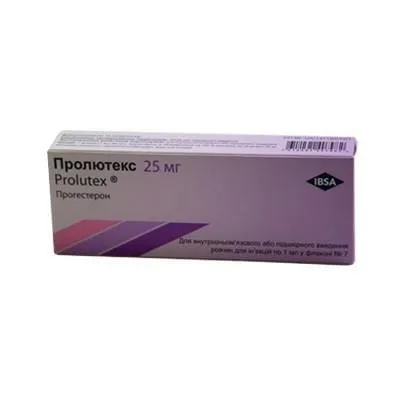
Table of Contents
INSTRUCTIONS FOR MEDICAL USE OF THE MEDICINAL PRODUCT Prolutex (Prolutex®)
Composition:
Active substance: progesterone;
1 vial (1 ml) contains progesterone (calculated as 100 % substance 22.48 mg/ml) 25 mg;
Excipients: hydroxypropylbetadex, disodium phosphate, sodium dihydrogen phosphate dihydrate, water for injections.
Pharmaceutical form. Solution for injection
Main physicochemical properties: clear, colorless solution, free from visible foreign particles.
Pharmacotherapeutic group.
Sex hormones and drugs used in disorders of the reproductive system. Progestogens. ATC code G03DA04.
Pharmacological Properties
Pharmacodynamics. Progesterone is a hormone of the corpus luteum; it induces the transition of the endometrium from the proliferative phase, caused by follicular hormone, into the secretory phase, and after fertilization, promotes its transformation into a state necessary for the development of the fertilized ovum. It also reduces excitability and contractility of the uterine musculature and fallopian tubes, and stimulates development of the terminal elements of the mammary gland.
Pharmacokinetics. Progesterone concentration in blood serum increases after subcutaneous administration of 25 mg of the drug in healthy postmenopausal women. One hour after a single subcutaneous dose, the maximum concentration reaches 50.7 ± 16.3 ng/mL.
After intramuscular or subcutaneous injection, it is rapidly and well absorbed from the site of administration.
Progesterone metabolism occurs in the liver; a small portion accumulates in subcutaneous adipose tissue. The main metabolite is biologically active pregnandiol. Pregnanediol, after conjugation with glucuronic acid, passes from the liver into the blood and then into urine. A smaller portion of progesterone is converted into pregnanediolone and pregnanolone. All metabolites of progesterone excreted in urine are inactive.
The elimination half-life is several minutes. 50–60% is excreted in urine, over 10% via bile.
The amount of metabolites excreted in urine varies depending on the phase of the corpus luteum.
Clinical characteristics.
Indications.
For luteal phase support in infertile women undergoing assisted reproductive technologies who are unable to use or tolerate vaginal progesterone preparations.
Contraindications.
Hypersensitivity to progesterone or to any of the excipients. Liver disease, hepatic or renal insufficiency; hepatitis; predisposition to thrombosis; active venous or arterial thromboembolism; severe thrombophlebitis or these conditions in medical history; neurological disorders with depressive symptoms; porphyria; malignant tumors of the breast and genital organs; ectopic pregnancy or missed abortion; vaginal bleeding of unknown origin; condition following abortion.
Interaction with other medicinal products and other forms of interaction.
Hepatic enzymes of the cytochrome P450-3A4 system (e.g., rifampicin, carbamazepine, griseofulvin, phenobarbital, phenytoin, or St. John’s wort preparations) may increase the rate of elimination and thus reduce the bioavailability of progesterone. Conversely, ketoconazole and other inhibitors of cytochrome P450-3A4 may decrease elimination and thereby increase the bioavailability of progesterone.
Since progesterone may affect blood glucose levels, dosage adjustment of hypoglycemic agents may be required.
Progesterone may inhibit the metabolism of cyclosporine, leading to increased plasma concentrations and risk of cyclosporine toxicity.
There are no data on the effects of concomitant administration of other injectable drugs with progesterone.
The influence of concomitantly administered injectable drugs on the action of progesterone contained in Progyluton has not been studied.
Concomitant use of progesterone with other medicinal products is not recommended.
Special precautions for use
In case of suspected myocardial infarction, cerebrovascular accident, arterial or venous thromboembolism, thrombophlebitis, or retinal thrombosis, treatment with the drug must be discontinued.
The drug should be used with caution in patients with mild to moderate hepatic impairment. Patients with a history of depressive symptoms should be closely monitored. If symptoms worsen, the drug should be discontinued.
Since progesterone may cause fluid retention (e.g., in epilepsy, asthma, migraine, or cardiac or renal insufficiency), conditions whose symptoms may be influenced by this factor should be monitored.
Reduced insulin sensitivity and, consequently, impaired glucose tolerance have been observed in a small number of patients receiving combined estrogen and progesterone therapy.
The mechanism of this effect is unknown. Therefore, diabetic patients receiving progesterone therapy should be under continuous medical supervision.
The use of sex steroids may also increase the risk of retinal vascular lesions. To prevent such complications, Prolutex should be used with caution in patients aged 35 years and older, smokers, and patients with risk factors for atherosclerosis.
Treatment should be discontinued in cases of transient ischemic disorders, sudden severe headache, or deterioration in visual perception associated with papilledema or retinal hemorrhage.
Sudden discontinuation of progesterone may lead to increased anxiety, abrupt mood changes, and heightened susceptibility to epileptic seizures.
Prior to initiating Prolutex therapy, the patient should be evaluated for infertility or pregnancy complications.
The solution must not be used if it is cloudy or contains any particles.
Any unused solution should be disposed of according to local requirements.
This medicinal product contains less than 1 mmol (23 mg)/dose of sodium, i.e., essentially "sodium-free".
Use during pregnancy or breastfeeding.
Fertility
Prolutex is used to treat certain forms of infertility.
Pregnancy
There are limited and unconfirmed data on the risk of congenital anomalies, including genital anomalies in both male and female offspring, associated with exogenous progesterone exposure during pregnancy.
Breastfeeding
Progesterone passes into breast milk; therefore, breastfeeding should be discontinued during treatment.
Ability to affect reaction speed when driving or operating machinery
Progesterone may cause drowsiness and/or dizziness; therefore, patients who drive or operate machinery should use the drug with caution.
Dosage and Administration
For subcutaneous and intramuscular administration.
The solution is intended for single use only.
The medication should be used immediately after the first opening of the vial; any remaining solution must be discarded.
Injections must be administered only by a healthcare professional.
One 25 mg injection once daily, starting on the day of follicular puncture and usually up to the 12th week of confirmed pregnancy.
Indications for the use of Prolyutex apply only to women of reproductive age.
Special patient groups
Elderly patients
There are no clinical data on the use of Prolyutex in patients aged 65 years and older.
Renal or hepatic impairment
There are no clinical data on the use of Prolyutex in patients with impaired liver or kidney function.
Method of administration
Prolyutex therapy should be initiated under the supervision of a physician experienced in the treatment of fertility disorders.
Prolyutex is intended for intramuscular or subcutaneous administration.
Intramuscular administration
Select an appropriate site (the upper outer quadrant of the left or right buttock). Disinfect the selected area and administer a deep injection (the needle should be inserted at a 90° angle).
The medication should be injected slowly to prevent local tissue damage.
Subcutaneous administration
Select an appropriate site (anterior thigh or lower abdominal wall), disinfect the area, firmly pinch the skin, and insert the needle at an angle between 45° and 90°.
The medication should be injected slowly to prevent local tissue damage.
Children
The safety and efficacy of progesterone in children have not been established; therefore, the drug is not recommended for this patient population.
Overdose
Symptoms: high doses of progesterone may cause drowsiness.
Treatment: discontinue progesterone therapy and administer symptomatic and supportive treatment.
Adverse reactions
The most commonly reported adverse reactions during treatment with Prolyutex in clinical studies were injection site reactions, breast-related events, and vulvovaginal disorders.
Table 1
Adverse reactions observed in women treated with Prolyutex during clinical studies
| System organ classes |
Very common (≥ 1/10) |
Common (≥ 1/100, < 1/10) |
Uncommon (≥ 1/1000, < 1/100) |
| Psychiatric disorders |
Mood alteration |
||
| Nervous system disorders |
Headache |
Dizziness, somnolence |
|
| Gastrointestinal disorders |
Abdominal distension, abdominal pain, nausea, vomiting, constipation |
Gastrointestinal disorders |
|
| Skin disorders |
Pruritus, rash |
||
| Reproductive system disorders |
Uterine muscle spasm, vaginal bleeding |
Galactorrhea, breast pain, vaginal discharge, vulvovaginal pruritus, vulvovaginal discomfort, vulvovaginal inflammation |
Breast disorders |
| General disorders and administration site conditions |
Injection site reactions* |
Injection site haematomas, injection site induration, increased fatigue |
Hot flushes, malaise, pain |
*Reactions at the injection site, such as irritation, pain, pruritus, and swelling.
Table 2
Adverse reactions observed in patients during treatment with other drugs of this class
| Organ systems |
Adverse reactions |
| Psychiatric |
Depression |
| Nervous system |
Insomnia |
| Hepatobiliary system |
Jaundice |
| Reproductive system |
Menstrual cycle disturbances, premenstrual syndrome |
| Skin |
Urticaria, acneiform eruptions (acne), hirsutism, alopecia |
| General disorders and administration site reactions |
Weight gain, anaphylactoid reactions |
Shelf life.
2 years.
Storage conditions.
Store in the original packaging at a temperature not exceeding 25 °C.
Keep out of reach and sight of children.
Do not store in the refrigerator and do not freeze.
Incompatibility.
The medicine should not be mixed with other medicinal products.
Packaging.
1 ml in a vial, 7 vials of glass with labels in a cardboard box.
Prescription status.
Prescription only.
Manufacturer.
IBSA Institut Biochimique SA, Switzerland.
Manufacturer's address and location of operations.
Via Piano Sciresca 49, 6912 Pazzallo, Switzerland.