Progesterone
Ukraine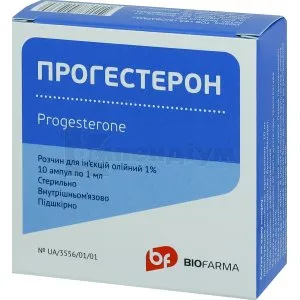
Table of Contents
I N S T R U C T I O N for medical use of the medicinal product PROGESTERONE (PROGESTERONE)
Composition:
Active substance: 1 ml of the preparation contains 10 mg or 25 mg of progesterone;
Excipients: benzyl benzoate, refined olive oil.
Pharmaceutical form. Oil injection solution.
Main physicochemical properties: transparent oily liquid ranging from pale yellow to greenish-yellow.
Pharmacotherapeutic group. Sex gland hormones and drugs used in disorders of the genital system. Progestogens.
ATC code: G03DA04.
Pharmacological Properties.
Pharmacodynamics.
Progesterone is a hormone of the corpus luteum; it induces the transition of the endometrium from the proliferative phase, caused by follicular hormone, into the secretory phase, and after fertilization promotes its transformation into a state necessary for the development of the fertilized ovum. It also reduces excitability and contractility of the uterine and fallopian tube musculature, and stimulates the development of terminal elements of the mammary gland. In small doses it stimulates, while in large doses it suppresses the secretion of gonadotropic hormones. It inhibits the action of aldosterone, leading to enhanced urinary excretion of sodium and chloride. It exerts catabolic and immunosuppressive effects.
Pharmacokinetics.
After intramuscular and subcutaneous administration, it is rapidly and almost completely absorbed. It is metabolized in the liver, forming conjugates with glucuronic and sulfuric acid. The main metabolite of progesterone is the biologically active pregnandiol. Pregnanediol, after conjugation with glucuronic acid, passes from the liver into the blood and then into the urine. A smaller portion of progesterone is converted into pregnanolone and pregnandione. All metabolites of progesterone excreted in the urine are inactive.
The half-life is several minutes.
50–60% is excreted in the urine, over 10% via bile.
The amount of metabolites excreted in the urine varies depending on the phase of the corpus luteum.
Clinical characteristics.
Indications. Amenorrhea, anovulatory uterine bleeding, endocrine infertility, including that caused by luteal phase deficiency, habitual abortion, oligomenorrhea, algodysmenorrhea (on the background of hypogonadism).
Contraindications. Liver disease, impaired liver function, hepatitis, hepatic or renal insufficiency, cholestatic jaundice during pregnancy (in medical history), benign hyperbilirubinemia; known or suspected malignant neoplasms of the breast or genital organs; tachycardia, predisposition to thrombosis, active venous or arterial thromboembolism, severe thrombophlebitis, stroke, or these conditions in medical history; neurological disorders with depressive symptoms; porphyria; pregnancy after 36 weeks, ectopic pregnancy, or missed abortion, including in medical history; vaginal bleeding of unknown origin, condition after abortion; hypersensitivity to components of the drug.
Interaction with other medicinal products and other types of interactions. Progesterone reduces the effect of agents stimulating myometrial contractions (oxytocin, pituitrin), anabolic steroids (retabolil, nerobol), and pituitary gonadotropic hormones. When interacting with oxytocin, the lactogenic effect is reduced. Enhances the action of diuretics, antihypertensive drugs, immunosuppressants, bromocriptine, and systemic coagulants. Reduces the effectiveness of anticoagulants. The effect of progesterone is diminished when used concomitantly with barbiturates. Alters the effects of hypoglycemic agents. When used together with hepatic enzyme inducers, an increase or decrease in plasma progesterone concentration is possible.
Special precautions for use.
Progestins may cause fluid retention. Therefore, the drug should be used under strict medical supervision in patients with epilepsy, migraine, bronchial asthma, cardiovascular diseases, arterial hypertension, or chronic renal failure.
The use of progestins may adversely affect carbohydrate and lipid metabolism. The dose of progesterone used may be important in minimizing this effect. The drug should be used cautiously in patients with diabetes mellitus or hyperlipoproteinemia.
Progesterone should also be used with caution in patients with a history of psychiatric disorders; the drug must be discontinued at the first signs of depression.
Impaired glucose tolerance, the mechanism of which is not fully understood, has been observed in a small number of patients receiving combined estrogen and progestin therapy. Therefore, blood glucose levels should be closely monitored in patients with diabetes mellitus.
A statistically significant association has been established between the use of drugs containing a combination of estrogen and progestin and pulmonary artery embolism, cerebral thrombosis, and embolism. Available data also suggest a possible association between their use and neuro-ophthalmological disorders (e.g., retinal thrombosis, optic neuritis). Therefore, when using Progesterone, attention must be paid to early signs and symptoms of thromboembolism (thrombophlebitis, cerebrovascular disorders, pulmonary artery thromboembolism, retinal thrombosis), and if such symptoms occur, the treatment must be discontinued.
Medication should be suspended until a thorough examination is performed if sudden partial or complete vision loss, sudden onset of proptosis, diplopia, or migraine occurs. The use of the drug should be discontinued if papilledema or retinal vascular lesions are detected during examination.
Since the metabolism of steroid hormones occurs in the liver, Progesterone should not be used in patients with impaired liver function.
With prolonged use of high doses of Progesterone, menstruation may cease.
The drug should not be used in patients with undiagnosed vaginal bleeding or in patients with a history of peripheral arterial disease. In cases of breakthrough bleeding, as in all cases of irregular vaginal bleeding, non-functional causes should be considered and appropriate diagnostic measures taken. Regular examinations are recommended during treatment, with frequency and scope individually determined. A preliminary examination should include breast and pelvic organ examination and a Papanicolaou test.
Patients with any progesterone-dependent tumor, such as meningioma in the past and/or its progression during pregnancy or previous hormonal therapy, should be under strict medical supervision.
When histological examination of tissue samples is performed, the histologist should be informed that the patient has been receiving progestin therapy.
Patient age is not an absolute limiting factor in the use of progesterone, although progestogen therapy may mask the onset of menopause.
Use during pregnancy or breastfeeding.
Pregnancy
The drug should be used during pregnancy only for the prevention and treatment of threatened miscarriage. The use of the drug is contraindicated after the 36th week of pregnancy. The drug should not be used in women who are planning pregnancy in the near future. The risk of congenital anomalies, including genital anomalies in children of both sexes, associated with the action of exogenous progesterone during pregnancy, has not been fully studied.
Breastfeeding
Progesterone passes into breast milk; therefore, the drug should not be used during breastfeeding.
Fertility
High doses of progesterone have an anti-fertility effect; therefore, the use of high doses of the drug is expected to impair fertility until treatment is discontinued.
Ability to influence reaction rate when driving or operating machinery. The drug may cause dizziness and drowsiness. During treatment, patients should refrain from driving vehicles and engaging in potentially hazardous activities requiring increased attention and psychomotor reaction speed.
Method of Administration and Dosage
Before use, gently warm the ampoule containing the drug in a water bath (up to 30–40 °C). If crystals have formed, heat the ampoule in boiling water until the crystals are completely dissolved. Administer the drug intramuscularly or subcutaneously.
In anovulatory uterine bleeding, administer the drug at a dose of 5–15 mg daily for 6–8 days. If curettage of the uterine cavity mucosa has been performed in advance, begin injections 18–20 days after the procedure. If curettage cannot be performed, administer the drug during bleeding. In such cases, bleeding may temporarily intensify (for 3–5 days), therefore patients with moderate or severe anemia should receive a blood transfusion (200–250 ml) prior to treatment. If bleeding does not stop after 6–8 days of treatment, further administration of progesterone is not advisable. If bleeding stops, treatment should not be discontinued earlier than after 6 days.
In hypogonadism and amenorrhea, administer the drug (immediately after estrogenic agents) at 5 mg daily or 10 mg every other day for 6–8 days.
For prevention and treatment of threatened miscarriage due to luteal phase deficiency, administer 10–25 mg daily or every other day until the risk of miscarriage is completely eliminated. In cases of habitual miscarriage, the drug may be administered up to the 4th month of pregnancy.
In algodysmenorrhea, to reduce or eliminate pain, begin administration 6–8 days before menstruation, at a dose of 5–10 mg daily for 6–8 days. The treatment course may be repeated several times. The maximum single and daily dose by intramuscular injection is 25 mg (2.5 ml of 1 % solution or 1 ml of 2.5 % solution). Progesterone treatment for algodysmenorrhea associated with uterine hypoplasia may be combined with prior administration of estrogenic agents.
Children. This medicinal product is not intended for use in pediatric practice.
Overdose. When higher doses of the drug are used, adverse effects described in the relevant section occur more frequently. If adverse effects occur, treatment with the drug should be discontinued and resumed at a lower dose after their disappearance. Symptomatic treatment may be necessary if required.
Adverse reactions.
Progesterone is usually well tolerated. In isolated cases, the following adverse reactions may occur:
Cardiovascular system: tachycardia, circulatory disorders, increased arterial pressure, arterial or venous thromboembolism;
Nervous system: headache, dizziness, drowsiness, insomnia, depression, nervousness, back pain;
Reproductive system and mammary glands: breast swelling, increased sensitivity and breast pain, disorders of the external genital organs such as burning, dryness, genital pruritus, changes in cervical erosion and vaginal discharge, cystitis-like syndrome, bleeding, breakthrough bleeding, vaginal mycosis, premenstrual syndrome, menstrual cycle disorders, acyclic bloody discharge, amenorrhea, oligomenorrhea, galactorrhea, hirsutism, changes in libido, uterine spasms;
Gastrointestinal tract: abdominal distension, abdominal pain, nausea, vomiting, constipation, diarrhea, flatulence;
Endocrine disorders: impaired glucose tolerance;
Respiratory system: dyspnea;
Hepatobiliary system: liver function disorders and changes in liver function tests, cholestatic jaundice;
Metabolic and nutritional disorders: changes in appetite, weight gain or weight loss, edema, albuminuria;
Skin and soft tissues: allergic skin reactions, erythema multiforme, nodular erythema, hemorrhagic rash, pruritus, urticaria, skin rash (including generalized), acne, chloasma, alopecia, hirsutism;
General disorders and injection site reactions: increased fatigue, weakness, fever, hypersensitivity reactions including anaphylactic reactions (e.g., eosinophilic pneumonia); fluid retention, edema, paresthesia; injection site reactions including pain, irritation and/or redness, swelling; fluid retention, paresthesia; injection site changes including pain and swelling;
Effect on the fetus: excessive amounts of progesterone may cause virilization of the female fetus (up to ambiguity of sex assignment).
Laboratory parameters: changes in plasma lipid profile.
Progestins may affect the results of the following laboratory tests: liver function (increased sulfobromophthalein retention and other tests); hemostasis system parameters (increased levels of prothrombin and factors VII, VIII, IX, and X); tests for thyroid function (increased levels of plasma protein-bound iodine and butanol-extractable iodine, decreased plasma thyroxine-binding capacity).
Shelf life. 5 years.
Storage conditions. Store in the original packaging to protect from light at a temperature not exceeding 25 °C. Keep out of reach of children.
Incompatibility. The medication must not be mixed with other medicinal products.
Packaging. 1 ml of the drug in an ampoule. 5 ampoules per blister pack, 2 blister packs per cardboard box.
Prescription status. Prescription only.
Manufacturer. LTD "FZ "STADA", Ukraine.
Manufacturer's address and place of business.
37 Kyivska St., Bila Tserkva, Kyiv region, 09100, Ukraine.