Prednitop
Ukraine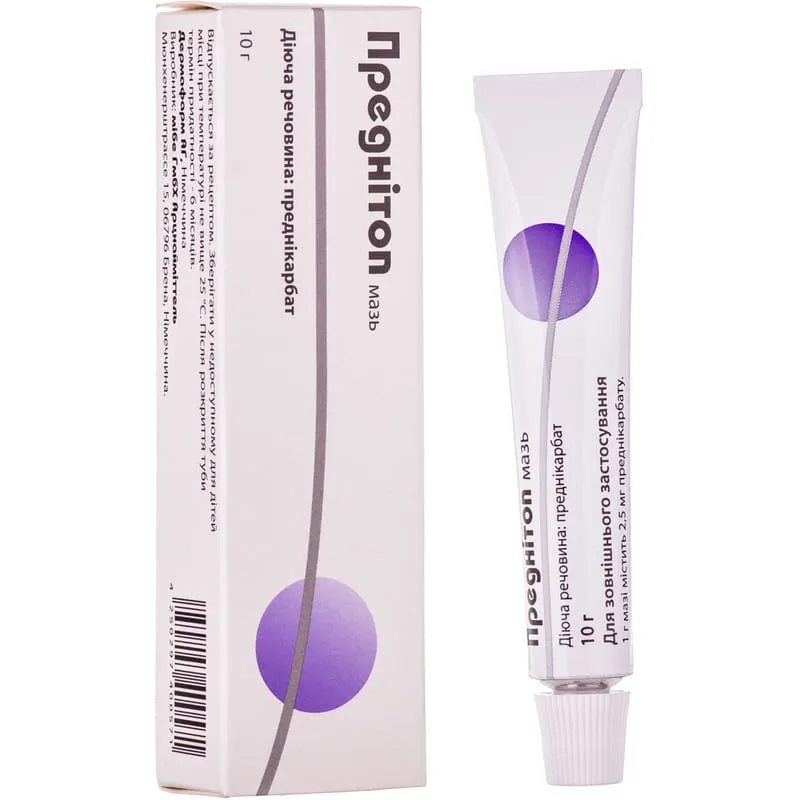
Table of Contents
INSTRUCTION FOR MEDICAL USE OF THE MEDICINAL PRODUCT PREDNI TOP®
Composition:
Active substance: prednicarbate;
1 g of ointment contains 2.5 mg of prednicarbate;
Excipients: glycerol monooleate, white soft paraffin, disodium edetate, octyldodecanol, magnesium sulfate heptahydrate, purified water.
Pharmaceutical form. Ointment.
Main physicochemical characteristics: white, opaque, slightly shiny ointment.
Pharmacotherapeutic group. Corticosteroids for dermatological use. Simple corticosteroids. Potent corticosteroids (group III). Prednicarbate.
ATC code D07AC18.
Pharmacological properties.
Pharmacodynamics.
Prednicarbate, an ingredient of the drug Prednitop®, is specially designed for topical use and is a potent glucocorticoid with clearly pronounced anti-inflammatory, anti-allergic, anti-exudative, anti-proliferative, and anti-pruritic effects.
The anti-proliferative effect of glucocorticoids is explained by reduced turnover of involved cells and decreased intensity of DNA synthesis. It is known that this results in suppression of granulation, wound closure, and fibroblast proliferation.
The anti-allergic effect of glucocorticoids is due to their immunosuppressive action and influence on antibody- and cell-mediated hypersensitivity:
The immunosuppressive effect of glucocorticoids is primarily based on reduction in number and activity of lymphocytes (T-lymphocytes, B-lymphocytes).
Their effect on antibody-mediated hypersensitivity also involves suppression of release of vasoactive substances (e.g., histamine), and on cell-mediated hypersensitivity – reduction in lymphokine release.
The anti-inflammatory effect is partly based on influence on arachidonic acid metabolism, resulting in reduced formation of inflammatory mediators (e.g., prostaglandins, leukotrienes). On the other hand, excessive cellular signals are reduced to normal levels.
Results of conducted double-blind studies have shown that, from the standpoint of clinical efficacy, prednicarbate—despite being non-halogenated—is equivalent to halogenated corticosteroids such as betamethasone valerate, desoximetasone, or fluorocortolone.
The extremely low impact of prednicarbate on collagen synthesis and fibroblast growth in human skin reflects the minimal atrophogenic potential of the active substance. Suppression of endogenous cortisol synthesis after application over large areas of affected skin (e.g., psoriasis, neurodermatitis) has not been observed with prednicarbate.
Pharmacokinetics.
After topical application, prednicarbate is further metabolized in the skin to prednisolone-17-ethylcarbonate, which demonstrates 8.3 times greater affinity for glucocorticoid receptors than prednicarbate itself. Prednisolone-17-ethylcarbonate slowly degrades to prednisolone. After application to the skin, neither prednicarbate nor its known metabolites have been detected systemically. Minimal systemic availability after skin application was also confirmed by unchanged levels of endogenous cortisol secretion.
Clinical characteristics.
Indications.
Inflammatory skin disorders requiring treatment with locally applied corticosteroids.
Prednitop®, ointment, is indicated for the treatment of acute and chronic skin disorders, regardless of whether the skin is weeping, normal, or dry.
Contraindications.
- Hypersensitivity to prednicarbate or to any other component of the medicinal product.
- Application in the area around the eyes.
- Presence of skin reactions to vaccination.
- Infectious skin diseases (including tuberculosis, syphilis), viral infections (including varicella, herpes simplex).
- Perioral dermatitis, rosacea.
Interaction with other medicinal products and other forms of interaction.
Not known.
Concomitant use of Prednitop® ointment in the genital or anal area, due to the presence of white soft paraffin as an excipient, with latex condoms may reduce their strength and reliability.
Special precautions for use
Treatment with Prednitop® is possible in bacterial and fungal skin infections only when used concomitantly with antibacterial or antifungal agents.
Do not apply the drug to areas around the eyes. Avoid contact of the drug with the eyes or mucous membranes.
Repeated entry of small amounts of topical corticosteroid-containing drugs such as Prednitop®, ointment, into the conjunctival sac may over time lead to increased intraocular pressure.
Visual disturbances
Visual disturbances may occur during systemic or topical use of corticosteroids. If a patient presents with symptoms such as blurred vision or other visual disturbances, he or she should be referred to an ophthalmologist to evaluate possible causes, including cataract, glaucoma, or rare conditions such as central serous chorioretinopathy, which has been reported following systemic or topical corticosteroid therapy.
Use during pregnancy or breastfeeding
Pregnancy
There are currently insufficient data on the use of Prednitop®, ointment, in pregnant women. Due to the embryotoxic and teratogenic effects of glucocorticoids demonstrated in animal studies following systemic administration, prednicarbate should be used during pregnancy only if clearly necessary and after careful assessment of benefit versus risk. Do not apply prednicarbate to skin areas exceeding 20% of body surface.
Breastfeeding period
There are no data on whether prednicarbate is excreted in breast milk. Other glucocorticoids are known to be excreted in breast milk. Therefore, during breastfeeding, prednicarbate should not be applied over large skin areas. Avoid contact between the infant and treated skin areas. Do not apply Prednitop® to the area of the mammary glands.
Ability to influence reaction speed while driving or operating machinery
No data available.
Dosage and Administration.
Apply the medication once daily as a thin layer to the affected skin areas and, if possible, gently rub in. If necessary, the frequency of application may be increased to twice daily.
The physician determines the time of day (morning or evening) at which Prednitop® should be applied.
Experience with treatment duration is up to 2 weeks. Treatment for longer periods should only be carried out after careful assessment of benefit and risk. Prior to initiating repeated treatment, consult a physician.
Children.
Prednitop®, ointment, may be used in children under 1 year of age only when strictly indicated, due to the increased risk of systemic effects resulting from absorption of glucocorticoids (e.g., growth retardation). If treatment with Prednitop® ointment cannot be avoided, its use should be limited to the minimum amount required to achieve therapeutic success.
Overdose.
No adverse effects have been observed with short-term use of elevated doses (very large quantity, very large application area, or very frequent application).
With prolonged use of higher-than-recommended doses or exceeding the recommended treatment duration, local adverse effects may occur (e.g., skin striae, skin atrophy). In addition, typical systemic corticosteroid effects should not be ruled out.
Adverse Reactions
During treatment with Prednitop® ointment, a sensation of skin burning may occasionally occur.
Rarely, pruritus, folliculitis, or allergic skin reactions (e.g., redness, exudation, pustules, and burning sensation) may develop during use of the medication.
During treatment with Prednitop®, theoretically, adverse effects typical of topical glucocorticoids may occur. These include: skin atrophy with partial, prolonged (irreversible), clinically visible thinning of the skin; prolonged dilation of small superficial skin vessels (telangiectasia); visible skin redness (erythema); and striae on the skin (Striaedistensae); rosacea-like or perioral dermatitis with or without skin atrophy. Abrupt discontinuation of therapy may lead to recurrent exacerbation of previous symptoms (rebound phenomenon), impaired wound healing, and, when applied around the eyes, increased risk of glaucoma and/or cataract (lens opacification). Due to the immunosuppressive effect of glucocorticoids, a masked or intensified development of existing skin infections may occur, such as fungal, bacterial, or viral infections (e.g., herpes simplex), skin depigmentation, and localized or generalized excessive hair growth (hypertrichosis).
The risk of local adverse effects increases with prolonged duration of treatment and/or use under occlusive dressing, as well as in areas of increased skin sensitivity, such as the face.
After prolonged and/or very frequent use or application to large skin areas, especially under occlusive dressings, suppression of the hypothalamic–anterior pituitary–adrenal cortex regulatory system due to percutaneous absorption should not be excluded.
Eye Disorders
Frequency unknown: central serous chorioretinopathy (a class effect), blurred vision (see also section "Special Warnings and Precautions for Use").
Reporting of suspected adverse reactions
Reporting suspected adverse reactions after marketing authorization is very important. It allows continued monitoring of the benefit/risk balance of the medicinal product. Healthcare professionals are required to report any suspected adverse reactions.
Shelf life
2 years. After opening the tube – 6 months.
Storage conditions
Keep out of reach and sight of children. Store at temperatures not exceeding 25°C.
Packaging
Tubes of 10 g, 30 g, or 50 g, packed in a cardboard box.
Prescription status
Prescription only.
Manufacturer
mibe GmbH Arzneimittel
Manufacturer's address
Muenchener Strasse 15, Brehna, Saxony-Anhalt, 06796, Germany