Prednicarb-darnitsa
Ukraine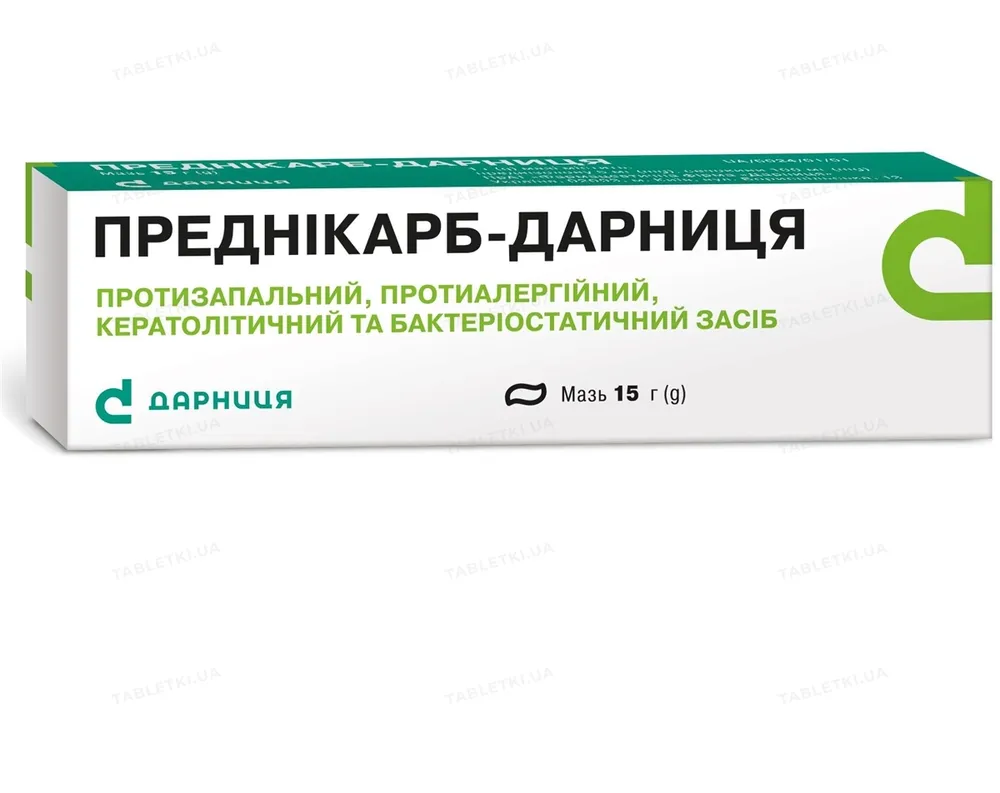
Table of Contents
INSTRUCTIONS FOR MEDICAL USE OF THE MEDICINAL PRODUCT PREDNICARB-DARNITSA (PREDNICARB-DARNITSA)
Composition:
Active substances: prednisolone, urea;
1 g of ointment contains: prednisolone 5 mg, urea 100 mg;
Excipients: disodium edetate, propylene glycol, liquid paraffin, macrogol cetostearyl ether, cetyl alcohol, stearyl alcohol, purified water.
Pharmaceutical form. Ointment.
Main physicochemical properties: white ointment with a very slight specific odor, homogeneous in appearance.
Pharmacotherapeutic group.
Corticosteroids for dermatological use. Corticosteroids in combination with other medicinal products. ATC code D07X A02.
Pharmacological properties.
Pharmacodynamics.
A combined medicinal product for topical use with anti-inflammatory, anti-exudative, anti-allergic, anti-pruritic, keratoplastic, keratolytic, and antimicrobial effects.
Prednisolone is a glucocorticosteroid, a dehydrogenated analogue of hydrocortisone. When applied topically, it exerts anti-inflammatory, anti-allergic, anti-pruritic, and anti-exudative effects. It reduces the formation, release, and activity of inflammatory mediators (histamine, kinins, prostaglandins, lysosomal enzymes). It suppresses cell migration to the site of inflammation and reduces vasodilation and increased vascular permeability at the inflammatory site. It decreases exudation due to vasoconstrictive action. It exerts immunosuppressive effects in type III and type IV hypersensitivity reactions by inhibiting the effects of antigen-antibody complexes that accumulate on blood vessel walls and cause allergic vasculitis. It suppresses the activity of macrophages, target cells, and cytokines involved in the development of allergic contact dermatitis. It prevents sensitized T-lymphocytes and macrophages from reaching target cells.
Urea (carbamide) regulates the skin's water balance and maintains its turgor. By interacting with keratin in skin cells, it enhances skin hydration and desquamation of the stratum corneum, providing keratoplastic (softening of the keratinized epithelium) and keratolytic effects. At a concentration of 10%, urea exerts bacteriostatic and fungistatic effects upon topical application. It has mild superficial local anesthetic activity, contributing to its anti-pruritic effect, which is additively enhanced by the similar action of prednisolone.
Pharmacokinetics.
With topical application, prednisolone is absorbed.
It crosses the placental barrier and passes in small amounts into breast milk.
The excipients contained in the ointment formulation retain urea at the site of application and prevent its absorption into the systemic circulation.
Clinical characteristics.
Indications.
Psoriasis; atopic dermatitis; various forms of eczema (including with lichenification); dyshidrosis; seborrheic dermatitis; ichthyosis; ichthyosiform dermatoses associated with dryness and hyperkeratosis.
Contraindications.
Individual hypersensitivity to components of the drug; Cushing's syndrome; varicella (chickenpox); vaccination period; herpes simplex; wounds and ulcers; bacterial, viral, fungal skin infections; cutaneous tuberculosis; skin manifestations of syphilis; skin tumors; common acne, rosacea; dermatoses accompanied by pronounced exudation.
Interaction with other medicinal products and other forms of interaction.
Systemic and topical glucocorticosteroid agents enhance the effect of the drug.
Concomitant use with antimicrobial and antifungal agents helps prevent secondary infection during prolonged use of the drug.
Special precautions for use.
The medicinal product should be prescribed at the lowest possible doses and for the shortest duration necessary to achieve the desired therapeutic effect.
To minimize the impact on healthy tissues, the area of skin to which the ointment is applied should not exceed the size of the affected area.
Treatment should be carried out under medical supervision. During treatment, regular ophthalmological monitoring and blood pressure control are required.
To reduce the risk of adverse effects, corticosteroids should be alternated with non-steroidal medicinal agents.
The maximum allowable skin surface area treated with the medicinal product must not exceed 20% of the body surface.
Glucocorticosteroids should be used only in short courses and solely for the treatment of exacerbations, not for prophylaxis.
When prescribing the medicinal product, the daily secretory rhythm of glucocorticosteroids should be taken into account: higher doses in the morning, moderate doses during the day, and lower doses in the evening.
Sudden discontinuation of the medicinal product is dangerous, as it may lead to disease exacerbation and worsening of the patient's general condition. The drug must be discontinued gradually.
Vaccination against smallpox or other types of immunization should not be performed during treatment with this medicinal product due to the immunosuppressive effects of glucocorticosteroids.
Avoid contact of the medicinal product with the eyes, mucous membranes, and scalp.
High doses should be prescribed with strict medical supervision in patients with a history of psychosis.
Use with caution in immunodeficiency states (including AIDS or HIV infection).
If skin irritation or signs of hypersensitivity occur during treatment with the ointment, therapy should be discontinued and appropriate alternative treatment initiated.
Prolonged use of the medicinal product on large body surface areas, especially in children, may lead to systemic adverse effects on the endocrine system. These adverse reactions are extremely rare, reversible, and resolve immediately after discontinuation of the drug. Patients undergoing such treatment require regular monitoring of hypothalamic-pituitary-adrenal (HPA) axis function. If symptoms of HPA axis suppression occur, the drug should be discontinued or the intervals between ointment applications increased.
Topical corticosteroids used in psoriasis treatment may, in some cases, lead to disease relapse, development of tolerance, increased risk of generalized pustular psoriasis, and local or systemic toxicity (reversible suppression of the hypothalamic-pituitary-adrenal axis) due to impaired skin barrier function. Therefore, careful patient monitoring is essential during psoriasis treatment with this medicinal product.
In case of fungal or bacterial superinfection of the skin, additional treatment with antifungal or antibacterial agents is required.
Use during pregnancy or breastfeeding.
The medicinal product is contraindicated during pregnancy and breastfeeding.
Ability to affect reaction speed when driving or operating machinery.
No effect.
Method of Administration and Dosage.
Adults and children over 1 year of age.
Apply externally. Apply the ointment in a thin layer to affected skin areas 1–3 times daily. For enhanced effect on limited areas, occlusive dressings may be used. The duration of treatment is determined by the physician depending on the nature of the disease and therapeutic response; usually the treatment course lasts 6–14 days.
When prescribing to children, the total treatment duration should be limited to 5–7 days, and measures that enhance absorption of glucocorticosteroids (warming, fixing, and occlusive dressings) should be avoided.
Children.
Apply to children aged 1 year and older only to limited skin areas and for a short course (5–7 days). The use of the medicinal product in children aged 1 to 3 years is possible only if the expected therapeutic benefit outweighs the potential risk to the child. In such cases, the total duration of treatment should be limited, and measures that enhance steroid resorption and absorption (warming, fixing, and occlusive dressings) should be avoided. Diapers may create an occlusive effect.
Prolonged use in children, regardless of age, should be avoided. During prolonged treatment, to prevent local infectious complications, combination therapy with antimicrobial medicinal products may be considered.
It is not recommended to apply to large skin surfaces. It should be remembered that the larger the area of application, the higher the probability of developing adverse reactions. When using the medicinal product in children, one should consider the possibility of developing signs of hypothalamic-pituitary-adrenal (HPA) axis suppression, which occurs more frequently in children than in adults due to greater drug absorption in children, related to a higher skin surface area to body weight ratio.
In children treated with topically applied corticosteroids, adrenal suppression, Cushing's syndrome, growth retardation, inadequate weight gain, and increased intracranial pressure have been reported.
Overdose.
Depending on the amount of corticosteroid absorbed into the body, both local and systemic adverse reactions may develop. In case of overdose, treatment should not be abruptly discontinued—therapy should be tapered gradually by reducing the dose. If symptoms of adrenal insufficiency develop, intravenous hydrocortisone administration may be required.
Adverse reactions.
Immune system side effects: allergic reactions are possible.
Skin and subcutaneous tissue disorders: the following may occur during application: pruritus, hyperemia, edema, skin rash, dermatitis, urticaria, dry skin, burning sensation, stinging, skin irritation, steroid acne, purpura, telangiectasia.
Prolonged use or application over large skin areas may lead to systemic adverse reactions, including secondary skin infections, skin atrophy, hypertrichosis, and hypercortisolism.
General disorders and administration site conditions: skin fissures at the application site are possible. The following adverse effects (frequency not known) may also occur: skin thinning (skin atrophy), striae, folliculitis, skin discoloration, bacterial cellulitis.
Shelf life. 2 years.
Do not use the medicinal product after the expiry date stated on the packaging.
Storage conditions.
Store in the original packaging at a temperature not exceeding 25 °C. Do not freeze.
Keep out of reach of children.
Packaging.
15 g in a tube; 1 tube per carton.
Prescription status.
Prescription only.
Manufacturer.
JSC "Pharmaceutical Company "Darnytsia".
Manufacturer's address and place of business.
13, Borispilska Street, Kyiv, 02093, Ukraine.