Pradaxa
Ukraine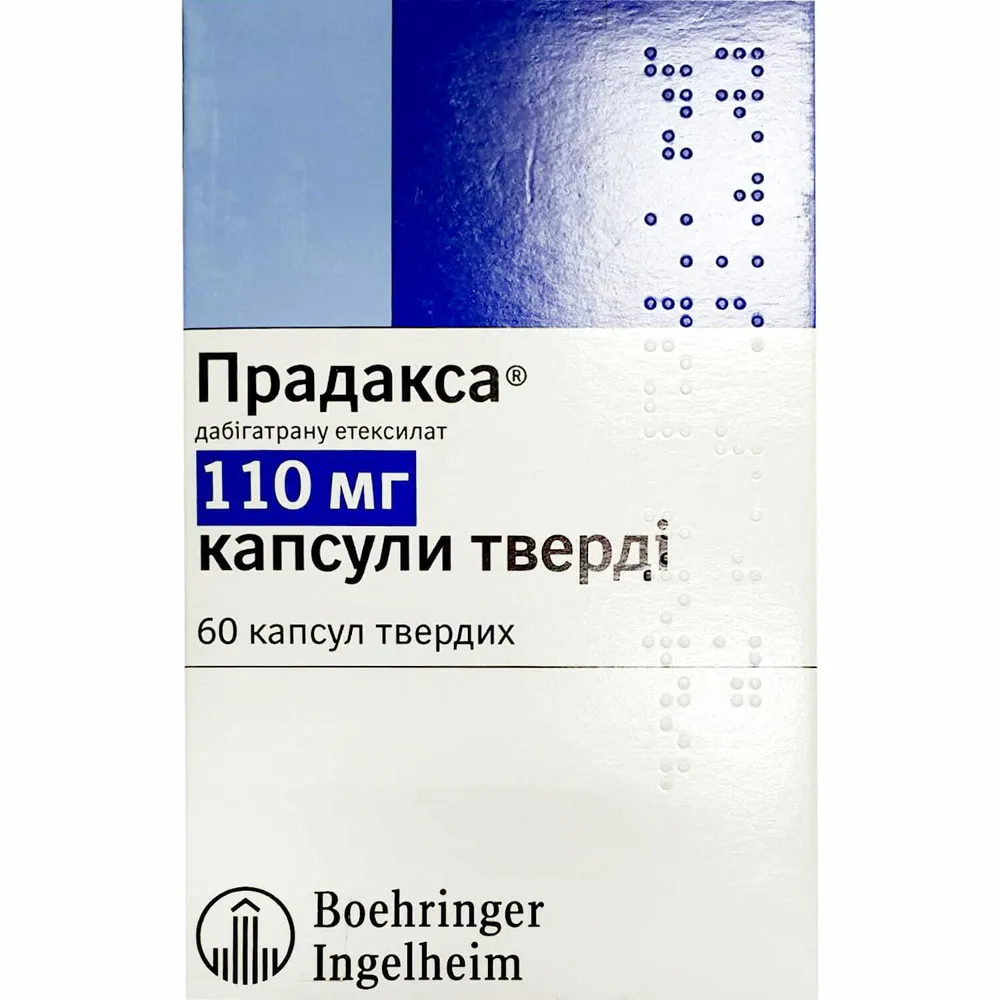
Table of Contents
INSTRUCTIONS FOR MEDICAL USE OF THE MEDICINAL PRODUCT PRADAXA® (PRADAXA®)
Composition:
Active substance: dabigatran etexilate;
1 capsule contains 150 mg of dabigatran etexilate in the form of mesilate;
Excipients: acacia, tartaric acid, hypromellose, dimethicone, talc, hydroxypropylcellulose;
Capsule shell: carrageenan (E 407), potassium chloride, titanium dioxide (E 171), indigocarmine (E 132), hypromellose, purified water;
Printing ink on capsule (black color SW-9008): shellac, butyl alcohol, isopropyl alcohol, black iron oxide (E 172), purified water, propylene glycol (E 1520), anhydrous ethyl alcohol, concentrated ammonium solution, potassium hydroxide.
Pharmaceutical form. Hard capsules.
Main physicochemical characteristics: elongated capsules made of hydroxypropylmethylcellulose (size 0) with an opaque light-blue cap bearing the Boehringer Ingelheim company symbol in black and an opaque white body with the black symbol «R150», containing yellowish pellets.
Pharmacotherapeutic group. Antithrombotic agents. Direct thrombin inhibitors.
ATC code B01A E07.
Pharmacological Properties.
Pharmacodynamics.
Mechanism of action. Dabigatran etexilate belongs to low-molecular-weight prodrugs which do not exhibit pharmacological activity. After oral administration, dabigatran etexilate is rapidly absorbed and converted to dabigatran by esterase-catalyzed hydrolysis in plasma and the liver. Dabigatran is a potent, competitive, reversible direct thrombin inhibitor and is the main active substance in plasma.
Since thrombin (a serine protease) activates the conversion of fibrinogen to fibrin in the blood coagulation system, its inhibition prevents thrombus formation. Dabigatran also inhibits free thrombin, fibrin-bound thrombin, and thrombin-induced platelet aggregation.
Pharmacodynamic effects. A clear correlation exists between plasma concentration of dabigatran and the degree of anticoagulant effect based on studies. Dabigatran prolongs the thrombin time (TT), clotting time (CT), and activated partial thromboplastin time (aPTT).
The calibrated, diluted thrombin time (dTT) test provides an approximate value of dabigatran plasma concentration, which can be compared with the expected level. If the dTT test result is at or below the limit of quantification, additional coagulation tests (TT, CT, and aPTT) should be considered.
The CT test can provide a direct measurement of the activity of direct thrombin inhibitors.
The aPTT test is widely available and provides an approximate indicator of the anticoagulant intensity achieved with dabigatran. However, the aPTT test has limited sensitivity and is not suitable for precise quantitative assessment of the anticoagulant effect, especially at high plasma concentrations of dabigatran. Although high aPTT values should be interpreted with caution, they indicate the presence of an anticoagulant effect in the patient.
Clinical efficacy and safety.
Ethnic origin
No clinically important ethnic differences were observed among patients of Caucasian, African American, Hispanic, Japanese, or Chinese descent.
In the RE-LY clinical trial, dabigatran etexilate at a dose of 110 mg twice daily was non-inferior to warfarin in stroke and systemic embolism prevention in adult patients with non-valvular atrial fibrillation (NVAF), with a lower risk of intracranial hemorrhage, overall bleeding, or major bleeding. The dose of dabigatran 150 mg twice daily significantly reduced the risk of ischemic and hemorrhagic stroke, cardiovascular death, intracranial hemorrhage, and overall bleeding compared to warfarin. The rate of major bleeding at these doses was comparable to that with warfarin. The incidence of myocardial infarction with dabigatran etexilate at doses of 110 mg and 150 mg twice daily compared to warfarin was not significantly increased (risk ratio 1.29; p = 0.0929 and risk ratio 1.27; p = 0.1240, respectively). A significant positive impact of dabigatran etexilate compared to warfarin is improved INR monitoring.
Patients undergoing catheter ablation for atrial fibrillation. A prospective, open-label, randomized, multicenter exploratory study with blinded endpoint assessment (RE-CIRCUIT) was conducted in 704 patients receiving stable anticoagulant therapy. The study compared continuous therapy with dabigatran etexilate 150 mg twice daily versus continuous INR-adjusted warfarin therapy in patients undergoing catheter ablation for paroxysmal or persistent atrial fibrillation. Of the 704 patients enrolled, 317 underwent catheter ablation under continuous dabigatran therapy and 318 under continuous warfarin therapy. All patients underwent transesophageal echocardiography (TEE) prior to catheter ablation. The primary endpoint (defined as major bleeding according to ISTH criteria) was reached in 5 (1.6%) patients in the dabigatran etexilate group and in 22 (6.9%) patients in the warfarin group (risk difference -5.3%; 95% CI -8.4; -2.2; P = 0.0009). There were no cases of stroke/systemic embolism/TIA in the dabigatran etexilate group, whereas one TIA occurred in the warfarin group from the time of ablation to 8 weeks post-ablation. This exploratory study demonstrated that dabigatran etexilate use is associated with a significant reduction in major bleeding compared to INR-adjusted warfarin therapy during ablation.
Non-interventional study data
In the non-interventional study (GLORIA-AF), safety and efficacy data were prospectively collected (during phase II) in patients with newly diagnosed non-valvular atrial fibrillation (NVAF) receiving dabigatran etexilate in real-world settings. The study included 4859 patients receiving dabigatran etexilate (55% received 150 mg twice daily, 43% received 110 mg twice daily, 2% received 75 mg twice daily). Patients were followed for 2 years. Mean CHADS2 and HAS-BLED scores were 1.9 and 1.2, respectively. The mean treatment observation period was 18.3 months. Major bleeding occurred in 0.97 cases per 100 patient-years. Life-threatening bleeding was recorded in 0.46 cases per 100 patient-years, intracranial hemorrhage in 0.17 cases per 100 patient-years, and gastrointestinal bleeding in 0.60 cases per 100 patient-years. Stroke occurred in 0.65 cases per 100 patient-years.
Additionally, in a non-interventional study [Graham DJ et al., Circulation. 2015;131:157-164] involving over 134,000 elderly patients with non-valvular atrial fibrillation (NVAF) in the United States (equivalent to over 37,500 patient-years of observation during therapy), dabigatran etexilate (84% of patients receiving 150 mg twice daily, 16% receiving 75 mg twice daily) was associated with a reduced risk of ischemic stroke (risk ratio 0.80, 95% confidence interval [CI] 0.67–0.96), intracranial hemorrhage (risk ratio 0.34, CI 0.26–0.46), and mortality (risk ratio 0.86, CI 0.77–0.96), as well as an increased risk of gastrointestinal bleeding (risk ratio 1.28, CI 1.14–1.44) compared to warfarin. No difference was observed in the risk of major bleeding (risk ratio 0.97, CI 0.88–1.07).
These real-world observations are consistent with the safety and efficacy profile of dabigatran etexilate established in the RE-LY trial when used for the specified indication.
Patients undergoing percutaneous coronary intervention (PCI) with stenting
A prospective, randomized, open-label study (Phase IIIb) with endpoint masking (PROBE design), aimed at evaluating dual therapy with dabigatran etexilate (at doses of 110 mg or 150 mg twice daily) plus clopidogrel or ticagrelor (P2Y12 antagonist) compared to triple therapy with warfarin (INR-adjusted to 2.0–3.0) plus clopidogrel or ticagrelor and aspirin, was conducted in 2725 patients with non-valvular atrial fibrillation who underwent PCI with stenting (RE-DUAL PCI). Patients were randomized to either dual therapy with dabigatran etexilate 110 mg twice daily, dual therapy with dabigatran etexilate 150 mg twice daily, or triple therapy with warfarin. Elderly patients outside the United States (aged ≥80 years in all countries and ≥70 years in Japan) were randomized to receive dual therapy with dabigatran etexilate 110 mg or triple therapy with warfarin. The primary endpoint was a composite of major bleeding based on ISTH (International Society on Thrombosis and Haemostasis) criteria or clinically relevant non-major bleeding.
The rate of the primary endpoint was 15.4% (151 patients) in the dual therapy group with dabigatran etexilate 110 mg compared to 26.9% (264 patients) in the warfarin triple therapy group (RR 0.52; 95% CI 0.42, 0.63; P < 0.0001 for non-inferiority and P < 0.0001 for superiority), and 20.2% (154 patients) in the dual therapy group with dabigatran etexilate 150 mg compared to 25.7% (196 patients) in the corresponding warfarin triple therapy group (RR 0.72; 95% CI 0.58, 0.88; P < 0.0001 for non-inferiority and P = 0.002 for superiority). In a descriptive analysis, the rate of major bleeding by TIMI (Thrombolysis In Myocardial Infarction) criteria was lower in both dual therapy groups with dabigatran etexilate than in the warfarin triple therapy group: 14 events (1.4%) in the 110 mg dual therapy group versus 37 events (3.8%) in the warfarin triple therapy group (RR 0.37; 95% CI 0.20, 0.68; P = 0.002), and 16 events (2.1%) in the 150 mg dual therapy group versus 30 events (3.9%) in the corresponding warfarin triple therapy group (RR 0.51; 95% CI 0.28, 0.93; P = 0.03). Lower rates of intracranial hemorrhage were observed in both dabigatran etexilate dual therapy groups compared to the corresponding warfarin triple therapy group: 3 events (0.3%) in the 110 mg dual therapy group versus 10 events (1.0%) in the warfarin triple therapy group (RR 0.30; 95% CI 0.08, 1.07; P = 0.06), and 1 event (0.1%) in the 150 mg dual therapy group versus 8 events (1.0%) in the corresponding warfarin triple therapy group (RR 0.12; 95% CI 0.02, 0.98; P = 0.047). Regarding the rate of the composite efficacy endpoint of death, thromboembolic events (myocardial infarction, stroke, and systemic embolism), or unplanned revascularization, both dabigatran etexilate dual therapy groups collectively were non-inferior to the warfarin triple therapy group (13.7% vs. 13.4%, respectively; RR 1.04; 95% CI: 0.84, 1.29; P = 0.0047 for non-inferiority). No statistically significant differences were observed in individual components of the efficacy endpoints between either dabigatran etexilate dual therapy group and the warfarin triple therapy group.
Clinical studies on thromboembolism prevention in patients with mechanical heart valve
In clinical trials involving patients who recently underwent mechanical heart valve replacement (e.g., during hospitalization) and patients who underwent mechanical heart valve replacement more than 3 months prior, increased thromboembolic complications (primarily strokes and prosthetic valve thrombosis, symptomatic or asymptomatic) and higher rates of bleeding were observed with dabigatran etexilate compared to warfarin. In patients in the early postoperative period, major bleeding primarily manifested as hemorrhagic pericardial effusion, especially in those who initiated dabigatran etexilate (e.g., on day 3) after heart valve replacement surgery (see section "Contraindications").
Pharmacokinetics.
After oral administration, dabigatran etexilate is rapidly and completely converted to dabigatran, the active form in plasma. The conversion of the prodrug dabigatran etexilate to the active substance dabigatran via esterase-catalyzed hydrolysis is the predominant metabolic reaction. The absolute bioavailability of dabigatran after oral administration of dabigatran etexilate is approximately 6.5%.
After oral administration of dabigatran etexilate, the plasma pharmacokinetic profile of dabigatran is characterized by a rapid increase in concentration, reaching Cmax within 0.5–2 hours after administration.
Absorption. Postoperative absorption of dabigatran etexilate assessed 1–3 hours after surgery was relatively low compared to absorption in healthy volunteers and showed a gradual AUC profile without high peak plasma concentrations. Maximum plasma concentration is reached 6 hours after administration in the postoperative period due to concomitant factors such as anesthesia, gastrointestinal paresis, and surgical intervention, regardless of the oral dosage form. In an additional study, slow and prolonged absorption was typically observed only on the day of surgery. In subsequent days, absorption of dabigatran is rapid, and maximum plasma concentration is achieved within 2 hours after drug administration.
Food does not affect the bioavailability of dabigatran etexilate but delays the time to reach maximum plasma concentration by 2 hours.
Cmax and AUC are dose-proportional.
Oral bioavailability may be increased by 75% compared to the capsule formulation after a single dose and by 37% at steady state when pellets are administered without the hydroxypropylmethylcellulose (HPMC) capsule shell. Therefore, the integrity of HPMC capsules must always be maintained during clinical use to prevent unintentional increases in the bioavailability of dabigatran etexilate (e.g., by sprinkling onto food or drinks) (see section "Dosage and administration").
Distribution. Low (34–35%), concentration-independent binding of dabigatran to human plasma proteins was observed. The volume of distribution of dabigatran (60–70 L) exceeds total body water volume, indicating moderate tissue distribution.
Metabolism. The metabolism and elimination of dabigatran were studied after administration of a single intravenous dose of radiolabeled dabigatran to healthy men. After intravenous administration, radiolabeled dabigatran was primarily excreted in urine (85%). Fecal excretion accounted for 6% of the administered dose. Recovery of the initial radioactivity to 88–94% occurred within 168 hours after dabigatran administration. Dabigatran undergoes conjugation to form pharmacologically active acylglucuronides. There are four positional isomers: 1-O, 2-O, 3-O, and 4-O-acylglucuronides, each constituting less than 10% of total dabigatran in plasma. Traces of other metabolites can only be detected using highly sensitive analytical methods. Dabigatran is primarily excreted unchanged in urine at a rate of approximately 100 mL/min, corresponding to the glomerular filtration rate.
Elimination
Plasma concentration of dabigatran decreases biexponentially, with a mean terminal half-life of 11 hours in elderly healthy volunteers. After multiple doses, the terminal half-life is approximately 12–14 hours. The half-life is independent of dose. The half-life is prolonged in patients with impaired renal function (see Table 1).
Special patient groups.
Renal impairment. In Phase I studies, exposure (AUC) to dabigatran after oral administration was approximately 2.7-fold higher in adult volunteers with moderate renal impairment (creatinine clearance (CrCl) between 30 and 50 mL/min) compared to adult volunteers without renal impairment.
In a small number of adult volunteers with severe renal impairment (creatinine clearance 10–30 mL/min), exposure (AUC) to dabigatran was approximately 6-fold higher and the elimination half-life approximately 2-fold longer compared to volunteers without renal impairment (see sections "Dosage and administration", "Contraindications", and "Special precautions").
Table 1
Terminal half-life of dabigatran in healthy volunteers and individuals with impaired renal function
| Glomerular filtration rate (creatinine clearance), mL/min |
Half-life, hours (gCV %; interval) |
| > 80 |
13.4 (25.7 %; 11.0–21.6) |
| > 50–≤ 80 |
15.3 (42.7 %; 11.7–34.1) |
| > 30–≤ 50 |
18.4 (18.5 %; 13.3–23.0) |
| ≤ 30 |
27.2 (15.3 %; 21.6–35.0) |
In addition, dabigatran exposure (trough and peak levels) was evaluated in a prospective, open-label, randomized pharmacokinetic study involving patients with non-valvular atrial fibrillation and severe renal impairment (creatinine clearance (CrCl) 15–30 mL/min) receiving 75 mg of dabigatran etexilate twice daily.
With this dosing regimen, the geometric mean trough concentration measured immediately before the next dose was 155 ng/mL (CV 76.9%), and the geometric mean peak concentration measured two hours after the last dose was 202 ng/mL (CV 70.6%).
Dabigatran clearance during hemodialysis was studied in 7 adult patients with end-stage renal disease without atrial fibrillation. Four-hour dialysis was performed with a dialysate flow rate of 700 mL/min and a blood flow rate of either 200 mL/min or 350–390 mL/min. This resulted in a 50–60% reduction in dabigatran concentration, respectively. The amount of drug removed by dialysis is proportional to a blood flow rate of 300 mL/min. The anticoagulant activity of dabigatran decreases with decreasing plasma concentration and does not affect the pharmacokinetic/pharmacodynamic relationship.
Elderly patients. In a Phase I dedicated pharmacokinetic study, elderly patients showed a 40–60% increase in AUC and a Cmax increase of more than 25% compared to younger patients. The effect of age on dabigatran exposure was confirmed in the RE-LY trial: approximately 31% higher concentrations in patients aged ≥75 years and approximately 22% lower in patients aged <65 years compared to patients aged 65–75 years (see sections "Dosage and administration" and "Special warnings and precautions for use").
Hepatic impairment. No changes in dabigatran exposure were observed in 12 adult patients with moderate hepatic impairment (Child–Pugh classification, class B) compared to 12 control patients (see sections "Dosage and administration" and "Special warnings and precautions for use").
Body weight. Dabigatran concentrations were approximately 20% lower in adult patients with body weight >100 kg compared to those with body weight of 50–100 kg. The majority (80.8%) of subjects were in the category ≥50 kg and <100 kg, with no clear difference identified (see sections "Dosage and administration" and "Special warnings and precautions for use"). Data for adult patients with body weight <50 kg are limited.
Gender. Female patients with atrial fibrillation had, on average, 30% higher concentrations during and after treatment. Dose adjustment is not required (see section "Dosage and administration").
Race. There are no clinically relevant differences in the pharmacokinetics and pharmacodynamics of dabigatran between Caucasian and African-American patients, or those of Hispanic, Japanese, or Chinese origin.
Pharmacokinetic interactions. In vitro interaction studies showed no inhibition or induction of major cytochrome P450 isoenzymes. This was confirmed by in vivo studies in healthy volunteers, where no interactions were observed when dabigatran etexilate was co-administered with the following active substances: atorvastatin (CYP3A4), digoxin (P-gp transporter interaction), and diclofenac (CYP2C9).
Clinical characteristics.
Indications.
Prevention of stroke and systemic embolism in adult patients with non-valvular atrial fibrillation (NVAF) who have one or more risk factors such as: previous stroke or transient ischemic attack (TIA), age ≥ 75 years, heart failure (New York Heart Association [NYHA] class ≥ II), diabetes mellitus, or arterial hypertension.
Treatment of deep vein thrombosis (DVT) and pulmonary embolism (PE), and prevention of recurrent DVT and PE in adults.
Contraindications.
- Known hypersensitivity to the active substance or to any of the excipients listed in the section "Composition".
- Severe renal impairment (creatinine clearance < 30 mL/min).
- Active clinically significant bleeding.
- Injury or condition considered a significant risk factor for major bleeding, including current or recent gastrointestinal ulceration, presence of malignant neoplasms with high bleeding risk, recent trauma to the brain or spinal cord, recent surgery on the brain or spinal cord or ophthalmologic surgery, recent intracranial hemorrhage, known or suspected esophageal varices, arteriovenous malformations, vascular aneurysms, or significant intraspinal or intracerebral vascular abnormalities.
- Concomitant use of any anticoagulant medicinal product such as unfractionated heparin (UFH), low-molecular-weight heparins (enoxaparin, dalteparin, etc.), heparin derivatives (fondaparinux, etc.), oral anticoagulants (warfarin, rivaroxaban, apixaban, etc.), except under specific circumstances, including transition from or to anticoagulant therapy (see section "Dosage and administration"), when UFH is used at doses required to maintain patency of a central venous or arterial catheter, or when UFH is used during catheter ablation for atrial fibrillation (see section "Interaction with other medicinal products and other forms of interaction").
- Hepatic impairment or liver disease that may affect survival.
- Concomitant use with the following strong P-gp inhibitors: systemic ketoconazole, cyclosporine, itraconazole, dronedarone, and the fixed-dose combination glecaprevir/pibrentasvir (see section "Interaction with other medicinal products and other forms of interaction").
- Mechanical heart valve requiring anticoagulant therapy (see section "Pharmacological properties. Pharmacodynamics").
Interaction with other medicinal products and other forms of interaction.
Transporter interactions.
Dabigatran etexilate is a substrate of the efflux transporter P-gp. Concomitant use of P-gp inhibitors (see Table 2) is expected to increase plasma concentrations of dabigatran.
Unless otherwise specified, careful clinical monitoring (for signs of bleeding or anemia) is recommended when dabigatran is used concomitantly with strong P-gp inhibitors. Dose reduction of dabigatran may be required when used in combination with certain P-gp inhibitors (see sections "Dosage and administration", "Contraindications", "Special precautions", and subsection "Pharmacodynamics").
Table 2
Transporter interactions
| P-gp Inhibitors |
||
| Concomitant use is contraindicated (see section "Contraindications") |
||
| Ketoconazole |
Ketoconazole increases the total AUC0-∞ and Cmax of dabigatran by 2.38-fold and 2.35-fold, respectively, after a single oral dose of 400 mg, and by 2.53-fold and 2.49-fold, respectively, after multiple oral doses of 400 mg ketoconazole once daily. |
|
| Dronedarone |
When dabigatran etexilate was administered concomitantly with dronedarone, total AUC0-∞ and Cmax values of dabigatran increased approximately by 2.4-fold and 2.3-fold, respectively, after multiple 400 mg doses of dronedarone twice daily, and by approximately 2.1-fold and 1.9-fold, respectively, after a single 400 mg dose. |
|
| Itraconazole, cyclosporine |
Based on in vitro results, an effect similar to that with ketoconazole can be expected. |
|
| Glecaprevir/ pijbrintasvir |
Concomitant use of dabigatran etexilate with the fixed-dose combination of P-gp inhibitors glecaprevir/pijbrintasvir increases the effect of dabigatran and may increase the risk of bleeding. |
|
| Concomitant use is not recommended |
||
| Tacrolimus |
In vitro studies have shown that tacrolimus has a similar inhibitory effect on P-gp as itraconazole and cyclosporine. The clinical use of dabigatran etexilate with tacrolimus has not been studied. However, limited clinical data with another P-gp substrate (everolimus) suggest that P-gp inhibition by tacrolimus is weaker than that with strong P-gp inhibitors. |
|
| Precautions to be followed in case of concomitant use (see sections "Dosage and Administration" and "Special Warnings") |
||
| Verapamil |
When dabigatran etexilate (150 mg) and oral verapamil were used concomitantly, Cmax and AUC of dabigatran increased depending on the timing of administration and the formulation of verapamil (see sections "Dosage and Administration" and "Special Warnings"). The greatest increase in dabigatran exposure was observed when the first dose of immediate-release verapamil was administered one hour before dabigatran etexilate (increase in Cmax by approximately 2.8-fold and in AUC by approximately 2.5-fold). The effect gradually decreased with extended-release verapamil (increase in Cmax by approximately 1.9-fold and in AUC by approximately 1.7-fold) or after multiple doses of verapamil (increase in Cmax by approximately 1.6-fold and in AUC by approximately 1.5-fold). No significant interaction was observed when verapamil was administered 2 hours after dabigatran etexilate (increase in Cmax by approximately 1.1-fold and in AUC by approximately 1.2-fold). This is explained by complete absorption of dabigatran within 2 hours. |
|
| Amiodarone |
When dabigatran etexilate was administered concomitantly with a single 600 mg dose of amiodarone, the volume and rate of absorption of amiodarone and its active metabolite desethylamiodarone (DEA) were not significantly altered. The area under the concentration-time curve (AUC) and Cmax increased by approximately 1.6-fold and 1.5-fold, respectively. Due to the long elimination half-life of amiodarone, interaction is possible for several weeks after discontinuation of amiodarone (see sections "Dosage and Administration" and "Special Warnings"). |
|
| Quinidine |
Quinidine was administered at a dose of 200 mg every 2 hours up to a total dose of 1000 mg. Dabigatran etexilate was administered twice daily for 3 days, on day 3 with or without quinidine. AUCτ,ss and Cmax,ss of dabigatran increased overall by 1.53-fold and 1.56-fold, respectively, when quinidine was administered concomitantly (see sections "Dosage and Administration" and "Special Warnings"). |
|
| Clarithromycin |
When clarithromycin (500 mg twice daily) was administered concomitantly with dabigatran etexilate in healthy volunteers, AUC increased by approximately 1.19-fold and Cmax by approximately 1.15-fold. |
|
| Ticagrelor |
When a single dose of dabigatran etexilate (75 mg) was administered concomitantly with the highest initial dose of ticagrelor (180 mg), AUC and Cmax of dabigatran increased by 1.73-fold and 1.95-fold, respectively. After multiple doses of ticagrelor (90 mg twice daily), exposure to dabigatran increased by 1.56-fold and 1.46-fold for Cmax and AUC, respectively. Concomitant administration of the highest initial dose of ticagrelor 180 mg and 110 mg dabigatran etexilate (at steady state) increases AUCτ,ss and Cmax,ss of dabigatran by 1.49-fold and 1.65-fold, respectively, compared to administration of dabigatran etexilate alone. When the highest initial dose of 180 mg ticagrelor was administered 2 hours after 110 mg dabigatran etexilate (at steady state), the increase in AUCτ,ss and Cmax,ss of dabigatran was reduced to 1.27-fold and 1.23-fold, respectively, compared to dabigatran etexilate alone. This staggered administration is recommended when initiating ticagrelor at the highest initial dose. Concomitant administration of 90 mg ticagrelor twice daily (maintenance dose) with 110 mg dabigatran etexilate increases AUCτ,ss and Cmax,ss of dabigatran by 1.26-fold and 1.29-fold, respectively, compared to dabigatran alone. |
|
| Posaconazole |
Posaconazole also inhibits P-gp to some extent, but has not been clinically studied. Caution should be exercised when dabigatran etexilate is administered concomitantly with posaconazole. |
|
| P-gp Inducers |
||
| Concomitant use should be avoided |
||
| For example, rifampicin, St. John's wort (Hypericum perforatum), carbamazepine or phenytoin |
Concomitant use is expected to reduce dabigatran concentrations. Prior administration of rifampicin 600 mg once daily for 7 days reduces total Cmax and total exposure of dabigatran by 65.5% and 67%, respectively. The inductive effect diminished, resulting in dabigatran exposure close to baseline by day 7 after discontinuation of rifampicin. No further increase in bioavailability was observed during the subsequent 7 days. |
|
| Protease inhibitors such as ritonavir |
||
| Concomitant use is not recommended |
||
| For example, ritonavir and its combinations with other protease inhibitors |
They affect P-gp (both as inhibitors and inducers). They have not been studied and therefore are not recommended for concomitant use with dabigatran etexilate. |
|
| P-gp Substrates |
||
| Digoxin |
In a study involving 24 healthy volunteers, concomitant administration of dabigatran etexilate and digoxin showed no changes regarding digoxin or clinically significant changes in dabigatran exposure. |
|
Anticoagulants and antiplatelet medicinal products.
Medicinal products for which therapy has not been investigated or for which experience with use is limited, and medicinal products which may increase the risk of bleeding when used concomitantly with dabigatran etexilate: anticoagulants such as unfractionated heparin (UFH), low-molecular-weight heparins (LMWHs) and heparin derivatives (fondaparinux, desirudin), thrombolytics and vitamin K antagonists, rivaroxaban and other oral anticoagulants (see section "Contraindications"), antiplatelet medicinal products such as GPIIb/IIIa receptor antagonists, ticlopidine, prasugrel, ticagrelor, dextran and sulfinpyrazone (see section "Special precautions for use").
According to data from the RE-LY phase III study (see subsection "Pharmacodynamics"), concomitant use of other oral or parenteral anticoagulants with dabigatran etexilate and with warfarin increases the incidence of major bleeding by approximately 2.5-fold, primarily during transition from one anticoagulant to another (see section "Contraindications"). Furthermore, concomitant use of antiplatelet agents, aspirin (ASA) or clopidogrel approximately doubles the rate of major bleeding with both dabigatran etexilate and warfarin (see section "Special precautions for use").
UFH may be used at doses required to maintain patency of central venous or arterial catheters, or during catheter ablation for atrial fibrillation (see section "Contraindications").
Table 3
Interaction with anticoagulants and antiplatelet medicinal products.
| Nonsteroidal anti-inflammatory drugs (NSAIDs) |
Short-term use of NSAIDs for perioperative analgesia was not associated with an increased risk of bleeding when used concomitantly with dabigatran etexilate. With long-term use of NSAIDs during the RE-LY study, the risk of bleeding increased by approximately 50% with both dabigatran etexilate and warfarin. |
| Clopidogrel |
In a study in young healthy male volunteers, concomitant administration of dabigatran etexilate and clopidogrel did not prolong capillary bleeding time compared to clopidogrel monotherapy. Furthermore, AUCτ,ss and Cmax,ss values of dabigatran, coagulation parameters used to assess the effect of dabigatran, or inhibition of platelet aggregation as an effect of clopidogrel remained unchanged compared to combination therapy and corresponding monotherapies. With clopidogrel dosing at 300 mg or 600 mg, AUCτ,ss and Cmax,ss of dabigatran increased by approximately 30–40% (see section "Special warnings and precautions for use"). |
| Acetylsalicylic acid |
Data from studies indicate that concomitant use of 81 mg or 325 mg acetylsalicylic acid (ASA) with dabigatran etexilate at a dose of 150 mg twice daily may increase the risk of any bleeding from 12% to 18% and 24%, respectively (see section "Special warnings and precautions for use"). |
| Low-molecular-weight heparins |
Concomitant use of low-molecular-weight heparins, such as enoxaparin, and dabigatran etexilate has not been studied. After switching from 3-day therapy with enoxaparin 40 mg once daily, 24 hours after the last enoxaparin dose, dabigatran exposure was slightly lower than after dabigatran etexilate alone (single dose 220 mg). Higher anti-FXa/FIIa activity was observed after dabigatran etexilate administration with prior enoxaparin treatment compared to treatment with dabigatran etexilate alone. This is due to prior enoxaparin treatment and is not clinically significant. Pretreatment with enoxaparin did not significantly affect other anticoagulation tests for dabigatran. |
Table 4
Other interactions
| Selective serotonin reuptake inhibitors (SSRIs), selective norepinephrine reuptake inhibitors (SNRIs) |
|
| SSRIs and SNRIs |
SSRIs and SNRIs increased the risk of bleeding during the study in all treatment groups. |
| Substances affecting gastric pH |
|
| Pantoprazole |
When the medicinal product PRADAXA and pantoprazole were used concomitantly, a decrease in AUC of dabigatran by approximately 30% was observed. Pantoprazole and other proton pump inhibitors (PPIs) were used concomitantly with PRADAXA in clinical studies. Concomitant use of PPIs did not reduce the efficacy of PRADAXA. |
| Ranitidine |
Concomitant administration of ranitidine and dabigatran etexilate had no clinically significant effect on the extent of absorption of dabigatran. |
Interactions related to the metabolic profile of dabigatran etexilate and dabigatran.
Dabigatran etexilate and dabigatran are not metabolized by the cytochrome P450 system and have no in vitro effect on cytochrome P450 enzymes. Therefore, interactions between dabigatran and corresponding medicinal products are not expected.
Special precautions for use.
Bleeding risk. Dabigatran etexilate should be used with caution in cases of high bleeding risk or when used concomitantly with medicinal products affecting hemostasis by inhibiting platelet aggregation. Bleeding may occur at any site during treatment. If hemoglobin and/or hematocrit levels decrease for unexplained reasons or if arterial pressure decreases, the presence of bleeding should be investigated.
In the event of life-threatening or uncontrolled bleeding, when rapid reversal of dabigatran's anticoagulant effect is required, the specific reversal agent idarucizumab is available for administration. Dabigatran is eliminated by hemodialysis. The use of fresh whole blood or fresh frozen plasma, coagulation factor concentrates (activated or non-activated), recombinant factor VIIa, platelet concentrates, or other possible options may be considered (see section "Overdose").
In clinical trials, the use of dabigatran etexilate was associated with increased rates of major gastrointestinal bleeding. The risk was higher in elderly patients (≥75 years) receiving dabigatran 150 mg twice daily. Additional risk factors (see also Table 5) include concomitant use of antiplatelet agents such as clopidogrel and acetylsalicylic acid (ASA), or nonsteroidal anti-inflammatory drugs (NSAIDs), as well as the presence of esophagitis, gastritis, or gastroesophageal reflux.
Risk factors
Table 5
Factors that may increase the risk of bleeding
| Risk factors |
|
| Pharmacodynamic and pharmacokinetic factors |
Age ≥ 75 years |
| Factors increasing dabigatran plasma levels |
Major:
Minor:
|
| Pharmacodynamic interactions (see section "Interaction with other medicinal products and other forms of interaction") |
|
| Diseases/procedures with bleeding risk |
|
Data in patients with body weight < 50 kg are limited (see section "Pharmacokinetics").
Precautions and bleeding risk management
For the management of haemorrhagic complications, see section "Overdose".
Benefit-risk assessment
Injury, conditions, procedures and/or pharmacological therapy (e.g. NSAIDs, antiplatelet agents, SSRIs and SNRIs, see section "Interaction with other medicinal products and other forms of interaction") that significantly increase the risk of major bleeding require careful benefit-risk assessment. Dabigatran etexilate should only be used if the expected benefit outweighs the bleeding risks.
Close clinical monitoring
Close clinical monitoring for signs of bleeding or anaemia is recommended throughout the treatment period, especially in the presence of multiple risk factors (see Table 5 above). Particular caution is advised when dabigatran etexilate is co-administered with verapamil, amiodarone, quinidine or clarithromycin (P-gp inhibitors) and in the event of bleeding, particularly in patients with impaired renal function (see section "Interaction with other medicinal products and other forms of interaction"). Close monitoring for signs of bleeding is recommended in patients receiving concomitant non-steroidal anti-inflammatory drugs (see section "Interaction with other medicinal products and other forms of interaction").
Discontinuation of dabigatran etexilate
Patients who develop acute renal failure must discontinue dabigatran etexilate (see section "Contraindications").
In the event of severe bleeding, treatment should be discontinued, the source of bleeding investigated, and consideration given to the use of a specific reversal agent (idarucizumab). Dabigatran is dialysed during haemodialysis.
Use of proton pump inhibitors
The use of proton pump inhibitors may be considered to prevent gastrointestinal bleeding.
Coagulation laboratory parameters
Although routine anticoagulation monitoring is generally not required with this medicinal product, measuring the anticoagulant effect associated with dabigatran may be useful to identify excessively high dabigatran exposure in the presence of additional risk factors. Parameters such as diluted thrombin time (dTT), ecarin clotting time (ECT), and activated partial thromboplastin time (aPTT) may be helpful, but results should be interpreted with caution due to variability between assays (see section "Pharmacodynamics").
The INR (International Normalised Ratio) test is unreliable in patients taking dabigatran etexilate: false-positive INR elevations have been observed. Therefore, the INR test should not be performed. Table 6 provides threshold values for coagulation tests that may be associated with an increased risk of bleeding (see section "Pharmacodynamics").
Table 6
Threshold values of coagulation tests that may be associated with an increased risk of bleeding
| Test |
Indications |
| prevention of stroke and systemic embolism in adult patients with non-valvular atrial fibrillation with one or more risk factors (prevention of NVAF), VTE/PE |
|
| rTP [ng/mL] |
> 200 |
| PT [x-fold upper limit of normal] |
> 3 |
| aPTT [x-fold upper limit of normal] |
> 2 |
| INR |
not required |
Use of fibrinolytic agents for the treatment of acute ischemic stroke.
Fibrinolytic agents may be considered for the treatment of acute ischemic stroke if PT, aPTT, or INR test results do not exceed the upper limit of normal (ULN) according to local reference values.
Surgical and interventional procedures. Patients receiving dabigatran etexilate who undergo surgical or invasive procedures are at increased risk of bleeding. Therefore, surgical intervention may require temporary discontinuation of dabigatran etexilate.
Patients may continue dabigatran etexilate during cardioversion. Dabigatran etexilate therapy (150 mg twice daily) does not need to be interrupted in patients with atrial fibrillation undergoing catheter ablation (see section "Dosage and administration").
Caution should be exercised when temporarily discontinuing treatment for surgical procedures, and anticoagulation monitoring should be ensured. Dabigatran clearance may take longer in patients with renal impairment (see section "Pharmacokinetics"). Caution is advised for any procedure. In such cases, a coagulation test (see sections "Contraindications" and "Pharmacodynamics") may help determine whether hemostasis is impaired.
Emergency surgery or urgent procedures. Dabigatran etexilate should be temporarily discontinued. When rapid reversal of the anticoagulant effect is required, a specific reversal agent (idarucizumab) may be administered. Dabigatran is eliminated by hemodialysis.
Reversal of dabigatran therapy is associated with a thrombotic risk in patients related to their underlying condition. Dabigatran etexilate may be restarted 24 hours after administration of idarucizumab, provided the patient is clinically stable and adequate hemostasis has been achieved.
Surgical and interventional procedures in subacute conditions. Dabigatran etexilate should be temporarily discontinued. Surgical or interventional procedures should be delayed for at least 12 hours after the last dose of dabigatran, if possible. If surgery cannot be delayed, the risk of bleeding may be increased. The risk of bleeding and urgency of the procedure should be carefully weighed before administering the drug.
Planned surgery. If possible, dabigatran etexilate should be discontinued at least 24 hours prior to invasive or surgical procedures. For patients at high risk of bleeding or undergoing major surgery where hemostasis may be required, discontinuation of dabigatran etexilate 2–4 days prior to surgery should be considered.
Table 7
Guidelines for discontinuation prior to invasive or surgical procedures
| Renal function (creatinine clearance, mL/min) |
Expected elimination half-life (hours) |
Dabigatran etexilate should be discontinued prior to elective surgery |
|
| High risk of bleeding or major surgery |
Standard risk |
||
| ≥ 80 |
~ 13 |
2 days before |
24 hours before |
| ≥ 50–< 80 |
~ 15 |
2–3 days before |
1–2 days before |
| ≥ 30–< 50 |
~ 18 |
4 days before |
2–3 days before (> 48 hours) |
Spinal anaesthesia/epidural anaesthesia/lumbar puncture. Procedures such as spinal anaesthesia may require full functioning of the haemostatic system.
The risk of spinal or epidural haematoma may be increased with traumatic or repeated puncture and prolonged postoperative use of epidural catheters. After catheter removal, at least 2 hours should elapse before administering the first dose of dabigatran etexilate. Such patients require careful monitoring for neurological symptoms and symptoms of spinal or epidural haematoma.
Postoperative phase. Treatment with dabigatran etexilate should be resumed/started after invasive procedures or surgical interventions as soon as the clinical situation allows and adequate haemostasis has been achieved.
Patients at risk of bleeding or patients at risk of excessive effect, especially those with reduced renal function (see also Table 5), should be treated with caution (see section "Special precautions for use" and subsection "Pharmacodynamics").
Patients at high risk of mortality due to surgery and with hereditary risk factors for thromboembolic events. Data on the efficacy and safety of dabigatran etexilate in this patient group are limited; therefore, treatment should be administered with caution.
Hepatic impairment. Patients with elevated liver enzymes more than twice the upper limit of normal (ULN) were excluded from the main trials. Due to lack of experience, the use of dabigatran etexilate is not recommended in this patient group.
The use of the drug is contraindicated in patients with hepatic insufficiency or liver disease that may affect survival (see section "Contraindications").
Interaction with P-gp inducers.
Concomitant use of P-gp inducers should be avoided due to the expected reduction in dabigatran concentrations (see section "Interaction with other medicinal products and other types of interactions" and subsection "Pharmacokinetics").
Patients with antiphospholipid syndrome
Direct oral anticoagulants (DOACs), including dabigatran etexilate, are not recommended for patients with a history of thrombosis who have been diagnosed with antiphospholipid syndrome. In particular, in patients with triple positivity (lupus anticoagulant, anti-cardiolipin antibodies, and anti-beta-2-glycoprotein I antibodies), treatment with DOACs may be associated with an increased frequency of recurrent thrombotic events compared to vitamin K antagonist therapy.
Myocardial infarction (MI).
In the phase III RE-LY clinical trial (prevention of stroke in AF, see subsection "Pharmacodynamics"), the overall incidence of MI was 0.82, 0.81, and 0.64 %/year with dabigatran etexilate 110 mg twice daily, dabigatran etexilate 150 mg twice daily, and warfarin, respectively. The relative risk increased by 29% and 27% with dabigatran compared to warfarin. Regardless of therapy, the highest absolute risk of MI was observed in the following subgroups with a similar relative risk: patients with a history of myocardial infarction, patients aged ≥65 years with diabetes or coronary artery disease, patients with left ventricular ejection fraction <40%, and patients with moderate renal impairment. Additionally, an increased risk of myocardial infarction was observed in patients receiving concomitant acetylsalicylic acid with clopidogrel or clopidogrel alone.
In three active-controlled phase III VTE/PE studies, a higher rate of myocardial infarction was observed in patients receiving dabigatran etexilate compared to those receiving warfarin: 0.4% and 0.2%, respectively, in the short-term studies RE-COVER and RE-COVER II, and 0.8% and 0.1% in the long-term study RE-MEDY. The increase was statistically significant in these studies (p = 0.022).
According to data from the RE-SONATE study, which compared dabigatran etexilate with placebo, the rate of myocardial infarction was 0.1% in patients receiving dabigatran etexilate and 0.2% in those receiving placebo.
Cancer patients (VTE/PE)
The efficacy and safety of use in this patient group have not been studied.
Special precautions for use. When removing PRADAXA capsules from the blister pack, the following rules should be observed: separate one individual blister from the other blister along the perforated line; remove the hard capsule from the blister immediately before administration; peel off the foil without pushing the capsule through it.
Use during pregnancy or breastfeeding.
Women of reproductive potential. Women of reproductive potential should avoid pregnancy during treatment with PRADAXA.
Pregnancy. There are no adequate data on the use of PRADAXA in pregnant women. Animal studies have shown reproductive toxicity. The potential risk to pregnant women is unknown. Dabigatran etexilate should not be used during pregnancy except when the expected benefit to the woman outweighs the potential risk to the fetus.
Breastfeeding. There are no clinical data on the effect of dabigatran on breastfed infants. As a precaution, breastfeeding should be discontinued during treatment with PRADAXA.
Fertility. There are no data on the effect on fertility in humans.
In animal studies, an effect on female fertility was observed, including a reduced number of implantations and increased pre-implantation losses at a dose of 70 mg/kg (plasma exposure levels were 5 times higher than in humans). No other effects on female fertility were observed. No effect on male fertility was detected. At doses that were toxic to females (plasma exposure levels 5–10 times higher than in humans), reduced fetal body weight and embryonic viability, along with increased fetal abnormalities, were observed in rats and rabbits. In pre- and postnatal studies, increased intrauterine mortality was observed at doses toxic to females (dose at which plasma exposure levels were 4 times higher than in humans).
Ability to influence reaction rate while driving or operating machinery.
Dabigatran etexilate has no effect or a negligible effect on the ability to drive or operate machinery.
Method of administration and dosage.
Dosing.
Prevention of stroke and systemic embolism in adult patients with non-valvular atrial fibrillation with one or more risk factors (stroke prevention in NVAF).
Treatment of deep vein thrombosis (DVT) and pulmonary embolism (PE), and prevention of recurrent DVT and PE in adults.
Table 8
Recommended doses of dabigatran etexilate for NVAF, DVT, and PE
| Recommended dose |
|
| Prevention of stroke and systemic embolism in adult patients with non-valvular atrial fibrillation with one or more risk factors (stroke prevention in AF) |
The recommended dose of dabigatran etexilate is 300 mg: one 150 mg capsule twice daily |
| Treatment of DVT and PE and prevention of recurrent DVT and PE in adults (DVT/PE) |
The recommended dose of dabigatran etexilate is 300 mg: one 150 mg capsule twice daily, after five days of parenteral anticoagulant therapy |
| Recommended dose reduction |
|
| Patients aged 80 years and older |
The daily dose of dabigatran etexilate is 220 mg: one 110 mg capsule twice daily |
| Patients receiving verapamil concomitantly |
|
| Consider dose reduction |
|
| Patients aged 75–80 years |
The daily dose of dabigatran etexilate (300 mg or 220 mg) should be determined based on individual assessment of thromboembolic risk and bleeding risk |
| Patients with moderate renal impairment (CrCL 30–50 mL/min) |
|
| Patients with gastritis, esophagitis, or gastroesophageal reflux |
|
| Other patients with increased risk of bleeding |
|
In the case of DVT/PE, it is recommended to use 220 mg of dabigatran etexilate: one 110 mg capsule twice daily. This dosage is based on pharmacokinetic and pharmacodynamic analyses and has not been studied under clinical conditions.
See information provided below and sections «Special precautions for use», «Interaction with other medicinal products and other forms of interaction», «Pharmacodynamics», and «Pharmacokinetics».
If patients are intolerant to dabigatran etexilate, they should be instructed to consult their physician immediately regarding switching to an alternative appropriate therapy to prevent stroke and systemic embolism associated with atrial fibrillation, as well as for the treatment of deep vein thrombosis and pulmonary embolism.
Assessment of renal function before and during treatment with dabigatran etexilate
In all patients, and particularly in elderly patients (> 75 years), since renal impairment may frequently occur in patients in this age group:
- Before initiating treatment with dabigatran etexilate, renal function should be assessed by calculating creatinine clearance to exclude severe renal impairment (CrCL < 30 mL/min) (see sections «Contraindications», «Special precautions for use», and «Pharmacokinetics»).
- Renal function should be assessed if there is suspicion of worsening renal function during therapy (e.g., in cases of hypovolemia, dehydration, or concomitant use of certain medicinal products).
Additional requirements for patients with mild to moderate renal impairment and patients aged 75 years and older:
- During treatment with dabigatran etexilate, renal function should be evaluated at least once a year, or more frequently as needed in certain clinical situations where a decline or worsening of renal function is expected (e.g., in cases of hypovolemia, dehydration, or concomitant use of certain medicinal products).
The method used to assess renal function (CrCL in mL/min) is the Cockcroft-Gault formula.
Duration of treatment
Table 9
Duration of treatment with dabigatran etexilate in NVAF, DVT, and PE
| Indications |
Treatment duration |
| VTE |
Treatment with the medicinal product should be long-term |
| DVT and PE |
Treatment duration should be determined individually following careful assessment of the benefits of treatment and the risk of bleeding (see section "Special warnings and precautions for use"). Short-term treatment (for at least 3 months) should be based on transient risk factors (such as recent surgery, trauma, immobilization), while long-term treatment should be based on permanent risk factors or idiopathic DVT or PE. |
Missed Dose
A missed dose of dabigatran etexilate may be taken if there are still at least 6 hours before the next scheduled dose. If less than 6 hours remain before the next dose, the missed dose should not be taken.
Do not take a double dose to compensate for a missed dose.
Discontinuation of Dabigatran Etexilate
Treatment with dabigatran etexilate must not be stopped without consulting a physician. Patients should be advised to contact their doctor if gastrointestinal symptoms such as dyspepsia occur (see section "Side Effects").
Switching from Dabigatran Etexilate to Parenteral Anticoagulants
Before switching from dabigatran etexilate to a parenteral anticoagulant, it is recommended to wait 12 hours after the last dose (see section "Interaction with Other Medicinal Products and Other Forms of Interactions").
Switching from Parenteral Anticoagulants to Dabigatran Etexilate
After discontinuation of a parenteral anticoagulant, dabigatran etexilate should be initiated 0–2 hours before the next scheduled dose of the parenteral anticoagulant or at the time of discontinuation of the parenteral anticoagulant in case of continuous treatment (e.g., intravenous unfractionated heparin) (see section "Interaction with Other Medicinal Products and Other Forms of Interactions").
Switching from Dabigatran Etexilate to Vitamin K Antagonists (VKAs)
Switching conditions to VKAs based on CrCl (creatinine clearance):
- CrCl ≥ 50 mL/min: Initiate VKA therapy 3 days before discontinuing dabigatran etexilate;
- CrCl ≥ 30 to <50 mL/min: Initiate VKA therapy 2 days before discontinuing dabigatran etexilate.
Since dabigatran etexilate may elevate the international normalized ratio (INR), INR values will only reliably reflect the effect of VKAs 2 days after stopping dabigatran etexilate. Until then, INR values should be interpreted with caution.
Switching from Vitamin K Antagonists (VKAs) to Dabigatran Etexilate
Vitamin K antagonist therapy should be discontinued. Dabigatran etexilate may be administered as soon as the international normalized ratio (INR) is < 2.0.
Cardioversion (Stroke Prevention in Atrial Fibrillation)
Patients may continue taking dabigatran etexilate during cardioversion.
Catheter Ablation for Atrial Fibrillation (Stroke Prevention)
Catheter ablation may be performed in patients receiving dabigatran etexilate at a dose of 150 mg twice daily. Dabigatran etexilate therapy does not need to be interrupted (see section "Pharmacological Properties. Pharmacodynamics").
Percutaneous Coronary Intervention (PCI) with Stenting (Stroke Prevention)
Patients with non-valvular atrial fibrillation who have undergone PCI with stenting may be treated with dabigatran etexilate in combination with antiplatelet agents after achieving hemostasis (see subsection "Pharmacodynamics").
Special Patient Populations
Elderly Patients
For dosage recommendations in this patient group, see Table 8 above.
Patients at Risk of Bleeding
Patients at increased risk of bleeding (see sections "Special Warnings and Precautions for Use", "Interaction with Other Medicinal Products and Other Forms of Interactions", "Pharmacokinetics") should be closely monitored clinically (for signs of bleeding or anemia). Dose adjustment may be considered at the physician's discretion after evaluating the potential benefits and risks for each individual patient (see Table 8 above). A coagulation test (see section "Special Warnings and Precautions for Use") may help identify patients at increased risk of bleeding due to excessive dabigatran exposure. If excessive dabigatran exposure is detected in patients at high risk of bleeding, a reduced dose (220 mg: one 110 mg capsule twice daily) is recommended. In case of clinically significant bleeding, treatment should be discontinued.
Patients with gastritis, esophagitis, or gastroesophageal reflux disease may be prescribed a reduced dose due to an increased risk of major gastrointestinal bleeding (see Table 8 above and section "Special Warnings and Precautions for Use").
Renal Impairment
Treatment with dabigatran etexilate is contraindicated in patients with severe renal impairment (creatinine clearance < 30 mL/min) (see section "Contraindications").
No dose adjustment is required in patients with mild renal impairment (creatinine clearance 50–80 mL/min). The recommended dose of dabigatran etexilate in patients with moderate renal impairment (creatinine clearance 30–50 mL/min) is 300 mg: one 150 mg capsule twice daily. However, in patients at high risk of bleeding, the dose of dabigatran etexilate may be reduced to 220 mg: one 110 mg capsule twice daily (see sections "Special Warnings and Precautions for Use" and "Pharmacokinetics"). Close clinical monitoring is recommended for patients with renal impairment.
Concomitant Use of dabigatran etexilate with P-glycoprotein Inhibitors of Weak to Moderate Intensity, e.g., Amiodarone, Quinidine, or Verapamil
Dose adjustment is not required when dabigatran etexilate is used concomitantly with amiodarone or quinidine (see sections "Special Warnings and Precautions for Use", "Interaction with Other Medicinal Products and Other Forms of Interactions", "Pharmacokinetics").
Patients receiving verapamil concomitantly should have their dose reduced (see Table 8 above and sections "Special Warnings and Precautions for Use" and "Interaction with Other Medicinal Products and Other Forms of Interactions"). In this case, dabigatran etexilate and verapamil should be administered at the same time.
Body Weight
No dose adjustment is required (see section "Pharmacokinetics"), but close clinical monitoring is recommended for patients with body weight < 50 kg (see section "Special Warnings and Precautions for Use").
Gender
No dose adjustment is required (see section "Pharmacokinetics").
Route of Administration
This medicinal product is administered orally. The capsule may be taken with or without food. The capsule should be swallowed whole with a glass of water to facilitate passage into the stomach. Patients should be advised not to open the capsule, as this may increase the risk of bleeding (see subsection "Pharmacokinetics").
Children
There is no justification for using PRADAXA in pediatric patients for the following indications: stroke and systemic embolism prevention in patients with non-valvular atrial fibrillation, treatment of deep vein thrombosis (DVT) and pulmonary embolism (PE).
Overdose
Doses of dabigatran etexilate exceeding the recommended doses increase the risk of bleeding.
In case of suspected overdose, a coagulation test may help assess the risk of bleeding (see section "Special Warnings and Precautions for Use" and subsection "Pharmacodynamics"). A calibrated quantitative test or repeated diluted thrombin time test can help predict when dabigatran levels will reach a certain threshold (see subsection "Pharmacodynamics"). As an additional measure, dialysis may be initiated.
Excessive anticoagulant effect may require discontinuation of dabigatran etexilate treatment. Since dabigatran is primarily eliminated via the kidneys, adequate diuresis should be maintained.
Due to low plasma protein binding, dabigatran may be removed by dialysis; however, clinical experience with dialysis is limited (see subsection "Pharmacokinetics").
Management of Bleeding Complications
In case of bleeding complications, treatment should be discontinued and the source of bleeding identified. Appropriate supportive treatment should be considered based on the clinical situation, such as surgical hemostasis or restoration of circulating blood volume, as determined by the physician.
In life-threatening or uncontrolled bleeding where rapid reversal of the anticoagulant effect of dabigatran is required, a specific reversal agent (idarucizumab) with antagonistic effect on the pharmacodynamic action of dabigatran may be administered (see section "Special Warnings and Precautions for Use").
The use of coagulation factor concentrates (activated or non-activated) or recombinant factor VIIa may be considered. There are some experimental data on the role of these agents in reversing the anticoagulant effect of dabigatran, but clinical evidence of their benefit and the potential risk of recurrent thromboembolic events are very limited. Coagulation tests may be unreliable after administration of the proposed coagulation factor concentrates. Caution should be exercised when interpreting these tests. Caution should also be exercised when using platelet concentrates if thrombocytopenia is present or long-acting antiplatelet agents have been used. Symptomatic treatment should be administered as directed by the physician.
Consultation with a coagulation expert may be considered in cases of major bleeding (if such an expert is available).
Adverse reactions.
Summary of safety profile
The safety of dabigatran etexilate has been evaluated in clinical trials involving approximately 64,000 patients; of these, approximately 35,000 patients received treatment with dabigatran etexilate.
Overall, adverse reactions were observed in 22% of patients with atrial fibrillation receiving the drug for stroke and systemic embolism prevention (long-term use for more than 3 years), in 14% of patients treated for deep vein thrombosis (DVT) and pulmonary embolism (PE), and in 15% of patients receiving the drug for prevention of DVT and PE.
The most common adverse reaction was bleeding, observed in approximately 16.6% of patients with atrial fibrillation treated long-term for stroke and systemic embolism prevention, and in 14.4% of patients treated for DVT/PE. Additionally, bleeding occurred in 19.4% of patients in the RE-MEDY study on prevention of DVT/PE and in 10.5% of patients in the RE-SONATE study on prevention of DVT/PE.
Since the patient groups treated for the three indications are not comparable and bleeding events are categorized by organ systems, a brief description of major and any bleeding events is separated by indication and presented in Tables 11–14.
Although bleeding events were infrequent in clinical studies, they may be massive or severe and, regardless of location, may lead to loss of functional capacity, be life-threatening, or even result in fatal outcomes.
Table 10 lists adverse reactions identified during studies and post-marketing data for the indications of stroke and systemic embolism prevention, as well as treatment and prevention of deep vein thrombosis and pulmonary embolism, by organ system and frequency. Frequency is defined as: very common (≥ 1/10), common (≥ 1/100 to < 1/10), uncommon (≥ 1/1,000 to < 1/100), rare (≥ 1/10,000 to < 1/1,000), very rare (< 1/10,000), and not known (cannot be estimated from available data).
Table 10
Adverse reactions
| Frequency |
||
| System organ class / adverse reaction |
Prevention of stroke and systemic embolism in patients with atrial fibrillation |
Treatment and prevention of deep vein thrombosis/pulmonary embolism |
| Blood and lymphatic system disorders |
||
| anaemia |
common |
uncommon |
| decreased haemoglobin |
uncommon |
unknown |
| thrombocytopenia |
uncommon |
rare |
| decreased haematocrit |
rare |
unknown |
| neutropenia |
unknown |
unknown |
| agranulocytosis |
unknown |
unknown |
| Immune system disorders |
||
| drug hypersensitivity |
uncommon |
uncommon |
| rash |
uncommon |
uncommon |
| pruritus |
uncommon |
uncommon |
| anaphylactic reactions |
rare |
rare |
| angioedema |
rare |
rare |
| urticaria |
rare |
rare |
| bronchospasm |
unknown |
unknown |
| Nervous system disorders |
||
| intracranial haemorrhage |
uncommon |
rare |
| Vascular disorders |
||
| haematoma |
uncommon |
uncommon |
| bleeding |
uncommon |
uncommon |
| Respiratory, thoracic and mediastinal disorders |
||
| nosebleed |
common |
common |
| haemoptysis |
uncommon |
uncommon |
| Gastrointestinal disorders |
||
| gastrointestinal haemorrhage |
common |
common |
| abdominal pain |
common |
uncommon |
| diarrhoea |
common |
uncommon |
| dyspepsia |
common |
common |
| nausea |
common |
uncommon |
| rectal bleeding |
uncommon |
common |
| haemorrhoidal bleeding |
uncommon |
uncommon |
| gastrointestinal ulcer, including oesophageal ulcer |
uncommon |
uncommon |
| gastroesophagitis |
uncommon |
uncommon |
| gastro-oesophageal reflux disease |
uncommon |
uncommon |
| vomiting |
uncommon |
uncommon |
| dysphagia |
uncommon |
rare |
| Hepatobiliary disorders |
||
| liver function abnormalities / liver function test abnormality |
uncommon |
uncommon |
| increased alanine aminotransferase |
uncommon |
uncommon |
| increased aspartate aminotransferase |
uncommon |
uncommon |
| increased liver enzymes |
rare |
uncommon |
| hyperbilirubinaemia |
rare |
unknown |
| Skin and subcutaneous tissue disorders |
||
| skin bruising |
common |
common |
| alopecia |
unknown |
unknown |
| Musculoskeletal and connective tissue disorders |
||
| haemarthrosis |
rare |
uncommon |
| Renal and urinary disorders |
||
| urogenital haemorrhage, including haematuria |
common |
common |
| General disorders and administration site conditions |
||
| injection site bruising |
rare |
rare |
| catheter site bruising |
rare |
rare |
| Injury, poisoning and procedural complications |
||
| traumatic bruising |
rare |
uncommon |
| incision site bruising |
rare |
rare |
Description of selected adverse reactions
Bleeding
Due to its pharmacological mechanism of action, the use of dabigatran etexilate may be associated with an increased risk of occult or overt bleeding, which can occur in any tissues or organs. The symptoms and severity (including fatal outcomes) depend on the location, extent, and/or spread of bleeding and/or anemia. During clinical trials, mucosal bleeding (e.g., gastrointestinal, genitourinary) was observed more frequently with long-term treatment with dabigatran etexilate compared to treatment with VKAs (vitamin K antagonists). Therefore, in addition to adequate clinical monitoring, laboratory assessments of hemoglobin/hematocrit levels are important for detecting occult bleeding. The risk of bleeding may increase in certain patient groups, such as patients with moderate renal impairment and/or those receiving concomitant therapy affecting hemostasis or strong P-gp inhibitors (see section "Special precautions for use": Risk of bleeding). Hemorrhagic complications may manifest as weakness, pallor, dizziness, headache, unexplained swelling, dyspnea, and shock of unknown origin.
Known complications of bleeding, such as compartment syndrome, acute kidney injury due to hypoperfusion, and anticoagulant-related nephropathy, have been reported in patients with predisposing risk factors during treatment with dabigatran etexilate. Therefore, the possibility of bleeding should always be considered when evaluating any patient receiving anticoagulant therapy. A specific reversal agent for dabigatran—idarucizumab—is available and can be used in cases of uncontrolled bleeding (see section "Overdose").
Prevention of stroke and systemic embolism in adult patients with atrial fibrillation who have one or more risk factors.
Table 11 presents data on bleeding events ranging from major to any bleeding in the pivotal trials for stroke and systemic embolism prevention in patients with atrial fibrillation.
Table 11
Bleeding events in clinical trials for stroke and systemic embolism prevention in patients with atrial fibrillation
| Parameter |
Dabigatran etexilate, 110 mg twice daily |
Dabigatran etexilate, 150 mg twice daily |
Warfarin |
| Number of randomized patients |
6015 |
6076 |
6022 |
| Major bleeding |
347 (2.92%) |
409 (3.40%) |
426 (3.61%) |
| Intracranial bleeding |
27 (0.23%) |
39 (0.32%) |
91 (0.77%) |
| Gastrointestinal bleeding |
134 (1.13%) |
192 (1.60%) |
128 (1.09%) |
| Fatal bleeding |
26 (0.22%) |
30 (0.25%) |
42 (0.36%) |
| Minor bleeding |
1566 (13.16%) |
1787 (14.85%) |
1931 (16.37%) |
| Any bleeding |
1759 (14.78%) |
1997 (16.60%) |
2169 (18.39%) |
In patients randomized to dabigatran etexilate 110 mg twice daily or 150 mg twice daily, a significantly lower risk of life-threatening bleeding and intracranial hemorrhage was observed compared to warfarin [p<0.05]. Both doses of dabigatran etexilate were also associated with a statistically significantly lower overall incidence of bleeding. In patients randomized to dabigatran etexilate 110 mg twice daily, a significantly lower risk of major bleeding was observed compared to warfarin (risk ratio 0.81 [p=0.0027]). In patients randomized to dabigatran etexilate 150 mg twice daily, a significantly higher risk of major gastrointestinal bleeding was observed compared to warfarin (risk ratio 1.48 [p=0.0005]). This effect was predominantly observed in patients aged ≥75 years.
The clinical advantages of dabigatran etexilate in stroke and systemic embolism prevention, as well as in reducing the risk of intracranial bleeding compared to warfarin, were observed across individual subgroups, including those defined by renal impairment, age, and concomitant use of other medicinal products such as antiplatelet agents or P-gp inhibitors. While certain patient subgroups have an increased risk of major bleeding when using anticoagulants, treatment with dabigatran carries an excess risk of gastrointestinal bleeding, which may occur within 3–6 months after initiation of dabigatran etexilate therapy.
Treatment of VTE and PE and prevention of recurrent VTE and PE in adults (treatment of VTE/PE).
Table 12 presents bleeding events observed during the pooled pivotal RE-COVER and RE-COVER II studies evaluating treatment of VTE/PE. In the pooled studies, the primary safety endpoints of major bleeding, major or clinically relevant non-major bleeding, and any bleeding were significantly lower compared to warfarin at the nominal 5% significance level.
Table 12
Bleeding events in the RE-COVER and RE-COVER II studies evaluating treatment of VTE and PE
| Parameter |
Dabigatran etexilate, 150 mg twice daily |
Warfarin |
Relative risk, dabigatran compared to warfarin (95% confidence interval) |
| Number of patients included in the safety analysis |
2456 |
2462 |
|
| Major bleeding |
24 (1.0%) |
40 (1.6%) |
0.60 (0.36; 0.99) |
| Intracranial hemorrhage |
2 (0.1%) |
4 (0.2%) |
0.50 (0.09; 2.74) |
| Major gastrointestinal bleeding |
10 (0.4%) |
12 (0.5%) |
0.83 (0.36; 1.93) |
| Bleeding, life-threatening |
4 (0.2%) |
6 (0.2%) |
0.66 (0.19; 2.36) |
| Major bleeding / clinically significant bleeding |
109 (4.4%) |
189 (7.7%) |
0.56 (0.45; 0.71) |
| Any bleeding |
354 (14.4%) |
503 (20.4%) |
0.67 (0.59; 0.77) |
| Any gastrointestinal bleeding |
70 (2.9%) |
55 (2.2%) |
1.27 (0.90; 1.82) |
Bleeding events with both treatment methods were assessed after the first administration of dabigatran etexilate or warfarin following the end of parenteral therapy (oral treatment period only). The presented data include all bleeding events observed during dabigatran etexilate administration. For warfarin, all bleeding events were included except those occurring during the transition period from parenteral therapy to warfarin.
Table 13 presents bleeding events observed during the main RE-MEDY study on prevention of VTE/PE. Some bleeding events (major/clinically significant; any) at the nominal significance level of 5% were significantly lower in patients receiving dabigatran etexilate compared to those receiving warfarin.
Table 13
Bleeding events in the RE-MEDY study aimed at prevention of VTE and PE
| Parameter |
Dabigatran etexilate, 150 mg twice daily |
Warfarin |
Relative risk, dabigatran compared to warfarin (95% confidence interval) |
| Number of patients included in the safety analysis |
1430 |
1426 |
|
| Major bleeding |
13 (0.9%) |
25 (1.8%) |
0.54 (0.25; 1.16) |
| Intracranial hemorrhage |
2 (0.1%) |
4 (0.3%) |
Cannot be calculated* |
| Major gastrointestinal bleeding |
4 (0.3%) |
8 (0.5%) |
Cannot be calculated* |
| Bleeding, life-threatening |
1 (0.1%) |
3 (0.2%) |
Cannot be calculated* |
| Major bleeding / clinically significant bleeding |
80 (5.6%) |
145 (10.2%) |
0.55 (0.41; 0.72) |
| Any bleeding |
278 (19.4%) |
373 (26.2%) |
0.71 (0.61; 0.83) |
| Any gastrointestinal bleeding |
45 (3.1%) |
32 (2.2%) |
1.39 (0.87; 2.20) |
* Risk ratio was not assessed, as no events were observed in either patient group.
Table 14 presents data on bleeding events observed during the main RE-SONATE study on prevention of VTE/PE. The rates of major bleeding/clinically relevant bleeding and any bleeding at the nominal 5% significance level were significantly lower in patients receiving placebo compared to those receiving dabigatran etexilate.
Table 14
Bleeding events in the RE-SONATE study directed at prevention of VTE and PE
| Parameter |
Dabigatran etexilate 150 mg twice daily |
Placebo |
Relative risk of dabigatran compared to placebo (95% confidence interval) |
| Number of patients included in the safety analysis |
684 |
659 |
|
| Major bleeding |
2 (0.3%) |
0 |
Cannot be calculated* |
| Intracranial hemorrhage |
0 |
0 |
Cannot be calculated* |
| Major gastrointestinal bleeding |
2 (0.3%) |
0 |
Cannot be calculated* |
| Bleeding, life-threatening |
0 |
0 |
Cannot be calculated* |
| Major bleeding/Clinically relevant bleeding |
36 (5.3%) |
13 (2.0%) |
2.69 (1.43; 5.07) |
| Any bleeding |
72 (10.5%) |
40 (6.1%) |
1.77 (1.20; 2.61) |
| Any gastrointestinal bleeding |
5 (0.7%) |
2 (0.3%) |
2.38 (0.46; 12.27) |
* Risk ratio was not evaluated, as no cases were observed in either patient group.
Agranulocytosis and neutropenia
Agranulocytosis and neutropenia have been very rarely reported during treatment with dabigatran etexilate. As adverse reactions were reported during post-marketing surveillance in a population of unknown size, the exact frequency of occurrence cannot be reliably determined. The reporting rate was estimated to be 7 events per 1 million patient-years for agranulocytosis and 5 events per 1 million patient-years for neutropenia.
Reporting of suspected adverse reactions
Reporting of adverse reactions after drug authorization is important. It allows continued monitoring of the benefit-risk balance of the medicinal product. Healthcare and pharmacy professionals, as well as patients or their legal representatives, should report all suspected adverse reactions and lack of efficacy through the automated pharmacovigilance information system at the following link: https://aisf.dec.gov.ua
Shelf life. 3 years.
Storage conditions.
Store in a dry, child-proof place at a temperature not exceeding 25 °C.
Packaging.
10 capsules in a blister; 3 or 6 blisters per cardboard box.
Prescription status.
Prescription only.
Manufacturer.
Boehringer Ingelheim Pharma GmbH & Co. KG, Germany.
Manufacturer's address and location of operations.
Binger Strasse 173, 55216 Ingelheim am Rhein, Germany.