Povidone-iodine vayum
Ukraine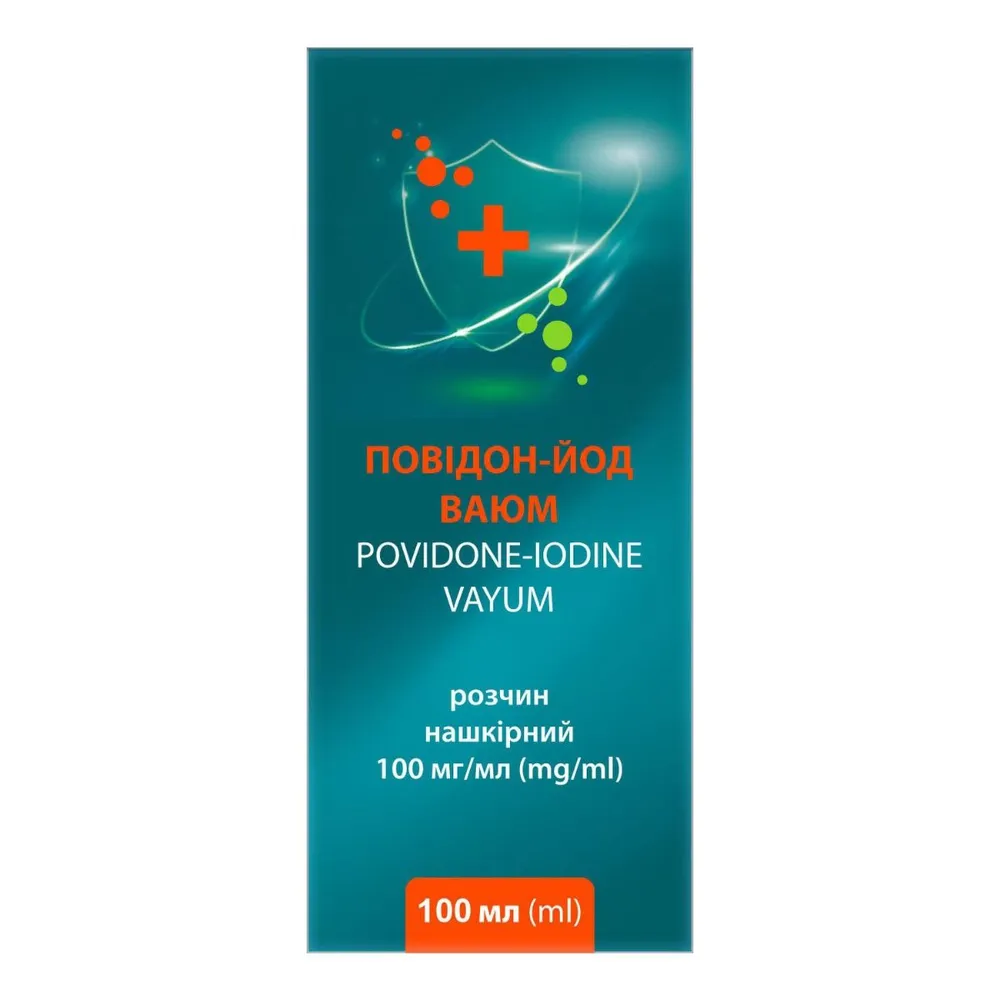
Table of Contents
INSTRUCTIONS FOR MEDICAL USE OF THE MEDICINAL PRODUCT Povidone-Iodine VAYUM (POVIDONE-IODINE VAYUM)
Composition:
Active substance: povidone-iodine;
100 ml of solution contain povidone-iodine 10.0 g;
Excipients: glycerol, purified water.
Pharmaceutical form. Topical solution.
Main physicochemical properties: brown solution with a characteristic iodine odor.
Pharmacotherapeutic group.
Antiseptics and disinfectants. Povidone-iodine.
ATC code D08AG02.
Pharmacological properties.
Pharmacodynamics.
Povidone-iodine is a complex of iodine and the polymer polyvinylpyrrolidone, which releases iodine gradually over a period of time after application to the skin. Free iodine exerts a strong bactericidal effect and has a broad spectrum of antimicrobial activity against bacteria, viruses, fungi, and protozoa.
Mechanism of action: free iodine provides a rapid bactericidal effect, while the polymer acts as an iodine reservoir.
Upon contact with skin and mucous membranes, a significant amount of iodine is released from the polymer.
When complexed with polyvinylpyrrolidone (PVP), iodine largely loses the local irritant properties typical of alcoholic iodine solutions, thus being well tolerated by skin, mucous membranes, and affected surfaces.
Iodine reacts with oxidative sulfhydryl (SH) and hydroxyl (OH) groups of amino acids present in enzymes and structural proteins of microorganisms, inactivating or destroying these proteins. Most microorganisms are destroyed in vitro within less than one minute, with the primary destructive effect occurring within the first 15–30 seconds. During this process, iodine is decolorized, so a change in the intensity of the brown color serves as an indicator of its effectiveness.
The active substance of the medicinal product has a broad antimicrobial spectrum of activity, including action against Gram-positive and Gram-negative bacteria (bactericidal), viruses (virucidal), fungi (fungicidal) and fungal spores (sporicidal), as well as certain protozoa (protozoicidal).
Due to its mechanism of action, resistance to the drug, including secondary resistance during prolonged use, is not expected.
The medicinal product is water-soluble and easily washed off with water.
Pharmacokinetics.
Prolonged application of the medicinal product to large wound surfaces or severe burns, as well as to mucous membranes, may lead to absorption of a significant amount of iodine. Typically, prolonged use results in a rapid increase in blood iodine levels. Concentrations return to baseline levels within 7–14 days after the last application.
In patients with normal thyroid gland function, increased iodine stores do not cause clinically significant changes in thyroid hormone status.
Absorption and renal excretion of povidone-iodine depend on its molecular weight; since this varies between 35,000–50,000, retention of the substance is possible.
The volume of distribution is approximately 38% of body weight. The biological half-life after vaginal administration is about 2 days. Normal total plasma iodine levels are approximately 3.8–6 µg/dL, while inorganic iodine levels range from 0.01–0.5 µg/dL.
The drug is primarily excreted by the kidneys with a clearance rate of 15 to 60 mL/min, depending on plasma iodine levels and creatinine clearance (normally 100–300 µg of iodine per 1 g of creatinine).
Clinical characteristics.
Indications.
For hygienic and surgical hand disinfection and antiseptic treatment of skin and mucous membranes, e.g. prior to surgical procedures, gynecological and obstetric procedures, urinary bladder catheterization, biopsy, injections, punctures, blood collection, as well as in case of accidental skin contamination with infectious material (as an immediate measure). For antiseptic treatment of wounds and burns.
Contraindications.
Hypersensitivity to iodine or suspected hypersensitivity to iodine, or hypersensitivity to other components of the medicinal product; dermatitis herpetiformis Duhring; thyroid gland dysfunction (nodular colloid goiter, endemic goiter, Hashimoto's thyroiditis); period before and after treatment and scintigraphy with radioactive iodine in patients with thyroid carcinoma; renal insufficiency.
The medicinal product is contraindicated during pregnancy after the second month and during breastfeeding.
Interaction with other medicinal products and other types of interactions.
Due to its oxidizing properties, povidone-iodine may interfere with the results of certain diagnostic tests, such as occult blood detection in feces or urine, or glucose detection in urine. When povidone-iodine is used, iodine uptake by the thyroid gland may be reduced—this may affect the results of certain diagnostic tests (e.g. thyroid scintigraphy, measurement of protein-bound iodine, radioactive iodine uptake). Interaction with iodine used for thyroid therapy is also possible.
Simultaneous or immediate sequential application of povidone-iodine after antiseptics containing octenidine may lead to the development of dark necroses at the application sites.
Povidone-iodine should not be used simultaneously with disinfectants containing chlorhexidine, hydrogen peroxide, taurolidine, silver sulfadiazine, mercury, or alkalis due to possible partial reduction of the product's activity.
The product may react with proteins and unsaturated organic compounds; therefore, reduced efficacy of povidone-iodine can be compensated by increasing its dose.
Simultaneous topical application of povidone-iodine and tincture of benzoin may reduce pH, potentially causing a burning sensation, especially if the wound is bandaged.
Concomitant use of povidone-iodine and lithium preparations may produce a synergistic hypothyroid effect.
Special precautions for use.
The use of povidone-iodine may reduce iodine uptake by the thyroid gland, which can affect the results of certain diagnostic tests and procedures (thyroid scintigraphy, determination of protein-bound iodine, diagnostic procedures involving radioactive iodine), making treatment of thyroid disorders with iodine-containing drugs impossible. After discontinuation of povidone-iodine therapy, a break of at least 1–4 weeks is required.
The drug should not be used in patients before or after radioactive iodine treatment for thyroid cancer or during radioactive iodine scintigraphy.
Significant amounts of iodine may induce hyperthyroidism in patients with impaired thyroid function (e.g., nodular colloid goiter, endemic goiter). Therefore, the duration of use and the treated surface area should be limited in such patients. Even after completion of treatment, patients should be monitored for early symptoms of hyperthyroidism and thyroid function should be controlled.
The oxidizing effect of povidone-iodine may cause false-positive results in diagnostic tests (e.g., toluidine and guaiac tests for hemoglobin, and tests for glucose in feces and urine).
The oxidizing effect of povidone-iodine may cause corrosion of metals, whereas plastics and synthetic materials are generally resistant to povidone-iodine. In some cases, a change in the color of povidone-iodine may be observed, which usually resolves spontaneously.
Povidone-iodine can be easily removed from textiles and other materials with warm water and soap. Stubborn stains should be treated with ammonia or sodium thiosulfate solution.
During preoperative skin disinfection, care should be taken to ensure that no residual solution remains under the patient’s body (due to possible skin irritation).
Since the development of hyperthyroidism cannot be ruled out, prolonged use of povidone-iodine (more than 14 days) or its application in large amounts over extensive body surfaces (more than 10% of body surface area) in patients (especially elderly patients) with latent thyroid dysfunction is permissible only after careful assessment of the benefit-risk ratio. Such patients should be monitored for early signs of hyperthyroidism and appropriate evaluation of thyroid function, even after discontinuation of the drug (for up to 3 months).
Povidone-iodine should be used in newborns and children under 1 year of age only under strict indications. If necessary, thyroid function should be monitored.
Light and temperatures above 40 °C accelerate the degradation of the active substance.
Oropharyngeal administration may lead to the development of pneumonitis.
The solution is intended for external use only.
Use during pregnancy or breastfeeding.
Povidone-iodine has no teratogenic effects. The drug is contraindicated after the 2nd month of pregnancy and during breastfeeding. Iodine crosses the placental barrier and may pass into breast milk. The concentration of the drug in breast milk exceeds that in plasma. There is a risk of transient hypothyroidism in the newborn if the drug enters the child’s gastrointestinal tract. Breastfeeding must be discontinued during treatment.
Ability to affect reaction rate while driving or operating machinery.
Unknown.
Method of Administration and Dosage
The medicinal product is intended for topical use, either undiluted or diluted.
Do not mix the preparation with hot water. Only brief warming to body temperature is permitted.
Dosage.
Undiluted solution is used for disinfection of hands and patient's skin prior to surgery, urinary catheterization, injections, and punctures.
The solution can be applied 2–3 times daily.
Hygienic hand disinfection
Apply 2 times 3 mL of undiluted solution; each 3 mL dose remains on the skin for 30 seconds.
Surgical hand disinfection
Apply 2 times 5 mL of undiluted solution; each 5 mL dose remains on the skin for 5 minutes.
For skin disinfection, the undiluted solution is left on the skin until it dries.
For the indications specified above, the solution may also be used after dilution with tap water. However, for surgical procedures and for antiseptic treatment of wounds and burns, the solution should be diluted with 0.9% sodium chloride solution or Ringer's solution.
The following dilutions are recommended:
| Indications |
Dilution |
Volume of preparation / volume of diluent |
| Wet compress |
1:5 – 1:10 |
200 ml – 100 ml / 1 L |
| Sitz baths |
1:25 |
40 ml / 1 L |
| Preoperative bath |
1:100 |
10 ml / 1 L |
| Hygienic bath |
1:1000 |
10 ml / 10 L |
| Vaginal douching Intrauterine contraceptive device (IUD) insertion Perineal irrigation Irrigation in urology |
1:25 |
4 ml / 100 ml |
| Irrigation of chronic and postoperative wounds |
1:2 – 1:20 |
50 ml – 5 ml / 100 ml |
| Irrigation in orthopedics and traumatology Irrigation during oral cavity surgery |
1:10 |
10 ml / 100 ml |
The solution should be diluted immediately before use.
Children.
Povidone-iodine should be used in newborns and children under 1 year of age only under strict indications. If necessary, thyroid function should be monitored.
Overdose.
Symptoms characteristic of acute iodine intoxication include:
- metallic taste in the mouth, increased salivation, sensation of burning or pain in the mouth or throat;
- eye irritation and swelling;
- skin reactions;
- gastrointestinal disturbances and diarrhea;
- renal dysfunction and anuria;
- circulatory insufficiency;
- laryngeal edema with secondary asphyxia, pulmonary edema, metabolic acidosis, hypernatremia. Prolonged treatment of burn wounds with large amounts of povidone-iodine may provoke disturbances in electrolyte balance or serum osmolarity, leading to renal dysfunction or metabolic acidosis.
Treatment. Symptomatic and supportive therapy should be administered, with special attention to electrolyte balance, renal function, and thyroid function.
In cases of intoxication due to oral ingestion, immediate administration of food products containing starch or protein (such as starch solution in water or milk) is indicated, followed by gastric lavage with 5% sodium thiosulfate solution. If necessary, intravenous administration of 10 ml of 10% sodium thiosulfate solution at 3-hour intervals may be performed. Monitoring of thyroid function is recommended for early detection of iodine-induced hyperthyroidism.
Side effects.
Laboratory findings: changes in serum electrolyte levels (hypernatremia) and osmolality, metabolic acidosis.
Renal and urinary system disorders: impaired kidney function, acute kidney failure.
Skin and subcutaneous tissue disorders: local hypersensitivity skin reactions such as contact dermatitis with formation of psoriasis-like small erythematous bullous lesions; allergic reactions including itching, redness, rash, angioneurotic edema. Chemical skin burn. If these symptoms occur, discontinue use of the medicinal product.
Endocrine system disorders: hyperthyroidism, hypothyroidism. Prolonged use of povidone-iodine may lead to absorption of a large amount of iodine.
In some cases, iodine-induced hyperthyroidism has been reported following prolonged use of the product, primarily in patients with pre-existing thyroid disease.
In rare cases, generalized acute reactions with hypotension and/or respiratory distress (anaphylactic reactions) may occur.
Shelf life.
3 years.
Do not use the medicinal product after the expiry date stated on the packaging.
Storage conditions.
Store in the original packaging at a temperature not exceeding 25 °C.
Keep out of reach of children.
Packaging.
30 ml, 50 ml, 100 ml in a bottle; 50 ml in a bottle with a spray dispenser; 1 bottle in a carton.
500 ml in a bottle.
Supply category.
Over-the-counter.
Manufacturer.
LLC «ELADUM PHARMA».
ELADUM PHARMA SRL.
Manufacturer's name and address of the place of business.
MD-3715, Centenarului str., no. 2/c, Cojusna village, Straseni district, Republic of Moldova.
MD-3715, Centenarului street, no. 2/c, Cojusna village, Straseni district, Republic of Moldova.
Marketing authorization holder.
LLC «VAYUM-PHARM».
Address of the marketing authorization holder.
7A Y. Glushka St., apt. 1, Kyiv, 04060, Ukraine.