Polydex
Ukraine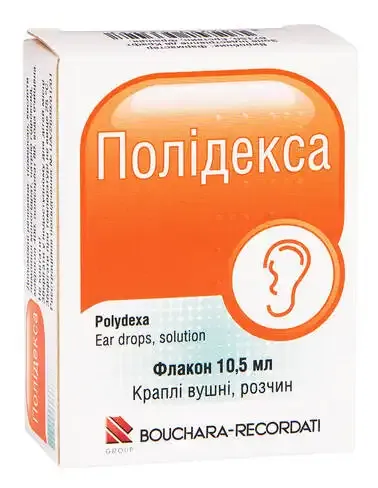
Table of Contents
INSTRUCTIONS FOR MEDICAL USE OF THE MEDICINAL PRODUCT POLYDEXA (POLYDEXA)
Composition:
Active substances: 1 ml of solution contains neomycin sulfate 10 mg (6500 IU), polymyxin B sulfate 10000 IU, dexamethasone sodium metasulfobenzoate 1 mg;
Excipients: thiomersal, citric acid monohydrate, sodium hydroxide, macrogol 400, polysorbate 80, purified water.
Pharmaceutical form. Ear drops, solution.
Main physico-chemical properties: clear yellow-colored solution.
Pharmacotherapeutic group.
Combined preparations containing corticosteroids and antimicrobial agents. Dexamethasone and antimicrobial agents.
ATC code S02C A06.
Pharmacological properties.
Pharmacodynamics.
The therapeutic effect is due to the anti-inflammatory action of dexamethasone and the antimicrobial activity of neomycin and polymyxin B. When these antibiotics are combined, the spectrum of antimicrobial action is broadened against most Gram-positive and Gram-negative microorganisms causing infectious and inflammatory ear diseases.
Polymyxin B is active against Acinetobacter, Aeromonas, Alcaligenes, Citrobacter, Enterobacter, E.coli, Klebsiella, Moraxella, P.aeruginosa, Salmonella, Shigella, S.maltophilia.
Resistant to polymyxin B are cocci and bacilli, B.catarrhalis, Brucella, B.cepacia, B.pseudomallei, Campylobacter, C.meningosepticum, Legionella, Morganella, Neisseria, Proteus, Providencia, Serratia, V.cholera El Tor, Mycobacteria.
Neomycin is active against Corynebacterium, Listeria monocytogenes, Met-S Staphylococcus, Acinetobacter, B.catarrhalis, Campylobacter, Citrobacter, Enterobacter, E.coli, H.influenzae, Klebsiella, Morganella, Proteus, Providencia, Salmonella, Serratia, Shigella, Yersinia, Pasteurella.
Resistant to neomycin are Enterococci, N.asteroides, Met-R Staphylococcus, Streptococcus, A.denitrificans, Burkholderia, Flavobacterium sp., P.stuartii, P.aeruginosa, S.maltophilia, Chlamydia, Mycoplasma, Rickettsiae, and resistant anaerobic bacteria.
Pharmacokinetics.
In the absence of tympanic membrane damage, systemic absorption is not observed.
Clinical characteristics.
Indications.
Local treatment of bacterial external otitis without damage to the tympanic membrane, including infectious eczema of the external auditory canal.
Contraindications.
Hypersensitivity (allergy) to any component of the medicinal product, particularly to neomycin or other aminoglycosides, polymyxin B, or dexamethasone; existing or suspected perforation of the tympanic membrane; presence of signs of viral infection in the external auditory canal, including varicella (chickenpox) and infection caused by Herpes simplex.
Interaction with other medicinal products and other forms of interaction.
Concomitant use of this medicinal product with any other locally applied medicinal products is not recommended.
Concurrent treatment with CYP3A inhibitors, including medicinal products containing cobicistat, may increase the risk of systemic adverse reactions. Such combinations should be avoided unless the benefit outweighs the increased risk of systemic corticosteroid-related adverse effects. If such combinations are prescribed, treatment should be administered under physician supervision with monitoring for systemic corticosteroid adverse effects.
No studies on drug interactions with other agents have been conducted.
The effect of critical concentrations of the antibacterial components of the medicinal product was studied to determine susceptible, intermediate, or resistant strains of microorganisms.
Special precautions for use
Warning. Prior to initiating treatment, an examination of the tympanic membrane must be performed. The use of the drug is contraindicated if the integrity of the tympanic membrane is compromised, as irreversible ototoxic effects (e.g. deafness, balance disturbances) may occur.
Local application of antibacterial agents may lead to sensitization to the active substances and may result in systemic reactions.
The presence of a corticosteroid does not prevent skin allergic reactions to antibiotics, but may alter the clinical presentation of an allergic reaction.
The drug must be discontinued immediately if skin rash or other local or systemic signs of allergic reactions occur.
Athletes should be informed that this medicinal product contains an active substance (dexamethasone) that may lead to a positive doping test.
Do not swallow the solution; do not use by injection.
During use, avoid touching the dropper tip with fingers and avoid contact of the dropper with the ear to minimize the risk of contamination.
If symptoms persist after 10 days of treatment, the patient should consult a physician for reassessment of diagnosis and treatment strategy.
Despite topical application, it should be considered that prolonged use (beyond the recommended duration) or use of doses significantly exceeding the recommended ones may result in systemic effects.
When treating with this medicinal product, official recommendations for appropriate use of antibiotics must be followed.
Visual disturbances
Visual disturbances may occur during systemic or local corticosteroid therapy. If blurred vision or any other visual symptoms occur during corticosteroid treatment, an ophthalmological examination is required to rule out cataract, glaucoma, or rarer conditions such as central serous retinopathy, which may occur with systemic or local corticosteroid use.
Thiomersal
The medicinal product contains thiomersal, which may cause local skin reactions (e.g. contact dermatitis) and skin discoloration (see section "Adverse reactions").
Use during pregnancy or breastfeeding
Pregnancy
Data on the use of this drug in animals and in clinical practice are lacking. However, systemic exposure in the absence of tympanic membrane perforation is unlikely.
The use of this drug during pregnancy should only be considered if clearly needed.
Breastfeeding
The use of this drug during breastfeeding should only be considered if clearly needed.
Fertility
Not applicable.
Ability to affect reaction speed when driving or operating machinery.
No influence on the ability to drive or operate machinery has been observed.
Method of Administration and Dosage.
Apply the medication topically by instilling drops into the ear.
Instill drops into the external auditory canal of the affected ear each morning, and repeat the procedure in the evening.
Dosage for adults: 1–5 drops into the affected ear twice daily.
Dosage for children (depending on the child's age): 1–2 drops into the affected ear twice daily.
The duration of treatment depends on the nature and severity of the disease and is determined individually by the physician. The average duration of treatment is 7 days.
Before using the drops, warm the bottle by holding it in the palm of the hand to avoid discomfort caused by instillation of cold liquid into the ear. Tilt the head, instill the required number of drops into the ear, and gently pull the earlobe several times. Keep the head tilted for about 5 minutes to facilitate better penetration of the solution into the auditory canal. If necessary, repeat the procedure for the other ear.
Do not administer the medication under pressure.
After completion of treatment, the bottle should be discarded; do not store the medication for future use.
Children.
Use only as prescribed by a physician for the treatment of children of any age.
Overdose.
No cases of overdose have been reported.
Adverse reactions.
Adverse reactions are classified by frequency and organ system classes. Frequency is defined as follows: very common (> 1/10), common (from > 1/100 to < 1/10), uncommon (from > 1/1000 to < 1/100), rare (from > 1/10000 to < 1/1000), very rare (< 1/10000), frequency not known (cannot be estimated based on available data).
| Organ system Class |
Adverse reactions |
Frequency |
| Infections and infestations |
Antibiotic-resistant microorganisms |
Unknown |
| Immune system disorders |
Allergy to antibiotics (neomycin, polymyxin B)1 |
Unknown |
| Eye disorders |
Blurred vision |
Unknown |
| Ear and labyrinth disorders |
Vestibular or cochlear ototoxicity2 |
Unknown |
| Skin and subcutaneous tissue disorders |
Local skin reactions (e.g., contact dermatitis)3 Skin discoloration3 |
Unknown |
| General disorders and administration site conditions |
Local reactions (irritation) |
Unknown |
1 Sensitization, which may interfere with further general use of the respective antibiotic.
2 In case of perforation of the tympanic membrane.
3 Associated with the presence of thiomersal.
Reporting of adverse reactions following registration of the medicinal product is of great importance. This allows continuous monitoring of the benefit-risk balance of the medicinal product. Healthcare and pharmaceutical professionals, as well as patients or their legal representatives, should report all suspected adverse reactions and lack of efficacy of the medicinal product via the Automated Information System for Pharmacovigilance at the following link: https://aisf.dec.gov.ua.
Shelf life. 3 years.
Storage conditions.
Store at a temperature not exceeding 25 °C.
Keep out of reach and sight of children.
Packaging. 10.5 ml in a vial, 1 vial with a dropper in a cardboard box.
Prescription status. Prescription only.
Manufacturer. Pharmaster.
Manufacturer's location and address of its place of business.
Zone Industrielle de Kraft 67150, Erstein, France.