Poly-mix b
Ukraine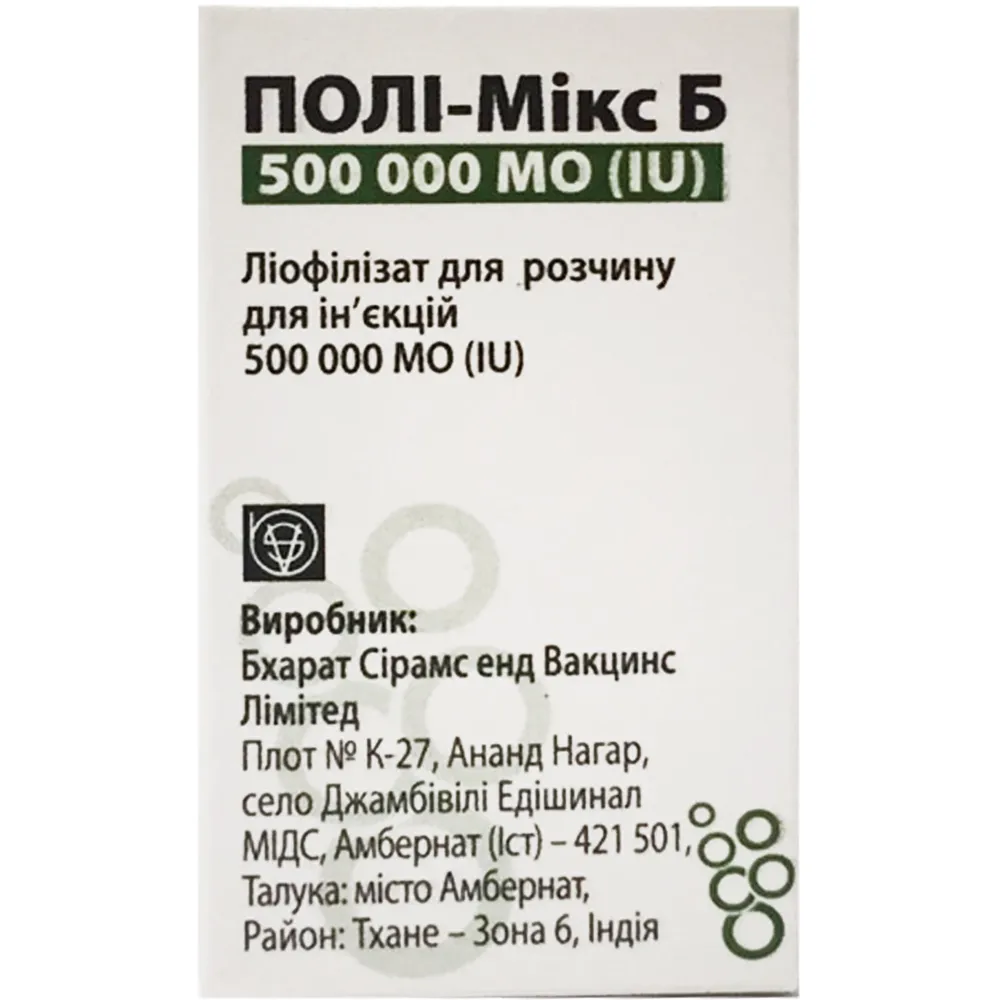
Table of Contents
INSTRUCTION FOR MEDICAL USE OF THE MEDICINAL PRODUCT POLY-MxB (POLY-MxB)
Composition:
Active substance: polymyxin B;
1 vial contains polymyxin B sulfate equivalent to polymyxin B 500,000 IU;
Pharmaceutical form. Lyophilisate for solution for injection.
Main physicochemical properties: white or almost white lyophilized powder which, when reconstituted with 5 ml of water for injections, forms a clear, colorless solution.
Pharmacotherapeutic group. Antibacterials for systemic use.
ATC code J01XB02.
Pharmacological properties.
Pharmacodynamics.
Polymyxin belongs to the group of polypeptide antibiotics and is produced by Bacillus polymyxa. Polymyxin B sulfate exerts a bactericidal effect against almost all Gram-negative bacteria, except for the Proteus group. Polymyxins increase the permeability of the bacterial cell membrane. All Gram-positive bacteria, fungi, and Gram-negative cocci, N. gonorrhoeae and N. meningitidis, are resistant to polymyxin B.
Susceptibility test determination on plate: when using the disk diffusion method of Kirby-Bauer, a disk containing 300 IU of polymyxin B should yield a zone of inhibition greater than 11 mm to identify a bacterial strain as resistant to polymyxin B.
Pharmacokinetics.
Polymyxin B sulfate is not absorbed from the normal gastrointestinal tract. Since the drug loses 50% of its activity in blood serum, serum levels of activity are low.
Repeated injections may lead to a cumulative effect. Activity levels are generally higher in infants and children.
The drug is slowly excreted by the kidneys. Tissue penetration is low, and it does not cross the blood-brain barrier into cerebrospinal fluid. At therapeutic doses, polymyxin B sulfate causes some nephrotoxicity with mild tubular damage.
Clinical characteristics.
Indications.
Polymyxin B sulfate is the drug of choice for the treatment of urinary tract infections, meningitis, and bacteremia caused by susceptible strains of Pseudomonas aeruginosa.
Indicated for serious infections caused by susceptible strains of the following organisms:
- H. influenzae, including meningitis.
- Escherichia coli, including urinary tract infections.
- Aerobacter aerogenes, including bacteremia.
- Klebsiella pneumoniae, including bacteremia.
POLY-Mix B may also be used as a subconjunctival injection for the treatment of eye infections caused by susceptible strains of Ps. aeruginosa.
Contraindications.
POLY-Mix B is contraindicated in patients who have previously experienced hypersensitivity reactions to polymyxins.
Interaction with other medicinal products and other forms of interaction.
Concomitant use of polymyxins with neuromuscular blocking agents (curare-like) and other neurotoxic drugs, such as ether, tubocurarine, succinylcholine, gallamine, decamethonium, and sodium citrate, should be avoided, as these agents may cause the development of neuromuscular blockade. Simultaneous administration of sodium cephalothin and polymyxins may enhance the development of neurotoxicity, and therefore this combination of antimicrobial agents should be avoided. In addition, antimicrobial agents with neurotoxic effects, such as aminoglycosides, should either be avoided or used with extreme caution in patients receiving polymyxins. In such cases, careful monitoring of patients receiving these antibiotics is required. Experimental studies have shown that the use of polymyxins in combination with glutamic acid may cause degenerative atrophy in the peripheral nerve.
Special precautions for use.
Intramuscular and intrathecal administration should be prescribed only for hospitalized patients to ensure continuous medical supervision.
When using nearly all antibacterial agents, including polymyxin B sulfate, there is a risk of developing Clostridium difficile-associated pseudomembranous colitis and diarrhea, the severity of which may range from mild diarrhea to fatal colitis. If antibiotic-associated diarrhea or colitis is suspected or confirmed, the current antibacterial treatment (including polymyxin B sulfate) must be discontinued and appropriate therapeutic measures should be initiated immediately.
POLY-Mix B should be used with caution in patients with nephrotoxic syndromes, as albuminuria, tubular-cell casts, and azotemia may occur after administration of the drug. If urine output decreases and serum blood urea nitrogen levels increase, therapy with this drug should be discontinued.
There have been reports that high serum concentrations of the drug in patients with impaired renal function and/or nephrotoxicity may lead to neurotoxic reactions such as irritability, weakness, drowsiness, ataxia, peripheral paresthesia, limb numbness, and blurred vision.
Neurotoxicity of POLY-Mix B may result in respiratory paralysis due to neuromuscular blockade, particularly when the drug is administered shortly after anesthesia and/or muscle relaxants.
Renal function should be monitored prior to initiating therapy, and during parenteral treatment, monitoring of renal function and drug levels in the blood is required. Concomitant use of curare-like muscle relaxants and other neurotoxic drugs (ether, tubocurarine, succinylcholine, gallamine, decamethonium, and sodium citrate), which may cause respiratory depression, should be avoided. If signs of respiratory paralysis occur, respiration must be restored and administration of the drug discontinued.
Like other antibiotics, this medicinal product may cause overgrowth of pathogenic microorganisms, including fungi. If superinfection occurs, appropriate therapy should be initiated and monitoring continued for 2 months after completion of treatment.
Use during pregnancy or breastfeeding.
The safety of the medicinal product POLY-Mix B during pregnancy has not been established.
There is no information available regarding the excretion of the drug into breast milk during lactation.
Ability to affect reaction rate while driving or operating machinery.
No influence of the medicinal product on the ability to drive vehicles or operate machinery has been observed.
Administration and Dosage
For intravenous use
Dissolve 500,000 IU of polymyxin B sulfate in 300–500 mL of 5% aqueous dextrose solution for continuous intravenous infusion.
Adults and children: 15,000 to 25,000 IU/kg body weight per day for patients with normal renal function. For patients with impaired renal function, the dose should be reduced from 15,000 IU/kg. The injection may be administered every 12 hours; however, the total daily dose must not exceed 25,000 IU/kg per day.
Infants: Infants with normal renal function may receive up to 40,000 IU/kg per day without adverse effects.
For intramuscular use
Due to severe pain at the injection site, repeated administration is not recommended, especially in infants and children.
Dissolve 500,000 IU of polymyxin B sulfate in 2 mL of sterile distilled water (sterile water for injection), sterile physiological saline (sodium chloride), or 1% procaine hydrochloride solution.
Adults and children: 25,000 to 30,000 IU/kg per day. The dose should be reduced in the presence of renal insufficiency. The daily dose may be divided and administered every 4 or 6 hours.
Infants: Infants with normal renal function may receive up to 40,000 IU/kg per day without adverse effects.
Doses reaching 45,000 IU/kg per day have been used in limited clinical studies for the treatment of premature and newborn infants with sepsis caused by Ps. aeruginosa.
For intrathecal use
This preparation is best suited for the treatment of meningitis caused by Ps. aeruginosa.
Dissolve 500,000 IU of polymyxin B sulfate in 5 mL of sterile physiological saline (sodium chloride) to obtain a concentration of 100,000 IU/mL. Then dilute the resulting solution in 5 mL of sterile physiological saline (sodium chloride) to obtain a concentration of 50,000 IU/mL.
Adults and children aged 2 years and older: administer a dose of 50,000 IU once daily intrathecally for 3–4 days, followed by 50,000 IU every other day for at least 2 weeks after cerebrospinal fluid cultures become negative and glucose levels in the cerebrospinal fluid normalize.
Children under 2 years of age: administer a dose of 20,000 IU once daily intrathecally for 3–4 days or 25,000 IU every other day. Continue administration of 25,000 IU every other day for at least 2 weeks after cerebrospinal fluid cultures become negative and glucose levels in the cerebrospinal fluid normalize.
For ophthalmic use (only for subconjunctival injection)
For the treatment of ocular infections caused by Ps. aeruginosa, use a solution concentration of 0.1% to 0.25% (10,000–25,000 IU/mL), instilling 1–3 drops hourly, increasing the interval depending on the therapeutic response.
Dissolve 500,000 IU of polymyxin B sulfate in 20–50 mL of sterile water for injection or sterile physiological saline (sodium chloride) to obtain a concentration of 10,000–25,000 IU/mL.
For the treatment of corneal infections and conjunctivitis caused by Ps. aeruginosa, a dose of up to 100,000 IU per day may be administered as a subconjunctival injection.
However, care should be taken to avoid exceeding the total systemic and ophthalmic instillation dose of more than 25,000 IU/kg/day.
Children
POLY-Mix B should be used with caution (see section "Administration and Dosage").
Overdose
Cases of polymyxin overdose, primarily sodium colistimethate, have been reported. In most cases, polymyxin overdose led to acute renal failure and various manifestations of neurotoxicity, including neuromuscular blockade and apnea. Fatal cases of polymyxin overdose are rare. There are no known agents capable of counteracting the effects of polymyxin in case of overdose.
Treatment requires immediate discontinuation of the drug and appropriate supportive therapy. In cases of acute renal failure, hemodialysis and peritoneal dialysis may exacerbate renal dysfunction, as they have minimal effect on the elimination of polymyxins. If apnea occurs, artificial ventilation of the lungs must be performed.
Adverse Reactions.
Renal toxicity reactions:
- albuminuria;
- cylindruria;
- azotemia;
- increased serum drug levels without dose escalation.
Neurotoxic reactions:
- facial flushing;
- dizziness up to ataxia;
- somnolence;
- peripheral paresthesia: perioral paresthesia and paresthesia with pain sensation in a "stocking and glove" distribution;
- apnea due to concomitant use of curare-like muscle relaxants, other neurotoxic drugs, or accidental overdose;
- signs of meningitis following intrathecal administration, such as: fever, headache, neck stiffness, increased cell count and protein in cerebrospinal fluid.
Other types of reactions:
- drug fever;
- urticarial rash;
- pain (severe) at intramuscular injection sites;
- thrombophlebitis at intravenous administration sites.
Shelf life.
3 years.
Storage conditions.
Store at a temperature not exceeding 25 °C. Protect from light. Keep out of reach of children.
The prepared solution after reconstitution should be stored at a temperature between 2 °C and 8 °C. Unused medicinal product must be discarded 72 hours after reconstitution.
Incompatibility.
In the absence of compatibility studies, POLI-Mix B should not be administered simultaneously with other medicinal products.
Packaging.
1 vial of lyophilisate for solution for injection in a cardboard box.
Prescription category. Prescription only.
Manufacturer.
Bharat Serums and Vaccines Limited.
Manufacturer's address and location of business operations.
PLOT NO: K-27, PARTS K-27 AND K-27/1, ANAND NAGAR, VILLAGE JAMBIWILI, EDISHINAL MIDS, AMBERNATH (I) – 421506
Taluka: AMBERNATH CITY, District: THANE - ZONE 6, India