Pms-cholestyramine regular with orange flavor
Ukraine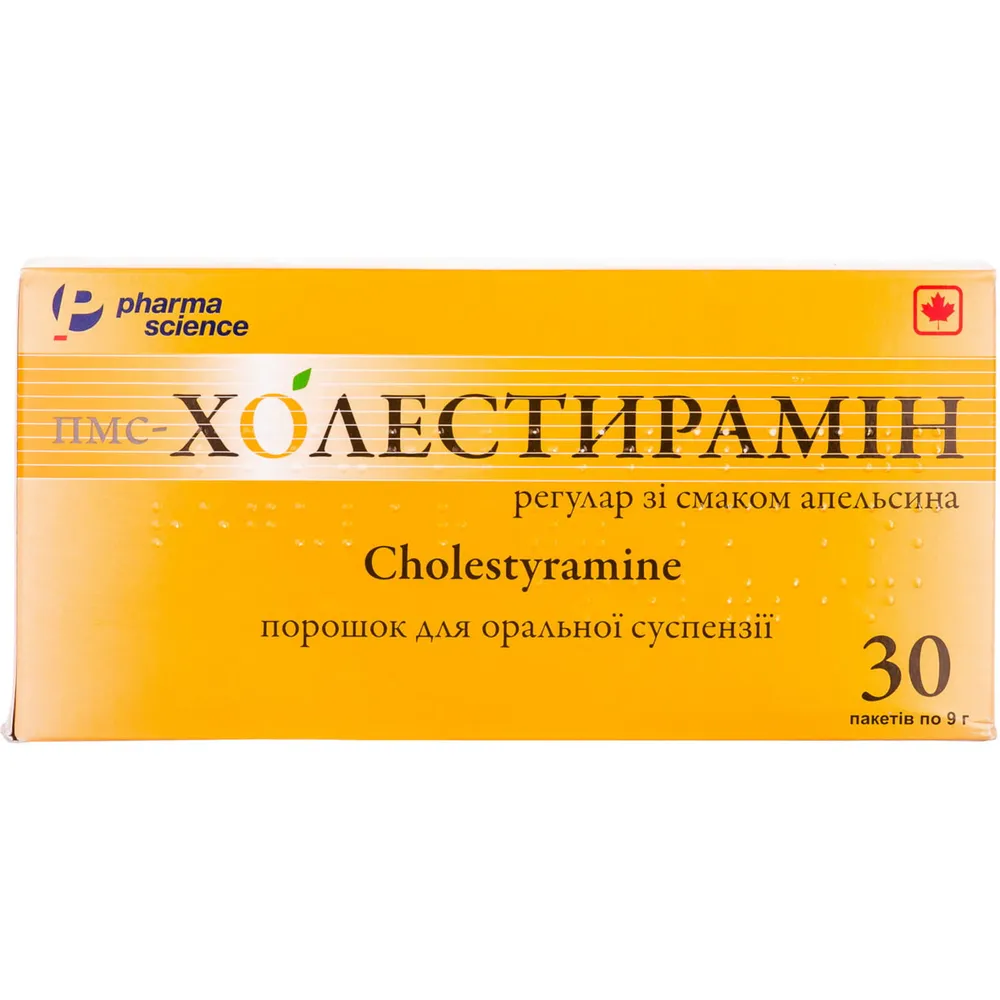
Table of Contents
INSTRUCTIONS FOR MEDICAL USE OF THE MEDICINAL PRODUCT pms-Cholestyramine Regular Orange Flavour
Composition:
Active substance: cholestyramine resin, a copolymer of styrene and divinylbenzene with quaternary ammonium functional groups;
1 sachet of powder contains 4 g of cholestyramine resin;
Excipients: sucrose, anhydrous citric acid, colloidal anhydrous silicon dioxide, colouring agent Yellow No. 4 FCF (E 110), colouring agent D&C Yellow No. 10 (quinoline yellow E 104), 15% D&C Yellow No. 10 aluminium lake (quinoline yellow E 104), propylene glycol alginate, orange flavour containing: orange flavour, maltodextrin, acacia (gum arabic E 414), butylated hydroxytoluene (E 321).
Pharmaceutical form. Powder for oral suspension.
Main physicochemical properties: fine powder of white or yellowish colour with a slight orange odour. Foreign particles are absent.
Pharmacotherapeutic group.
Lipid-lowering agents. Cholestyramine. ATC code C10AC01.
Pharmacological properties.
Pharmacodynamics.
Cholestyramine is an anion-exchange resin with quaternary ammonium groups on a polystyrene polymeric backbone. In the form of chloride, it binds bile acids in vivo and in vitro, exchanging chloride ions for bile acid ions.
Pharmacokinetics.
The only precursor of bile acids in the body is cholesterol. During normal digestion, bile acids are secreted into the intestine. The majority of bile acids are reabsorbed from the intestine and returned to the liver via enterohepatic circulation. In serum of healthy individuals, only a relatively small amount of bile acids is present.
In the intestine, cholestyramine binds bile acids, forming an insoluble complex that is excreted in feces. Thus, a portion of bile acids does not return to the liver via enterohepatic circulation.
As a result of significant loss of bile acids in feces during cholestyramine administration, enhanced oxidation of cholesterol occurs to form bile acids. This process leads to a reduction in plasma beta-lipoprotein or low-density lipoprotein levels, as well as a decrease in serum cholesterol concentration. Therefore, despite increased cholesterol synthesis in the liver, its plasma concentration decreases.
Clinical characteristics.
Indications.
Cholestyramine is indicated as an adjunctive therapy (in addition to diet and physical exercise) for lowering elevated serum cholesterol levels in patients with primary hypercholesterolemia, aimed at reducing the risk of atherosclerotic coronary artery disease and myocardial infarction.
Cholestyramine may be used to reduce elevated cholesterol levels in patients with combined hypercholesterolemia and hypertriglyceridemia; however, the drug is not indicated when hypertriglyceridemia is the predominant disorder.
Cholestyramine may be used for symptomatic treatment of diarrhea caused by bile acids in patients with short bowel syndrome, as well as for relief of pruritus associated with cholestasis due to partial obstruction of the biliary tract.
Contraindications.
Cholestyramine is contraindicated in complete obstruction of the biliary tract, when bile cannot enter the intestine at all.
The drug is contraindicated in patients with known hypersensitivity to the active substance or to any of the excipients contained in the formulation.
Interaction with other medicinal products and other forms of interactions.
As an ion-exchange resin, cholestyramine has a high affinity not only for bile acids but also for other anions. It is difficult to predict a priori whether cholestyramine administration will affect the intestinal absorption of certain medicinal products. The potential for such interaction between drugs and cholestyramine should be considered unless absence of interaction has been proven by clinical studies.
Cholestyramine may reduce the absorption of orally administered drugs such as thyroxine, warfarin, chlorothiazide (acidic form), phenylbutazone, tetracycline, penicillin G, and digoxin. It should be noted that upon discontinuation of cholestyramine, toxic effects related to digoxin may occur if the dose of digoxin had been increased to compensate for its reduced absorption under the influence of cholestyramine. Cholestyramine may also affect the pharmacokinetics of drugs undergoing enterohepatic recirculation, such as estrogens.
Studies on the interaction between cholestyramine and various HMG-CoA reductase inhibitors have been conducted. Although cholestyramine reduces the bioavailability of these inhibitors, the clinical effects on cholesterol reduction when combining HMG-CoA reductase inhibitors with cholestyramine are additive.
It should be noted that cholestyramine may bind other medicinal products. Therefore, other medicinal products should be administered no later than 1 hour before, or no earlier than 4–6 hours (preferably even longer) after, administration of cholestyramine.
Special precautions for use.
The drug should not be used in dry form. The drug is intended only for use as an aqueous suspension.
Before initiating cholestyramine therapy, other cholesterol-lowering measures (e.g., dietary therapy, weight reduction) should be attempted. It is also necessary to treat underlying conditions such as hypothyroidism, diabetes mellitus, nephrotic syndrome, dysproteinaemia, obstructive liver diseases, which may be the cause of hypercholesterolaemia. It is also important to verify whether the use of other medicinal products may increase low-density lipoprotein cholesterol levels. A positive trend toward lowering cholesterol levels is observed within the first month of cholestyramine treatment. The drug may be continued to maintain the achieved effect.
There is a possibility that the use of cholestyramine as chloride may lead to hyperchloraemic acidosis, which is particularly more likely in younger individuals, where the relative dose of the drug will be higher.
Cholestyramine use may cause constipation or exacerbate existing constipation. In such cases, the dose of the drug should be reduced or the drug discontinued. Haemorrhoids may also be aggravated due to constipation. In any case, it is advisable to avoid allowing the patient to reach such a condition, especially in the presence of clinical symptoms of coronary artery disease.
Cholestyramine may potentially cause steatorrhoea or exacerbate existing steatorrhoea. In such cases, a reduction in the dose of the drug may be required.
Effect on vitamin absorption: Since cholestyramine binds bile acids, it may interfere with intestinal absorption of fat-soluble vitamins A, D, and K. During prolonged cholestyramine therapy, parenteral forms of a mixture of vitamins A and D should be administered.
Vitamin K deficiency developing during prolonged cholestyramine use may lead to hypoprothrombinaemia and an increased risk of bleeding. In the event of such manifestations, parenteral forms of vitamin K1 should be administered; prevention of recurrences is also possible with oral administration of vitamin K1.
Prolonged use of cholestyramine may also lead to decreased serum or erythrocyte folate levels. In such cases, folic acid-containing preparations should be taken.
Laboratory tests. During the first months of cholestyramine use, regular monitoring of serum cholesterol levels is required. Periodic monitoring should continue thereafter. Serum triglyceride levels should also be monitored periodically.
Use in patients aged 60 years and older.
Adequate studies on the efficacy of cholestyramine in different age groups have not been conducted. However, gastrointestinal adverse effects are more likely in elderly patients.
Excipients.
The drug contains sucrose. If you have been diagnosed with intolerance to certain sugars, consult your doctor before taking this medicinal product.
The drug contains the colouring agent Sunset Yellow FCF (E 110), which may cause allergic reactions.
Use during pregnancy or breastfeeding.
Since cholestyramine is not absorbed from the gastrointestinal tract, it theoretically cannot have a negative effect on the fetus when taken at recommended doses. However, controlled clinical studies on the use of the drug in pregnant women have not been conducted. In addition, cholestyramine may interfere with the intestinal absorption of fat-soluble vitamins, which may adversely affect fetal development.
The drug should be used with caution in breastfeeding women, as it may interfere with vitamin absorption in the intestine, potentially leading to inadequate nutrition of the infant.
Thus, the use of the drug in pregnant women and women who are breastfeeding is possible only when the potential benefit of the drug use outweighs the potential risk to the fetus or infant.
Ability to influence reaction speed when driving or operating machinery.
There are no data available; however, the possibility of developing nervous system-related adverse reactions such as dizziness, drowsiness, and loss of consciousness should be considered.
Administration and Dosage
Cholestyramine is administered orally.
To minimize possible gastrointestinal adverse effects, it is advisable to initiate therapy with one dose of the drug once daily. The dosage may then be increased after 1–2 days.
It is important to motivate the patient to adhere to the prescribed treatment regimen despite the occurrence of gastrointestinal adverse effects. Successful treatment depends significantly on ensuring compliance with the prescribed dosing schedule.
The recommended adult dosage is 4 g of cholestyramine 1 to 6 times daily. The dosage may be adjusted to best meet the individual needs of the patient.
The drug must not be taken in dry form; it is intended solely for administration as an aqueous suspension.
Preparation of the drug for administration: The color of the drug may vary from batch to batch, which does not affect the quality of the drug.
To prepare the suspension, the contents of one sachet should be placed into a glass containing 120–180 mL of water or a non-carbonated beverage (such as milk or fruit juice). After 1 minute, the powder should be mixed vigorously in the liquid. The powder may also be mixed in soup or in pulpy juice freshly squeezed from fruits (such as apples or pineapples).
Children
The safety and efficacy of cholestyramine in children have not been established.
Overdose
One case of overdose has been reported in a patient who took the drug for several weeks at a dose of 150% of the maximum recommended daily dose. No significant adverse effects were observed. The main potential consequence of overdose is gastrointestinal obstruction. The required symptomatic therapy is determined by the presence and severity of such obstruction.
Adverse Reactions
The most common adverse effect associated with cholestyramine use is constipation, particularly at high doses and in elderly patients (aged 60 years and older). In most cases, these side effects can be managed with standard symptomatic therapy. In some cases, temporary dose reduction or discontinuation of the drug may be required.
Less frequently observed adverse effects include gastric distension, flatulence, abdominal bloating, nausea, vomiting, diarrhea, steatorrhea, anorexia, heartburn, skin rash, skin irritation, irritation of the tongue and perianal area, tendency to bleeding due to hypoprothrombinemia (vitamin K deficiency), impaired night vision due to vitamin A deficiency, hyperchloremic acidosis in children, osteoporosis, and manifestations of vitamin D deficiency.
Gallbladder and biliary sludge, including gallbladder sludge, have been observed in some patients. This may reflect underlying liver disease and is not necessarily related to cholestyramine use.
One patient experienced biliary colic with each dose of the drug. Another case involved an acute abdominal syndrome; radiographic examination revealed a paste-like mass in the transverse colon.
Other adverse reactions have been reported, although not all may be directly attributable to cholestyramine administration. These include gastrointestinal and rectal bleeding, black stools, hemorrhoidal bleeding, duodenal ulcer bleeding, dysphagia, hiccups, belching, rectal pain, exacerbation of peptic ulcer disease, sour taste sensation, acute pancreatitis exacerbation, and diverticulitis.
Laboratory abnormalities: Liver function disturbances.
Hematologic changes: Alterations in prothrombin time (prolongation or shortening), ecchymoses, anemia, gingival bleeding.
Musculoskeletal system: Back pain, muscle pain, joint pain, arthritis.
Neurological changes: Headache, dizziness, anxiety, fatigue, tinnitus, loss of consciousness, drowsiness, sciatica, paresthesia.
Renal effects: Hematuria, dysuria, foul-smelling urine, diuresis (increased urine output).
Ocular effects: Uveitis.
Hypersensitivity reactions: Urticaria, bronchial asthma, dyspnea, wheezing.
Other changes: Weight loss or weight gain, increased libido, gland swelling, edema, dental caries.
Shelf life. 3 years.
Storage conditions.
Store in a dry, child-resistant place at a temperature not exceeding 30 °C.
Packaging.
9 g of powder in a sachet, 30 sachets per cardboard box.
Prescription status. Prescription only.
Manufacturer.
Pharmascience Inc.
Manufacturer's address.
6111 Royalmount Avenue, Suite 100, Montreal, Quebec H4P 2T4, Canada.