Pyridoxine hydrochloride (vitamin b6)
Ukraine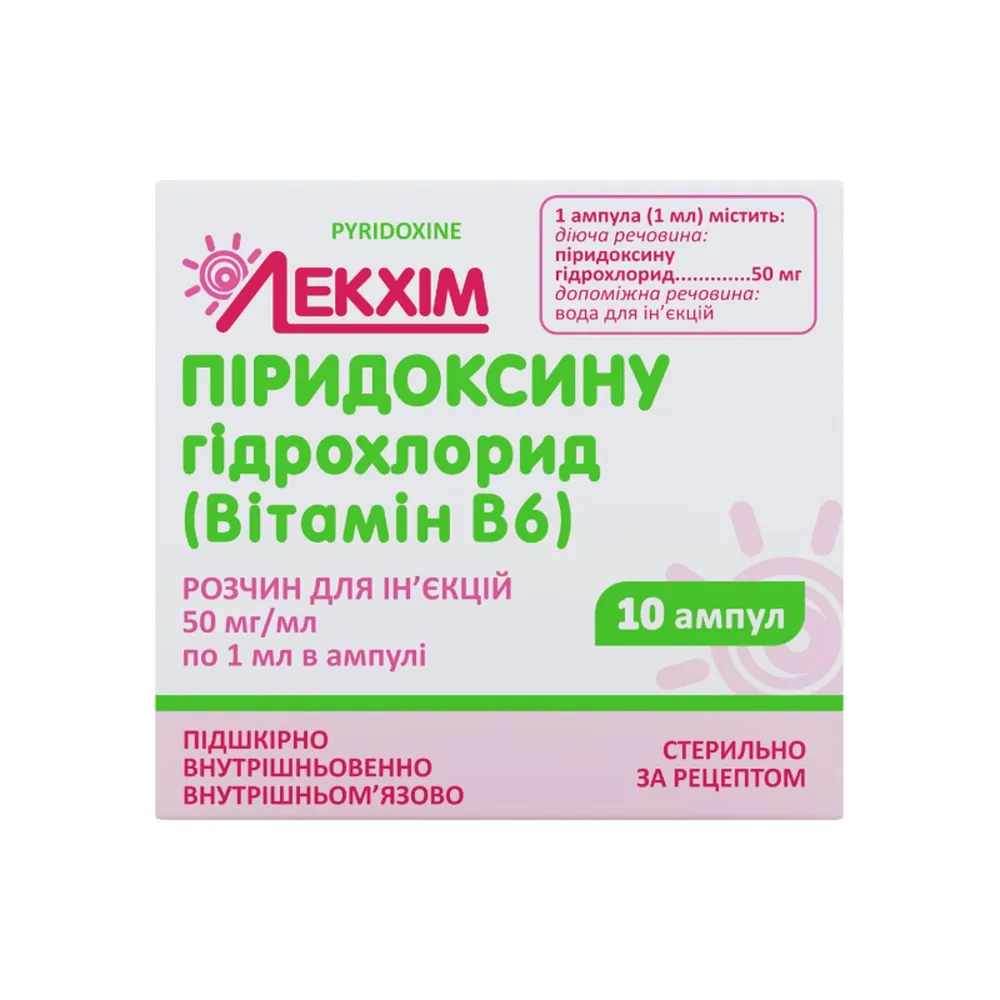
Table of Contents
INSTRUCTION FOR MEDICAL USE OF THE MEDICINAL PRODUCT PYRIDOXINE HYDROCHLORIDE (VITAMIN B6)
Composition:
Active substance: pyridoxine;
1 ml of solution contains pyridoxine hydrochloride 50 mg;
Excipient: water for injections.
Pharmaceutical form. Solution for injection.
Main physicochemical properties: clear, colorless or slightly yellowish solution.
Pharmacotherapeutic group. Simple vitamin preparations. Pyridoxine (vitamin B6).
ATC code A11H A02.
Pharmacological Properties
Pharmacodynamics
The drug is a water-soluble vitamin B6 (pyridoxine).
Vitamin B6 plays an important role in metabolism and is essential for the normal functioning of the central and peripheral nervous systems. It participates in the synthesis of neurotransmitters.
In the body, it is phosphorylated to pyridoxal-5-phosphate—the coenzyme for decarboxylation and transamination reactions of amino acids. It actively participates in the metabolism of tryptophan, methionine, cysteine, glutamic acid, and other amino acids, as well as in histamine metabolism. It plays a key role in the transport of amino acids across the cell membrane.
It participates in the synthesis of proteins, enzymes, porphyrins, hemoglobin, and prostaglandins, in the metabolism of serotonin and catecholamines, and in vitamin B6 metabolism. It improves the utilization of unsaturated fatty acids, normalizes lipid metabolism in atherosclerosis (reduces cholesterol and lipid levels), enhances myocardial contractility, promotes the conversion of folic acid into its active form, and stimulates hematopoiesis.
In atherosclerosis and diabetes mellitus, it reduces the level of glycated hemoglobin. It exerts a diuretic effect, contributes to lowering elevated arterial pressure, and potentiates the action of diuretics. In depression, it stimulates the production of norepinephrine and serotonin. By binding to fibrinogen and specific amino groups on the surface of platelets, it inhibits their aggregation.
Pharmacokinetics
Metabolized in the liver to form pharmacologically active metabolites—pyridoxal phosphate and pyridoxamine phosphate. The plasma protein binding of pyridoxal phosphate is 90%. It penetrates well into all tissues and accumulates predominantly in the liver, to a lesser extent in muscles and the central nervous system. It crosses the placenta and is excreted into breast milk. The elimination half-life is 15–20 days. It is excreted by the kidneys (excess daily requirement is excreted unchanged); approximately 2% is excreted via bile after intravenous administration. It is removed by hemodialysis.
Clinical characteristics.
Indications.
Hypovitaminosis and avitaminosis of vitamin B6. Complex treatment of toxemia in pregnant women, atherosclerosis, anemias (including sideroblastic anemia), leukopenia, nervous system disorders (radiculitis, neuritis, neuralgia, Parkinsonism, Little's disease), involutional depression, seborrheic and non-seborrheic dermatitis, herpes zoster, neurodermatitis, psoriasis, exudative diathesis, hangover and alcohol withdrawal syndrome. Also indicated for dizziness and motion sickness, Meniere's disease. Pyridoxine hydrochloride prevents or reduces toxic effects (especially polyneuritis) during antituberculosis therapy. Treatment of pyridoxine-dependent seizures.
Contraindications.
Increased individual sensitivity to the drug. Peptic ulcer disease of the stomach and duodenum (due to possible increase in gastric juice acidity). Liver diseases accompanied by severe functional insufficiency. Ischemic heart disease.
Interaction with other medicinal products and other types of interactions.
Pyridoxine enhances the effect of diuretics, reduces the antiparkinsonian activity of levodopa (but does not reduce the efficacy of the levodopa + carbidopa combination); potentiates the action of cardiac glycosides in patients with chronic heart failure; reduces the neurotoxic effect of isoniazid; prevents the development of ophthalmological complications arising from prolonged use of resorptive-action chloramphenicol preparations (synthomycin, chloramphenicol); eliminates side effects of tricyclic antidepressants caused by anticholinergic activity (dry mouth, urinary retention); reduces the hypnotic effect of hypnotics and sedatives; weakens the effect of phenytoin; increases resistance to hypoxia when used in combination with glutamic acid/asparken.
The effect of pyridoxine is weakened by penicillin, cycloserine, ethionamide, immunosuppressants, isoniazid, hormonal contraceptives, hydralazine sulfate; corticosteroids reduce the amount of vitamin B6 in the body.
Special precautions for use.
The metabolism of pyridoxine is reduced with regular alcohol consumption. May cause a false-positive result in the urobilinogen test using Ehrlich's reagent.
Use during pregnancy or breastfeeding.
The drug should be prescribed during pregnancy only for pregnancy-related toxemia. Use of high doses during pregnancy may lead to dependence syndrome in newborns. When used during breastfeeding, a decrease in lactation is possible; therefore, the drug should be used during this period only if clearly indicated.
Ability to affect reaction rate while driving or operating machinery.
The drug generally does not impair the ability to drive a vehicle or operate complex machinery; however, individual responses should be taken into account.
Method of Administration and Dosage.
Administer intramuscularly, intravenously, or subcutaneously in cases where oral administration is not possible.
The treatment course is individual and determined by the type and severity of the disease.
Prepare the solution immediately before use — dilute a single dose of the drug in 1–2 mL of water for injections or 0.9% sodium chloride solution.
Vitamin B6 deficiency. Administer at a daily dose of 50–100 mg (1–2 mL) in 1–2 administrations; treatment course — 3–4 weeks.
Sideroblastic anemia. Administer intramuscularly at a dose of 100 mg (2 mL) twice a week. It is advisable to simultaneously prescribe folic acid, vitamin B12, and riboflavin.
Parkinsonism. Administer intramuscularly at a daily dose of 100 mg (2 mL). Treatment course — 20–25 injections; repeat therapy after 2–3 months. According to another treatment regimen, start with a daily dose of 50–100 mg (1–2 mL), then increase the dose by 50 mg (1 mL) daily until reaching a daily dose of 300–400 mg (6–8 mL) as a single injection over 12–15 days.
Involutional depression. Administer intramuscularly at a daily dose of 200 mg (4 mL); treatment course — 20–25 injections.
Use of isoniazid group drugs. Prophylactically administer at a daily dose of 5–10 mg (0.1–0.2 mL) throughout the entire course of isoniazid treatment.
Overdose of isoniazid group drugs. For each 1 g of overdosed drug, administer 1 g (20 mL) of pyridoxine intravenously at a rate of 0.5 g/min. In cases of isoniazid overdose exceeding 10 g, administer pyridoxine intravenously at a dose of 4 g (80 mL), followed by intramuscular administration of 1 g (20 mL) of pyridoxine every 30 minutes. Total daily dose — 70–350 mg/kg.
Pregnancy toxemia. Administer at a daily dose of 50 mg (1 mL) intramuscularly; treatment course — 10–20 injections.
Pyridoxine-dependent anemia (microcytic, hypochromic with increased plasma iron levels). Administer at a daily dose of 50–200 mg (1–4 mL) for 1–2 months. If no effect is observed, switch to another form of therapy.
Pyridoxine-dependent syndrome, including pyridoxine-dependent seizures. Administer intravenously (at a rate of 50 mg/min) or intramuscularly at a daily dose of 50–500 mg (1–10 mL); treatment course — 3–4 weeks.
Other indications. Usually administer at a daily dose of 50–100 mg (1–2 mL) in 1–2 administrations.
For children, in cases of vitamin B6 deficiency, the dose is determined individually by a physician at 1–2 mg/kg body weight per day; treatment course — 2 weeks. In cases of pyridoxine-dependent seizures, administer intravenously by slow infusion at a rate of 50 mg/min or intramuscularly at a daily dose of 50–100 mg (1–2 mL); maximum doses for children have not been established. In cases of overdose of isoniazid group drugs, administer 1 g (20 mL) of pyridoxine intravenously for each 1 g of overdosed drug. If the isoniazid dose is unknown, administer pyridoxine at a dose of 70 mg/kg body weight; maximum dose — 5 g (100 mL).
Children. In pediatric practice, administer the drug according to the recommendations provided in the section "Method of Administration and Dosage." The drug should be administered intramuscularly and intravenously.
Overdose.
Symptoms: intensification of adverse effects; disturbances in protein, carbohydrate, and lipid metabolism; degenerative changes in the central nervous system (peripheral neuropathy) and parenchymal organs (metabolic disturbances associated with a significant reduction in nicotinamide coenzymes NAD and NADPH and niacin deficiency). Symptoms of peripheral neuropathy include hyperesthesia, paresthesia, and muscle weakness. Sensory neuropathies may occur with progressive gait disturbance, numbness, and tingling in the legs and arms, partial alopecia, decreased resistance to infections, and reduced activity of the blood coagulation system. With prolonged administration in high doses, hypervitaminosis B6 develops, characterized by a sharp decrease in protein content in muscle tissue and internal organs. Early signs of hypervitaminosis B6 may include skin rashes, dizziness, and seizures. After discontinuation of the drug, these symptoms resolve.
Treatment: discontinue the drug, symptomatic therapy.
Adverse reactions.
Cardiovascular system: tachycardia, chest pain.
Nervous system: headache, dizziness, weakness, drowsiness, excitement, coordination disorders, paresthesia, numbness in extremities, glove-and-stocking sensation (feeling of constriction in extremities), loss of consciousness and development of seizures with rapid intravenous administration.
Respiratory system: dyspnea.
Gastrointestinal tract: nausea, gastralgia, heartburn, increased gastric secretion.
Metabolism and nutritional disorders: decreased folic acid levels.
Immune system, skin and subcutaneous tissue: hypersensitivity reactions, including anaphylactic shock, urticaria, rash, pruritus, skin hyperemia, fever, dermatitis, angioneurotic edema, photosensitization.
Local reactions at site of administration: hyperemia, pruritus, burning sensation.
Shelf life.
2 years.
Storage conditions.
Store in original packaging, out of reach of children, at a temperature not exceeding 25 °C.
Incompatibility.
Pharmaceutically incompatible with solutions of vitamin B1 (thiamine) and B12 (cyanocobalamin), alkaline solutions, iron salts, and oxidizing agents. Should not be administered earlier than 12 hours after thiamine injection. It is not recommended to mix in the same infusion system or syringe with the following medicinal products: adrenomimetics, sodium ampicillin, amphotericin B, ascorbic acid, phytonadione, dipyridamole, sodium oxiferroscorbionate, phenothiazine derivatives (chlorpromazine), furosemide, etamsylate, and ephedrine.
Packaging. 1 ml in ampoules. 10 ampoules per carton with partitions; or 5 ampoules in a single-sided blister, 2 blisters per carton; or 100 ampoules per box with partitions.
Prescription status.
Prescription only.
Manufacturer.
Private Joint-Stock Company "Lekhym-Kharkiv".
Manufacturer's address.
36 Severina Pototskogo Street, Kharkiv, Kharkiv Region, 61115, Ukraine.