Pyrazinamide-darnitsa
Ukraine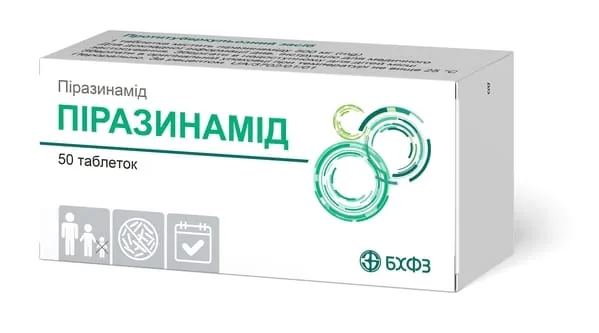
Table of Contents
INSTRUCTIONS FOR MEDICAL USE OF THE MEDICINAL PRODUCT PYRAZINAMIDE-DARNITSA (PYRAZINAMIDE-DARNITSA)
Composition:
active substance: pyrazinamide;
1 tablet contains pyrazinamide 500 mg;
excipients: pregelatinized starch, corn starch, calcium hydrogen phosphate dihydrate, colloidal anhydrous silicon dioxide, sodium lauryl sulfate, talc, magnesium stearate.
Pharmaceutical form. Tablets.
Main physicochemical properties: white or almost white tablets, flat cylindrical in shape, with bevel and score line.
Pharmacotherapeutic group. Antituberculosis agents. ATC code J04A K01.
Pharmacological Properties
Pharmacodynamics
Pyrazinamide belongs to the pharmacotherapeutic group of second-line antituberculosis medicinal products. The drug penetrates well into the foci of tuberculosis lesions. Its activity is not reduced in the acidic environment of caseous masses; therefore, it is commonly prescribed for caseous lymphadenitis, tuberculomas, and caseous-pneumonic processes.
When treating with Pyrazinamide-Darnitsia alone, rapid development of resistance in Mycobacterium tuberculosis may occur; therefore, it is generally prescribed in combination with other antituberculosis medicinal products.
Pharmacokinetics
Pyrazinamide is almost completely absorbed in the gastrointestinal tract. After oral administration of 1 g of the drug, plasma concentration reaches 45 µg/mL within 2 hours and 10 µg/mL within 15 hours. Pyrazinamide is hydrolyzed into its active metabolite—pyrazinoic acid—and then into an inactive metabolite. The elimination half-life of the drug under normal renal function is 9–10 hours. Approximately 70% of pyrazinamide is excreted by the kidneys. The drug is eliminated within 24 hours, primarily in the form of metabolites.
Clinical characteristics.
Indications.
Treatment of all forms of tuberculosis (in combination with other antituberculosis medicinal products).
Contraindications.
Hypersensitivity to pyrazinamide or to other ingredients of the medicinal product, or to other medicinal products closely related in chemical structure (ethionamide, isoniazid, niacin).
Severe hepatic insufficiency.
Acute gout, asymptomatic hyperuricemia.
Interaction with other medicinal products and other forms of interaction.
Concomitant use of pyrazinamide and ethionamide increases the risk of hepatotoxicity, especially in diabetic patients. Liver function should be monitored regularly during treatment with this combination. If any signs of impaired liver function occur, treatment with this combination should be discontinued.
Pyrazinamide reduces the metabolism of cyclosporine and thereby decreases cyclosporine serum levels. In patients receiving cyclosporine, serum cyclosporine levels should be monitored from the initiation of pyrazinamide therapy and after its discontinuation.
Pyrazinamide may reduce the effectiveness of drugs used to treat gout and of agents promoting the excretion of uric acid from the body (allopurinol, colchicine, probenecid, sulfinpyrazone). This may increase serum uric acid levels in patients with gout receiving pyrazinamide. Dose adjustments of these medications may be necessary to control hyperuricemia when drugs for the treatment of gout and uricosuric agents are used concomitantly with pyrazinamide.
Concomitant use of pyrazinamide and allopurinol may reduce the metabolism of pyrazinamide metabolites. However, the metabolism of pyrazinamide itself is not significantly altered.
Zidovudine may substantially reduce serum levels of pyrazinamide and increase the risk of anemia.
Pyrazinamide interferes with Acetest® and Ketostix® tests, as it turns the test color red-brown.
Pyrazinamide may interfere with the determination of serum iron concentration using the Ferrochek® II instrument.
Pyrazinamide is widely used in combination with other antituberculosis agents, for example, isoniazid. In particular, for chronic destructive forms, combination with rifampicin (pronounced effect) or ethambutol (better tolerability) is recommended.
Concomitant use with medicinal products that block tubular secretion may reduce their excretion and enhance toxic reactions. Enhances the antituberculosis effect of ofloxacin and lomefloxacin.
Concomitant use of pyrazinamide and isoniazid may reduce serum concentrations of isoniazid, especially in patients with slow isoniazid metabolism.
Concomitant use of pyrazinamide and phenytoin may increase serum phenytoin concentrations and, consequently, may lead to signs of phenytoin intoxication.
If CNS side effects (e.g., ataxia, hyperreflexia, nystagmus, tremor) occur during concomitant administration of pyrazinamide and phenytoin, the medicinal products should be discontinued, serum phenytoin concentrations should be determined, and the phenytoin dose adjusted accordingly.
Pyrazinamide may enhance the effect of hypoglycemic medicinal products.
Instructions for Use
During treatment with this medicinal product, liver function should be monitored by performing biochemical tests every 2–4 weeks (thymol test, bilirubin determination, glutamic-oxaloacetic transaminase, serum ALT and AST), as well as determination of uric acid in blood. If liver function abnormalities occur, the drug should be discontinued immediately. To reduce the toxic effect of pyrazinamide, methionine, lipoic acid (lipocaine), glucose, and vitamin B12 are prescribed.
Pyrazinamide should be used with caution in patients with impaired liver function and in those at increased risk of liver damage associated with the use of hepatotoxic medicinal products and alcohol. Pyrazinamide may enhance the toxic effect of alcohol.
Pyrazinamide inhibits renal excretion of urates, which may result in hyperuricemia, usually without signs of gout. Pyrazinamide should be administered cautiously in patients with a history of gout.
Pyrazinamide should be prescribed with caution in patients with hypersensitivity to ethionamide, isoniazid, niacin, or other medicinal products similar in chemical structure, as such patients may exhibit increased sensitivity to pyrazinamide as well.
Pyrazinamide should be administered cautiously in patients with diabetes mellitus due to difficulties in maintaining desired blood glucose concentrations.
In patients with porphyria, pyrazinamide may provoke acute attacks of porphyria.
In patients with renal insufficiency, accumulation of pyrazinamide in the body may occur.
Use during Pregnancy or Breast-Feeding
The medicinal product is contraindicated during pregnancy and breast-feeding.
Ability to Influence Reaction Rate when Driving or Operating Machinery
Adverse reactions involving the nervous system may occur during treatment with this medicinal product; therefore, patients should refrain from driving or operating machinery during this period.
Dosage and Administration.
Tablets should be taken whole, with water, as a single dose after a meal. The ideal body weight is always used to calculate the daily dose.
The daily dose for adults and children aged 15 years and older is 20–30 mg/kg of body weight per dose. The medicinal product is taken 1–3 times daily, depending on tolerance. The maximum daily dose should not exceed 1.5 g.
Due to possible decline in kidney and liver function, elderly patients are generally administered pyrazinamide at doses close to the lower limit of the usual adult dose—15 mg/kg of body weight per day.
The usual dose of pyrazinamide for patients with moderate renal impairment is 12–20 mg/kg of body weight per day. Pyrazinamide should be avoided in patients with creatinine clearance below 50 mL/min.
For patients undergoing hemodialysis or peritoneal dialysis, the usual adult dose is prescribed. It is recommended to administer the dose within 24 hours prior to the start of dialysis.
When pyrazinamide is administered at usual doses to patients with impaired liver function, it may accumulate in the body; therefore, lower doses—15 mg/kg of body weight per day—are required. Liver function tests should be performed before initiating pyrazinamide therapy and every 2–4 weeks during treatment.
The duration of treatment depends on the course of the disease and the patient's tolerance to the medicinal product, and is determined by the physician (usually 6–8 months).
Children.
The medicinal product is not administered to children under 15 years of age.
Overdose.
In individual cases—liver function disturbances and increased transaminase levels. These abnormalities returned to normal after discontinuation of the medicinal product.
Also observed were excitement, dyspeptic symptoms, liver function disturbances, hyperuricemia, and increased severity of adverse reactions.
Treatment. Gastric lavage, administration of activated charcoal, monitoring of liver function, and determination of serum urate levels are required. Treatment is symptomatic. It is important for the patient to maintain high fluid intake. Hemodialysis is effective.
Adverse reactions.
Respiratory system, thoracic and mediastinal organs: dyspnea, shortness of breath, dry cough.
Gastrointestinal tract: dyspeptic symptoms, epigastric and stomach pain, loss of appetite, nausea, vomiting, diarrhea, peptic ulcer, metallic taste in the mouth.
Hepatobiliary system (liver and biliary tract): liver function disorders, increased levels of liver transaminases, bilirubin, and thymol test; hepatomegaly; in isolated cases – dose-dependent acute liver atrophy, jaundice.
Renal and urinary system: interstitial nephritis; in isolated cases – myoglobinuric renal failure due to rhabdomyolysis, dysuria, pain during urination.
Nervous system: dizziness, headache, sleep disturbances, increased excitability, depression; in isolated cases – hallucinations, seizures, confusion, peripheral neuropathy, paresthesia.
Cardiovascular system: decreased arterial pressure, discomfort in the heart area, sensation of warmth, facial hyperemia.
Blood and lymphatic system: thrombocytopenia, eosinophilia, anemia, sideroblastic anemia, erythrocyte vacuolization, porphyria, increased serum iron concentration, hypercoagulation, tendency to thrombus formation, splenomegaly.
Immune system: anaphylactoid reactions, angioneurotic edema, fever; in isolated cases – anaphylactic shock.
Skin and subcutaneous tissue: hyperemia, skin rashes, pruritus, urticaria, photosensitization, acne, toxic-allergic dermatitis.
Musculoskeletal system and connective tissue: arthralgia, joint swelling, joint stiffness, myalgia, rhabdomyolysis, gout attacks.
General disorders and administration site reactions: general weakness, malaise, hyperuricemia, pellagra, hyperthermic syndrome.
Shelf life. 2 years.
Storage conditions.
In the original packaging at a temperature not exceeding 25 °C.
Packaging.
10 tablets in a blister pack; 5 blisters per carton; 1000 tablets in containers.
Prescription status. Prescription only.
Manufacturer. JSC "Pharmaceutical Company "Darnytsia".
Manufacturer's address and place of business.
13, Boryspylska Street, Kyiv, 02093, Ukraine.