Pyrantel polpharma
Ukraine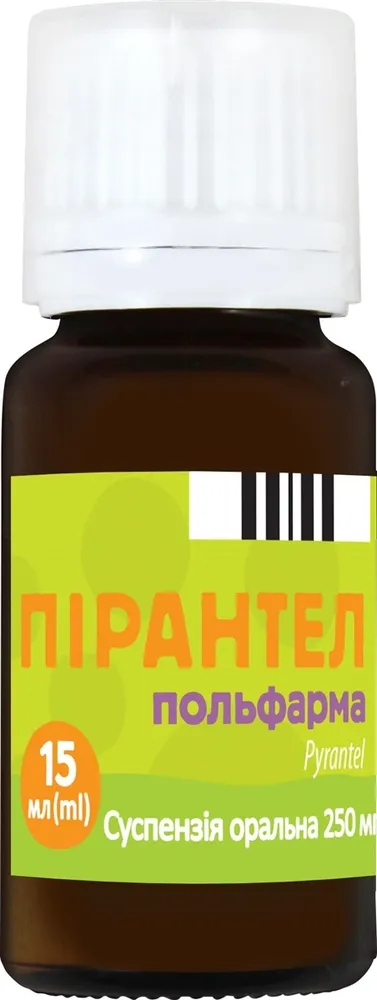
Table of Contents
INSTRUCTIONS FOR MEDICAL USE OF THE MEDICINAL PRODUCT PYRANTEL POLPHARMA
Composition:
Active substance: pyrantel;
250 mg of pyrantel (as pyrantel pamoate) per 5 ml of suspension;
Excipients: sodium benzoate (E 211); sodium carmellose; sorbitol solution, non-crystallizing (E 420); glycerin; aluminum-magnesium silicate; polysorbate 80; polyvinylpyrrolidone; apricot flavor (aromatic substances, isopropyl alcohol, ethanol 96%); simethicone emulsion; citric acid monohydrate; sodium hydroxide; purified water.
Pharmaceutical form. Oral suspension.
Main physicochemical properties: light yellow suspension with a characteristic odor. Separation into a liquid layer and sediment may occur, which after shaking forms a uniform suspension.
Pharmacotherapeutic group. Anthelmintics.
ATC code P02CC01.
Pharmacological properties.
Pharmacodynamics.
Pyrantel Polfa is an anthelmintic agent. It is active against Enterobius vermicularis, Ascaris lumbricoides, Ancylostoma duodenale, and Necator americanus. Pyrantel Polfa causes neuromuscular blockade, paralyzing helminths, resulting in their elimination via intestinal peristalsis along with fecal matter. Pyrantel Polfa is active against both mature and immature susceptible forms of helminths. It does not affect migrating helminth larvae passing through tissues.
Pharmacokinetics.
Intestinal absorption is very low. After administration, plasma concentrations are very low (0.05–0.13 mcg/mL) and are reached within 1–3 hours. Up to 93% of the drug is excreted unchanged in feces. Less than 7% is found in urine, both unchanged and in metabolized form.
Clinical characteristics.
Indications.
Enterobiasis, ascariasis, ancylostomiasis.
Contraindications.
Hypersensitivity to pyrantel or to any of the other components of the drug.
Concomitant use with piperazine.
Avoid using pyrantel during treatment of myasthenia gravis.
Interaction with other medicinal products and other forms of interaction.
May increase plasma levels of theophylline. Concomitant use of piperazine inhibits the effect of pyrantel.
Special precautions for use
Pyrantel Polfa should be prescribed with caution in patients with impaired liver function (may temporarily increase levels of aspartate aminotransferase). Dose reduction may be necessary.
Laxatives should not be used during treatment.
For enterobiasis, Pyrantel Polfa is recommended to be administered to all family members.
Fourteen days after taking the medication, a laboratory parasitological examination must be performed.
To prevent reinfection, strict adherence to personal hygiene rules is recommended: daily perianal hygiene, frequent nail cleaning several times a day. Children's nails should be kept short. Underwear and nightwear should be changed regularly. Scratching of the perianal area should be avoided.
Pyrantel Polfa should be prescribed with caution in patients receiving inadequate nutrition or in patients with anemia.
The medicinal product contains sorbitol solution; therefore, it should not be administered to patients with rare hereditary fructose intolerance. Sorbitol solution may cause a mild laxative effect.
This medicinal product contains less than 1 mmol (23 mg)/dose of sodium, i.e. it is practically sodium-free.
This medicinal product contains a small amount of ethanol (alcohol), less than 100 mg/dose.
Use during pregnancy or breastfeeding
Pregnancy
Animal experimental studies have shown no evidence of teratogenic effects of the drug. However, due to the lack of controlled studies on the use of pyrantel during pregnancy or breastfeeding, administration of the drug during these periods is not recommended. Treatment with pyrantel during pregnancy is possible only in cases of extreme necessity and only if, in the opinion of the physician, the benefit to the mother outweighs the potential risk to the fetus.
Breastfeeding period
No studies have been conducted to evaluate the passage of the drug into breast milk; therefore, the drug should not be used during breastfeeding. If treatment with Pyrantel Polfa is necessary for breastfeeding women, breastfeeding must be discontinued.
Ability to affect reaction speed when driving or operating machinery
No studies have been conducted on the effect of the drug on the ability to drive or operate machinery. If dizziness, drowsiness, weakness, hallucinations, or disorientation occur, patients should refrain from driving or operating vehicles and from working with machinery or complex equipment.
Dosage and Administration
Orally, during or after a meal.
5 ml of suspension contains 250 mg of pyrantel.
Shake well before use to obtain a homogeneous suspension.
For adults, it is preferable to use pyrantel in tablet form; however, if tablets cannot be taken, the suspension formulation should be used.
Ascariasis and Enterobiasis
For enterobiasis and ascariasis, the recommended single dose is 10–12 mg/kg body weight, i.e.:
- children with body weight ≥10 kg: 2.5 ml of suspension per 10 kg body weight as a single dose;
- adults with body weight up to 75 kg: 15 ml of suspension as a single dose;
- adults with body weight over 75 kg: 20 ml of suspension as a single dose.
In cases of enterobiasis, strict hygiene measures are required for all family members to ensure complete elimination of parasites. To prevent reinfection, a second dose is recommended 3 weeks after the initial dose.
Hookworm infection caused by Ancylostoma duodenale or Necator americanus
For hookworm infection, in cases of severe infestation or in endemic areas, the dose is 20 mg/kg daily, divided into 1 or 2 doses, administered over 2–3 days, i.e.:
- children with body weight ≥10 kg: 5 ml per 10 kg body weight daily;
- adults with body weight up to 75 kg: 30 ml daily;
- adults with body weight over 75 kg: 40 ml daily.
In infections caused by Ancylostoma duodenale (occurring in non-endemic areas), a single dose of 10 mg/kg body weight may be sufficient.
An oral dosing syringe (5 ml) with graduations is provided in the package.
Children
For use in children with body weight above 10 kg.
Overdose
Symptoms of overdose may include: visual disturbances, spatial disorientation, dizziness, loss of consciousness or dizziness upon changing body position, sweating, fatigue or general weakness, arrhythmia, muscle spasms, tremor, and muscle weakness; exhaustion, asphyxia (difficulty breathing, loss of consciousness); nausea, vomiting, loss of appetite, spasmodic abdominal pain, diarrhea, headache, drowsiness or insomnia, agitation, skin rashes, and liver injury.
Treatment
No specific antidotes are available. In case of overdose, symptomatic and supportive treatment is required (early gastric lavage, maintenance of airway patency, and support of arterial blood pressure).
Adverse Reactions.
When the drug is administered at therapeutic doses, the following disorders may occur in individual cases:
Gastrointestinal disorders: nausea, vomiting, loss of appetite, abdominal pain, diarrhea, constipation, tenesmus;
Nervous system disorders: headache, dizziness, insomnia, drowsiness, hallucinations with disorientation, paresthesia, ataxia;
Skin and subcutaneous tissue disorders: urticaria, skin rashes;
Hepatobiliary disorders: decreased or transient increase in liver transaminase levels;
Ear and labyrinth disorders: hearing disturbances;
Other: hyperthermia, nasal congestion, visual disturbances, asthenia, weakness, increased fatigue.
Hypersensitivity reactions are possible.
Shelf life.
3 years.
Storage conditions.
Store in the original packaging at a temperature not exceeding 25°C. Keep out of the reach of children.
After opening the bottle, store with tightly closed cap for up to 21 days.
The medicinal product should not be used after the expiry date stated on the packaging.
Packaging.
15 ml amber glass bottles with a polyethylene screw cap and tamper-evident ring.
One bottle with a graduated measuring device in a cardboard box.
Availability.
Over-the-counter (without prescription).
Manufacturer.
Pharmaceutical Works POLPHARMA S.A.
Manufacturer's address and location of operations.
Medana Branch in Sieradz, 10, Wladyslawa Lokietka Str., 98-200 Sieradz, Poland