Piofag® bacteriophage polyvalent
Ukraine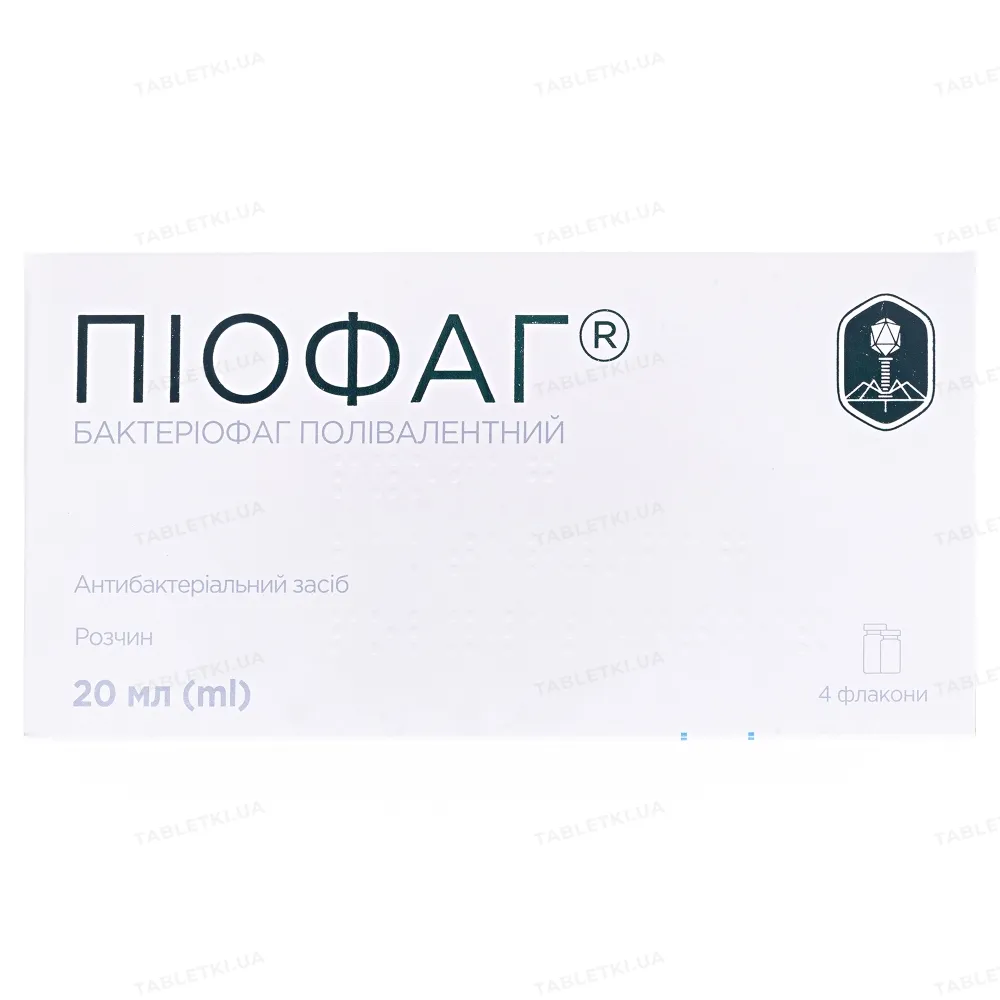
Table of Contents
INSTRUCTION FOR MEDICAL USE OF THE MEDICINAL PRODUCT PIOFAG® POLYVALENT BACTERIOPHAGE
Composition:
Active substance: 1 ml of the preparation contains specific bacteriophages at a concentration of not less than 1×10^5 phage particles against the following microorganism species: Streptococcus pyogenes, Staphylococcus aureus, Escherichia coli, Pseudomonas aeruginosa, Proteus vulgaris, Proteus mirabilis;
Excipients: sodium chloride; magnesium chloride hexahydrate; sodium hydroxide; diluted hydrochloric acid; water for injections.
Pharmaceutical form. Solution.
Main physicochemical properties: clear liquid, a yellowish tint may be permitted.
Pharmacotherapeutic group. Antibacterial agents. Other antibacterial agents. ATC code J01X X.
Immunobiological and biological properties.
The preparation has the ability to specifically lyse the following bacteria: Streptococcus pyogenes, Staphylococcus aureus, Escherichia coli, Pseudomonas aeruginosa, Proteus vulgaris, Proteus mirabilis. Bacteriophages specifically target bacterial cells, multiply inside the bacterial cell, and destroy it by lysis. The antibacterial effect of the preparation is due to the specific lysis of pathogenic bacteria, while the normal microflora remains unaffected. Under the influence of bacteriophages, phagocytosis is activated, the activity of neutrophils and their metabolic activity increases, thus preventing recurrence of infectious disease and chronic inflammation. The number of leukocytes and neutrophils decreases, while the lymphocyte level rises, predominantly due to T-lymphocytes. Bacteriophages rapidly penetrate into blood and lymph and are excreted by the kidneys with urine.
Clinical characteristics.
Indications.
Treatment and prevention of purulent-inflammatory and intestinal diseases caused by staphylococci, streptococci, Pseudomonas aeruginosa, pathogenic Escherichia coli of various serogroups, Proteus. The drug is used as monotherapy or as part of combined therapy.
Contraindications.
Hypersensitivity to the components of the drug.
Special safety precautions.
An essential condition for effective phage therapy is prior determination of the pathogen's sensitivity to the phage. Treatment with the drug should be initiated as early as possible. The drug must not be used if the solution becomes cloudy.
Interaction with other medicinal products and other types of interactions.
The drug can be used in combination with other antibacterial agents, as well as monotherapy—in cases of patient intolerance to antibiotic therapy or in the presence of antibiotic-resistant strains of the causative agent.
Special precautions for use.
This medicinal product contains less than 1 mmol (23 mg)/dose of sodium, i.e. it is practically sodium-free.
Use during pregnancy or breastfeeding.
Safety and efficacy have not been established; therefore, use is contraindicated.
Ability to influence reaction speed when driving or operating machinery.
The use of this medicinal product does not affect reaction speed when driving or operating machinery.
Method of administration and dosage.
Treatment of purulent-inflammatory diseases with localized lesions should be carried out both locally and orally (internally) simultaneously. The duration of treatment is 7–20 days.
When dosing the drug, the instructions for medical use must be followed. When using low doses (2–8 drops), the drug should be drawn up using a sterile 0.5–1 mL syringe or using a spray nozzle. One milliliter of the drug contains 20 drops of bacteriophage solution; one spray from the spray nozzle delivers 0.2 mL of solution.
Locally, the liquid phage is applied as irrigation, compresses, and packing in amounts up to 200 mL, depending on the size of the affected area. In abscesses, bacteriophage is introduced into the focus cavity after pus removal by puncture. The volume of administered preparation should be slightly less than the volume of drained pus. In osteomyelitis, after appropriate surgical treatment, 10–20 mL of bacteriophage is instilled into the wound.
Administration into cavities—pleural, joint, and other confined spaces—up to 100 mL of bacteriophage, followed by placement of a capillary drain, through which bacteriophage is re-administered over several days.
In cases of cystitis, pyelonephritis, and urethritis, the drug is taken orally. If the bladder or renal pelvis cavities are drained, bacteriophage is administered via cystostomy or nephrostomy 1–2 times daily: 20–50 mL into the bladder and 5–7 mL into the renal pelvis.
In purulent-inflammatory gynecological diseases, the drug is administered into the vaginal or uterine cavity at a dose of 5–10 mL once daily.
In purulent-inflammatory ear diseases (otitis), throat (angina), and nasal conditions, the drug is administered at a dose of 2–10 mL 1–3 times daily. Bacteriophage is used for rinsing, irrigation, instillation, and moistening of pledgets (which are inserted and left for 1 hour).
In conjunctivitis and keratoconjunctivitis, the drug is administered as 2–3 drops 4–5 times daily; in purulent corneal ulcers—as 4–5 drops; in purulent iridocyclitis—the drug is used as 6–8 drops every 3 hours, combined with oral administration.
In the treatment of stomatitis and chronic generalized periodontitis, the drug is used as mouth rinses 3–4 times daily at a dose of 10–20 mL, and pledgets soaked with the drug are placed into periodontal pockets for 5–10 minutes.
In intestinal forms of disease, internal organ infections, and dysbiosis, the drug is administered orally and by enema. Orally, bacteriophage is taken 3 times daily on an empty stomach, 1 hour before meals.
Recommended dosage of the drug is presented in Table 1.
Table 1
| Age |
Dose per administration (ml) |
| orally |
|
| Up to 6 months |
5 |
| From 6 to 12 months |
10 |
| From 1 to 3 years |
15 |
| From 3 to 8 years |
20 |
| From 8 years |
30 |
The use of bacteriophages does not exclude the use of other antibacterial agents. If chemical antiseptics have been used for wound treatment prior to the application of bacteriophage, the wound should be thoroughly rinsed with sterile 0.9% sodium chloride solution.
For intestinal forms of the disease, rectal administration of bacteriophage once daily as an enema after bowel evacuation may be used instead of one oral dose.
The recommended dosage regimen for rectal administration is specified in Table 2.
Table 2
| Age |
Dose per administration (ml) |
| rectally |
|
| Up to 6 months |
10 |
| From 6 to 12 months |
20 |
| From 1 to 3 years |
30 |
| From 3 to 8 years |
40 |
| From 8 years |
50 |
For prophylactic purposes, the optimal regimen is daily oral administration of a single age-appropriate dose. The duration of use is determined by the epidemiological situation.
Children.
The drug is intended for use in children.
Overdose.
Cases of overdose have not been reported.
Adverse Reactions.
Cases of adverse reactions have not been reported.
Shelf Life.
3 years.
Storage Conditions.
Store at a temperature of 2 to 8 °C in the original packaging. After the first opening of the vial, storage for no more than 10 days at a temperature of 2 to 8 °C is permitted. Transportation is allowed at a temperature not exceeding 25 °C for up to 30 days; thereafter, the medicinal product must be stored at 2 to 8 °C.
Incompatibility.
Do not mix with other medicinal products.
Packaging.
Solution in 10 ml vials № 4, supplied with dropper caps or without dropper caps, in cardboard boxes; in 20 ml vials № 1, supplied with a spray nozzle, in cardboard boxes; in 20 ml vials № 4, supplied with a spray nozzle or without a spray nozzle, in cardboard boxes; in 50 ml vials № 1, in a cardboard box.
Prescription Status.
Prescription only.
Manufacturer.
LLC "FARMEKS GROUP", Ukraine, for NEO PROBIO CARE INC., Canada.
Manufacturer's Location and Address of Business Activity.
100, Shevchenka Street, Boryspil, Kyiv region, 08301, Ukraine.
or٭
Manufacturer.
LIMITED LIABILITY COMPANY "NEOPROBIOCARE-UKRAINE".
Manufacturer's Location and Address of Business Activity.
154 Akademika Zabolotnoho Street, Kyiv, 03143, Ukraine.
or٭
Manufacturer.
Private Joint-Stock Company "Infuzia", Ukraine, for NEO PROBIO CARE INC., Canada.
Manufacturer's Location and Address of Business Activity.
84A Nemirovskе Highway, village Vinnitski Khotory, Vinnitsa district, Vinnitsa region, 23219, Ukraine.
٭ The instruction leaflet inside the cardboard box will indicate only one manufacturer (the one involved in the production of the specific batch).
Marketing Authorization Holder.
NEO PROBIO CARE INC., Canada.
Address of Marketing Authorization Holder.
599 Centennial Drive, Burlington, Ontario, L7T 4L7, Canada