Piaskledin® 300
Ukraine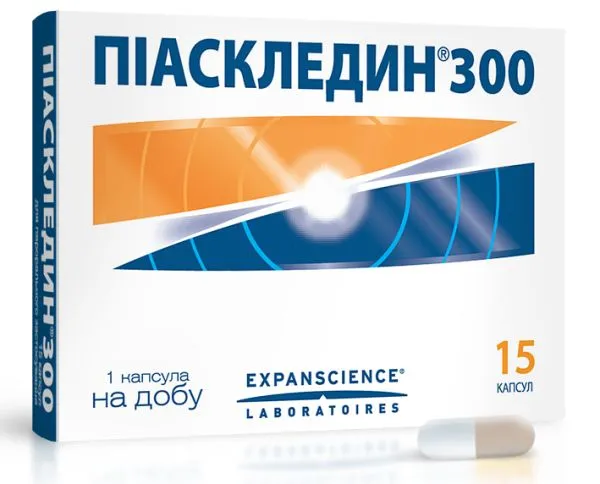
Table of Contents
INSTRUCTIONS FOR MEDICAL USE OF THE MEDICINAL PRODUCT PIAKLEDIN® 300 (PIASCLEDINE® 300)
Composition:
Active substances: non-saponifiable components of avocado oil; non-saponifiable components of soybean oil;
1 capsule contains a mixture of non-saponifiable components of avocado and soybean oils 300 mg, corresponding to 100 mg of non-saponifiable components of avocado oil and 200 mg of non-saponifiable components of soybean oil;
Excipients: colloidal anhydrous silicon dioxide, butylhydroxytoluene (E 321), polysorbate 80;
capsule shell: gelatin, titanium dioxide (E 171).
Pharmaceutical form. Capsules.
Main physicochemical properties: semi-transparent sealed capsules with a white cap marked "P" and a white body marked "300", or a white cap marked "300" and a white body marked "P", containing a brownish paste.
Pharmacotherapeutic group.
Other non-steroidal anti-inflammatory and antirheumatic agents. Avocado and soybean oils, non-saponifiable. ATC code M01AX26.
Pharmacological properties.
The mechanism of action of avocado/soybean unsaponifiables has been evaluated in in vitro and in vivo studies in patients with osteoarthritis, in which the following main pharmacological properties were demonstrated:
- avocado and soybean oil unsaponifiables enhance collagen synthesis by articular chondrocytes and reduce IL-1 (interleukin-1) synthesis by chondrocytes;
- increase expression of PAI-1 (plasminogen activator inhibitor-1, a fraction that inhibits plasminogen activator, thereby preventing joint damage in osteoarthritis);
- increase expression of transforming growth factor β (TGF-β) in chondrocytes, which was later recognized as having anabolic effects on cartilage tissue.
All the above properties of avocado and soybean oil unsaponifiables support the view that Piascleden**®** 300 stimulates transforming growth factor β (TGF-β), leading to the restoration of extracellular matrix components in articular cartilage.
Pharmacodynamics.
Piascleden**®** 300 belongs to a new class of medicinal products known as "SYSADOA" (Symptomatic Slow-Acting Drugs for Osteoarthritis), whose main characteristic is their delayed onset of action.
Pharmacokinetics.
Piascleden® is a medicinal product composed of a complex mixture of substances derived from soybean and avocado. Development and validation of analytical methods for such medicinal products are highly challenging. Pharmacokinetic data would not provide additional clinical value or alter the benefit-risk ratio for patients taking Piascleden® 300; therefore, preclinical pharmacokinetic studies have not been conducted.
Clinical characteristics.
Indications.
Piasclidine® 300 is used in rheumatology for the treatment of adults: symptomatic treatment of knee osteoarthritis.
Contraindications.
Hypersensitivity to any of the active or excipient ingredients of the medicinal product listed in the section "Composition".
Interaction with other medicinal products and other forms of interaction.
Patients should inform their physician or pharmacist about concomitant use of other medicinal products.
Piasclidine® 300 may affect anticoagulants or be affected by them.
Special precautions for use
Consult a physician before using Piascledine**®** 300.
Piascledine**®** 300 belongs to a new class of medicinal products known as "SYSADOA" (Symptomatic Slow-Acting Drugs for Osteoarthritis), which are primarily characterized by their delayed onset of action. Therefore, the therapeutic effect may become apparent only after several weeks and usually persists after discontinuation of treatment. For this reason, at the beginning of treatment with Piascledine**®** 300, concomitant use of nonsteroidal anti-inflammatory drugs (NSAIDs) and/or analgesics may be recommended; the dosage of these should be gradually reduced as the efficacy of Piascledine**®** 300 increases.
Inform your physician if there is no improvement or if symptoms worsen within 2–3 months.
In some patients, symptoms indicating liver dysfunction have been observed during treatment with Piascledine**®** 300. Before starting treatment, inform your physician if the patient has current or past liver disorders, such as liver disease or gallstones. Liver function tests should be monitored regularly before and during treatment with Piascledine**®** 300. If symptoms of liver dysfunction occur—such as nausea (malaise), vomiting, abdominal pain, fatigue, loss of appetite, jaundice (yellowing of the skin or eyes), or dark urine—treatment must be stopped immediately and medical advice sought.
Allergic reactions such as urticaria, pruritus, and/or skin rashes have been reported in some patients during treatment with Piascledine**®** 300. Inform your physician if the patient has a history of allergic skin or mucosal reactions, particularly those induced by medicinal products, or of severe atopic disorders. If symptoms of an allergic reaction occur, treatment must be discontinued immediately and a physician consulted.
During clinical studies with Piascledine**®** 300, increased blood pressure associated with combined symptoms such as hearing disturbances or headaches has been reported in some patients. Inform your physician if the patient has a history of hypertension. Blood pressure should be monitored regularly during treatment with Piascledine**®** 300.
During clinical studies with Piascledine**®** 300, one isolated case of a significant decrease in platelet count was reported. If symptoms of coagulation disorders occur—such as red or purple spots on the skin, spontaneous bruising or ecchymoses, or mucosal bleeding—consult a physician to monitor platelet count and discontinue Piascledine**®** 300 if necessary.
Use during pregnancy or breastfeeding
Clinical studies in pregnant women have not been conducted; therefore, Piascledine**®** 300 is not recommended during pregnancy.
There is no available information on the use of this medicinal product during breastfeeding; therefore, its use is not recommended during this period.
Ability to influence the ability to drive or operate machinery
Piascledine**®** 300 does not affect the ability to drive or operate machinery.
Dosage and Administration.
For oral use in adults.
Take 1 capsule once daily during a meal, with one glass of water. The capsule must not be chewed.
If a dose is missed, the usual daily dose should be taken the next day; the dose must not be doubled. The duration of treatment with Piascledine® 300 is determined according to the physician's recommendations.
Children. Piascledine® 300 is intended for adults only. Do not use this medication in children (under 18 years of age).
Overdose. Taking a dose of Piascledine® 300 higher than prescribed may increase the risk of gastrointestinal or hepatic disorders. In case of accidental overdose, immediate consultation with a physician or pharmacist is required.
Side effects
Frequency categories for adverse reactions: very common (≥1/10); common (≥1/100, <1/10); uncommon (≥1/1000, <1/100); rare (≥1/10,000, <1/1000); very rare (<1/10,000); not known (cannot be estimated from available data).
The most commonly reported adverse reactions associated with the use of Piasclidine® 300 are diarrhea, abdominal pain, upper abdominal discomfort, and nausea.
The following effects have also been reported:
Common (may occur in 1 out of 10 people):
- diarrhea
Uncommon (may occur in 1 out of 100 people):
- allergic reactions such as itching, rash, redness, urticaria, and eczema;
- headache;
- upper abdominal discomfort, heartburn, nausea, unpleasant taste in the mouth, abdominal pain, change in stool color;
- dark urine;
- weakness, fatigue.
Rare (may occur in 1 out of 1000 people):
- gastrointestinal disorders such as enteritis, vomiting, dryness of the oral mucosa, belching;
- urolithiasis (urinary stones);
- decreased platelet count;
- increased blood pressure.
Additionally, the following serious liver-related disorders have been reported with unknown frequency: liver injury or biliary obstruction, as well as increased levels of liver enzymes in blood (such as transaminases, alkaline phosphatase, bilirubin, and gamma-glutamyl transferase).
Shelf life. 3 years.
Storage conditions.
Store at temperatures not exceeding 25 °C. Keep out of reach of children.
Packaging.
15 capsules in a PVC/aluminum blister; 1 or 2 blisters per cardboard box.
Supply category. Over-the-counter (without prescription).
Manufacturer/Applicant: Laboratoires Expanscience, France
Manufacturer’s address and location of business activity/Applicant’s address:
Rue des 4 Fils, Épernon, 28230, France / 1 Place des Saisons, 92048 Paris La Défense Cedex, France.