Permethrin ointment 4 %
Ukraine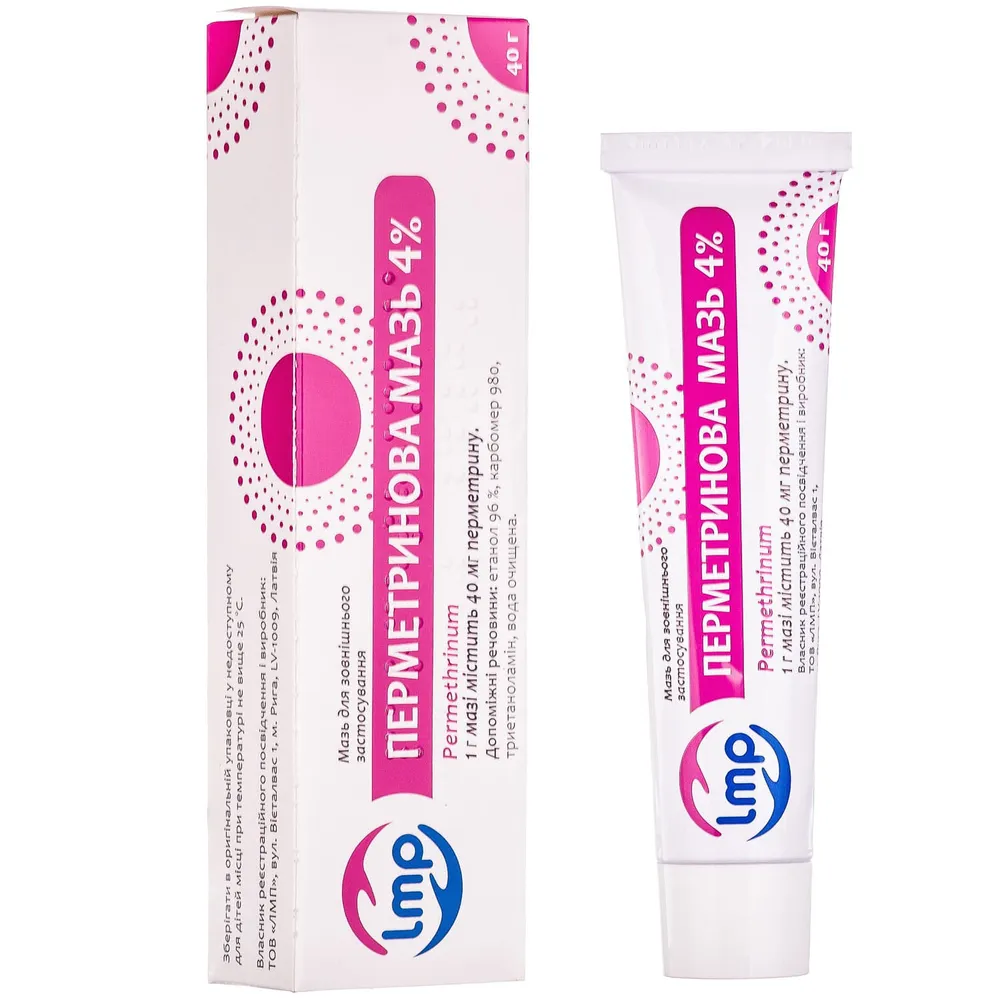
Table of Contents
INSTRUCTIONS FOR MEDICAL USE OF THE MEDICINAL PRODUCT Permethrin Ointment 4% (Permethrin ointment 4%)
Composition:
Active substance: permethrin;
1 g of ointment contains 40 mg of permethrin;
Excipients: ethanol 96%, carbomer 980, triethanolamine, purified water.
Pharmaceutical form. Ointment.
Main physicochemical properties: gel-like opaque mass of white to creamy color.
Pharmacotherapeutic group. Agents acting on ectoparasites, including scabies mites. ATC code P03AC04.
Pharmacological properties.
Pharmacodynamics.
Permethrin is a mixture of cis- and trans-isomers of a synthetic pyrethroid. It is an insecticidal and acaricidal agent for topical use, effective against many insects, including the scabies mite. It inhibits development and causes death of larvae and adult individuals. Antiparasitic action is due to disruption of ionic permeability through sodium channels and inhibition of membrane depolarization (repolarization) processes in insect nerve cells, resulting in a paralyzing effect. Permethrin is low in toxicity for humans and warm-blooded animals.
Pharmacokinetics.
After topical application, absorption is no more than 2%. The portion of the substance that enters systemic circulation is rapidly hydrolyzed into inactive metabolites and is excreted mainly in urine. As an anti-scabies agent, it is effective after a single treatment.
Clinical characteristics.
Indications.
Scabies.
Contraindications.
Hypersensitivity to the active substance, other pyrethroids or pyrethrins, or to any of the excipients; acute inflammatory skin conditions of the scalp.
Interaction with other medicinal products and other forms of interaction.
Before applying the ointment, treatment with corticosteroids used for managing eczematous-like reactions should be discontinued, as there is a risk of exacerbating scabies symptoms due to immunosuppressive effects. This interaction may lead to increased adverse reactions or reduced efficacy of either product.
Special precautions for use
Permethrin cream 4% is intended for topical use only.
Patients who are hypersensitive to chrysanthemum plants or other plants of the Compositae family should consult a physician before using this medicinal product, as cross-sensitivity may occur between synthetic pyrethroids such as permethrin.
The cream may be irritating to the conjunctiva of the eye; contact with eyes must therefore be avoided. Contact of the cream with mucous membranes (e.g., nose, mouth, genitals) and open wounds should also be avoided. If contact occurs, the affected mucous membranes should be thoroughly rinsed with copious amounts of running water. Personnel applying the cream should protect their hands with rubber gloves. Hands should be thoroughly washed with soap after the procedure.
This medicinal product should be used in children only under medical supervision.
If itching persists for more than 4 weeks after treatment for scabies, the patient should consult a physician.
To prevent reinfestation with scabies, clothing, headwear, and bed linen should be decontaminated (e.g., by thermal treatment).
Consult a physician in cases of pre-existing skin disorders, impaired skin integrity, inflammatory skin conditions, secondary skin infections, or when using other medicinal products.
It is important to follow the recommendations provided in this instruction (especially regarding duration of treatment and reapplication of the cream in areas washed with water after application), as treatment failures have been reported when instructions were not followed.
Despite the low acute toxicity of permethrin with topical application, prolonged application to the skin or long-term use should be avoided, as prolonged exposure to permethrin may increase systemic absorption and neurotoxic effects, particularly in young children.
The medicinal product is harmful to all insect species and to aquatic flora and fauna (fish, algae, daphnids). Do not allow entry into aquariums.
Use during pregnancy or breastfeeding
Data on the use of this medicinal product during pregnancy are limited. After dermal application, systemic absorption does not exceed 2%. The product is not recommended during pregnancy unless the expected benefit to the mother outweighs the potential risk to the fetus and child.
Due to limited experience with use in breastfeeding women, the risk-benefit balance should be carefully evaluated, and the cream should be used only if clearly needed. Breastfeeding should be discontinued during treatment and for at least one week after completion of treatment.
Effect on ability to drive or operate machinery
There are no reports on the effect of this medicinal product on the ability to drive or operate machinery.
Dosage and Administration
Dosage
It is not possible to determine an exact dosage for treatment due to varying body surface areas to which the medicinal product is applied. Dosage may increase when applied to the face, ears, and scalp.
Approximate Dosage
Adults and adolescents aged 12 years and older
Apply 40 g of cream (equivalent to one tube). Some adults may require more to cover the entire body, but do not use more than 80 g per application.
Children aged 6–12 years
Apply 20 g of cream (equivalent to ½ tube).
Children aged 2 months to 5 years
Apply 10 g of cream (equivalent to ¼ tube).
The safety and efficacy of the medicinal product in infants under 2 months of age have not been established. Data are lacking.
A small amount
Administration
The medicinal product is intended for topical use only and must not be taken orally. Apply a thin layer of cream to clean, dry, cool skin. Do not apply immediately after a hot bath. The cream is fully absorbed into the skin; therefore, there is no need to continue applying more cream once it is no longer visible on the skin.
Do not apply the cream to damaged skin, mucous membranes, or areas near the eyes. In case of accidental contact with these areas, rinse thoroughly with water as described in the section "Special Precautions".
Individuals applying the cream may wear gloves to avoid possible hand irritation.
Adults, adolescents, and children aged 2 years and older
Apply the cream to the entire body, excluding the head and face, unless these areas are affected.
Special attention should be paid to the areas between fingers and toes, under fingernails, wrists, underarms, external genitalia, breasts, and buttocks.
Children aged 2 months to 2 years
The medicinal product should be used under medical supervision due to limited experience in this age group. Apply the cream to the entire body, including the neck, face, ears, and scalp. Special attention should be paid to the areas between fingers and toes, under fingernails, wrists, underarms, external genitalia, and buttocks.
Do not apply the cream around the mouth (children may lick it off) or around the eyes. Children may also lick the medicinal product from their hands; therefore, gloves should be used if necessary.
The medicinal product must not be used in newborns and infants under 2 months of age due to increased risk of systemic reactions and limited experience in this age group.
Elderly individuals (over 65 years)
Apply the cream to the entire body, including the neck, face, ears, and scalp. Special attention should be paid to the areas between fingers and toes, under fingernails, wrists, underarms, external genitalia, breasts, and buttocks. Avoid application around the eyes.
The cream should remain on the skin for 14 hours, but not less than 8 hours. If any area where the cream was applied is washed with water during this period, reapply the cream to that area. After 8–14 hours, the entire body should be thoroughly washed with water in a bath or shower.
It is also important to follow general parasite eradication measures:
- Individuals in close contact with the infected person should be treated simultaneously, even if they do not show symptoms;
- Nails should be kept short and clean;
- Clothing, underwear, bed linen, and towels should be changed daily for at least 7 days and washed at high temperatures (at least 60°C);
- Clothing unsuitable for washing should be stored in sealed plastic bags for at least 7 days;
- Carpets, beds, mattresses, and all upholstered furniture should be thoroughly vacuumed.
Duration of Treatment
- Treatment success (percentage of individuals successfully treated) is approximately 90% after a single application. If treatment fails (no signs of healing or new lesions appear), a second application should be performed no sooner than 7 days after the first application, if necessary.
- Skin rashes and itching may persist for up to 2 weeks, and in some cases up to 4 weeks after treatment. This may not only be due to treatment failure but also to hypersensitivity reactions caused by treatment or to residual parasite antigens. If there is no improvement within 4 weeks, if symptoms worsen, or if new burrows appear, consult a physician.
- At the end of treatment, emollients may be applied to dry skin.
After completion of treatment, any remaining medicinal product should be discarded.
Children.
Contraindicated in children under 2 months of age. In children aged 2 months and older, use only as directed by a physician.
Overdose.
There is no information on cases of overdose.
Overdose in adults after topical application is impossible, and unlikely in children due to the very low systemic absorption of permethrin after topical use. Overdose is possible only if a large amount of the medicinal product is accidentally ingested. Symptoms of permethrin poisoning include nausea, vomiting, headache, dizziness, weakness, and in severe cases, skin sensory disturbances such as tingling, tinnitus, numbness, hyperexcitability, tremor, and seizures. Symptomatic and intensive therapy should be administered as needed. Gastric lavage may be performed if ingestion occurred less than 2 hours prior.
Excessive topical application may exacerbate moderate adverse reactions such as skin reactions and paresthesia (paresthesia has also been reported following oral poisoning).
In case of overdose, discontinue use of the product and wash the skin thoroughly with large amounts of warm water. Antihistamines may be used if necessary.
Side effects
Most side effects are mild and transient: rash, itching, and skin paraesthesia in the form of stinging, burning, and prickling sensations. In patients with scabies, these reactions may persist for up to 2 weeks, and in some cases up to 4 weeks, despite successful treatment. These are usually due to an allergic reaction to the presence of dead scabies mites under the skin and do not necessarily indicate treatment failure.
Terms used to describe the frequency of adverse reactions: very common (≥1/10), common (≥1/100 to <1/10), uncommon (≥1/1,000 to <1/100), rare (≥1/10,000 to <1/1,000), very rare (<1/10,000), not known (cannot be estimated from available data).
Disorders of the skin and subcutaneous tissue
Common: skin rash, pruritus, erythema, scaling/dry skin.
Very rare: hypopigmentation of the skin, folliculitis.
Not known: dermatitis, urticaria.
Disorders of the nervous system
Common: sensory disturbances, sensations of burning, prickling, or numbness.
Disorders of the respiratory system
Not known: hypersensitivity reactions—manifested as dyspnea.
Gastrointestinal disorders
Not known: nausea, diarrhea.
In patients with scabies, skin discomfort is usually described as burning, prickling, or numbness. This effect may occur immediately after application of the medicinal product in individual patients; it is more commonly observed in patients with severe disease and is usually mild and transient.
Other transient irritation symptoms, including erythema, swelling, eczema, rash, and itching, are part of the symptoms of scabies.
Shelf life. 3 years.
Storage conditions.
Store in the original packaging, out of the reach of children, at a temperature not exceeding 25°C.
Keep in tightly closed packaging.
The medicinal product is harmful to all insect species and to aquatic flora and fauna (fish, algae, daphnia). Avoid entry into aquariums.
Do not dispose of the medicinal product via wastewater or household waste. Ask your pharmacist how to dispose of medicines no longer in use. These measures will help protect the environment.
Packaging. 40 g in aluminium tubes; 1 tube per cardboard box.
Supply category. Over-the-counter.
Manufacturer. LLC "LMP".
Manufacturer's location and address of place of business.
- Viestalu 1, Riga, LV-1009, Latvia.