Papazol-darnitsa
Ukraine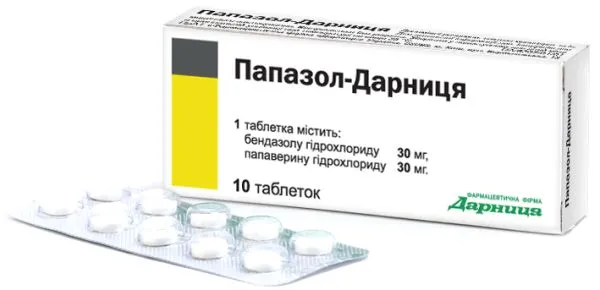
Table of Contents
INSTRUCTIONS FOR MEDICAL USE OF THE MEDICINAL PRODUCT PAPAZOL-DARNITSA (PAPAZOL-DARNITSA)
Composition:
Active substances: 1 tablet contains bendazole hydrochloride 30 mg, papaverine hydrochloride 30 mg;
Excipients: lactose monohydrate, microcrystalline cellulose, potato starch, sodium croscarmellose, calcium stearate.
Pharmaceutical form. Tablets.
Main physicochemical properties: tablets of white color with a grayish tint, flat cylindrical shape, with a bevel.
Pharmacotherapeutic group. Peripheral vasodilators. ATC code C04AX.
Pharmacological Properties.
Pharmacodynamics.
A combined medicinal product containing the alkaloid papaverine and an imidazole derivative – bendazole.
Papaverine is a myotropic spasmolytic agent. It acts as an inhibitor of the enzyme phosphodiesterase, leading to intracellular accumulation of cyclic 3',5'-adenosine monophosphate (cAMP). The accumulation of cAMP disrupts the contractility of smooth muscles, resulting in their relaxation during spasms. Papaverine reduces muscle tone, decreases contractile activity of smooth muscles, and thereby produces vasodilatory and spasmolytic effects. Its action on the central nervous system is weak; only at higher doses does it exhibit a slight sedative effect.
Bendazole is a myotropic spasmolytic agent. It directly affects the smooth muscles of blood vessel walls and internal organs by acting on imidazole receptors. It reduces arterial pressure, lowers free calcium content in smooth muscles, relieves spasms of smooth muscles in abdominal organs, and stimulates spinal cord functions. It enhances tissue resistance to hypoxia and increases the synthesis of nucleic acids and proteins.
Clinical Characteristics
Indications
Spasm of smooth muscles of internal organs (pylorospasm, spastic colitis, cholecystitis, peptic ulcer of the stomach and duodenum, intestinal colic, renal colic, ureteral spasm);
transient spasm of cerebral vessels;
moderately expressed spasm of peripheral vessels;
additional agent in the complex therapy of arterial hypertension.
Contraindications
Hypersensitivity to the active substance or to other components of the drug; atrioventricular conduction disorders; severe heart failure; arterial hypotension; diseases associated with decreased muscle tone; seizure disorders; bronchial obstructive syndrome; bleeding gastric and duodenal ulcers; hypotonic colitis; habitual constipation; head trauma; severe hepatic and renal insufficiency; chronic nephritis with edema and impaired renal nitrogen excretory function; diabetes mellitus; hypothyroidism; adrenal insufficiency; prostate hyperplasia; glaucoma.
The drug is contraindicated in rare hereditary conditions that may lead to incompatibility with the excipient (see section "Special Precautions").
Interaction with Other Medicinal Products and Other Forms of Interaction
Concomitant use of papazol with other medicinal products may result in:
with antihypertensive agents of various groups, tricyclic antidepressants, diuretics, procainamide, reserpine, quinidine, phentolamine – enhanced hypotensive effect; with prolonged use in combination with β-adrenoblockers, the drug prevents the increase in total peripheral resistance caused by β-adrenoblockers;
with anticholinergic agents – enhanced anticholinergic effect;
with barbiturates – mutual enhancement of effects;
with levodopa, methyldopa – reduced efficacy of these medicinal products;
with central nervous system (CNS) depressants – increased toxicity of these medicinal products; such combination is not recommended;
with cardiac glycosides – pronounced enhancement of myocardial contractile function due to reduction in total peripheral vascular resistance;
with adsorbents, astringents, and coating agents – reduced absorption of the drug from the gastrointestinal tract.
The efficacy of the drug is reduced by tobacco smoking.
Special precautions.
The medicinal product should be prescribed with caution and in doses lower than the average therapeutic dose in patients with severe heart diseases, supraventricular tachycardia, respiratory depression, reduced intestinal peristalsis, shock conditions, debilitated patients, and elderly patients.
Prolonged use of the medicinal product for the treatment of arterial hypertension is not recommended, particularly in elderly patients.
Orthostatic hypotension may occur during treatment with this medicinal product.
If symptoms of liver dysfunction develop, including gastrointestinal disturbances, jaundice, eosinophilia, or elevated liver enzymes, administration of the medicinal product must be discontinued.
Patients should inform their physician if any of the following symptoms occur: flushing, sweating, headache, increased fatigue, jaundice, skin rash, nausea, epigastric discomfort, constipation.
Smoking may reduce the effectiveness of the medicinal product.
During treatment with this medicinal product, consumption of alcohol and concomitant use of drugs that depress the central nervous system should be avoided.
The medicinal product contains lactose; therefore, patients with rare hereditary forms of galactose intolerance, lactase deficiency, or glucose-galactose malabsorption should not take this medicinal product.
Use during pregnancy or breastfeeding.
The medicinal product is contraindicated during pregnancy or breastfeeding.
Ability to influence reaction rate while driving or operating machinery.
During treatment with this medicinal product, patients should refrain from driving or operating complex machinery.
Dosage and Administration.
The medicinal product should be administered to adults orally, 2 hours before or after meals, 1 tablet 2–3 times a day. The maximum single dose is 1 tablet; the maximum daily dose is 4 tablets.
The duration of treatment is determined by the physician depending on the nature and course of the disease and the effectiveness of therapy.
Children.
The medicinal product is contraindicated in children.
Overdose.
Poisoning symptoms represent a combination of papaverine and bendazole overdosage.
Symptoms of bendazole poisoning: arterial hypotension, arrhythmia, increased sweating, sensation of heat, dizziness, nausea, headache, weakness, decreased tissue perfusion.
Symptoms of papaverine poisoning: restlessness, inhibition, drowsiness, weakness, headache, sweating, visual disturbances, diplopia, dyspnea, ataxia, nystagmus, central nervous system depression, sinus tachycardia, partial or complete atrioventricular block, arterial hypotension, collapse, coma, cyanosis, metabolic acidosis, hyperventilation, hyperglycemia, hyperkalemia, nausea, vomiting, constipation, gastrointestinal disturbances, skin rash.
Treatment: discontinue the drug, gastric lavage until washings are clear, saline laxative and activated charcoal. Symptomatic treatment. There is no specific antidote.
Adverse Reactions
When using the medicinal product, adverse reactions characteristic of papaverine and bendazole preparations may occur in individual patients.
Respiratory system, thoracic organs and mediastinum: dry cough, rhinitis, dyspnea.
Gastrointestinal tract: nausea, constipation, gastric discomfort.
Hepatobiliary system: increased activity of liver transaminases, jaundice.
Nervous system: headache, drowsiness, weakness, dizziness.
Cardiovascular system: AV block, arrhythmias, decreased myocardial contractility, arterial hypotension, orthostatic hypotension, palpitations, chest pain, flushing, ventricular extrasystoles, tachycardia; with prolonged use – worsening of ECG parameters due to reduced cardiac output.
Blood and lymphatic system: eosinophilia.
Immune system: hypersensitivity reactions, including rash, pruritus, urticaria, Quincke's edema.
General disorders: increased sweating, hyperemia, sensation of heat.
If any adverse events occur, the patient should consult a physician!
Shelf life: 5 years.
Do not use the medicinal product after the expiry date stated on the package.
Storage conditions.
Store in the original packaging, out of reach of children, at a temperature not exceeding 25 °C.
Packaging.
10 tablets in a blister pack; 1 blister pack in a carton.
Availability category: Over-the-counter.
Manufacturer: JSC "Pharmaceutical Company "Darnytsia".
Manufacturer's address and place of business:
13, Boryspylska Street, Kyiv, 02093, Ukraine.