Papaverine hydrochloride
Ukraine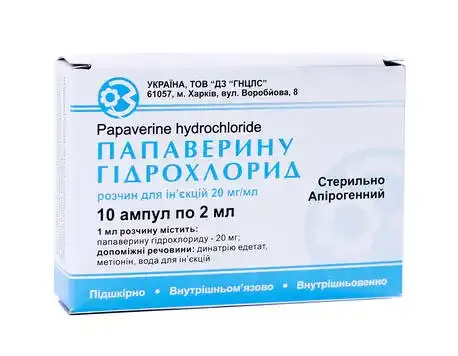
Table of Contents
INSTRUCTION FOR MEDICAL USE OF THE MEDICINAL PRODUCT PAPAVERINE HYDROCHLORIDE
Composition:
Active substance: papaverine;
1 ml of solution contains 20 mg of papaverine hydrochloride;
Excipients: disodium edetate, methionine, water for injections.
Pharmaceutical form. Solution for injection.
Main physicochemical characteristics: clear liquid with a slight yellowish tint.
Pharmacotherapeutic group. Agents used in functional gastrointestinal disorders. Papaverine and its derivatives. ATC code A03A D01.
Pharmacological properties.
Pharmacodynamics.
Papaverine is a myotropic, spasmolytic, and hypotensive agent.
The mechanism of action involves inhibition of the enzyme phosphodiesterase, which promotes intracellular accumulation of cyclic 3',5'-adenosine monophosphate, resulting in impaired contractility of smooth muscles and their relaxation in spastic conditions. It reduces intracellular calcium levels. It decreases tone and relaxes smooth muscles of internal organs (gastrointestinal tract, respiratory and urogenital systems) and blood vessels. It causes arterial dilation and enhances blood flow, including cerebral blood flow. In higher doses, it reduces excitability of cardiac muscle and slows intracardiac conduction. Effects on the central nervous system are weak (sedative effect may occur at high doses).
Pharmacokinetics.
The extent of absorption is high. Plasma protein binding is 90%, forming stable complexes with serum albumin. It is well distributed in body tissues and penetrates through histohematologic barriers. It is metabolized in the liver. The half-life is 0.5–2 hours (may be prolonged up to 24 hours). It is primarily excreted by the kidneys in the form of metabolites.
Clinical characteristics.
Indications.
- Smooth muscle spasms of abdominal organs (pylorospasm, irritable bowel syndrome, cholecystitis, biliary colic);
- urinary tract spasms, renal colic;
- cerebral vessel spasm;
- peripheral vessel spasm (endarteritis).
Contraindications. Hypersensitivity to the components of the drug, arterial hypotension, atrioventricular conduction disturbances, comatose state, respiratory depression, concomitant use of monoamine oxidase inhibitors, glaucoma, hepatic insufficiency, bronchoobstructive syndrome, age over 75 years (risk of hyperthermia).
Interaction with other medicinal products and other types of interactions. The spasmolytic effect of papaverine is enhanced by barbiturates, diphenhydramine (dimenhydrinate), metamizole (analgin), and diclofenac. The hypotensive effect is enhanced when used concomitantly with antihypertensive agents of other classes, as well as with tricyclic antidepressants, procainamide, reserpine, and quinidine. Papaverine may reduce the antiparkinsonian effect of levodopa and the hypotensive effect of methyldopa. When used concomitantly with alprostadil for intracavernous administration, there is a risk of developing priapism. Phentolamine potentiates the effect of papaverine on the corpora cavernosa of the penis when administered together.
Concomitant use with cardiac glycosides results in pronounced enhancement of myocardial contractile function due to decreased total peripheral vascular resistance. When used together with procainamide, enhancement of the hypotensive effect is possible.
A possible reduction in the tonic effect of anticholinesterase agents on smooth muscle under the influence of papaverine hydrochloride may occur.
A possible reduction in the spasmolytic activity of papaverine hydrochloride under the influence of morphine may occur. However, papaverine hydrochloride can be used together with morphine hydrochloride to reduce the spasmogenic effect of the latter, and also with promedol for pain associated with smooth muscle spasms.
There are reports of hepatitis development during concomitant use with furadantin (nitrofurantoin).
When reserpine-containing drugs are combined with papaverine hydrochloride, the antihypertensive effect is enhanced.
When combined with antidepressants, enhancement of the hypotensive effect is possible.
Pharmaceutically compatible with dibazole.
When used simultaneously, papaverine hydrochloride potentiates the effect of alcohol.
In patients who smoke, papaverine metabolism is accelerated, and its plasma concentration and pharmacokinetic effects are reduced.
Special precautions for use.
The drug should be administered with caution and in doses lower than the average therapeutic doses:
- to elderly and debilitated patients;
- to patients with traumatic brain injury;
- to patients with chronic renal insufficiency;
- to patients with supraventricular tachycardia, severe heart failure with signs of decompensation;
- in cases of adrenal insufficiency, hypothyroidism, benign prostatic hyperplasia, and shock states.
The drug should be administered intravenously very slowly and under monitoring of arterial pressure, heart rate, and electrocardiogram.
Intravenous injections of the drug should be administered with caution in patients with stenosing coronary atherosclerosis.
Hyperthermia may occur in elderly individuals.
Smoking reduces the effectiveness of the drug.
Alcohol consumption should be avoided during treatment with this drug.
This medicinal product contains less than 1 mmol (23 mg)/dose of sodium, i.e., it is practically sodium-free.
Use during pregnancy or breastfeeding. The safety and efficacy of the drug during pregnancy or breastfeeding have not been established. Breastfeeding should be discontinued during treatment with this drug.
Ability to affect reaction speed while driving or operating machinery. Patients should refrain from driving vehicles or operating other complex machinery during treatment with this drug.
Administration and Dosage
The drug is administered subcutaneously, intramuscularly, and intravenously.
Subcutaneously and intramuscularly, administer to adults and children aged 14 years and older 0.5–2 mL (10–40 mg) of a 2% solution. For intravenous administration, dissolve 1 mL of a 2% solution of papaverine hydrochloride (20 mg) in 10–20 mL of 0.9% sodium chloride solution and inject very slowly at a rate of 3–5 mL/min. Intravenous administration is the most effective.
For elderly patients, the initial single dose should not exceed 10 mg (0.5 mL of a 2% solution).
Maximum doses for adults:
- Subcutaneous or intramuscular administration: single dose – 100 mg (5 mL of a 2% solution), daily dose – 300 mg (15 mL of a 2% solution);
- Intravenous administration: single dose – 20 mg (1 mL of a 2% solution), daily dose – 120 mg (6 mL of a 2% solution).
Children aged 1 to 14 years: administer the drug 2–3 times daily. The single dose is 0.7–1 mg/kg of body weight.
Maximum daily dose for children (regardless of route of administration):
- Ages 1–2 years – 20 mg (1 mL of a 2% solution);
- Ages 3–4 years – 30 mg (1.5 mL of a 2% solution);
- Ages 5–6 years – 40 mg (2 mL of a 2% solution);
- Ages 7–9 years – 60 mg (3 mL of a 2% solution);
- Ages 10–14 years – 100 mg (5 mL of a 2% solution).
Children. The drug is indicated for children aged 1 year and older.
Overdose.
Symptoms: visual disturbances, diplopia, weakness, dry mouth, constipation, facial flushing, hyperventilation, nystagmus, ataxia, tachycardia, arterial hypotension, asystole, ventricular flutter, collapse. When high doses are administered or when the drug is injected rapidly into a vein, arrhythmias or complete atrioventricular block may develop. When administered in very high doses, papaverine may produce a mild sedative effect.
Treatment: discontinue the drug. Provide symptomatic treatment. The drug is completely removed from the blood by hemodialysis. There is no specific antidote.
Adverse reactions.
Central nervous system: drowsiness, increased sweating, headache, weakness, dizziness.
Sensory organs: visual disturbances, diplopia.
Gastrointestinal tract: nausea, constipation, diarrhea, anorexia, dry mouth.
Hepatobiliary system: jaundice, liver function disorders, increased activity of liver transaminases.
Cardiovascular system: arrhythmias, tachycardia, arterial hypotension, partial or complete atrioventricular block, asystole, ventricular extrasystoles, ventricular fibrillation, ventricular flutter, collapse.
Blood system: eosinophilia.
Respiratory system: apnea.
Skin, subcutaneous tissue and immune system: hypersensitivity reactions, including respiratory tract involvement, anaphylactic shock, pruritus, skin rash, urticaria, hyperemia of the skin of the upper trunk, face, and arms.
Other: local reactions at the injection site, including thrombosis at the injection site.
Shelf life. 4 years.
Storage conditions. Store at temperatures not exceeding 25 °C in the original packaging.
Keep out of reach of children.
Incompatibility. Chemically incompatible with sodium caffeine-benzoate; pharmaceutically incompatible with glucose solutions (partial inactivation of papaverine). Use only the recommended solvent (see section "Administration and dosage").
Packaging. 2 ml in ampoules, pack of 10 in a carton; 10 in a blister pack in a carton.
Prescription status. Prescription only.
Manufacturer.
Limited Liability Company "Research Plant "GNCLS".
Limited Liability Company "Pharmaceutical Company "Zdorov'ya".
Manufacturer's address and place of business.
8, Vorobiova Street, Kharkiv, Kharkiv Oblast, Ukraine.
(Limited Liability Company "Research Plant "GNCLS")
22, Shevchenka Street, Kharkiv, Kharkiv Oblast, 61013, Ukraine.
(Limited Liability Company "Pharmaceutical Company "Zdorov'ya")