Papaverine-zdorovya
Ukraine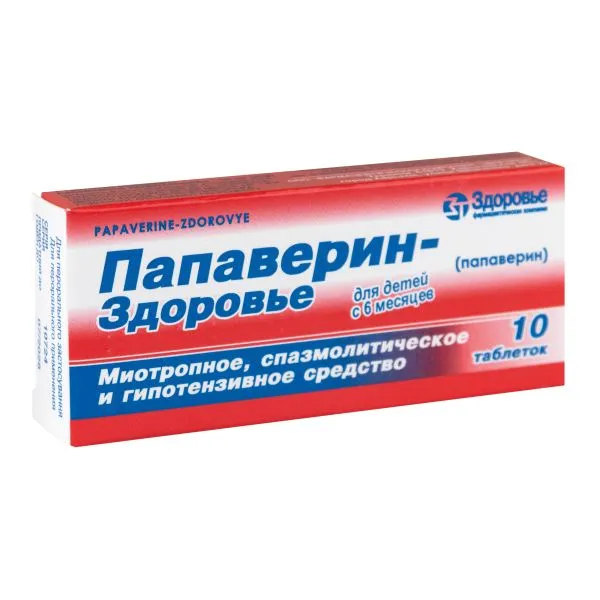
Table of Contents
INSTRUCTION for medical use of the medicinal product PAPAVERINE-ZDOROVYE (PAPAVERINE-ZDOROVYE)
Composition:
Active substance: papaverine;
1 tablet contains papaverine hydrochloride 10 mg;
Excipients: refined sugar, potato starch, stearic acid, talc.
Dosage form. Tablets.
Main physicochemical properties: white-colored tablets. Two perpendicular scored lines are imprinted on the tablets by compression, dividing the tablet into four equal parts.
Pharmacotherapeutic group. Agents used in functional disorders of the gastrointestinal tract. Papaverine. ATC code A03AD01.
Pharmacological properties.
Pharmacodynamics.
A myotropic, spasmolytic and antihypertensive agent.
The drug reduces tone, decreases contractile activity of smooth muscles and thus causes vasodilating and spasmolytic effects. Papaverine is an inhibitor of the enzyme phosphodiesterase, which leads to intracellular accumulation of cyclic 3',5'-adenosine monophosphate (cAMP). Accumulation of cAMP results in impaired contractility of smooth muscles and their relaxation in spastic conditions. The drug's action on the central nervous system is weak; only at higher doses does it exhibit a slight sedative effect.
Pharmacokinetics.
The extent of absorption is high; bioavailability averages 54%. Binding to plasma proteins is 90%, forming stable complexes with serum albumin. It is well distributed in body tissues and penetrates through histohematogenous barriers. Metabolized in the liver. T½ – 0.5–2 hours (may be prolonged up to 24 hours). Excreted mainly by the kidneys in the form of metabolites. Completely removed from blood during hemodialysis.
Clinical characteristics.
Indications.
Spasm of smooth muscles of abdominal organs (cholecystitis, pylorospasm, spastic colitis, renal colic), peripheral vessels (endarteritis), and cerebral vessels.
Contraindications. Hypersensitivity to any component of the drug; atrioventricular conduction disorders (atrioventricular block), glaucoma, hepatic insufficiency, respiratory depression, bronchoobstructive syndrome, arterial hypotension, comatose state, concomitant use of monoamine oxidase inhibitors (MAO inhibitors).
Interaction with other medicinal products and other types of interactions.
The spasmolytic effect of papaverine is enhanced by barbiturates, diphenhydramine (dimedrol), metamizole sodium (analgin), and diclofenac. The hypotensive effect is enhanced when used concomitantly with antihypertensive agents of other groups, as well as with antidepressants (including tricyclic antidepressants), procainamide (novocainamide), reserpine, and quinidine. Papaverine enhances the anticholinergic effects of anticholinergic drugs. Papaverine may reduce the hypotensive effect of methyldopa and the antiparkinsonian effect of levodopa. When used concomitantly with cardiac glycosides, a pronounced enhancement of myocardial contractile function may occur due to decreased total peripheral vascular resistance. A possible reduction in the tonic effect of anticholinesterase agents on smooth muscle under the influence of papaverine. There are reports of hepatitis development when used concomitantly with furadantin (nitrofurantoin). Papaverine potentiates the effect of alcohol when used simultaneously.
A possible reduction in the spasmolytic activity of papaverine under the influence of morphine may occur. However, papaverine is used together with morphine to reduce the spasmogenic effect of the latter, and also with promedol (meperidine) for pain associated with spasms of smooth musculature.
Special precautions for use.
The medicinal product should be prescribed with caution and in small doses in severe heart diseases, chronic renal insufficiency, adrenal insufficiency, hypothyroidism, supraventricular tachycardia, shock conditions, and in debilitated children. With caution and in doses lower than the average therapeutic doses, the drug should be prescribed to patients with traumatic brain injury and post-traumatic conditions, as well as in patients with benign prostatic hyperplasia.
The efficacy of the drug is reduced in smokers.
If a patient has known sugar intolerance, medical advice should be sought before taking this medicine (the product contains refined sugar, which should be taken into account by patients with diabetes mellitus).
Use during pregnancy or breastfeeding.
There is no available information regarding the safety and efficacy of the drug during pregnancy or breastfeeding.
Ability to affect reaction speed when driving or operating machinery.
Due to the possible occurrence of adverse reactions affecting the nervous system (specifically dizziness and drowsiness), patients should refrain from driving or operating complex machinery during treatment with this drug.
Dosage and Administration.
Administer orally to children 3–4 times daily.
Dosage depends on the child's age:
- from 6 months to 1 year – 2.5–5 mg (1/4–1/2 tablet) per dose. Maximum daily dose – 10 mg (1 tablet);
- 1–2 years – 2.5–5 mg (1/4–1/2 tablet) per dose. Maximum daily dose – 20 mg (2 tablets);
- 3–4 years – 5–10 mg (1/2–1 tablet) per dose. Maximum daily dose – 30 mg (3 tablets);
- 5–6 years – 10 mg (1 tablet) per dose. Maximum daily dose – 40 mg (4 tablets);
- 7–9 years – 15 mg (1\1/2 tablets) per dose. Maximum daily dose – 60 mg (6 tablets);
- 10–14 years – 15–20 mg (1\1/2–2 tablets) per dose. Maximum daily dose – 80 mg (8 tablets).
For children under 3 years of age, the single dose should be crushed and mixed with 1 teaspoon of boiled cooled water.
Children.
The drug is indicated for children aged 6 months and older.
Overdose.
Symptoms: visual disturbances, diplopia, weakness, dry mouth, redness of the skin of the upper part of the trunk, hyperventilation, nystagmus, ataxia, tachycardia, asystole, ventricular flutter, collapse, arterial hypotension, drowsiness, headache, nausea, constipation, increased sweating, allergic reactions. Accidental ingestion of very high doses of papaverine may result in toxic effects such as arrhythmias, complete or partial atrioventricular block.
Treatment: discontinue the drug, symptomatic therapy. Perform gastric lavage and administer enterosorbents. No specific antidote exists. The drug is completely removed from the blood during hemodialysis.
Adverse reactions.
Nervous system disorders: drowsiness, headache, dizziness.
Sensory organ disorders: vision disturbances, diplopia.
Gastrointestinal disorders: gastrointestinal disturbances, constipation, anorexia, nausea, dry mouth, diarrhea.
Hepatobiliary disorders: increased liver transaminase activity, jaundice, liver function abnormalities.
Cardiovascular disorders: arterial hypotension, orthostatic hypotension, flushing, arrhythmias, tachycardia, atrioventricular block, asystole, ventricular extrasystoles, ventricular fibrillation, ventricular flutter, collapse.
Respiratory system disorders: apnea.
Blood and lymphatic system disorders: eosinophilia.
Skin, subcutaneous tissue and immune system disorders: hypersensitivity reactions, including respiratory tract involvement, anaphylactic shock, pruritus, skin rash, urticaria, redness of the upper part of the trunk.
Other: malaise, increased sweating.
Shelf life. 4 years.
Storage conditions. Store in the original packaging at a temperature not exceeding 25 °C.
Keep out of reach of children.
Packaging. Tablets, 10 tablets in a blister pack in a box; 10 tablets in a blister pack.
Category of release. By prescription only.
Manufacturer. LIMITED LIABILITY COMPANY "CORPORATION "ZDOROVTYA".
Manufacturer's address and place of business.
22, Shevchenka Street, Kharkiv, Kharkiv Oblast, 61013, Ukraine.