Pancreatin 8000
Ukraine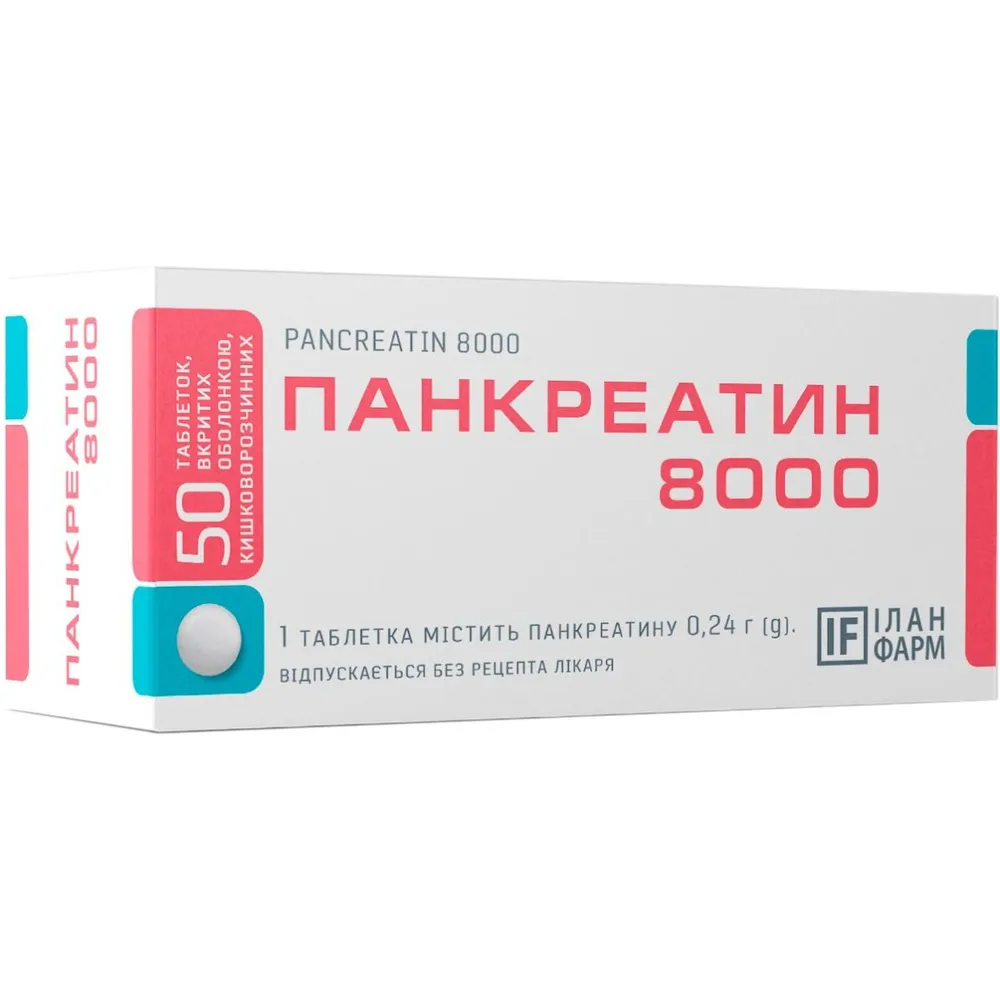
Table of Contents
INSTRUCTIONS FOR MEDICAL USE OF THE MEDICINAL PRODUCT PANKREATIN 8000 (PANCREATIN 8000)
Composition:
Active substance: 1 tablet contains pancreatin with enzymatic activity of not less than 8000 lipolytic IU Ph. Eur., 5600 amylolytic IU Ph. Eur., 370 proteolytic IU Ph. Eur.;
Excipients: sodium chloride, colloidal anhydrous silicon dioxide, microcrystalline cellulose, crospovidone, sodium croscarmellose, povidone 25, magnesium stearate, dispersion of methacrylic acid copolymer, talc, propylene glycol, titanium dioxide (E 171), carmoisine (E 122).
Pharmaceutical form. Gastric-resistant tablets.
Main physicochemical characteristics: round-shaped tablets coated with a pink film, with a faint specific odor; both upper and lower surfaces are convex. When broken, the core surrounded by a single continuous layer is visible under magnification.
Pharmacotherapeutic group. Digestive enzymes and enzyme preparations. Polyenzyme preparations (lipase, protease, amylase).
ATC code A09AA02.
Pharmacological properties.
Pharmacodynamics.
A polyenzyme preparation. Pancreatic enzymes (lipase, amylase, and protease) contained in the formulation facilitate digestion of fats, carbohydrates, and proteins, thereby promoting their complete absorption in the small intestine. In pancreatic disorders, the preparation compensates for the insufficiency of its exocrine function and improves the digestive process.
Pharmacokinetics.
The coating covering the tablets does not dissolve under the action of gastric juice and protects the enzymes from inactivation by gastric acid. The coating dissolves only under the influence of the neutral or slightly alkaline environment of the small intestine, thereby releasing the enzymes.
Clinical characteristics.
Indications.
- Diseases associated with impaired digestion due to insufficient secretion of pancreatic digestive enzymes, such as chronic pancreatitis.
- Conditions following simultaneous resection of the stomach and small intestine, functional acceleration of food passage through the intestine, intestinal disorders, and concurrent intake of poorly digestible plant-based, fatty, or unusual foods.
- Intestinal bloating and preparation for radiological or ultrasound diagnostic examinations.
Contraindications.
Hypersensitivity to the components of the drug. Acute pancreatitis or chronic pancreatitis in the acute phase. The drug should not be used in patients with obstructive intestinal obstruction.
Interaction with other medicinal products and other forms of interactions.
Concomitant use of pancreatin with iron-containing preparations may reduce iron absorption.
Folic acid. Absorption of folic acid may be reduced in patients taking pancreatic enzyme preparations; therefore, monitoring of folic acid levels is recommended when used concomitantly.
Acarbose, miglitol. Pancreatic enzyme preparations may potentially reduce the effect of these antidiabetic agents. Therefore, during concomitant treatment with pancreatin, monitoring of the antidiabetic agents' effect on the patient's blood glucose levels is recommended.
Special precautions for use.
Intestinal obstruction – when symptoms resembling this condition occur, the possibility of intestinal strictures should be considered. Unusual symptoms should be monitored, especially when doses exceeding 10,000 units of lipase/kg/day are administered.
There is a theoretical risk of transmission of porcine viral infections, including those caused by new or undefined viruses. The possibility of porcine viruses infecting humans cannot be completely excluded. However, to date, no cases of transmission of infectious diseases have been reported following the use of porcine pancreatin preparations.
The medicinal product contains active enzymes that may damage the mucous membrane of the oral cavity; therefore, tablets should be swallowed whole and not chewed.
The product should be used with caution in patients with renal insufficiency, hyperuricemia, and in patients with allergy to porcine-derived proteins.
This medicinal product contains 0.024 mmol (or 0.55 mg)/dose of sodium. Caution is advised when administering to patients on a sodium-restricted diet.
The medicinal product contains propylene glycol.
Use during pregnancy or breastfeeding.
Safety has not been established.
During pregnancy or breastfeeding, the use of this medicinal product should be avoided.
Ability to affect reaction speed while driving or operating machinery.
No effect.
Dosage and Administration.
The dose of the drug depends on the degree of pancreatic enzyme deficiency in the duodenum and is determined individually.
If no other recommendations are given, and also in cases of consuming hard-to-digest plant-based food, fatty or unusual food, take 1–2 tablets. In other cases listed above, when digestive disturbances occur, the recommended dose is 2–4 tablets. The dose may be increased if necessary. Dose escalation aimed at reducing disease symptoms, such as steatorrhea or abdominal pain, should be performed only under medical supervision. The daily dose of lipase should not exceed 15,000–20,000 IU Ph. Eur. per 1 kg of body weight.
Take tablets during meals, swallow whole, and drink with a sufficient amount of liquid, for example, one glass of water.
The duration of treatment depends on the course of the disease and is determined individually by the physician.
Children.
There is no experience with the use of the drug in children; therefore, its use is not recommended in this age group of patients.
Overdose.
Hyperuricemia and hyperuricosuria have been observed during intake of extremely high doses of pancreatin preparations. Treatment is symptomatic.
Side effects.
The following classification is used to assess the frequency of adverse reactions:
Very common: ≥ 1/10;
Common: ≥ 1/100 to < 1/10;
Uncommon: ≥ 1/1,000 to < 1/100;
Rare: ≥ 1/10,000 to < 1/1,000;
Very rare: < 1/10,000;
Frequency not known (cannot be estimated from the available data).
Immune system disorders. Very rare: immediate-type allergic reactions (skin rash, itching, sneezing, lacrimation, bronchospasm), anaphylactic reactions (urticaria, angioneurotic edema).
Frequency not known: Carmoisine (E 122) may cause allergic reactions.
Skin and subcutaneous tissue disorders. Frequency not known: urticaria, hyperemia, itching.
Gastrointestinal disorders. With the use of high doses of pancreatin, strictures may develop in the ileocecal region and ascending colon. Very rare: diarrhea, abdominal pain, nausea, changes in stool characteristics; intestinal obstruction, constipation, vomiting, abdominal distension may occur.
Renal and urinary disorders. Increased excretion of uric acid in urine may occur, especially with high doses of pancreatin. In such patients, urinary uric acid levels should be monitored to prevent formation of uric acid stones.
Reporting of suspected adverse reactions.
Reporting of suspected adverse reactions after authorization of the medicinal product is important. It allows continued monitoring of the benefit-risk balance of the medicinal product. Healthcare professionals are required to report any suspected adverse reactions.
Shelf life. 3 years.
Storage conditions.
Store at temperatures not exceeding 25°C.
Keep out of reach of children.
Packaging.
10 tablets in a blister; 2 or 5 blisters in a cardboard box.
10 tablets in a blister; 90 blisters in a cardboard box.
Prescription status.
Over-the-counter.
Manufacturer.
JSC "Tekhnolog".
Manufacturer's address and place of business.
8 Stara Prorizhna Street, Uman, Cherkasy Oblast, 20300, Ukraine.