Ozelar
Ukraine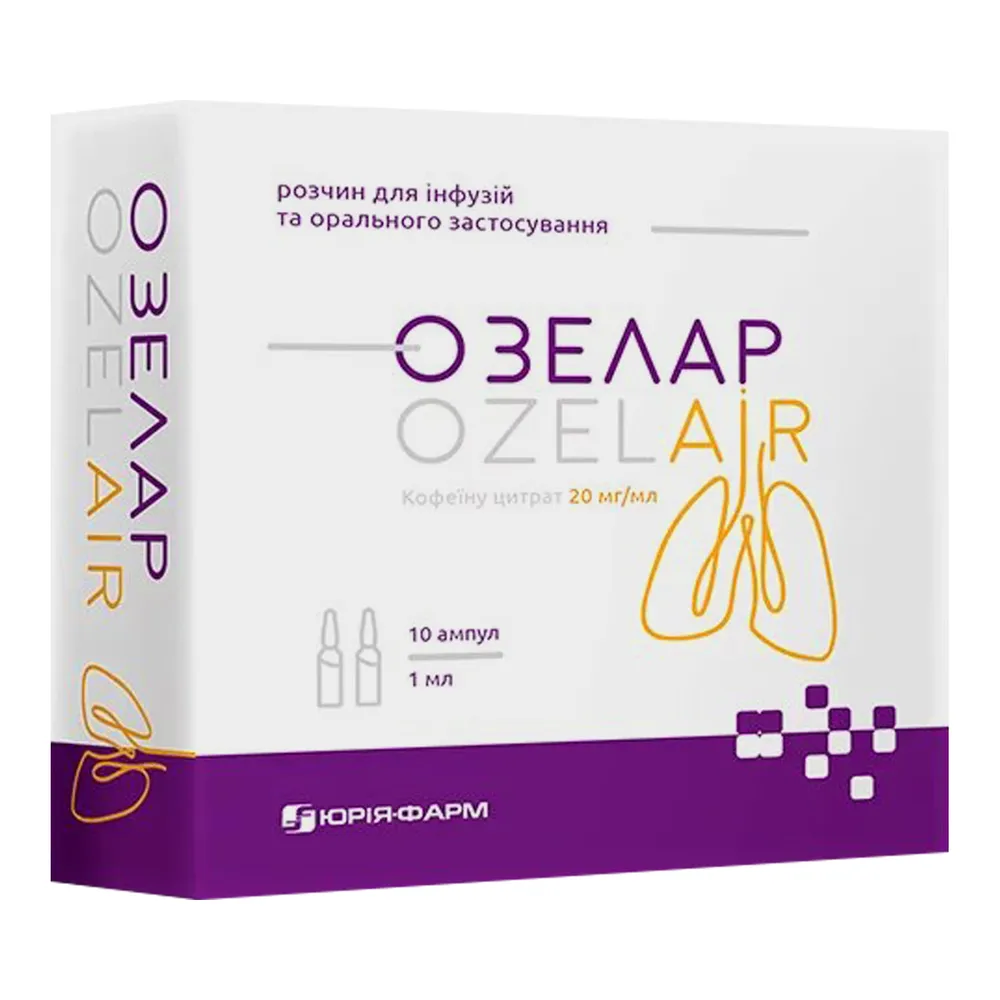
Table of Contents
INSTRUCTIONS FOR MEDICAL USE OF THE MEDICINAL PRODUCT OZELAIR (OZELAIR)
Composition:
Active substance: caffeine citrate;
1 ml of the medicinal product contains 20 mg of caffeine citrate (equivalent to 10 mg of caffeine);
Excipients: citric acid monohydrate; sodium citrate; water for injections.
Pharmaceutical form. Solution for infusion and oral use.
Main physicochemical properties: clear, colorless liquid.
Pharmacotherapeutic group. Psychoanaleptics, xanthine derivatives.
ATC code N06BC01.
Pharmacological Properties
Pharmacodynamics
Mechanism of Action
Caffeine is structurally related to the methylxanthines theophylline and theobromine.
Most of its effects are associated with antagonism of adenosine receptors of subtypes A1 and A2A, as demonstrated by receptor binding analyses, and occur at concentrations approximately equal to therapeutic levels.
Pharmacodynamic Effects
The primary action of caffeine is stimulation of the central nervous system (CNS). This underlies caffeine's effect in apnea of prematurity and involves several mechanisms, including:
- stimulation of respiratory centers;
- increased minute ventilation;
- reduced threshold for arterial carbon dioxide tension;
- enhanced responsiveness to carbon dioxide;
- increased skeletal muscle tone;
- reduced diaphragmatic fatigue;
- increased metabolic rate;
- increased oxygen consumption.
Therapeutic Efficacy and Safety
The therapeutic efficacy of caffeine citrate was evaluated in a multicenter, randomized, double-blind study comparing caffeine citrate with placebo in 85 preterm neonates (gestational age from 28 to 33 weeks) with apnea of prematurity. Infants received an intravenous loading dose of caffeine 20 mg/kg, followed by a daily maintenance dose of 5 mg/kg administered either intravenously or orally (via feeding tube) for 10–12 days. The protocol allowed for "rescue measures" with open-label caffeine citrate if apnea remained uncontrolled. In such cases, infants received an additional loading dose of caffeine 20 mg/kg between day 1 and day 8 of therapy.
The number of apnea-free days was greater with caffeine citrate (3.0 days vs. 1.2 days with placebo, p = 0.005); also, the percentage of patients without apnea for 8 or more days was higher (22% for caffeine vs. 0% for placebo).
In a recently conducted multicenter, placebo-controlled trial (n = 2006), short-term and long-term (18–21 months) outcomes in preterm neonates receiving caffeine citrate therapy were investigated. Patients were randomly assigned to receive an intravenous loading dose of caffeine citrate 20 mg/kg, followed by a daily maintenance dose of 5 mg/kg. If apnea persisted, the daily maintenance dose could be increased up to a maximum of 10 mg/kg. Maintenance dose adjustments were made weekly based on changes in body weight, and the dose could be administered orally if the patient tolerated full enteral feeding. Treatment with caffeine resulted in a reduced incidence of bronchopulmonary dysplasia [relative risk (95% CI [confidence interval]) 0.63 (0.52 to 0.76)] and improved rates of survival without neurodevelopmental impairment [relative risk (95% CI) 0.77 (0.64 to 0.93)].
The magnitude and direction of caffeine's effect on mortality and disability varied depending on the level of respiratory support required by neonates at randomization, showing greater efficacy in infants who required respiratory support [relative risk (95% CI) of mortality and disability — see table below].
Mortality and Disability in the Group Requiring Respiratory Support at Study Initiation
| Subgroup |
Relative risk (95 % CI) |
| No support |
1.32 (0.81 to 2.14) |
| Non-invasive support |
0.73 (0.52 to 1.03) |
| Endotracheal tube |
0.73 (0.57 to 0.94) |
Pharmacokinetics.
Caffeine citrate dissociates in aqueous solution. The citrate moiety is rapidly metabolized following infusion or oral administration.
Absorption
The effect of caffeine in caffeine citrate occurs within several minutes after the start of infusion. After oral administration of 10 mg of caffeine per kg of body weight to preterm neonates, peak plasma concentration (Cmax) ranges from 6 to 10 mg/L, and the mean time to reach peak concentration (tmax) ranges from 30 minutes to 2 hours. The extent of absorption is independent of the composition of the feeding mixture, but tmax may be prolonged.
Distribution
Caffeine rapidly reaches the brain after administration of caffeine citrate. Caffeine concentration in cerebrospinal fluid of preterm neonates is approximately equal to that in plasma. The mean volume of distribution (Vd) of caffeine in neonates (0.8–0.9 L/kg) is slightly higher than in adult patients (0.6 L/kg). Data on plasma protein binding in neonates and infants are lacking. In adults, the mean in vitro plasma protein binding is 36%.
Caffeine crosses the placenta into fetal circulation and is excreted into maternal milk.
Biotransformation
Caffeine metabolism in preterm neonates is very limited due to immature hepatic enzyme systems, and the majority of the active substance is excreted unchanged in urine. Hepatic cytochrome P450 1A2 (CYP1A2) is involved in caffeine biotransformation in older individuals.
There have been reports of interconversion between caffeine and theophylline in preterm neonates; caffeine levels reach approximately 25% of theophylline levels after theophylline administration, and it is expected that about 3–8% of administered caffeine is converted to theophylline.
Elimination
In early infancy, caffeine elimination is considerably slower than in adults due to immature hepatic and/or renal function. In neonates, caffeine clearance is almost entirely dependent on renal excretion. The mean elimination half-life (t1/2) of the fraction of caffeine excreted unchanged in urine (Ae) in infants is inversely related to gestational/postmenstrual age. In neonates, t1/2 is approximately 3–4 days, and Ae is about 86% (over 6 days). By nine months of age, caffeine metabolism approaches that of adults (t1/2 = 5 hours, Ae = 1%).
Pharmacokinetic studies of caffeine in neonates with hepatic or renal insufficiency have not been conducted.
In cases of significant renal impairment, due to the substantial potential for accumulation, the daily maintenance dose should be reduced, and the dose should be adjusted based on plasma caffeine concentrations. In preterm neonates with cholestatic hepatitis, a prolonged caffeine half-life has been observed along with increased plasma caffeine concentrations above normal ranges, suggesting the need for particularly cautious dosing in such patients.
Clinical characteristics.
Indications.
Treatment of primary apnea in premature newborns.
Contraindications.
Hypersensitivity to the active substance or to any of the excipients.
Interaction with other medicinal products and other forms of interaction.
In premature newborns, there is interconversion between caffeine and theophylline. These active substances should not be used simultaneously.
Cytochrome P450 1A2 (CYP1A2) is the main enzyme involved in caffeine metabolism in the human body. Therefore, caffeine has the potential to interact with active substances that are substrates of CYP1A2, inhibit CYP1A2, or induce CYP1A2. However, caffeine metabolism in premature newborns is limited due to immaturity of their hepatic enzyme system.
Despite limited data on caffeine interactions with other active substances in premature newborns, it may be necessary to reduce the dose of caffeine citrate after administration of active substances that decrease caffeine elimination rate in adults (e.g., cimetidine and ketoconazole). It may also be necessary to increase the dose of caffeine citrate after administration of active substances that increase caffeine elimination rate (e.g., phenobarbital and phenytoin). If there is any doubt regarding a possible interaction, monitoring of plasma caffeine concentration should be performed.
Since excessive intestinal microflora growth may be associated with the development of necrotizing enterocolitis, concomitant administration of caffeine citrate and medicinal products that suppress gastric secretion (H2-receptor antagonists or proton pump inhibitors) may theoretically increase the risk of necrotizing enterocolitis (see section «Special precautions for use», «Adverse reactions»).
Concomitant administration of caffeine and doxapram may enhance their stimulatory effects on the cardiovascular, respiratory, and central nervous systems. If concomitant use of these agents is indicated, careful monitoring of heart rate and blood pressure is required.
Special precautions for use.
Apnea
Apnea in preterm newborns is diagnosed by exclusion. Other causes of apnea (e.g., central nervous system disorders, primary pulmonary insufficiency, anemia, sepsis, metabolic disorders, cardiovascular disorders, obstructive apnea) must be ruled out or appropriately treated before initiating caffeine citrate therapy. Lack of response to caffeine therapy (if necessary, confirmed by plasma concentration levels) may indicate alternative causes of apnea.
Caffeine intake
In newborns whose mothers consumed large amounts of caffeine prior to delivery, baseline plasma caffeine concentration should be determined before starting caffeine citrate therapy, as caffeine crosses the placenta into the fetal circulation (see section "Dosage and administration", "Pharmacokinetics").
Breastfeeding mothers of newborns receiving caffeine citrate therapy should avoid consuming food, beverages, or medicinal products containing caffeine, as caffeine is excreted in breast milk (see section "Use during pregnancy or lactation", "Pharmacokinetics").
Theophylline
In newborns previously treated with theophylline, baseline caffeine concentration should be assessed before initiating caffeine citrate therapy, as theophylline is metabolized to caffeine in neonates.
Seizures
Caffeine is a central nervous system stimulant. Seizures have been reported in cases of overdose. Caffeine citrate should be used with particular caution in newborns with conditions associated with seizure disorders.
Cardiovascular reactions
Published studies have shown that caffeine intake increases heart rate, left ventricular cardiac output, and stroke volume. Therefore, caffeine citrate should be used cautiously in newborns with cardiovascular disorders. Evidence suggests caffeine may cause tachyarrhythmias in predisposed individuals. In newborns, this is usually sinus tachycardia. If any unusual rhythm disturbances were observed on cardiotocography (CTG) prior to delivery, caffeine citrate should be administered with caution.
Renal and hepatic impairment
Caffeine citrate should be administered with caution to preterm newborns with impaired renal or hepatic function. In safety studies involving a small number of patients with very low gestational age and renal/hepatic impairment, the incidence of adverse reactions was higher compared to preterm newborns without renal or hepatic dysfunction (see section "Dosage and administration", "Adverse reactions", "Pharmacokinetics"). To avoid toxicity in these patients, dosing should be based on therapeutic monitoring of plasma caffeine concentrations.
Necrotizing enterocolitis
Necrotizing enterocolitis is a common cause of morbidity and mortality in preterm newborns. There have been reports of a possible association between methylxanthine use and the development of necrotizing enterocolitis. However, a causal relationship between caffeine or other methylxanthines and necrotizing enterocolitis has not been established. All preterm newborns, especially those receiving caffeine citrate therapy, should be carefully monitored for signs of necrotizing enterocolitis (see section "Adverse reactions").
Caffeine citrate should be used with caution in infants with gastroesophageal reflux, as treatment may exacerbate this condition.
Caffeine citrate increases metabolic rate, which may lead to increased energy and nutritional requirements during therapy.
Diuresis and electrolyte loss caused by caffeine citrate may require correction of fluid and electrolyte balance.
This medicinal product contains sodium 0.0969 mmol (or 2.228 mg) per 1 ml dose, i.e., practically sodium-free.
Use during pregnancy or breastfeeding.
Pregnancy
In animal studies, high doses of caffeine demonstrated embryotoxic and teratogenic effects. These effects are not relevant to short-term administration in preterm newborns.
Lactation
Caffeine passes into breast milk and rapidly crosses the placenta into fetal circulation (see section "Pharmacokinetics").
Breastfeeding mothers of newborns receiving caffeine citrate therapy should avoid consuming food, beverages, or medicinal products containing caffeine.
In newborns whose mothers consumed large amounts of caffeine before delivery, baseline plasma caffeine concentration should be determined before starting caffeine citrate treatment (see section "Special precautions for use").
Fertility
Effects on the reproductive system observed in animals are not relevant to preterm newborns.
Ability to affect reaction speed when driving or operating machinery.
Not applicable.
Dosage and Administration
Initiation of caffeine citrate therapy should be performed under the supervision of a physician experienced in resuscitation procedures in neonates. The medicinal product must be administered exclusively in a neonatal intensive care unit equipped with appropriate monitoring and observation devices.
Dosage
The recommended dose for neonates receiving therapy for the first time is 20 mg of caffeine citrate per 1 kg of body weight, administered as a slow intravenous infusion over 30 minutes using a syringe pump or another controlled infusion device. Maintenance doses of 5 mg per 1 kg of body weight may be administered 24 hours after the loading dose, as a slow intravenous infusion over 10 minutes, repeated every 24 hours. Alternatively, maintenance doses of 5 mg per 1 kg of body weight may be administered orally every 24 hours using devices such as a nasogastric tube.
The recommended loading and maintenance doses of caffeine citrate are specified in the table below, together with explanations of the relationship between the volume of administered product and the amount of caffeine citrate delivered.
The dose expressed as caffeine is half the dose expressed as caffeine citrate
(20 mg of caffeine citrate is equivalent to 10 mg of caffeine).
| Dose of caffeine citrate (volume) |
Dose of caffeine citrate (mg/kg body weight) |
Route of administration |
Frequency |
|
| Loading dose |
1.0 ml/kg body weight |
20 mg/kg body weight |
Intravenous infusion (over 30 minutes) |
Once |
| Maintenance dose* |
0.25 ml/kg body weight |
5 mg/kg body weight |
Intravenous infusion (over 10 minutes) or oral administration |
Every 24 hours* |
* Initiation 24 hours after administration of the loading dose.
If an adequate therapeutic response is not achieved in preterm neonates after administration of the recommended loading dose, a repeat loading dose of 10–20 mg/kg may be administered within 24 hours.
If an adequate therapeutic effect is not achieved, consideration may be given to increasing the maintenance dose to 10 mg/kg, taking into account the cumulative potential of caffeine due to its prolonged elimination half-life in preterm neonates and the progressive increase in the ability to metabolize caffeine with advancing gestational age. If clinically indicated, monitoring of plasma caffeine levels is necessary. If there is no adequate therapeutic response after administration of a repeat loading dose or a maintenance dose of 10 mg/kg/day, the diagnosis of apnea in neonates may need to be reconsidered.
Dose adjustment and monitoring
Plasma caffeine concentrations should be periodically monitored during treatment, especially if there is no clinical improvement or if signs of toxicity appear.
Dose adjustment may also be necessary based on the physician’s decision, guided by plasma caffeine concentration monitoring in the presence of risk factors such as:
- Low gestational age (less than 28 weeks) and/or low body weight (less than 1000 g), particularly when receiving parenteral nutrition;
- Hepatic or renal impairment;
- Epilepsy;
- Clinically significant heart failure;
- Concomitant administration of drugs affecting caffeine metabolism;
- Maternal caffeine intake during breastfeeding.
Baseline caffeine level determination is recommended in:
- Infants whose mothers consumed large amounts of caffeine prior to delivery;
- Infants previously treated with theophylline, which is metabolized to caffeine.
The elimination half-life of caffeine in preterm neonates is prolonged, and due to its high potential for accumulation, extended monitoring may be required in infants receiving prolonged treatment.
Blood samples for monitoring should be collected immediately before the next dose if therapeutic efficacy is not observed, and 2–4 hours after administration if caffeine toxicity is suspected.
Although a defined therapeutic plasma caffeine level has not been established, studies have reported effective therapeutic levels between 8 and 30 mg/L. Safety concerns have generally not been raised when plasma caffeine levels remain below 50 mg/L.
Duration of therapy
The optimal duration of treatment has not been definitively established. Results from a recent multicenter study in preterm neonates reported a treatment duration of 37 days.
In clinical practice, treatment typically continues until the neonate reaches a gestational age of 37 weeks, by which time primary apnea usually resolves. However, this limit may be reassessed by the physician on a case-by-case basis depending on treatment efficacy, occurrence of apnea episodes despite therapy, or other clinical factors. Caffeine citrate administration is recommended to be discontinued after 5–7 days without significant apnea episodes.
If apnea recurs, caffeine citrate administration should be resumed at the maintenance dose or half the loading dose, depending on the time interval between discontinuation of caffeine citrate and recurrence of apnea.
Due to the delayed elimination of caffeine in this patient group, specific requirements for dose reduction and treatment discontinuation are not established.
Because of the risk of recurrent apnea after stopping caffeine citrate therapy, patient monitoring should continue for approximately 1 week after discontinuation.
Hepatic and renal impairment
Experience with the use of the drug in patients with hepatic or renal impairment is limited. In safety studies involving a small number of patients with very low gestational age and renal/hepatic impairment, the frequency of adverse reactions was higher compared to preterm neonates without renal or hepatic dysfunction (see sections "Special precautions", "Adverse reactions").
In the presence of renal impairment, the cumulative potential increases. The daily maintenance dose of caffeine citrate should be reduced according to plasma caffeine concentration levels.
In patients with very low gestational age, caffeine clearance is not dependent on liver function. Hepatic metabolism of caffeine develops gradually over several weeks after birth, and in older infants, hepatic impairment may require monitoring of plasma caffeine levels and dose adjustment.
Administration method
Caffeine citrate can be administered by intravenous infusion or orally. Intramuscular, subcutaneous, intrathecal, or intraperitoneal injection of the drug is not permitted.
For intravenous administration, caffeine citrate should be given as a controlled intravenous infusion using a syringe pump or another controlled infusion device. Caffeine citrate may be administered undiluted or diluted with sterile infusion solutions such as 50 mg/mL (5%) glucose solution, 9 mg/mL (0.9%) sodium chloride, or 100 mg/mL (10%) calcium gluconate, immediately after removal from the ampoule.
Children
The medicinal product may be used in preterm neonates.
Overdose
According to published data, plasma caffeine levels after overdose have ranged from 50 mg/L to 350 mg/L.
Symptoms
Literature reports of caffeine overdose symptoms in preterm neonates include: hyperglycemia, hypokalemia, fine limb tremors, agitation, hypertonia, opisthotonus, tonic-clonic seizures, epileptic seizures, tachypnea, tachycardia, vomiting, gastric irritation, gastrointestinal bleeding, fever, increased nervous-reflex excitability, elevated blood urea nitrogen, leukocytosis, and uncontrolled jaw and lip movements. One case of caffeine overdose was complicated by intraventricular hemorrhage and prolonged neurological complications. There have been no reported fatalities due to caffeine overdose in preterm neonates.
Management in case of overdose
In case of caffeine overdose, treatment is primarily symptomatic and supportive. Monitoring of potassium and glucose levels is required, with appropriate measures taken to correct hypokalemia and hyperglycemia. Studies have shown that plasma caffeine levels decrease following exchange transfusion. Seizure management may include intravenous administration of anticonvulsants (diazepam or barbiturates such as sodium pentobarbital or phenobarbital).
Adverse Reactions
Pharmacological and toxicological data on caffeine and other methylxanthines provide information on the likely adverse reactions associated with caffeine citrate. The described effects include stimulation of the central nervous system such as seizures, irritability, excited state, syndrome of increased neuromuscular reflex excitability; cardiovascular effects such as tachycardia, arrhythmia, hypertension, and increased cardiac stroke volume; and disturbances in metabolism and nutrition such as hyperglycemia. These effects are dose-dependent and may require plasma concentration monitoring and dose reduction.
Adverse reactions potentially associated with caffeine citrate, reported in medical literature and post-marketing safety studies, are listed below by system organ class and frequency of occurrence (according to MedDRA [Medical Dictionary for Regulatory Activities]).
The frequency of adverse reactions is defined as follows: very common (≥ 1/10), common (≥ 1/100 to < 1/10), uncommon (≥ 1/1000 to < 1/100), rare (≥ 1/10,000 to < 1/1000), very rare (< 1/10,000), and not known (cannot be estimated from available data).
| Organ systems |
Adverse reaction |
Frequency |
| Infections and infestations |
Sepsis |
Unknown |
| Immune system disorders |
Hypersensitivity reactions |
Uncommon |
| Metabolism and nutrition disorders |
Hyperglycemia |
Common |
| Hypoglycemia, failure to gain weight, feeding intolerance |
Unknown |
|
| Nervous system disorders |
Seizures |
Uncommon |
| Restlessness, hyperexcitability syndrome, agitation, brain injury |
Unknown |
|
| Ear and labyrinth disorders |
Deafness |
Unknown |
| Cardiac disorders |
Tachycardia |
Common |
| Arrhythmia |
Uncommon |
|
| Increased cardiac output from left ventricle and increased systolic volume of the heart |
Unknown |
|
| Gastrointestinal disorders |
Regurgitation, increased gastric aspirate, necrotizing enterocolitis |
Unknown |
| General disorders and administration site conditions |
Phlebitis at infusion site, inflammation at infusion site |
Common |
| Investigations |
Increased urine output, increased urinary excretion of sodium and calcium, decreased hemoglobin, decreased thyroxine levels |
Unknown |
Description of some adverse reactions
Necrotizing enterocolitis is a common factor of morbidity and mortality among premature infants. There have been reports suggesting a possible association between the use of methylxanthines and the development of necrotizing enterocolitis. However, a causal relationship between the administration of caffeine or other methylxanthines and necrotizing enterocolitis has not been established.
In a double-blind, placebo-controlled study of caffeine citrate involving 85 premature infants, necrotizing enterocolitis was diagnosed during the blinded phase of the study in 2 infants receiving active treatment and 1 infant receiving placebo, and in 3 infants during the open-label phase of the study. Three of the infants who developed necrotizing enterocolitis during the study died. A large multicenter study (n = 2006) on long-term outcomes in premature infants treated with caffeine citrate did not show an increased incidence of necrotizing enterocolitis in the caffeine group compared to placebo. All premature infants receiving caffeine citrate therapy should be carefully monitored for the development of necrotizing enterocolitis (see section "Dosage and administration").
Brain injury, seizures, and deafness were observed, but occurred more frequently in the placebo group.
Caffeine may suppress erythropoietin synthesis and consequently reduce hemoglobin levels with prolonged use.
Transient decreases in thyroxine (T4) levels have been observed in infants at the beginning of therapy, but these were not sustained throughout treatment.
Available data do not indicate any long-term adverse effects of caffeine therapy in newborns regarding neurological development, delayed weight gain, or effects on the cardiovascular, gastrointestinal, or endocrine systems. Caffeine does not exacerbate cerebral hypoxia or worsen the outcomes of any injuries, but this possibility should not be entirely ruled out.
Other special populations
In a safety study involving 506 premature infants treated with caffeine, safety data were obtained from 31 premature infants with impaired renal/hepatic function. In this subgroup of patients, adverse reactions occurred more frequently than in other children without organ dysfunction. Cardiac disorders (tachycardia, including one isolated case of arrhythmia) were most commonly reported.
Reporting of suspected adverse reactions
Reporting of suspected adverse reactions after marketing authorization is of great importance. It allows ongoing monitoring of the benefit-risk balance of the medicinal product. Healthcare and pharmaceutical professionals, as well as patients or their legal representatives, should report any suspected adverse reactions and lack of efficacy of the medicinal product via the Automated Pharmacovigilance Information System at the following link: https://aisf.dec.gov.ua.
Shelf life.
2 years.
Storage conditions.
Store at a temperature not exceeding 25 °C. Do not freeze. Keep out of reach of children.
The medicinal product should be administered immediately after opening the ampoule.
Incompatibilities.
This medicinal product must not be mixed or administered through the same infusion system with other medicinal products, except those specified in the section "Dosage and administration".
Packaging.
1 ml in ampoules № 10; 5 ampoules in a blister pack, 2 blister packs in a cardboard box.
Prescription status.
Prescription only.
Manufacturer.
LLC "Yuria-Pharm".
Manufacturer's address and location of its business operations.
108, Kobzarska Street, Cherkasy, Cherkasy region, 18030, Ukraine. Tel.: (044)-281-01-01.