Ovitrel
Ukraine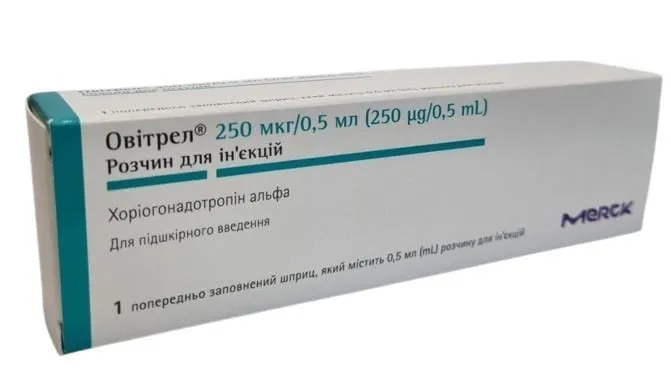
Table of Contents
INSTRUCTION FOR MEDICAL USE OF THE MEDICINAL PRODUCT OVTRELLE® (OVITRELLE®)
Composition:
Active substance: choriogonadotropin alfa;
One pre-filled syringe (0.5 mL solution) contains 250 mcg (6500 IU) of choriogonadotropin alfa;
Excipients: mannitol (E 421), methionine, poloxamer 188, phosphoric acid concentrated, sodium hydroxide, water for injections.
Pharmaceutical form. Solution for injection.
Main physicochemical properties: solution, practically free from visible particles.
Pharmacotherapeutic group. Sex hormones and modulators of the sex organs. Gonadotropins. Choriogonadotropin alfa.
ATC code G03G A08.
Pharmacological Properties
Pharmacodynamics
Ovitrelle® is a medicinal product containing recombinant human chorionic gonadotropin alpha produced by recombinant DNA technology. Chorionic gonadotropin alpha has an amino acid sequence identical to that of human chorionic gonadotropin (hCG) isolated from urine. In ovarian theca and granulosa cells, chorionic gonadotropin binds to transmembrane LH/hCG receptors, which also bind luteinizing hormone (LH).
The primary pharmacodynamic effect of the drug in women is the resumption of oocyte meiosis, follicular rupture (ovulation), formation of the corpus luteum, and production of progesterone and estradiol by the corpus luteum. In women, chorionic gonadotropin acts similarly to the natural mid-cycle surge in LH levels, thereby triggering ovulation.
Ovitrelle® is used to initiate final follicular maturation and early luteinization following treatment with follicle-stimulating medicinal products. In comparative clinical studies, administration of Ovitrelle® at a dose of 250 mcg was shown to be as effective as 5,000 IU or 10,000 IU of urinary hCG in inducing final follicular maturation and early luteinization in assisted reproductive technology (ART) cycles, and as effective as 5,000 IU of urinary hCG in inducing ovulation.
To date, no evidence of antibody development against Ovitrelle® has been observed in humans. Repeated administration of Ovitrelle® has been studied only in men. Clinical studies of the drug in women undergoing ART or treatment for anovulation were limited to a single treatment cycle.
Pharmacokinetics
Following intravenous administration, recombinant human chorionic gonadotropin alpha distributes into the extracellular fluid, with a distribution half-life of approximately 4.5 hours. The steady-state volume of distribution and total clearance are 6 L and 0.2 L/hour, respectively. There is no evidence that recombinant human chorionic gonadotropin alpha is metabolized or eliminated differently from endogenous hCG.
After subcutaneous administration, the terminal elimination half-life of recombinant human chorionic gonadotropin alpha is approximately 30 hours, and absolute bioavailability is about 40%.
Comparative studies of the lyophilized and liquid formulations of the drug demonstrated bioequivalence between these two forms.
Clinical characteristics.
Indications.
- Initiation of final follicular maturation and luteinization following follicular growth stimulation in adult women undergoing a controlled ovarian stimulation procedure prior to assisted reproductive technology (ART) procedures such as in vitro fertilization (IVF);
- Initiation of ovulation and luteinization in adult women with anovulation or oligoovulation following follicular growth stimulation.
Contraindications.
- Hypersensitivity to the active substance or to any of the excipients of the medicinal product.
- Tumors of the hypothalamus or pituitary gland.
- Enlargement of ovaries or ovarian cysts not due to polycystic ovary syndrome.
- Gynecological bleeding of unknown etiology.
- Carcinoma of the ovaries, uterus, or breasts.
- Active forms of thromboembolic disorders.
Ovitrel® must not be used in cases where an effective response to treatment cannot be achieved, such as in:
- Primary ovarian insufficiency.
- Congenital or acquired genital tract abnormalities incompatible with pregnancy.
- Uterine fibroids incompatible with pregnancy.
- Postmenopausal state.
Interaction with other medicinal products and other forms of interaction.
No specific studies on drug interactions between Ovitrel® and other medicinal products have been conducted; however, during therapy with recombinant LH (rLH), no clinically significant drug interactions have been observed.
Special precautions for use.
Tracking
To improve the traceability of biological medicinal products, the name and batch number of the administered medicinal product should be clearly recorded.
General recommendations
Prior to initiating treatment, the infertility of the couple should be evaluated with regard to their suitability for treatment and to identify any contraindications to pregnancy. In particular, patients should be examined for hypothyroidism, adrenal insufficiency, hyperprolactinemia, and appropriate specific treatment should be prescribed.
Currently, there is no clinical experience with the use of the drug for other indications (such as luteal phase deficiency or male pathologies); therefore, Ovitrel® is not indicated for the treatment of such conditions.
Ovarian hyperstimulation syndrome (OHSS)
An expected outcome of controlled ovarian stimulation is a certain increase in ovarian size. This phenomenon, which is most common in women with polycystic ovary syndrome, usually resolves without specific treatment.
In contrast to uncomplicated ovarian enlargement, OHSS is a syndrome that manifests with increasing severity. It includes marked ovarian enlargement, high serum levels of sex steroids, and increased vascular permeability, which may lead to fluid accumulation in the abdominal, pleural, and rarely pericardial cavities.
Mild manifestations of OHSS may include abdominal pain, abdominal discomfort, bloating, and ovarian enlargement. Moderate OHSS may additionally present with nausea, vomiting, ascites confirmed by ultrasound examination, and significant ovarian enlargement.
In severe cases of OHSS, additional symptoms may include severe ovarian enlargement, weight gain, dyspnea, and oliguria. Clinical examination may reveal hypovolemia, hemoconcentration, electrolyte imbalance, ascites, pleural effusions, or acute respiratory distress syndrome. In very rare cases, severe OHSS may be complicated by ovarian torsion and thromboembolic events such as pulmonary artery embolism, ischemic stroke, and myocardial infarction.
Independent risk factors for the development of OHSS include young age, low body weight, polycystic ovary syndrome, high doses of exogenous gonadotropins, high or rapidly rising serum estradiol levels, previous episodes of OHSS, and a large number of growing ovarian follicles or oocytes obtained in ART cycles.
Adherence to the recommended dosage and administration regimen of Ovitrel® may minimize the risk of ovarian hyperstimulation. Monitoring of stimulation cycles by ultrasound and measurement of estradiol levels is recommended for early detection of relevant risk factors.
There is evidence to suggest that hCG plays a key role in initiating OHSS and that this syndrome may become more severe and prolonged if pregnancy occurs. Therefore, in the presence of signs of ovarian hyperstimulation, administration of hCG should be discontinued and patients should be advised to abstain from sexual intercourse or use barrier contraception for at least 4 days.
OHSS can rapidly progress (within 24 hours) and become a serious medical complication within a few days; therefore, patients should remain under medical supervision for at least 2 weeks after hCG administration.
Mild or moderate forms of OHSS usually resolve spontaneously. If severe OHSS occurs, gonadotropin treatment must be discontinued, the patient should be hospitalized, and appropriate OHSS therapy initiated.
Multiple pregnancy
In patients undergoing ovulation induction, the rate of multiple pregnancies and births is increased compared to natural conception. Most multiple pregnancies are twin pregnancies. Multiple pregnancy, especially of higher order, carries an increased risk of adverse obstetric and perinatal outcomes.
To minimize the risk of higher-order multiple pregnancy, careful monitoring of ovarian response is recommended. In ART procedures, the risk of multiple pregnancy is primarily related to the number of embryos transferred, their quality, and the patient's age.
Pregnancy loss
The rate of pregnancy loss is higher in patients with anovulation and in those undergoing ART compared to spontaneous conception.
Ectopic pregnancy
Women with a history of tubal disease have an increased risk of ectopic pregnancy, regardless of whether conception occurs spontaneously or following infertility treatment. The incidence of ectopic pregnancy after ART has been reported to be higher than in the general population.
Congenital malformations
The incidence of congenital malformations after ART may be slightly higher than after spontaneous conception. This is believed to be due to differences in parental characteristics (e.g., maternal age, sperm quality) and the higher frequency of multiple pregnancies.
Thromboembolic events
In women with recent thromboembolic disorders or in women with established risk factors for thromboembolic events (such as personal or family history), gonadotropin treatment may further increase the risk of exacerbation or occurrence of such disorders. In such women, the benefit of gonadotropin use should be weighed against the risk of such events. However, it should be noted that pregnancy itself and OHSS also increase the risk of thromboembolic complications.
Reproductive system neoplasms
There have been reports of both benign and malignant neoplasms of the ovaries and other reproductive organs in women who have used multiple drugs for infertility treatment. It has not yet been established whether gonadotropin treatment increases the baseline risk of developing such tumors in infertile women.
Effect on blood or urine test results
For up to 10 days after administration, Ovitrel® may affect immunological assays for serum or urinary hCG levels, potentially leading to false-positive pregnancy test results. Patients should be informed of this.
Sodium content
This medicinal product contains less than 1 mmol of sodium (23 mg) per dose, i.e., it is essentially "sodium-free."
Use during pregnancy or breastfeeding.
Pregnancy
There are no indications for the use of Ovitrel® during pregnancy. Data from a small number of cases of use during pregnancy indicate no congenital malformations or fetotoxic or neonatal toxicity. Reproductive toxicity studies of chorionic gonadotropin alfa in animals have not been conducted; therefore, the potential risk of such use in humans is unknown.
Breastfeeding
Ovitrel® is not indicated for use during breastfeeding. Data on the excretion of chorionic gonadotropin alfa in milk are lacking.
Ability to affect reaction speed when driving vehicles or operating machinery.
Ovitrel® has no or negligible effect on the ability of patients to drive vehicles or operate machinery.
Method of Administration and Dosage
The medication should be administered under the supervision of a physician experienced in the treatment of infertility.
The medication is intended for subcutaneous injection. Only a clear solution free of foreign particles should be injected.
The maximum dose of the medication is 250 mcg. The following treatment regimens should be used.
Women undergoing controlled ovarian stimulation prior to assisted reproductive technologies such as in vitro fertilization (IVF)
The contents of one pre-filled Ovitrelle® syringe (250 mcg) should be administered 24–48 hours after the last injection of follicle-stimulating hormone (FSH) or human menopausal gonadotropin (hMG), i.e., upon achieving optimal follicular growth stimulation.
Women with anovulation or oligoovulation
The contents of one pre-filled Ovitrelle® syringe (250 mcg) should be administered 24–48 hours after achieving optimal stimulation of follicular growth. Patients are advised to have sexual intercourse on the day of Ovitrelle® administration and the following day.
Patients with renal or hepatic impairment
The safety, efficacy, and pharmacokinetic parameters of Ovitrelle® in patients with impaired renal or hepatic function have not been established.
Children
There are no indications for the use of Ovitrelle® in the pediatric patient population.
Overdose
The effects of Ovitrelle® overdose are unknown. However, overdose may potentially lead to the development of OHSS (see section "Special Warnings and Precautions for Use").
Adverse Reactions
Summary of safety profile
In comparative studies using different doses of Ovitrelle®, it was established that OHSS associated with Ovitrelle® is dose-dependent. OHSS occurred in approximately 4% of patients treated with Ovitrelle®. Severe OHSS was observed in less than 0.5% of patients (see section "Special warnings and precautions for use").
List of adverse reactions
The following frequency categories of adverse reactions are used: very common (≥ 1/10); common (≥ 1/100 to < 1/10); uncommon (≥ 1/1000 to < 1/100); rare (≥ 1/10,000 to < 1/1000); very rare (< 1/10,000); frequency not known (cannot be estimated from the available data).
Immune system disorders
Rare: hypersensitivity reactions ranging from mild to severe, including rash, anaphylactic reactions and shock.
Nervous system disorders
Common: headache.
Vascular disorders
Rare: thromboembolism (both associated and not associated with OHSS).
Gastrointestinal disorders
Common: abdominal pain, abdominal distension, nausea, vomiting.
Uncommon: abdominal discomfort, diarrhoea.
Reproductive system and breast disorders
Common: mild or moderate OHSS.
Uncommon: severe OHSS.
General disorders and administration site conditions
Common: injection site reactions.
Shelf life. 2 years.
Do not use after the expiry date stated on the packaging.
The product is intended for immediate and single use after first opening. However, stability studies during use have shown that the product remains stable for 24 hours after opening the package when stored at 2–8 °C.
Storage conditions.
Store at 2–8 °C (in a refrigerator). Store in the original packaging to protect from light. Keep out of the reach of children.
During the shelf life, the product may be stored at a temperature not exceeding 25 °C for up to 30 days without re-cooling. If the solution has not been used within these 30 days, it must be discarded.
Packaging.
0.5 mL of solution for injection in a pre-filled syringe (Type I glass) with a plunger stopper (halobutyl rubber), a plastic piston rod, and a fixed stainless steel needle, closed with a combined cap (rubber/polypropylene). One pre-filled syringe is placed in a blister pack and contained in a cardboard box.
Prescription status.
Prescription only.
Manufacturers.
Merck Serono S.p.A./Merck Serono S.p.A.
or
Merck Serono S.A., Aubonne branch/Merck Serono S.A., Succursale d’Aubonne.
Manufacturers' locations and addresses of business operations.
Via delle Magnolie 15 (loc. frazione Zona Industriale), 70026 Modugno (Bari), Italy
or
Zone Industrielle de l'Ouriettaz, 1170 Aubonne, Switzerland.