Otinum
Ukraine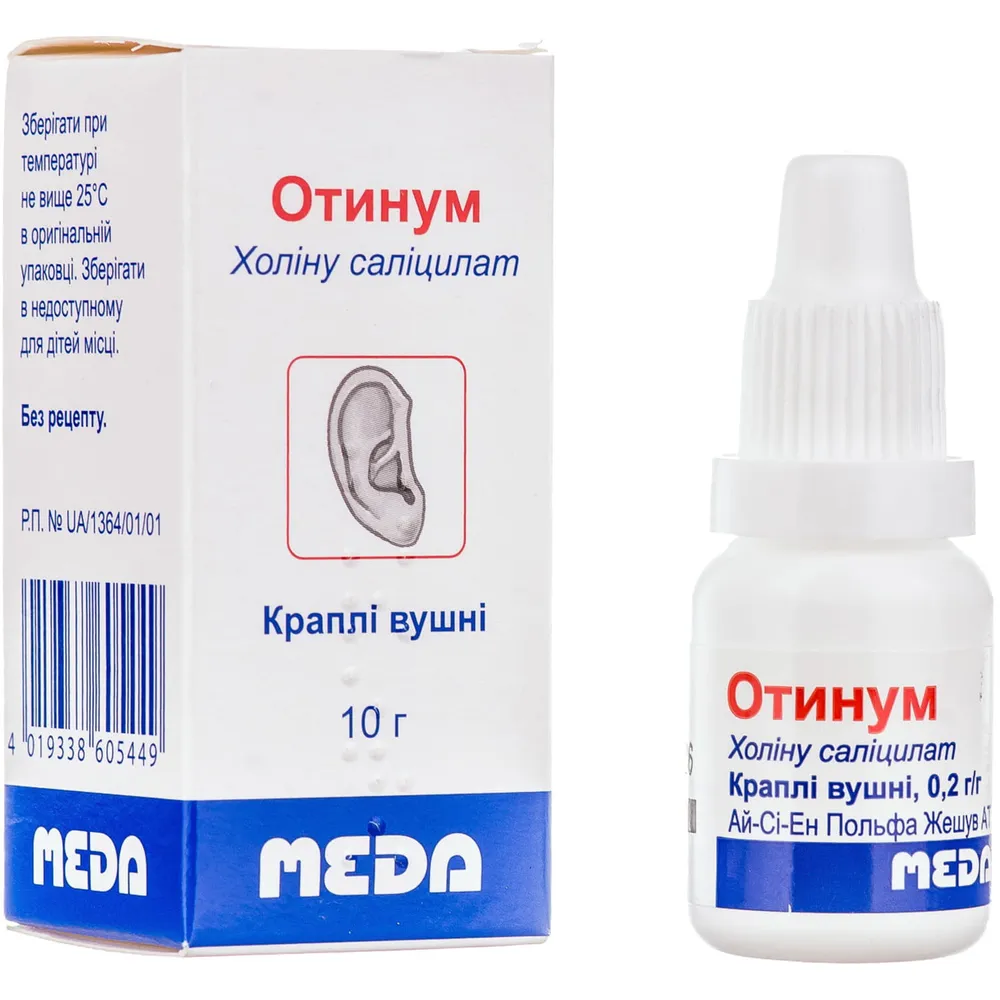
Table of Contents
INSTRUCTIONS FOR MEDICAL USE OF THE MEDICINAL PRODUCT OTINUM (OTINUM)
Composition:
Active substance: choline salicylate;
1 g of drops contains choline salicylate 0.2 g;
Excipients: glycerol, ethanol 96%, chlorobutanol hemihydrate, purified water.
Pharmaceutical form. Ear drops.
Main physicochemical characteristics: clear, colorless to light yellow liquid.
Pharmacotherapeutic group. Preparations used in otology. Other preparations used in otology. ATC code S02D.
Pharmacological properties.
Pharmacodynamics.
Choline salicylate is a derivative of salicylic acid which, when instilled into the ear, exerts anti-inflammatory and analgesic effects. It inhibits the activity of cyclooxygenase, the enzyme responsible for prostaglandin synthesis. Choline salicylate also inhibits the synthesis of thromboxane and prostacyclin.
Glycerin contained in the preparation softens earwax, facilitating its removal.
When applied locally, the preparation does not produce systemic effects.
Pharmacokinetics.
Data on the pharmacokinetics of salicylates used in otology are lacking.
Clinical characteristics.
Indications.
Acute otitis media, tympanitis, and external otitis.
May also be used prior to irrigation of the external auditory canal in cases of impacted earwax.
Contraindications.
Hypersensitivity to the active substance, other salicylates, or to any of the excipients.
Previously diagnosed perforation of the tympanic membrane.
Bleeding or discharge from the ear.
Severe ear pain and hearing impairment.
Age under 18 years.
Interaction with other medicinal products and other forms of interaction. There are no data regarding interactions of salicylate administered by ear drops with other medicinal products. Otinum is intended for topical use and has no systemic effect.
Concomitant use of oral nonsteroidal anti-inflammatory drugs may enhance the local effect of the medicinal product.
Special precautions.
The occurrence of any type of ear pain is an indication for consultation with a physician.
The appearance of additional symptoms (fever, ear discharge) or suspicion of a foreign body in the ear canal is an indication for consultation with a physician.
The drug is intended for short-term use in local treatment of symptoms of inflammation of the external auditory canal. For these indications, patients should not use the drug for more than 3 days without consulting a physician.
In case of recurrence of the disease, the physician should determine the necessity of continued use of the drug.
Otium is a symptomatic treatment drug.
Use of this drug may mask symptoms of other external ear diseases and complicate or delay their proper diagnosis.
The drug contains chlorobutanol hemihydrate.
Use during pregnancy or breastfeeding. Considering the mode of action of the drug and the potential risk associated with salicylates, use of the drug during pregnancy or breastfeeding is not recommended.
Ability to affect reaction speed when driving or operating machinery. No influence of the drug on the ability to drive vehicles or operate machinery has been observed.
Dosage and Administration.
Adults.
For short-term treatment of local symptoms of ear canal inflammation: usually instill 3–4 drops into the ear canal every 6–8 hours for no more than 3 days.
For softening earwax prior to its removal: usually instill 3–4 drops into the ear canal every 12 hours for 4 days.
Elderly patients. No dosage adjustment is necessary.
Patients with renal or hepatic impairment. Impaired renal and/or hepatic function is not a contraindication for the use of Otinum, as the medicinal product is applied locally and has no systemic effect. No dosage adjustment is required for this patient group.
Route of administration.
The product is intended for local use as ear drops.
Self-treatment of local symptoms of ear canal inflammation should not last longer than 3 days.
Patients should be advised to seek immediate medical attention if there is no improvement after 3 days, or if their condition worsens within 3 days of starting treatment.
Instructions for product administration.
- Wash hands and unscrew the bottle cap.
- Tilt the head or lie on the side with the affected ear facing upward.
- Gently pull the earlobe (lower part of the auricle) downward and backward.
- Turn the open bottle upside down, squeeze it, and instill 3–4 drops of the product into the affected ear.
- Keep the head tilted for several minutes to allow the drops to enter the ear canal.
- Wipe away excess liquid with a clean tissue.
- Close the bottle.
Additional recommendations regarding the use of Otinum.
- To facilitate administration, assistance from another person or use of a mirror may be helpful.
- Care should be taken to prevent water from entering the treated ear.
Children. Data on use in children are limited.
Overdose.
As there is no information available on overdose with Otinum ear drops in humans, specific recommendations for the management of overdose have not been established.
Signs of salicylate toxicity may occur after ingestion of doses exceeding 150 mg/kg body weight. One package of Otinum contains 2 g of choline salicylate, which means that accidental or intentional oral ingestion is not considered dangerous for adults.
Symptoms that may occur following accidental overdose (after oral ingestion) include: confusion, dizziness, excessive sweating, vomiting, tinnitus, and hyperventilation. Ingestion of very large doses may lead to central nervous system depression.
Management of oral overdose includes:
- Elimination of choline salicylate from the body (induce emesis, gastric lavage, administration of activated charcoal),
- Monitoring of the patient's condition (particularly fluid and electrolyte balance),
- Symptomatic treatment (correction of fluid and electrolyte imbalances, forced diuresis if plasma salicylate levels exceed 300 mg/L).
Adverse reactions.
Criteria for assessing the frequency of adverse drug reactions:
| Very common: |
≥ 1/10 |
| Common: |
≥ 1/100 – < 1/10 |
| Uncommon: |
≥ 1/1000 – < 1/100 |
| Rare: |
≥ 1/10000 – < 1/1000 |
| Very rare: |
< 1/10000 |
| Frequency not known: |
cannot be estimated from the available data. |
General disorders and administration site reactions: Frequency unknown – local hypersensitivity reactions (redness, itching of the skin).
The medicinal product may cause hearing damage when administered to patients with a perforated eardrum.
Shelf life. 3 years.
Storage conditions. Store at a temperature not exceeding 25 °C in the original packaging. Keep out of reach of children.
Packaging. 10 g in a bottle; 1 bottle in a box.
Pharmaceutical category. Over-the-counter (without prescription).
Manufacturer. ICN Polfa Rzeszow S.A.
Address of the manufacturer and place of business. 35-959 Rzeszow, ul. Przemyslowa, 2, Poland.