Otof
Ukraine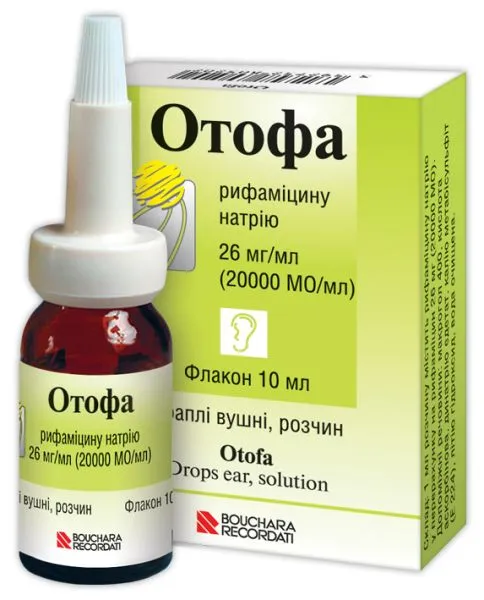
Table of Contents
INSTRUCTION FOR MEDICAL USE OF THE MEDICINAL PRODUCT OTOFA
Composition:
Active substance: rifamycin;
1 ml of solution contains sodium rifamycin equivalent to 26 mg of rifamycin per ml (20,000 IU/ml);
Excipients: macrogol 400, ascorbic acid, edetate disodium, potassium metabisulfite (E 224), lithium hydroxide, purified water.
Pharmaceutical form. Ear drops, solution.
Main physicochemical properties: Clear red-orange colored liquid.
Pharmacotherapeutic group.
Medicinal products used in otology. Antimicrobial agents.
ATC Code: S02AA12.
Pharmacological properties.
Pharmacodynamics.
Rifamycin exhibits antimicrobial activity against most Gram-positive and Gram-negative microorganisms causing infectious and inflammatory diseases of the middle ear. Its mechanism of action is associated with the formation of a stable complex with DNA-dependent RNA polymerase, thereby inhibiting bacterial growth.
Rifamycin is active against Bacillus anthracis, Listeria monocytogenes, R. equi, Staphylococcus, Streptococci A, B, C, G, Streptococcus, B. catarrhalis, Brucella, H. ducreyi, H. influenzae, N. gonorrhoeae, N. meningitidis, Pasteurella, Bacteroides, C. difficile, C. perfringens, Fusobacterium, Peptostreptococcus, Propionibacterium acnes, Chlamydia, Coxiella burnetii, Legionella, Mycobacterium, Enterococci.
Resistance to rifamycin is observed in enteric bacteria and atypical Mycobacterium.
Rifamycin is ineffective against P. aeruginosa; clinical and bacteriological resistance occurs frequently. This bacterial species may be responsible for at least 30% of cases of the diseases listed in the indications.
Pharmacokinetics.
Pharmacokinetic studies have not been conducted due to low systemic absorption.
Clinical characteristics.
Indications.
Local treatment of certain types of purulent otitis in the following conditions:
- use of tympanostomy tube;
- purulent involvement of the middle ear cavity;
- exacerbation of chronic suppurative otitis media with perforation of the tympanic membrane.
Contraindications.
Hypersensitivity/allergy to any component of the drug.
Interaction with other medicinal products and other forms of interaction.
Concomitant use of the drug with any other locally applied medicinal products is not recommended.
Special precautions.
No studies have been conducted on the use of the drug in external auditory canal otitis.
Official recommendations regarding appropriate use of antibiotics should be followed during treatment with this medicinal product.
Local application of antibacterial agents may cause sensitization to active substances and lead to systemic reactions.
The drug must be discontinued immediately if skin rashes or other systemic signs of allergic reactions occur.
Do not swallow the solution; do not use as an injection.
During use, avoid touching the dropper tip with fingers or the ear to minimize the risk of contamination.
If symptoms do not resolve after a 10-day treatment course, the patient should be re-examined and the treatment strategy reassessed.
Contact of the drug with clothing should be avoided, as the solution may leave stains on fabric.
Use during pregnancy or breastfeeding.
Adequate and well-controlled studies in pregnant women have not been conducted.
Due to the negligible systemic absorption of rifamycin when ear drops are administered, topical use of the drug during pregnancy or breastfeeding is permissible under physician's recommendation.
Ability to affect reaction speed when driving or operating machinery.
No cases of influence on reaction speed when driving or operating machinery have been reported.
Method of Administration and Dosage
The medication should be used topically by instillation into the ear.
Drops should be administered into the external auditory canal of the affected ear each morning, and the procedure should be repeated in the evening.
Dosage for adults: 5 drops into the affected ear twice daily.
Dosage for children: 3 drops into the affected ear twice daily.
The duration of treatment depends on the nature and severity of the disease and is determined individually by the physician. The average duration of treatment is 7 days.
Before using the drops, warm the bottle by holding it in the palm to avoid discomfort associated with instillation of cold liquid into the ear. Tilt the head, instill the required number of drops into the ear, and gently pull the earlobe several times. Keep the head tilted for approximately 5 minutes to facilitate better penetration of the solution into the ear canal. If necessary, repeat the procedure for the other ear.
Do not administer the medication under pressure.
After completion of treatment, the bottle should be discarded and not stored for future use.
Children
Use only as prescribed by a physician for the treatment of children of any age.
Overdose
No cases of overdose have been reported. Due to low systemic absorption, overdose is unlikely.
Adverse Reactions.
Immune system disorders.
Due to the presence of sulfites in the medicinal product, there is a risk of allergic reactions, including anaphylaxis, bronchospasm, and skin manifestations such as rash and eczema.
Investigations.
Possible pink discoloration of the tympanic membrane (visible during otoscopy).
Shelf life. 3 years.
Storage conditions. Store at a temperature not exceeding 25 °C. Keep out of reach of children.
Packaging. 10.0 mL in a bottle, 1 bottle with a dropper in a cardboard box.
Prescription status. Prescription only.
Manufacturer. Farmaster.
Manufacturer's address and place of business.
Zone Industrielle de Kraft, 67150 Erstein, France.