Ornidazole-zdorovya
Ukraine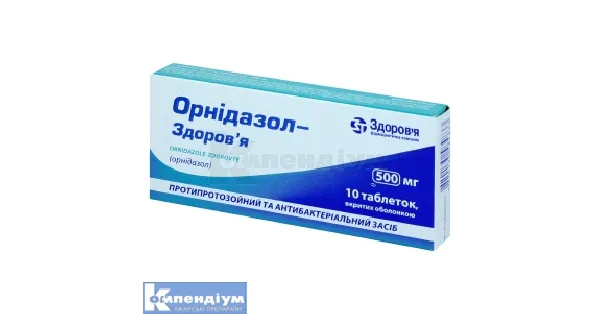
Table of Contents
INSTRUCTIONS FOR MEDICAL USE OF THE MEDICINAL PRODUCT ORNIDAZOLE-ZDOROV'YA (ORNIDAZOLE-ZDOROVYE)
Composition:
Active ingredient: 1 tablet contains ornidazole 500 mg;
Excipients: maize starch, microcrystalline cellulose, hypromellose, magnesium stearate, dry mixture "Opadry II white" containing titanium dioxide (E 171), talc, polyethylene glycol, polyvinyl alcohol.
Pharmaceutical form. Film-coated tablets.
Main physicochemical properties: film-coated tablets, white or almost white, round, biconvex.
Pharmacotherapeutic group. Agents used in amoebiasis and other protozoal infections. Nitroimidazole derivatives. Ornidazole. ATC code P01AB03.
Pharmacological Properties
Pharmacodynamics. Ornidazole is an antiprotozoal and antibacterial agent, a derivative of 5-nitroimidazole. It is active against Trichomonas vaginalis, Entamoeba histolytica, Giardia lamblia (Giardia intestinalis), as well as certain anaerobic bacteria such as Bacteroides, Clostridium spp., Fusobacterium spp., and anaerobic cocci.
In terms of its mechanism of action, ornidazole is a DNA-targeting agent with selective activity against microorganisms possessing enzymatic systems capable of reducing the nitro group and catalyzing the interaction of ferredoxin-like proteins with nitro compounds. After penetrating the microbial cell, the drug's action is mediated by reduction of the nitro group under the influence of microbial nitroreductases, leading to activation of the reduced nitroimidazole. The reduction products form complexes with DNA, causing DNA degradation and disrupting DNA replication and transcription processes. Additionally, the drug's metabolites exhibit cytotoxic properties and interfere with cellular respiration.
Pharmacokinetics.
Absorption. Ornidazole is rapidly absorbed from the gastrointestinal tract following oral administration. On average, absorption is about 90%. Maximum plasma concentration is achieved within 3 hours.
Distribution. Plasma protein binding of ornidazole is approximately 13%. The active substance penetrates into cerebrospinal fluid, other body fluids, and tissues.
The concentration of ornidazole in plasma ranges between 6–36 mg/L, which corresponds to levels considered optimal for various indications. After repeated administration of 500 mg and 1000 mg doses every 12 hours to healthy volunteers, the accumulation coefficient ranges from 1.5 to 2.5.
Metabolism. Ornidazole is metabolized in the liver, primarily forming 2-hydroxymethyl and α-hydroxymethyl metabolites. Both metabolites are less active against Trichomonas vaginalis and anaerobic bacteria compared to unchanged ornidazole.
Elimination. The elimination half-life is approximately 13 hours. Within the first 5 days after a single dose, 85% of the administered dose is excreted, mainly as metabolites. Approximately 4% of the administered dose is excreted unchanged by the kidneys.
Pharmacokinetic characteristics in specific organ or system dysfunction.
Liver. The elimination half-life of the active substance is prolonged to 22 hours in patients with hepatic cirrhosis, and clearance is reduced (35 compared to 51 mL/min) relative to healthy volunteers.
Kidney. The pharmacokinetics of ornidazole are not altered in renal impairment; therefore, dosage adjustment is not required.
Ornidazole is removed during hemodialysis. An additional dose of 500 mg of ornidazole should be administered before the start of hemodialysis if the daily dose is 2 g/day, or an additional 250 mg if the daily dose is 1 g/day.
Children (including newborns). The pharmacokinetics of ornidazole in children (including newborns) is similar to that in adults.
Clinical characteristics.
Indications. Trichomoniasis (urogenital infections in women and men caused by Trichomonas vaginalis).
Amebiasis (all intestinal infections caused by Entamoeba histolytica, including amoebic dysentery, all extraintestinal forms of amebiasis, particularly amoebic liver abscess). Giardiasis.
Contraindications. Hypersensitivity to the drug or to other derivatives of nitroimidazole. Central nervous system disorders (epilepsy, brain lesions, multiple sclerosis). Pathological blood disorders or other hematological abnormalities.
Interaction with other medicinal products and other types of interactions. Alcohol should not be consumed during treatment and for at least 3 days after discontinuation of the medicinal product.
Ornidazole enhances the effect of oral anticoagulants of the coumarin group, requiring appropriate adjustment of their dosage.
Ornidazole prolongs the muscle-relaxant effect of vecuronium bromide.
Concomitant use of phenobarbital and other enzyme inducers reduces the circulation period of ornidazole in serum, whereas enzyme inhibitors (e.g., cimetidine) increase it.
Special precautions for use.
When high doses of the drug are used or when treatment lasts more than 10 days, clinical and laboratory monitoring is recommended.
In patients with a history of hematological disorders, leukocyte monitoring is recommended, especially when repeated treatment courses are administered.
Exacerbation of central or peripheral nervous system disorders may occur during treatment with the drug. In case of peripheral neuropathy, impaired motor coordination (ataxia), dizziness, or clouding of consciousness, treatment should be discontinued.
Exacerbation of candidiasis may occur, which will require appropriate antifungal therapy.
When hemodialysis is performed, the reduced elimination half-life should be taken into account, and additional doses of the drug should be administered either before or after hemodialysis.
Serum concentrations of lithium salts, creatinine, and electrolytes should be monitored during lithium therapy.
The effects of other medicinal products may be enhanced or diminished during treatment with this drug.
Use with caution in patients with impaired liver function.
Use during pregnancy or breastfeeding. In experimental studies, the drug did not show teratogenic or toxic effects on the fetus. Since controlled studies in pregnant women have not been conducted, the drug should be prescribed during early pregnancy or breastfeeding only if absolutely indicated, when the potential benefits to the mother outweigh the potential risks to the fetus/infant.
Ability to affect reaction speed when driving or operating machinery. Use of Ornidazole-Zdorovya may cause such effects as drowsiness, rigidity, dizziness, tremor, seizures, impaired coordination, and transient loss of consciousness. Patients who drive or operate machinery should take into account the possibility of such adverse effects.
Administration and Dosage
Ornidazole-Zdorovya should be taken orally after meals, swallowing with a small amount of water.
Trichomoniasis. Recommended dosing regimens:
a) 1-day treatment course:
- Adults and children with body weight over 35 kg – 3 tablets as a single evening dose;
- Daily dose for children with body weight from 20 kg to 35 kg is 25 mg of ornidazole per 1 kg body weight, administered as a single dose.
b) 5-day treatment course:
- Adults and children with body weight over 35 kg – 2 tablets daily (1 tablet in the morning and 1 tablet in the evening).
Not recommended for children with body weight under 35 kg.
To prevent possible reinfection, the sexual partner should undergo the same treatment regimen.
Amoebiasis. Possible treatment regimens:
a) 3-day treatment course for patients with amoebic dysentery;
b) 5–10-day treatment course for all forms of amoebiasis.
Recommended dosing regimen of the drug:
| Duration of treatment |
Daily dose |
|
| Adults and children with body weight over 35 kg |
Children with body weight up to 35 kg |
|
| a) amoebic dysentery – 3 days |
3 tablets once daily in the evening. For body weight over 60 kg – 4 tablets (2 tablets in the morning and 2 in the evening) |
35 kg – 3 tablets per dose 25 kg – 2 tablets per dose 13 kg – 1 tablet per dose (calculated as 40 mg of ornidazole per kg of body weight per dose) |
| b) other forms of amoebiasis – 5–10 days |
2 tablets (1 tablet in the morning and 1 in the evening) |
35 kg – 2 tablets per dose 20 kg – 1 tablet per dose (calculated as 25 mg of ornidazole per kg of body weight per dose) |
Giardiasis. For adults and children with body weight over 35 kg, administer 3 tablets as a single dose in the evening; for children with body weight less than 35 kg – a single dose of 40 mg/kg body weight per day. Duration of treatment is 1–2 days.
Children. The drug should be used in children according to the dosage recommendations specified in the section "Dosage and administration".
Overdose.
Symptoms: intensification of adverse reactions.
Treatment: symptomatic therapy; no specific antidote is known. To remove ornidazole from the body, gastric lavage or hemodialysis is recommended. In case of seizures, intravenous diazepam is recommended.
Adverse reactions.
From the lymphatic system and blood-forming system: signs of bone marrow suppression, leukopenia, neutropenia.
From the nervous system: drowsiness, headache, dizziness, tremor, rigidity, coordination disorders, ataxia, seizures, fatigue, spatial disorientation, temporary loss of consciousness, confusion, excitement, and peripheral neuropathy.
General disorders: increased body temperature, chills, general weakness, shortness of breath.
From the gastrointestinal tract: taste disturbances, metallic taste in the mouth, coated tongue, nausea, vomiting, diarrhea, epigastric pain, dry mouth, loss of appetite.
From the hepatobiliary system: unknown – jaundice, disturbances in liver function biochemical parameters, elevated liver enzyme levels; hepatotoxicity.
From the immune system: hypersensitivity reactions, including anaphylactic shock, angioneurotic edema.
From the skin and subcutaneous tissue: skin rashes, urticaria, skin hyperemia, itching.
Infections and infestations: exacerbation of candidiasis.
Others: darkening of urine color, cardiovascular disorders, including decreased blood pressure.
Shelf life: 2 years.
Storage conditions: Store in the original packaging at a temperature not exceeding 25 °C.
Keep out of reach of children.
Packaging: Tablets № 10 (10×1), № 20 (10×2) in blisters in a box.
Prescription category: Prescription only.
Manufacturer: LIMITED LIABILITY COMPANY "CORPORATION "ZDOROVIYA".
Manufacturer's address and location of business activity: 22, Shevchenka Street, Kharkiv, Kharkiv Oblast, 61013, Ukraine.