Omeprazole-darnitsa
Ukraine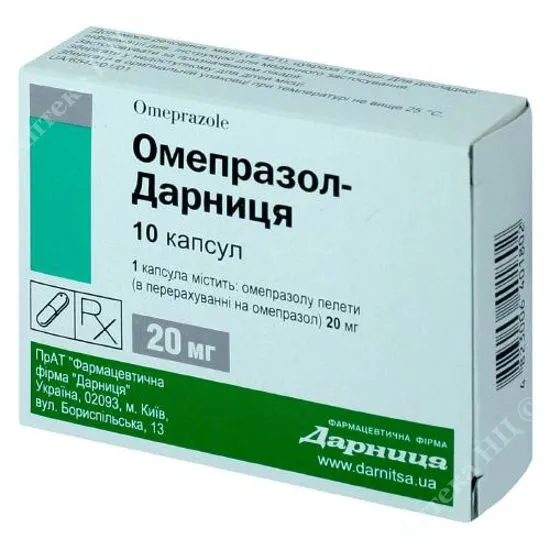
Table of Contents
INSTRUCTIONS FOR MEDICAL USE OF THE MEDICINAL PRODUCT OMEPRAZOLE-DARNITSA (OMEPRASOLE-DARNITSA)
Composition:
Active ingredient: omeprazole;
1 capsule contains omeprazole pellets (calculated as omeprazole) 20 mg;
Excipients: mannite (E 421), hypromellose, methacrylic acid copolymer dispersion, sodium lauryl sulfate, anhydrous sodium hydrogen phosphate, diethyl phthalate, sucrose, titanium dioxide (E 171), povidone, calcium carbonate, talc, polysorbate 80, sodium hydroxide.
Pharmaceutical form. Capsules. The capsules contain pellets.
Main physicochemical properties: hard gelatin capsules with a dark red opaque body and an opaque cap of dark grey or black color, containing spherical granules of white to off-white with a cream-pinkish hue.
Pharmacotherapeutic group. Drugs for treatment of peptic ulcer and gastroesophageal reflux disease. Proton pump inhibitors. ATC code A02BC01.
Pharmacological Properties.
Pharmacodynamics.
Omeprazole is an anti-ulcer antisecretory medicinal agent. It readily penetrates into the parietal cells of the gastric mucosa, accumulates there, and becomes activated at acidic pH levels. The active metabolite—sulfenamide—inhibits H+, K+-ATPase of the secretory membrane of parietal cells (proton pump), thereby blocking the release of hydrogen ions into the gastric lumen and inhibiting the final stage of hydrochloric acid secretion. It dose-dependently reduces basal and stimulated secretion, total volume of gastric secretion, and pepsin output. It effectively suppresses both nocturnal and daytime production of hydrochloric acid.
It exhibits bactericidal activity against Helicobacter pylori (H. pylori). Eradication of H. pylori with concomitant use of omeprazole and antibiotics enables rapid alleviation of disease symptoms, achieves a high rate of healing of damaged mucosa, and provides sustained long-term remission, while reducing the risk of gastrointestinal bleeding.
In reflux esophagitis, normalization of acid exposure in the esophagus and maintenance of intragastric pH > 4.0 over 24 hours—along with reduction of the destructive properties of gastric contents (inhibition of conversion of pepsinogen to pepsin)—promotes symptom relief and complete healing of esophageal lesions (healing rates exceed 90%). It is highly effective in treating severe and complicated forms of erosive and ulcerative esophagitis resistant to histamine H2-receptor blockers. Long-term maintenance therapy prevents recurrence of reflux esophagitis and reduces the risk of complications.
Pharmacokinetics.
After oral administration, the drug is rapidly and extensively absorbed from the gastrointestinal tract; however, its bioavailability does not exceed 50–55% (first-pass effect in the liver). Plasma protein binding (to albumin and acidic alpha1-glycoprotein) is very high—approximately 95%.
After a single 20 mg dose of omeprazole, inhibition of gastric secretion begins within the first hour, reaches its maximum within 2 hours, and lasts for approximately 24 hours. The magnitude of effect is dose-dependent. The ability of parietal cells to produce hydrochloric acid recovers within 3–5 days after discontinuation of therapy.
The drug is metabolized in the liver, forming at least six metabolites, which are practically devoid of antisecretory activity.
Excretion occurs mainly via the kidneys as metabolites (72–80%) and through the intestine (18–23%). The elimination half-life is 0.5–1 hour (with normal liver function) or 3 hours (in chronic liver disease).
In elderly patients, a slight increase in bioavailability and reduced elimination rate may occur.
Clinical characteristics.
Indications.
Benign gastric ulcer and duodenal ulcer, including those associated with the use of nonsteroidal anti-inflammatory drugs; eradication of Helicobacter pylori (as part of combination therapy with antibacterial agents); gastroesophageal reflux disease; prevention of aspiration of acidic gastric contents; Zollinger-Ellison syndrome; relief of symptoms of acid-related dyspepsia.
Contraindications.
Hypersensitivity to omeprazole, substituted benzimidazoles, or any other component of the medicinal product. Omeprazole, like other proton pump inhibitors (PPIs), must not be taken concomitantly with nelfinavir or atazanavir.
Interaction with other medicinal products and other forms of interaction.
Effect of omeprazole on the pharmacokinetics of other medicinal products.
Medicinal products whose absorption is pH-dependent.
Suppression of gastric acid secretion during treatment with omeprazole and other PPIs may decrease or increase the absorption of medicinal products whose absorption depends on gastric pH. As with other agents that reduce gastric acidity, absorption of drugs such as ketoconazole, itraconazole, and erlotinib may be reduced, whereas absorption of drugs such as digoxin may be increased during omeprazole treatment. Concomitant administration of omeprazole (20 mg/day) and digoxin in healthy volunteers increased the bioavailability of digoxin by 10% (up to 30% in two out of ten subjects).
Nelfinavir, atazanavir.
Plasma levels of nelfinavir and atazanavir are reduced when administered concomitantly with omeprazole.
Concomitant use of omeprazole and nelfinavir is contraindicated. Concomitant administration of omeprazole (40 mg once daily) reduced the mean exposure to nelfinavir by approximately 40%, and the mean exposure to its pharmacologically active metabolite M8 decreased by approximately 75–90%. This interaction may also be due to inhibition of CYP2C19 activity.
Concomitant use of omeprazole with atazanavir is not recommended. Concomitant administration of omeprazole (40 mg once daily) and atazanavir 300 mg/ritonavir 100 mg in healthy volunteers resulted in a 75% reduction in atazanavir exposure. Increasing the atazanavir dose to 400 mg did not compensate for the effect of omeprazole on atazanavir exposure. Concomitant administration of omeprazole (20 mg once daily) with atazanavir 400 mg/ritonavir 100 mg in healthy volunteers resulted in approximately a 30% reduction in atazanavir exposure compared to atazanavir 300 mg/ritonavir 100 mg once daily.
Digoxin.
Concomitant treatment with omeprazole (20 mg/day) and digoxin in healthy volunteers increased digoxin bioavailability by 10%. Rare cases of digoxin toxicity have been reported. However, caution should be exercised when prescribing high doses of omeprazole to elderly patients. Therapeutic drug monitoring of digoxin should be intensified.
Clopidogrel.
In a cross-over clinical study, clopidogrel (loading dose – 300 mg, followed by 75 mg/day) was administered alone and together with omeprazole (80 mg given simultaneously with clopidogrel) for 5 days. When clopidogrel and omeprazole were administered together, exposure to the active metabolite of clopidogrel decreased by 46% (day 1) and 42% (day 5). Mean inhibition of platelet aggregation decreased by 47% (after 24 hours) and 30% (day 5) when clopidogrel and omeprazole were co-administered. In another study, administration of clopidogrel and omeprazole at different times did not prevent their interaction, likely due to omeprazole’s inhibitory effect on CYP2C19. Conflicting data on the clinical significance of this PK/PD interaction regarding major cardiovascular events have been reported in observational and clinical studies.
Other medicinal products.
Absorption of posaconazole, erlotinib, ketoconazole, and itraconazole is significantly reduced; thus, clinical efficacy may be diminished. Concomitant use of the medicinal product with posaconazole and erlotinib should be avoided.
Medicinal products metabolized by CYP2C19.
Omeprazole is a moderate inhibitor of CYP2C19, the main enzyme responsible for omeprazole metabolism. Therefore, metabolism of concomitantly administered medicinal products that are also metabolized by CYP2C19 may be reduced, and systemic exposure to these agents may increase. Examples include R-warfarin and other vitamin K antagonists, cilostazol, diazepam, and phenytoin.
In healthy volunteers, a pharmacokinetic/pharmacodynamic interaction was observed between clopidogrel (loading dose – 300 mg, maintenance dose – 75 mg/day) and omeprazole (80 mg/day orally, i.e., a dose four times higher than the standard daily dose), resulting in a mean 46% reduction in exposure to the active metabolite of clopidogrel and a mean 16% reduction in maximum inhibitory effect (ADP-induced platelet aggregation). The clinical significance of this interaction remains unknown. As a precautionary measure, concomitant use of omeprazole and clopidogrel should be avoided.
Cilostazol.
In healthy volunteers, administration of omeprazole 40 mg increased the Cmax and AUC of cilostazol by 18% and 26%, respectively, and of one of its active metabolites by 29% and 69%, respectively.
Phenytoin.
Plasma phenytoin concentration monitoring is recommended during the first two weeks after initiating omeprazole treatment. If phenytoin dosage adjustment has been made, monitoring and further dose adjustments should continue after discontinuation of omeprazole.
Unknown mechanism.
Saquinavir.
Concomitant administration of omeprazole with saquinavir/ritonavir resulted in an approximately 70% increase in saquinavir plasma levels, which was associated with acceptable tolerability in HIV-infected patients.
Tacrolimus.
Increased serum tacrolimus levels have been reported with concomitant use of omeprazole. Intensified monitoring of tacrolimus concentrations and renal function (creatinine clearance) is required, and dosage adjustment of tacrolimus may be necessary.
Elevated methotrexate levels have been reported in some patients receiving concomitant proton pump inhibitors. If high-dose methotrexate therapy is required, temporary discontinuation of omeprazole should be considered.
Effect of other medicinal products on the pharmacokinetics of omeprazole.
Inhibitors of CYP2C19 and/or CYP3A4.
Since omeprazole is metabolized by CYP2C19 and CYP3A4 enzymes, medicinal products known to inhibit the activity of CYP2C19 or CYP3A4, or both enzymes (e.g., clarithromycin and voriconazole), may increase omeprazole plasma levels by slowing its metabolism. Concomitant administration of voriconazole resulted in more than a two-fold increase in omeprazole exposure. As high doses of omeprazole are generally well tolerated, dose adjustment of omeprazole is usually not required. However, dose adjustment should be considered in patients with severe hepatic impairment and in cases requiring long-term treatment.
Omeprazole is partially metabolized by CYP3A4 but does not inhibit this enzyme. Therefore, omeprazole does not affect the metabolism of medicinal products metabolized by CYP3A4, such as cyclosporine, lidocaine, quinidine, estradiol, erythromycin, and budesonide.
Inducers of CYP2C19 and/or CYP3A4.
Medicinal products known to induce the activity of CYP2C19 or CYP3A4, or both enzymes (e.g., rifampicin and St. John’s wort), may reduce omeprazole plasma levels by accelerating its metabolism.
Special precautions for use.
In patients with gastric ulcer or suspected gastric ulcer, if alarming symptoms occur, such as significant unintentional weight loss, frequent vomiting, dysphagia, vomiting with blood, or melena, malignancy must be ruled out, since drug administration may mask its symptoms and delay diagnosis.
Concomitant use of atazanavir with proton pump inhibitors is contraindicated.
Omeprazole, like other acid-inhibiting agents, may reduce the absorption of vitamin B12 (cyanocobalamin) due to hypo- or achlorhydria. This should be considered when treating patients with vitamin B12 deficiency or those at risk of reduced vitamin B12 absorption during long-term therapy. In individual cases, monitoring plasma vitamin B12 levels may be advisable.
Omeprazole is an inhibitor of CYP2C19. At the beginning or end of omeprazole treatment, potential interactions with drugs metabolized by CYP2C19, such as clopidogrel, should be taken into account.
For the treatment of chronic conditions in children, the drug should not be used for longer than recommended.
Use of proton pump inhibitors may lead to a slight increase in the risk of gastrointestinal infections caused by pathogens such as Salmonella and Campylobacter.
During long-term therapy, especially when treatment duration exceeds 1 year, patients should be under regular medical supervision and undergo laboratory monitoring of serum magnesium and calcium levels.
There have been reports of an increased risk of hypomagnesemia with prolonged use of omeprazole (1 year or more) at usual doses of 20–40 mg daily.
After discontinuation of the drug, serum magnesium levels returned to normal. Clinical manifestations of hypomagnesemia include increased neuromuscular excitability, manifested by carpopedal spasms, motor agitation; tachycardia, cardiac arrhythmias, elevated arterial pressure; and dystrophic disorders such as trophic skin erosions and ulcers. The diagnostic criterion for hypomagnesemia is a serum magnesium concentration below 1 mEq/L. Furthermore, cases have been reported in which hypomagnesemia led to hypocalcemia due to suppressed parathyroid hormone secretion under conditions of low magnesium levels in the body. In some patients, severe hypocalcemia and hypomagnesemia were observed, accompanied by seizure syndrome, cardiac rhythm disturbances, tetany, psychiatric disorders, and severe vomiting, leading to worsening of electrolyte imbalance.
Renal function impairment
Acute tubulointerstitial nephritis (TIN) has been observed in patients receiving omeprazole, occurring at any time during therapy (see section "Adverse reactions"). TIN may progress to renal failure.
If TIN is suspected, omeprazole should be discontinued and appropriate treatment initiated immediately.
The drug must not be used in patients with known hypersensitivity to omeprazole. Omeprazole may cause serious skin reactions. Symptoms may include skin redness, blisters, rash. In case of an allergic reaction, the drug should be discontinued and immediate medical attention sought.
Use during pregnancy or breastfeeding.
Studies have not shown any adverse effects of omeprazole on fetal or neonatal health during pregnancy. The drug may be used during pregnancy if, in the physician’s opinion, the expected benefit to the mother outweighs the potential risk to the fetus.
Omeprazole is excreted in breast milk in small amounts, but its effect on the infant is unknown. Therefore, breastfeeding should be discontinued during treatment with this medicinal product.
Ability to affect reaction speed when driving or operating machinery.
The effect of the drug on the ability to drive or operate machinery is unlikely; however, the possibility of adverse reactions such as dizziness and visual disturbances should be considered.
Dosage and Administration.
Take orally before or during meals, without chewing or damaging the capsule, swallowing it with a small amount of liquid. The dosage regimen depends on the type and severity of the disease and is determined individually by a physician for each patient.
Adults and children over 12 years of age.
Peptic ulcer of the stomach and duodenum: the daily dose is 1 capsule. The usual treatment course for duodenal ulcer is 4 weeks, for gastric ulcer – 8 weeks. If necessary, the daily dose may be increased to 2 capsules.
Treatment and prevention of gastric and duodenal ulcers, as well as gastro-duodenal erosions and dyspeptic symptoms associated with the use of nonsteroidal anti-inflammatory drugs: the recommended daily dose is 20 mg. The treatment course is 4–8 weeks.
For eradication of Helicobacter pylori: omeprazole is administered at a daily dose of 40 mg (20 mg twice daily) as part of a combined therapy according to approved international regimens:
“Triple” therapy for duodenal ulcer: for 1 week, twice daily: amoxicillin 1 g and clarithromycin 500 mg; for 1 week, twice daily: clarithromycin 250 mg and metronidazole 400 mg (or tinidazole 500 mg); for 1 week, three times daily: amoxicillin 500 mg and metronidazole 400 mg.
“Dual” therapy for duodenal ulcer: for 2 weeks, twice daily: amoxicillin 750 mg–1 g; for 2 weeks, three times daily: clarithromycin 500 mg.
“Dual” therapy for gastric ulcer: for 2 weeks, twice daily: amoxicillin 750 mg–1 g.
Gastroesophageal reflux disease (GERD): the daily dose is 1 capsule, treatment course – 4–8 weeks. For patients with reflux esophagitis resistant to treatment, 2 capsules daily are prescribed for 8 weeks.
Prevention of aspiration of acidic gastric contents: the recommended dose of omeprazole is 40 mg the evening before and 40 mg 2–6 hours before anesthesia.
Zollinger-Ellison syndrome: the initial single morning dose of omeprazole is 60 mg/day; if necessary, the daily dose may be increased to 80–120 mg. The dose should be individually adjusted according to the patient's response. If the daily dose exceeds 80 mg, it should be divided into 2–3 doses.
Acid-related dyspepsia: the daily dose is 10–20 mg once daily for 2–4 weeks. If symptoms do not resolve or recur rapidly after 4 weeks, the patient's diagnosis should be re-evaluated. If a single dose of omeprazole less than 20 mg is required, a medicinal product with a lower active ingredient content should be used.
Dose adjustment of omeprazole in elderly patients and in patients with impaired renal function is not required.
In patients with impaired liver function, the maximum daily dose of omeprazole is 20 mg.
Children. This medicinal formulation of omeprazole may be used in children aged 5 years and older with body weight of at least 20 kg.
For reflux esophagitis: treatment course – 4–8 weeks;
for symptomatic treatment of heartburn and regurgitation of hydrochloric acid in gastroesophageal reflux disease – 2–4 weeks. The daily dose is 20 mg; if necessary, the daily dose may be increased to 40 mg.
If a child cannot swallow the capsule, it should be opened and the contents mixed with a small amount of apple juice or yogurt (approximately 10 mL). Ensure that the child swallows the mixture immediately after preparation.
Omeprazole may be used as part of combination therapy for Helicobacter pylori eradication in children aged 5 years and older; however, this therapy should be conducted with special caution under strict medical supervision. The treatment course is 7 days; if necessary, it may be extended up to 14 days.
Treatment regimen:
- children with body weight 30–40 kg: omeprazole 20 mg, amoxicillin 750 mg, clarithromycin 7.5 mg/kg body weight, twice daily for 7 days;
- children with body weight over 40 kg: omeprazole 20 mg, amoxicillin 1 g, clarithromycin 500 mg, twice daily for 7 days.
The capsule should be taken immediately after opening the individual blister pack. Do not store capsules outside the blister for future use.
Children.
The medicinal product is prescribed for children over 5 years of age by a physician for the indications of reflux esophagitis, symptomatic treatment of heartburn and acid regurgitation in gastroesophageal reflux disease, and treatment of duodenal ulcer associated with H. pylori, under medical supervision.
Overdose.
Data on the effects of omeprazole overdose in humans are very limited. Doses up to 560 mg of omeprazole have been reported in the literature, and there have been isolated reports of single oral doses reaching 2400 mg of omeprazole (120 times higher than the usual recommended clinical dose). Symptoms reported include nausea, vomiting, dizziness, abdominal pain, diarrhea, and headache. In isolated cases, lethargy, depression, and confusion have also been reported.
The described symptoms are transient in nature. Elimination rate remains unchanged (first-order kinetics) with increasing dose.
Treatment. There is no specific antidote. Omeprazole is poorly removed by dialysis. Gastric lavage, symptomatic and supportive therapy are indicated.
Adverse Reactions
The most commonly observed adverse effects are headache, abdominal pain, constipation, diarrhea, bloating, and nausea/vomiting.
For assessment of adverse reactions, the following frequency categories are used: very common (≥ 1/10), common (≥ 1/100, < 1/10), uncommon (≥ 1/1000, < 1/100), rare (≥ 1/10,000, < 1/1000), very rare (< 1/10,000), frequency not known (cannot be estimated due to lack of data).
Eye disorders:
Rare – blurred vision, visual disturbances.
Ear and labyrinth disorders:
Uncommon – vertigo.
Respiratory, thoracic and mediastinal disorders:
Rare – bronchospasm.
Gastrointestinal disorders:
Common – abdominal pain, constipation, diarrhea, flatulence, nausea/vomiting;
Rare – dry mouth, stomatitis, gastrointestinal candidiasis, microscopic colitis.
Hepatobiliary disorders:
Uncommon – increased liver enzyme activity;
Rare – hepatitis, with or without jaundice;
Very rare – liver failure, encephalopathy in patients with known severe hepatic impairment.
Renal and urinary disorders:
Frequency not known – tubulointerstitial nephritis (with possible progression to renal failure).
Metabolism and nutrition disorders:
Rare – hyponatremia;
Frequency not known – hypomagnesemia, hypocalcemia.
Nervous system disorders:
Common – headache;
Uncommon – dizziness, paraesthesia, sleep disturbances, feeling of weakness, somnolence;
Rare – taste disturbances.
Psychiatric disorders:
Uncommon – insomnia;
Rare – anxiety, mild disorientation, depression;
Very rare – aggression, hallucinations.
Blood and lymphatic system disorders:
Rare – thrombocytopenia, leukopenia;
Very rare – agranulocytosis, pancytopenia.
Immune system disorders:
Rare – hypersensitivity reactions such as fever, angioneurotic edema, and anaphylactic reaction/shock.
Skin and subcutaneous tissue disorders:
Uncommon – dermatitis, hyperemia, pruritus, rash, urticaria;
Rare – alopecia, photosensitivity;
Very rare – erythema multiforme, Stevens-Johnson syndrome, toxic epidermal necrolysis.
Musculoskeletal and connective tissue disorders:
Rare – arthralgia, myalgia;
Very rare – muscle weakness.
Reproductive system and breast disorders:
Very rare – impotence, gynecomastia.
Other adverse reactions:
Uncommon – malaise, peripheral edema;
Rare – excessive sweating.
The adverse reaction profile observed in children is consistent with that in adults, both during short-term and long-term therapy.
Shelf life.
2 years.
Storage conditions.
Store in the original packaging at a temperature not exceeding 25 °C.
Keep out of reach and sight of children.
Packaging.
10 capsules in a blister pack; 1 or 3 blisters per carton.
Prescription status.
Prescription only.
Manufacturer.
JSC "Pharmaceutical Company "Darnitsya".
Manufacturer's address and place of business.
13, Borispilska Street, Kyiv, 02093, Ukraine.