Olopatadine unimed pharma
Ukraine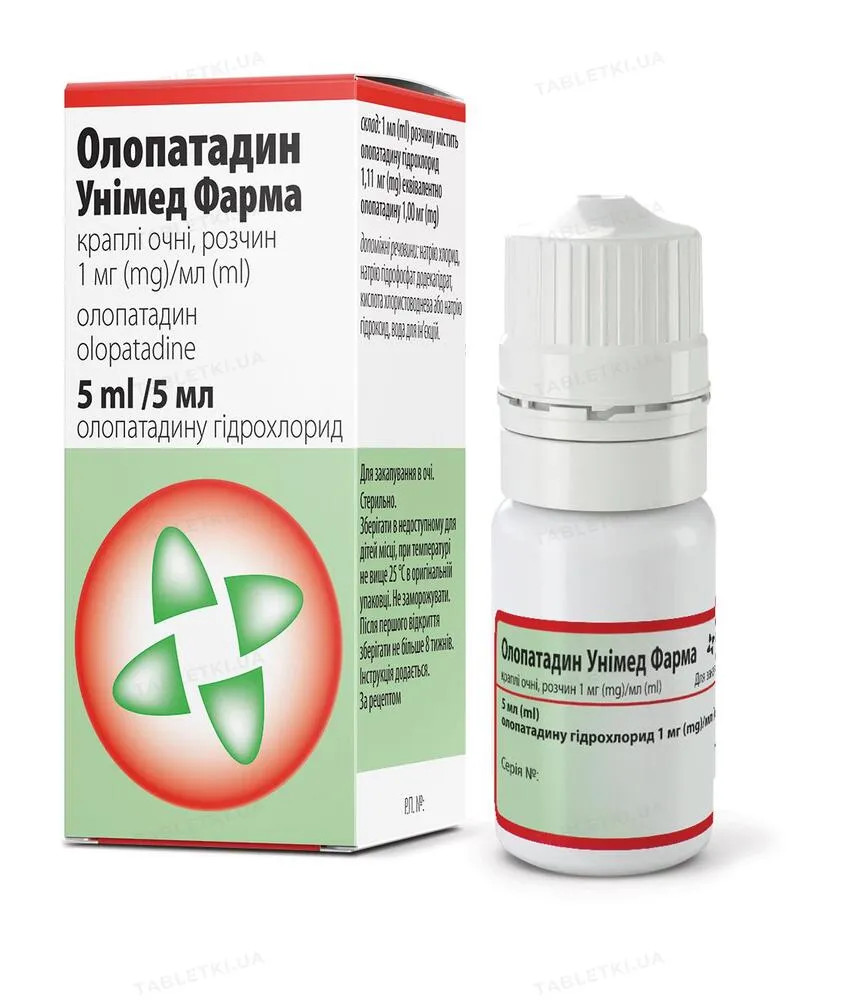
Table of Contents
INSTRUCTIONS for medical use of the medicinal product Olopatadine Unimed Pharma (Olopatadine Unimed Pharma)
Composition:
active substance: olopatadine;
1 ml of solution contains olopatadine hydrochloride 1.11 mg equivalent to olopatadine 1.00 mg;
1 ml contains 30 drops;
excipients: sodium chloride, sodium hydrogen phosphate dodecahydrate, hydrochloric acid or sodium hydroxide, water for injections.
Pharmaceutical form. Eye drops, solution.
Main physicochemical properties: clear, colorless solution free from visible mechanical particles.
Pharmacotherapeutic group. Agents used in ophthalmology. Anti-inflammatory and antiallergic agents. ATC code S01GX09.
Pharmacological Properties.
Pharmacodynamics.
Olopatadine is a potent, selective anti-allergic/antihistamine agent with multiple distinct mechanisms of action. It counteracts the release of histamine (the primary mediator of allergic response in humans) and prevents histamine-induced stimulation of cytokine production by human conjunctival epithelial cells. In vitro studies indicate that the drug acts on conjunctival mast cells, inhibiting the release of inflammatory mediators. It has been observed that topical ophthalmic administration of the drug in patients with patent nasolacrimal ducts reduces nasal signs and symptoms commonly associated with seasonal allergic conjunctivitis. The drug does not cause clinically significant changes in pupil diameter.
Standard safety studies, including pharmacology, repeated-dose toxicity, genotoxicity, carcinogenic potential, and reproductive toxicity studies, revealed no hazard to humans.
Delayed development of puppies was observed in pups nursed by dams that received systemic doses of olopatadine exceeding the maximum recommended dose for ophthalmic use in humans. Olopatadine was detected in the milk of lactating rats following oral administration.
Pharmacokinetics.
Olopatadine is systemically absorbed, as are other topically applied medicinal agents. However, with topical application, systemic absorption of olopatadine is minimal, and plasma concentrations range from below the level of quantification (< 0.5 ng/mL) to 1.3 ng/mL. These concentrations are 50–200 times lower than those achieved following oral administration of well-tolerated doses of the drug.
The elimination half-life of olopatadine in plasma following oral administration is approximately 8–12 hours, and the drug is primarily excreted by the kidneys. Approximately 60–70% of the administered dose was recovered in urine as unchanged active substance. Two metabolites, mono-desmethyl and N-oxide, were detected in urine at low concentrations.
Since olopatadine is excreted in urine predominantly as unchanged active substance, its pharmacokinetics are altered in renal impairment. Peak plasma concentrations in patients with severe renal insufficiency (mean creatinine clearance of 13 mL/min) were 2–3 times higher than in healthy adult volunteers. During hemodialysis in patients following oral administration of a 10 mg dose, plasma olopatadine concentrations were significantly lower on dialysis days compared to non-dialysis days, suggesting that olopatadine is removed during hemodialysis.
Following oral administration of a 10 mg dose, no significant differences in plasma concentrations, protein binding, urinary excretion of unchanged drug or metabolites were observed between young and elderly individuals.
Following oral administration in patients with severe renal insufficiency, somewhat higher plasma concentrations may be expected. However, since plasma concentrations following topical ophthalmic administration of olopatadine are 50–200 times lower than those achieved with well-tolerated oral doses, dosage adjustment is not required for elderly individuals or patients with renal impairment. Hepatic metabolism is not a major route of drug elimination; therefore, dosage adjustment is not necessary for patients with hepatic impairment.
Clinical characteristics.
Indications.
Treatment of seasonal allergic conjunctivitis.
Contraindications.
Hypersensitivity to the active substance or to any of the excipients of the medicinal product.
Interaction with other medicinal products and other forms of interaction.
Studies on the interaction of the medicinal product with other drugs have not been conducted.
In vitro studies have shown that olopatadine does not inhibit metabolic reactions of cytochrome P450 isoenzymes 1A2, 2C8, 2C9, 2C19, 2D6, 2E1, and 3A4. Olopatadine does not cause metabolic interactions with other active substances when used concomitantly.
Instructions for use.
The medicinal product is an antiallergic/antihistamine agent administered locally, but it is systemically absorbed. The use of the product should be discontinued in case of any signs of serious reactions or increased sensitivity.
Patients with a history of contact hypersensitivity to silver should not use this medicinal product, as the dispensed drops may contain traces of silver from the bottle cap.
Contact lens wearers
Soft contact lenses must be removed before instillation of the drops and may be reinserted 15 minutes after administration.
Use during pregnancy or breastfeeding.
Pregnancy.
Data on the ophthalmic use of olopatadine in pregnant women are lacking or limited in quantity. Reproductive toxicity has been observed in animals after systemic administration (see section "Pharmacological properties"). Olopatadine is not recommended for use in pregnant women or in women of reproductive potential who are not using contraceptive methods.
Breastfeeding period.
After oral administration in animals, olopatadine has been shown to pass into breast milk (see details in section "Pharmacological properties"). A risk to newborns/infants cannot be excluded. The product should not be used during breastfeeding.
Reproductive function.
No studies have been conducted to evaluate the effect of olopatadine on human reproductive function following topical ophthalmic administration.
Ability to influence reaction speed when driving vehicles or operating machinery.
Olopatadine UNIMED PHARMA has no effect or has a negligible effect on the ability to drive vehicles or operate machinery.
As with the use of any ophthalmic drops, transient blurred vision or other visual disturbances may affect the ability to drive vehicles or operate machinery. If blurred vision occurs upon instillation, the patient should wait until vision clears before driving or operating machinery.
Method of Administration and Dosage
For ophthalmic use only.
One drop of the medicinal product should be instilled into the conjunctival sac of the affected eye(s) twice daily (with an 8-hour interval). If necessary, treatment may last up to 4 months.
Use in elderly patients. No dosage adjustment is required for this patient group.
Use in children and adolescents. The medicinal product can be used in pediatric practice for children aged 3 years and older at the same dosage as in adults. Safety and efficacy of the medicinal product in children under 3 years of age have not been studied. Data for this age group are lacking.
Use in hepatic and renal impairment. Studies with olopatadine in the form of eye drops in patients with hepatic or renal impairment have not been conducted. However, no dosage adjustment is necessary in cases of hepatic or renal impairment (see section "Pharmacokinetics").
To prevent contamination of the dropper tip and the contents of the bottle, care must be taken not to touch the eyelids, adjacent areas, or other surfaces with the tip of the dropper cap. The bottle should be tightly closed after each use.
If more than one ophthalmic medicinal product is used locally, an interval of at least 5 minutes between applications should be maintained. Ophthalmic ointments should be applied last.
Children.
The medicinal product can be used in children aged 3 years and older at the same dosage as in adults.
Overdose
There are no data on overdose in humans following accidental or intentional ingestion. Olopatadine showed a low level of acute toxicity in animals. Accidental ingestion of the entire contents of one bottle of the medicinal product would result in a maximum systemic exposure of 5 mg olopatadine. This exposure could occur at a final dose of 0.5 mg/mL in a child weighing 10 kg with 100% absorption.
Prolongation of the QT interval in dogs was observed only at doses substantially exceeding the maximum human dose, indicating a low likelihood of QT interval prolongation during clinical use. In healthy volunteers, young adults, and elderly patients receiving 5 mg of the medicinal product orally twice daily for 2.5 days, a slight increase in QT interval was observed compared to placebo. Peak plasma concentrations of olopatadine (35 to 127 ng/mL) were at least 70 times higher than those achieved with topical olopatadine administration regarding effects on cardiac repolarization.
In case of overdose, appropriate diagnostic evaluation and treatment of the patient should be initiated.
Adverse Reactions
In clinical studies involving 1680 patients, olopatadine was administered one to four times daily in both eyes for up to four months, either as monotherapy or as add-on therapy to loratadine 10 mg.
Adverse reactions associated with the use of olopatadine occurred in approximately 4.5% of patients; however, only 1.6% of patients discontinued clinical studies due to these adverse reactions. No serious ophthalmological or systemic adverse reactions related to olopatadine were reported in clinical studies. The most frequently reported treatment-related adverse reaction was eye pain, with an overall incidence of 0.7%.
During clinical studies and based on post-marketing data, the following adverse reactions have been reported, classified according to the following convention: very common (≥1/10), common (≥1/100 to <1/10), uncommon (≥1/1000 to <1/100), rare (≥1/10,000 to <1/1000), very rare (<1/10,000), or not known (cannot be estimated from the available data). Within each frequency grouping, adverse reactions are presented in order of decreasing severity.
| System Organ Class |
Frequency |
Adverse Reactions |
| Infections and infestations |
Uncommon |
rhinitis |
| Immune system disorders |
Not known |
hypersensitivity, facial swelling |
| Nervous system disorders |
Common |
headache, dysgeusia |
| Uncommon |
dizziness, hypoesthesia |
|
| Not known |
drowsiness |
|
| Eye disorders |
Common |
eye pain, eye irritation, dry eye, abnormal eye sensitivity |
| Uncommon |
corneal erosion, corneal epithelial damage, corneal epithelial disorder, punctate keratitis, keratitis, corneal staining, eye discharge, photophobia, blurred vision, decreased visual acuity, blepharospasm, eye discomfort, eye pruritus, conjunctival follicles, conjunctival disorder, foreign body sensation in eye, increased lacrimation, eyelid erythema, ocular hyperemia, eyelid edema |
|
| Not known |
eyelid disorder, eye hyperemia, corneal edema, eye swelling, eye edema, conjunctivitis, mydriasis, visual disturbance, scaling of eyelid margins, periorbital edema |
|
| Respiratory, thoracic and mediastinal disorders |
Common |
nasal dryness |
| Not known |
dyspnea, sinusitis |
|
| Gastrointestinal disorders |
Not known |
nausea, vomiting |
| Skin and subcutaneous tissue disorders |
Uncommon |
contact dermatitis, skin burning sensation, dry skin |
| Not known |
dermatitis, erythema |
|
| General disorders and administration site conditions |
Common |
fatigue |
| Not known |
asthenia, malaise |
In patients with significant corneal involvement, corneal calcification has been very rarely reported during treatment with ophthalmic solutions containing phosphates.
Reporting of adverse reactions following marketing authorization of the medicinal product is important. It allows continuous monitoring of the benefit-risk balance of the medicinal product. Healthcare professionals and patients, as well as their legal representatives, should report all suspected adverse reactions and lack of efficacy via the Automated Pharmacovigilance Information System at the following link: https://aisf.dec.gov.ua.
Shelf life. 2 years.
After first opening, do not store for more than 8 weeks.
Storage conditions.
Keep out of reach of children. Store at a temperature not exceeding 25 °C in the original packaging. Do not freeze.
Packaging.
5 ml or 10 ml in a dropper bottle, one dropper bottle per cardboard box.
Prescription status. Prescription only.
Manufacturer.
LLC "UNIMED PHARMA" / "UNIMED PHARMA Ltd".
Manufacturer's address and location of its business operations.
Orieskova 11, 821 05, Bratislava, Slovak Republic /
Orieskova 11, 821 05 Bratislava, Slovak Republic.