Olidentrim® d3 forte 20 000
Ukraine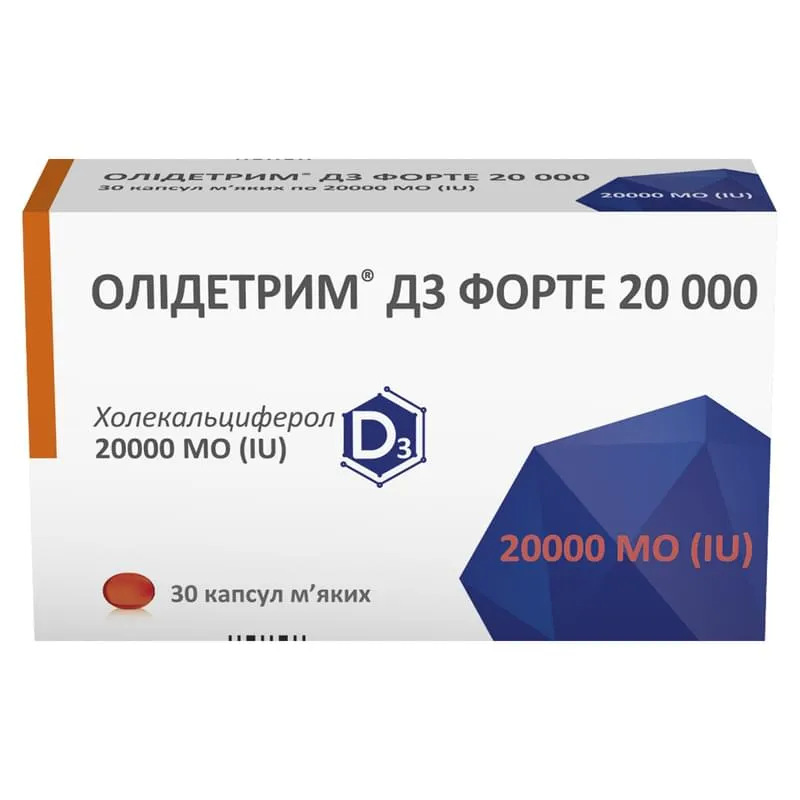
Table of Contents
INSTRUCTIONS FOR MEDICAL USE OF THE MEDICINAL PRODUCT OLIDETRIM® D3 FORTE 20 000 (OLIDETRIM D3 FORTE 20 000)
Composition:
active substance: cholecalciferol;
1 soft capsule contains 0.5 mg cholecalciferol, equivalent to 20,000 IU of vitamin D3;
excipients: capsule contents: all-rac-α-tocopheryl acetate (E 307), medium-chain triglycerides; capsule shell: gelatin, glycerin, purified water.
Pharmaceutical form. Soft capsules.
Main physicochemical properties: transparent, light-yellow, round, soft capsules with a seam line in the middle, filled with oily liquid.
Pharmacotherapeutic group. Vitamins. Vitamin D and analogues. Cholecalciferol.
ATC code A11C C05.
Pharmacological Properties
Pharmacodynamics
Cholecalciferol (vitamin D3) is synthesized in the skin under the influence of ultraviolet radiation, including sunlight, and is converted into its biologically active form, 1,25-dihydroxycholecalciferol, in two steps: first in the liver (hydroxylation at position 25 to calcifediol), and then in the kidneys (hydroxylation at position 1 to calcitriol). Calcifediol and calcitriol, the active metabolites of cholecalciferol, regulate transcription and translation processes via steroid receptors in the DNA of cellular nuclei, thereby inducing the synthesis of proteins responsible for calcium absorption in the body, as well as proteins involved in mineralization processes in bones.
Vitamin D plays a key role in regulating calcium and phosphate homeostasis (calcemic effect). In its biologically active form, cholecalciferol stimulates intestinal absorption of calcium, penetration of calcium into osteoid, and release of calcium from bone tissue. In the small intestine, cholecalciferol also increases passive and active transport of phosphorus. In bones, it enhances osteoclastic bone resorption and increases osteoclast activity. In the kidneys, it reduces excretion of calcium and phosphorus by stimulating tubular reabsorption.
Vitamin D also exerts immunomodulatory effects. A high level of the highly specific vitamin D receptor (VDR) has been detected in immunocompetent cells, particularly in macrophages, dendritic cells, and T- and B-lymphocytes, which may positively modulate immune function. Thus, normal vitamin D levels may enhance resistance to infections.
Vitamin D deficiency is defined as a serum concentration of 25-hydroxycholecalciferol (25(OH)D) < 20 ng/mL (< 50 nmol/L); the target concentration for optimal vitamin D effect is considered to be 30–50 ng/mL (75–125 nmol/L).
Vitamin D deficiency may lead, in particular, to impaired immunity (frequent colds and infections) and reduced muscle strength. Prolonged vitamin D deficiency may result in more serious disorders, such as the development of osteoporosis and bone deformities.
In cases of muscle weakness or reduced muscle mass (e.g., in elderly individuals or post-stroke patients), vitamin D supplementation reduces the number of falls and has a beneficial effect on muscle mass. Even mild vitamin D deficiency reduces skeletal muscle strength, and its correction improves physical performance, reduces the risk of falls, and accelerates recovery after fractures in rehabilitated patients.
Vitamin D deficiency causes impaired bone mineralization (osteomalacia in adults), and in children – also of the growth cartilage (rickets). Deficiency of calcium and/or vitamin D leads to reversible increase in parathyroid hormone (PTH) secretion. This secondary hyperparathyroidism results in enhanced bone remodeling, which may lead to bone deformities in children and decreased bone mass in adults, and in extreme cases – to bone fractures.
Parathyroid hormone (PTH) secretion by the parathyroid glands is directly suppressed by the biologically active form of cholecalciferol. PTH secretion is further suppressed by increased intestinal absorption of calcium induced by the biologically active form of cholecalciferol.
Causes of vitamin D deficiency include inadequate dietary intake, insufficient exposure to ultraviolet radiation [residents of high latitudes (> 35°), individuals spending most of their time indoors, night workers, or those with dark skin], impaired intestinal absorption and poor digestion of nutrients, liver cirrhosis, and renal insufficiency.
Pharmacokinetics
Absorption
Cholecalciferol from food is almost completely absorbed in the gastrointestinal tract in the presence of lipids and bile acids. Therefore, taking vitamin D during a main meal may enhance its absorption.
Distribution
Cholecalciferol accumulates in adipocytes, and its biological half-life in the form of 25(OH)D3 is approximately 2–3 weeks. After a single oral dose of cholecalciferol, maximum serum concentration of 25(OH)D3, the main storage form, is reached after a prolonged period.
Biotransformation
Cholecalciferol is metabolized by microsomal hydroxylase to 25-hydroxycholecalciferol (25(OH)D3, calcidiol), the primary storage form of vitamin D3. 25(OH)D3 is further hydroxylated in the kidneys to form the main active metabolite – 1,25-dihydroxycholecalciferol (1,25(OH)2D3, calcitriol). Circulating metabolites are bound to α-globulin.
Elimination
25(OH)D3 is slowly eliminated from serum with a half-life of approximately 50 days.
Cholecalciferol and its metabolites are primarily excreted via bile and feces.
Serum concentrations of 25(OH)D3 may remain elevated for several months after administration of high doses of cholecalciferol. Hypercalcemia caused by overdose may persist for several weeks (see section "Overdose").
Clinical characteristics
Indications
- Treatment of vitamin D deficiency and conditions caused by vitamin D deficiency in adults (particularly during initial treatment of confirmed severe deficiency).
- Prevention of vitamin D deficiency in adult patients at high risk.
Vitamin D deficiency is defined as a serum 25-hydroxycholecalciferol (25(OH)D) level < 20 ng/mL (< 50 nmol/L); the target concentration to ensure optimal vitamin D effect is defined as 30–50 ng/mL (75–125 nmol/L).
Contraindications
- Hypersensitivity to the active substance or to any of the other excipients contained in the medicinal product.
- Hypercalcaemia and/or hypercalciuria.
- Pseudohypoparathyroidism (vitamin D requirement may be lower than during normal sensitivity to vitamin D; risk of prolonged overdose).
- Sarcoidosis.
- Nephrolithiasis and/or nephrocalcinosis.
- Severe renal insufficiency.
- Tuberculosis.
- Hypervitaminosis D.
Interaction with other medicinal products and other forms of interaction
Concomitant use of anticonvulsants (e.g. phenytoin) or barbiturates (and possibly other enzyme-inducing medicinal products) may lead to reduced vitamin D effect due to metabolic inactivation.
Concomitant administration of benzothiadiazine derivatives (thiazide diuretics) increases the risk of hypercalcaemia due to reduced renal calcium excretion. Therefore, plasma and urinary calcium levels must be monitored.
Rifampicin may reduce the efficacy of cholecalciferol due to induction of liver enzymes.
Isoniazid may reduce the efficacy of cholecalciferol by inhibiting metabolic activation of cholecalciferol.
Concomitant treatment with ion-exchange resins (such as cholestyramine) or laxatives (such as liquid paraffin) may reduce vitamin D absorption in the gastrointestinal tract. Orlistat may potentially interfere with cholecalciferol absorption, as it is fat-soluble.
The cytotoxic agent actinomycin and imidazole antifungal agents reduce vitamin D activity by inhibiting the conversion of 25-hydroxycholecalciferol to 1,25-dihydroxycholecalciferol via the renal enzyme 1-α-hydroxylase.
Glucocorticoids may enhance vitamin D metabolism and elimination, which may lead to reduced vitamin D efficacy. When used concomitantly, an increased dose of Olidetrim® D3 Forte 20000 may be required.
Concomitant use with vitamin D analogues increases the risk of toxicity. The combination of Olidetrim® D3 Forte 20000 with metabolites or analogues of vitamin D should be avoided. Concomitant administration of vitamin D3 with metabolites or analogues of vitamin D is possible only exceptionally and only with monitoring of serum calcium levels.
Oral intake of vitamin D together with cardiac glycosides may enhance the efficacy and toxicity of digoxin due to increased calcium levels (risk of cardiac arrhythmias). In such patients, regular ECG monitoring and measurement of plasma and urinary calcium levels are required, as well as determination of digoxin or digitoxin concentration, if possible.
Concomitant use of the product with antacids containing aluminium or magnesium may provoke toxic effects of aluminium on bone and hypermagnesaemia in patients with renal insufficiency.
Ketoconazole may reduce the biosynthesis and catabolism of 1,25(OH)2-cholecalciferol.
Concomitant use with medicinal products containing high doses of calcium and phosphorus increases the risk of hyperphosphataemia.
Vitamin D may act as an antagonist to medicinal products used in hypercalcaemia, such as calcitonin, etidronate, and pamidronate.
Special precautions for use
Patients taking the medicinal product OliDetrim® D3 Forte 20000 on a monthly dosing regimen are advised not to consume products containing vitamin D, dietary supplements with vitamin D, and to limit sun exposure.
OliDetrim® D3 Forte 20000 is not recommended for individuals predisposed to calcium-containing kidney stone formation.
OliDetrim® D3 Forte 20000 should be used with particular caution in patients with impaired renal function, during treatment with benzothiadiazine derivatives, and in immobilized patients (due to the risk of developing hypercalcemia and hypercalciuria). In such patients, calcium and phosphate levels should be monitored. The risk of soft tissue calcification should be considered. In patients with severe renal insufficiency, vitamin D in the form of cholecalciferol is not properly metabolized; therefore, other forms of vitamin D should be used (see section "Contraindications").
When using the medicinal product at an equivalent daily dose exceeding 1000 IU of vitamin D, serum and urinary calcium levels should be monitored, and renal function should be assessed by measuring serum creatinine concentration. This monitoring is particularly important for elderly patients and during concomitant therapy with cardiac glycosides or diuretics (see section "Interaction with other medicinal products and other forms of interaction"). This also applies to patients predisposed to calcium-containing kidney stone formation.
Vitamin D is contraindicated in patients with sarcoidosis due to the risk of increased conversion of vitamin D into its active form.
The vitamin D content in OliDetrim® D3 Forte 20000 should be taken into account when prescribing other medicinal products containing vitamin D.
The need for additional calcium intake should be individually assessed for each patient. Any additional calcium intake should be administered under strict medical supervision to prevent hypercalcemia. In such cases, frequent monitoring of serum and urinary calcium levels is required.
Prior to initiating vitamin D therapy, a thorough patient assessment by a physician is required, including consideration of additional vitamin D intake from specific food products.
Careful monitoring of treatment response is recommended to prevent hypercalcemia.
OliDetrim® D3 Forte 20,000 should not be used in children (under 18 years of age).
Elderly patients
Age > 65 years
According to published data, in elderly patients with a history of falls, the risk of falling increased when using 60,000 IU of vitamin D monthly. Therefore, the use of cholecalciferol in elderly patients is recommended only after a careful benefit-risk assessment and only when clearly indicated. The dose should not exceed 24,000 IU per month. For elderly patients with a history of falls, consideration should be given to daily vitamin D supplementation.
Age > 70 years
When treating with vitamin D according to a protocol involving a loading dose, serum levels of 25(OH)D3 should also be regularly monitored. Treatment should be discontinued if levels reach ≥ 50 ng/mL.
Use during pregnancy or breastfeeding
Pregnancy
The medicinal product OliDetrim® D3 Forte 20,000 should not be used during pregnancy, except in cases where the woman's clinical condition requires treatment with cholecalciferol at a dose necessary to correct deficiency.
During pregnancy, vitamin D overdose should be avoided, as prolonged hypercalcemia may lead to delayed physical and mental development in the child, as well as supravalvular aortic stenosis and retinopathy.
Breastfeeding
Cholecalciferol and its metabolites pass into breast milk. Cases of overdose in breastfed infants have not been observed. Women who are breastfeeding should not take high-dose vitamin D supplements, such as 20,000 IU capsules, for additional vitamin D supply to newborns.
Fertility
No negative effects on fertility have been observed with vitamin D intake at recommended daily doses.
Ability to affect reaction speed when driving or operating machinery
Studies on the effect of the medicinal product on the ability to drive or operate machinery have not been conducted. Adverse effects of cholecalciferol that could impair the ability to drive or operate machinery are unknown.
Method of Administration and Dosage
Method of Administration
Oral use.
Capsules should be swallowed whole with water, preferably during a main meal.
Dosage
The dosage regimen and administration schedule should be individually adjusted depending on the clinical manifestations of each patient.
Depending on the daily dose of vitamin D individually determined for each patient, an appropriate dosing regimen of the drug should be established, specifying the recommended dose and the interval between administrations.
The usual recommended dose is given below.
Certain population groups are at high risk of vitamin D deficiency and may require higher doses and monitoring of serum vitamin D levels. These include:
- individuals residing in institutional settings or who have been hospitalized;
- individuals with dark skin;
- individuals whose effective sun exposure is limited due to wearing protective clothing or using sunscreen;
- individuals with obesity;
- patients under medical supervision for osteoporosis;
- individuals taking certain medications (e.g., anticonvulsants, glucocorticoids);
- patients with malabsorption, including inflammatory bowel disease and celiac disease;
- individuals who have recently been treated for vitamin D3 deficiency and require maintenance therapy.
Treatment of vitamin D deficiency and conditions caused by vitamin D deficiency should be continued for three months or until achieving a 25(OH)D concentration of 30–50 ng/mL. After that, it is advisable to continue vitamin D treatment at preventive doses recommended for the general population and determined according to the individual’s age and body weight.
National guidelines for the treatment and prevention of vitamin D deficiency may also be followed.
Treatment of vitamin D deficiency and related conditions in adults
Typically, for patients with laboratory-confirmed vitamin D deficiency, the recommended dose is:
- 20,000 IU twice weekly or 40,000 IU once weekly for 1–3 months
- or 50,000 IU once weekly for 1–3 months.
After this, treatment with vitamin D at a dose of 2,000 IU daily or 10,000 IU weekly is recommended. The dosage and frequency of administration should be individually determined by the physician. Some patients may require higher doses.
Further measurements of 25(OH)D concentration should be performed no later than 3–4 months after starting treatment, or earlier, to confirm that the target 25(OH)D concentration has been achieved and maintenance therapy can be initiated.
After completing treatment, the physician may recommend preventive vitamin D supplementation.
Dosing in patients with obesity
Adults with obesity (BMI ≥ 30 kg/m²) may require higher vitamin D doses. Typically, patients with obesity are recommended to double the dose compared to the dose recommended for patients with normal body weight.
Dosing in patients with low body weight
Adults with low body weight (BMI < 18.5 kg/m²) may, depending on the degree of body weight deficit, require doses lower than those recommended for patients with normal body weight.
Prevention of vitamin D deficiency in adult patients at high risk
It is recommended to take 2 or 3 capsules of 20,000 IU monthly or 1 capsule of 50,000 IU monthly.
Special patient groups
Hepatic impairment
Dosage adjustment is not required.
Renal impairment
Olidetrim® D3 Forte 20,000 should not be used in patients with severe renal insufficiency (see sections "Special precautions for use" and "Contraindications").
Elderly patients
The monthly dose should not exceed 24,000 IU. For elderly patients with a history of falls, daily vitamin D supplementation should be considered (see section "Special precautions for use").
Children
Olidetrim® D3 Forte 20000 is not recommended for use in children under 18 years of age.
Overdose
Symptoms
Acute and chronic overdose of vitamin D may cause hypercalcemia (increased calcium concentration in blood plasma) and hypercalciuria (increased calcium excretion in urine). Hypercalcemia occurs after administration of 50,000–100,000 IU of vitamin D3 per day. Symptoms of hypercalcemia may be nonspecific and include nausea, vomiting, diarrhea in the early stage, and constipation, anorexia, increased fatigue, headache, muscle and joint pain, muscle weakness, polydipsia, polyuria, kidney stone formation, nephrocalcinosis, renal failure, tissue calcium deposition, ECG changes, arrhythmias, and pancreatitis in the later stage. In pre-terminal stages, dehydration, photosensitivity, pancreatitis, rhinorrhea, hyperthermia, decreased libido, conjunctivitis, hypercholesterolemia, increased transaminase activity, arterial hypertension, and uremia may also occur. In rare and isolated cases, severe hypercalcemia due to vitamin D poisoning has led to fatal outcomes.
In severe cases, corneal clouding may occur, less frequently papilledema, uveitis, up to the development of cataracts.
Kidney stones may form, and calcification may occur in soft tissues such as blood vessels, heart, lungs, and skin.
Cholestatic jaundice may rarely develop.
Characteristic biochemical abnormalities include hypercalcemia, hypercalciuria, and elevated serum 25-hydroxycalciferol concentration.
Patients undergoing long-term treatment with higher doses of vitamin D should be informed about symptoms of possible overdose (nausea, vomiting, initial frequent diarrhea changing to constipation, anorexia, dizziness, headache, myalgia, arthralgia, muscle weakness, somnolence, azotemia, polydipsia, and polyuria). In severe cases, corneal clouding may occur, less frequently papilledema, uveitis up to the development of cataracts.
Treatment
Treatment of vitamin D-induced hypercalcemia may last several weeks.
Recommended treatment includes discontinuation of all sources of vitamin D, including dietary supplements and fortified foods, and avoidance of sun exposure. A low-calcium diet or calcium exclusion from the diet may also be considered.
High fluid intake is recommended, along with diuretic therapy such as furosemide, to ensure adequate diuresis. Additional treatment with calcitonin or corticosteroids may also be considered.
Phosphate infusions should not be administered to reduce vitamin D overdose-induced hypercalcemia due to the risk of metastatic calcification.
With normal renal function, calcium levels can usually be reduced by infusion of isotonic sodium chloride solution (3–6 liters within 24 hours) with added furosemide. In some cases, intravenous administration of sodium edetate at 15 mg/kg body weight/hour with continuous monitoring of calcium levels and ECG may also be recommended. However, in cases of oligoanuria, hemodialysis (using a calcium-free dialysate) should be performed.
There is no known specific antidote.
Adverse reactions
Frequency is defined as follows: uncommon (≥ 1/1,000 to < 1/100); rare (≥ 1/10,000 to < 1/1,000); frequency not known (cannot be estimated based on available data)
| Organ system classes (MedDRA) |
Frequency of adverse reactions |
Adverse reactions |
| Cardiac disorders |
Frequency unknown |
Arrhythmia, arterial hypertension |
| Immune system disorders |
Frequency unknown |
hypersensitivity reactions, such as angioedema or laryngeal edema |
| Metabolism and nutrition disorders |
Uncommon |
Hypercalcaemia, hypercalciuria |
| Frequency unknown |
Hypercholesterolemia, weight loss, polydipsia, increased sweating, pancreatitis |
|
| Gastrointestinal disorders |
Frequency unknown |
Constipation, flatulence, nausea, abdominal pain, diarrhoea, loss of appetite, vomiting, dry mouth, dyspepsia |
| Skin and subcutaneous tissue disorders |
Rare |
Hypersensitivity reactions, including urticaria, rash, pruritus |
| Nervous system disorders |
Frequency unknown |
Headache, somnolence, psychiatric disturbances, depression |
| Renal and urinary disorders |
Frequency unknown |
Elevated calcium levels in blood and/or urine, nephrolithiasis and tissue calcification, uraemia, polyuria |
| Musculoskeletal and connective tissue disorders |
Frequency unknown |
Myalgia, arthralgia, muscle weakness |
| Eye disorders |
Frequency unknown |
Conjunctivitis, photophobia |
| Hepatobiliary disorders |
Frequency unknown |
Increased aminotransferase activity |
| Psychiatric disorders |
Frequency unknown |
Decreased libido |
There have been isolated reports of fatal outcomes (see section "Overdose").
Reporting of suspected adverse reactions
Reporting suspected adverse reactions after authorization of the medicinal product is important. It allows continuous monitoring of the benefit/risk balance of the medicinal product. Healthcare professionals and patients, as well as their legal representatives, should report any suspected adverse reactions and lack of efficacy via the Automated Pharmacovigilance Information System at the following link: https://aisf.dec.gov.ua.
Shelf life. 2 years.
Storage conditions
Store at a temperature not exceeding 25 °C. Keep in the original packaging to protect from light. Keep out of reach of children.
Packaging
10 or 14 capsules in a blister.
1 (No. 10 or No. 14), 2 (2 × No. 10), or 3 (3 × No. 10) blisters in a cardboard box.
Prescription status
Prescription only.
Manufacturer
Pharmaceutical Plant "POLFARMA" S.A.
Manufacturer's address and place of business
Medan Branch in Sieradz, ul. Władysława Lokietka 10, 98-200 Sieradz, Poland.