Olfen® hydrogel
Ukraine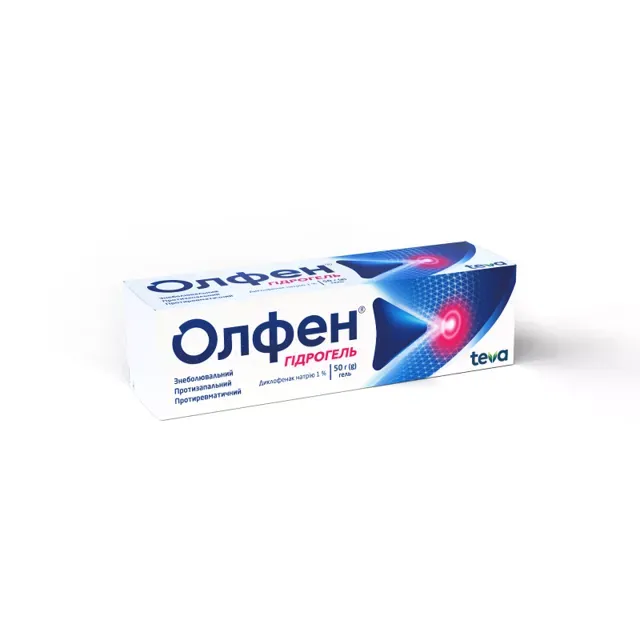
Table of Contents
INSTRUCTIONS FOR MEDICAL USE OF THE MEDICINAL PRODUCT Olfen® HYDROGEL (Olfen® HYDROGEL)
Composition:
active substance: diclofenac;
1 g of gel contains 10 mg of sodium diclofenac;
excipients: lactic acid, diisopropyl adipate, isopropyl alcohol, sodium metabisulfite (E 223), hydroxyethylcellulose, hydroxypropylcellulose, purified water.
Pharmaceutical form. Gel.
Main physicochemical properties: opalescent or slightly cloudy, colorless or slightly yellowish gel with the odor of isopropyl alcohol.
Pharmacotherapeutic group. Topical preparations for joint and muscular pain. Non-steroidal anti-inflammatory drugs. Diclofenac. ATC code M02A A15.
Pharmacological properties.
Pharmacodynamics.
OLFEN® HYDROGEL with the active substance sodium diclofenac is a non-steroidal anti-inflammatory agent for topical use.
Sodium diclofenac exerts pronounced anti-rheumatic, analgesic, anti-inflammatory, and antipyretic effects. The main mechanism of action is inhibition of prostaglandin biosynthesis.
In inflammation caused by injuries or rheumatic diseases, OLFEN® HYDROGEL reduces pain, tissue swelling, and shortens the recovery period of functions of damaged joints, ligaments, tendons, and muscles. OLFEN® HYDROGEL reduces acute pain within 1 hour after application. Relief of pain and functional impairments was achieved after 4 days of treatment with OLFEN® HYDROGEL.
Pharmacokinetics.
The amount of diclofenac absorbed through the skin is proportional to the area of application and depends on both the total applied dose of the drug and the degree of skin hydration.
After application of OLFEN® HYDROGEL to the skin over the wrist and knee joints, diclofenac is detected in blood plasma (where its maximum concentration is approximately 100 times lower than after oral administration), in the synovial membrane, and synovial fluid. Plasma protein binding of diclofenac is 99.7%.
Diclofenac accumulates in the skin, which acts as a reservoir from which the substance is gradually released into adjacent tissues. From there, diclofenac primarily penetrates into deeper inflamed tissues such as joints, where it continues to act and is found at concentrations up to 20 times higher than in blood plasma.
Diclofenac is mainly metabolized via hydroxylation, forming several phenolic derivatives, two of which are pharmacologically active, although to a much lesser extent than diclofenac.
Diclofenac and its metabolites are primarily excreted in urine. Total systemic plasma clearance of diclofenac is 263 ± 56 ml/min, and the terminal half-life is on average 1–3 hours.
In renal or hepatic insufficiency, metabolism and elimination of diclofenac from the body remain unchanged.
Clinical characteristics.
Indications.
Local treatment of pain and inflammation of joints, muscles, ligaments, and tendons of rheumatic or traumatic origin.
Contraindications.
Hypersensitivity to diclofenac or to any of the other components of the Olfen® HYDROGEL preparation. History of bronchial asthma, urticaria, or acute rhinitis attacks induced by acetylsalicylic acid or other nonsteroidal anti-inflammatory drugs. Third trimester of pregnancy.
Interaction with other medicinal products and other forms of interaction.
Since systemic absorption of diclofenac following topical application of the preparation is very low, the occurrence of interactions is unlikely.
Special precautions for use
Olfen® HYDROGEL should be used with caution in combination with oral nonsteroidal anti-inflammatory drugs. The likelihood of systemic adverse effects with topical application of diclofenac is considerably lower compared to oral formulations. However, systemic effects cannot be excluded when the product is applied over relatively large skin areas for prolonged periods.
Olfen® HYDROGEL should only be applied to intact skin surfaces. Contact of the product with damaged skin, open wounds, eczematous skin, eyes, and mucous membranes should be avoided. The product must not be ingested.
Treatment with the product should be discontinued if any skin rash occurs.
The gel must not be applied under occlusive, air-impermeable dressings, but may be used under non-occlusive dressings. In cases of ligament sprains, the affected area may be bandaged.
Use during pregnancy or breastfeeding
Pregnancy
There are no clinical data on the use of this medicinal product during pregnancy. Even though systemic exposure after topical application is lower than with oral administration, it is unknown whether the systemic exposure achieved after topical use could be harmful to the embryo/fetus.
Inhibition of prostaglandin synthesis may negatively affect pregnancy and/or embryofetal development. Epidemiological data suggest an increased risk of miscarriage, cardiac malformations, and gastroschisis following use of prostaglandin synthesis inhibitors in early pregnancy. This risk is considered to increase with higher drug doses and longer duration of therapy.
Sodium diclofenac should not be used during the first and second trimesters of pregnancy unless absolutely necessary. If sodium diclofenac is administered to a woman attempting to conceive or during the first or second trimester of pregnancy, the dose should be as low as possible and the duration of treatment as short as possible.
During the third trimester of pregnancy, all prostaglandin synthesis inhibitors, including diclofenac, may expose the fetus to the following risks:
- Cardio-pulmonary toxicity (with premature closure of the ductus arteriosus and development of pulmonary hypertension);
- Progressive renal dysfunction leading to renal failure with oligohydramnios, and renal toxicity.
Effects on the mother and newborn at the end of pregnancy:
- Possible prolonged bleeding – an effect related to inhibition of platelet aggregation, which may occur even with very low doses of the drug;
- Inhibition of uterine contractions, leading to delayed or prolonged labor.
Therefore, the medicinal product Olfen® HYDROGEL is contraindicated during the third trimester of pregnancy.
Breastfeeding
Like other NSAIDs, diclofenac passes into human breast milk in small amounts. However, when diclofenac is used at therapeutic doses, effects on the breastfed infant are not expected. The decision to use the product during breastfeeding should be made by a physician when there are strong medical reasons, and the expected benefit of treatment outweighs the potential risk. The product should not be applied to the mammary glands or large skin areas, and should not be used for prolonged periods.
Ability to influence reaction speed when driving or operating machinery
No effect.
Method of Administration and Dosage
The gel is intended for topical use only!
Adults and children aged 14 years and older
The amount of medication applied depends on the size of the affected area. Approximately 2–4 g of gel (corresponding in volume to applying a strip of gel covering 1–2 fingertip units) is sufficient for application to an area of 400–800 cm². Apply the gel 3–4 times daily to the affected area of skin, without rubbing. The daily dose should not exceed 15 g of gel.
After applying the medication, hands must be washed, except when the hands themselves are the area being treated.
Olfen® HYDROGEL may also be used in combined therapy with other dosage forms of Olfen®.
The duration of treatment depends on the nature of the disease and the treatment response.
The medication should not be used for longer than 14 consecutive days.
If the patient's condition does not improve or worsens after 7 days of treatment, the medication should be discontinued and medical advice must be sought.
Elderly patients do not require dose adjustment.
Children
Olfen® HYDROGEL is not recommended for use in children under 14 years of age. If the medication is used in children aged 14 years and older for longer than 7 days, or if disease symptoms worsen, medical advice should be sought.
Overdose
Due to the low systemic absorption of diclofenac into the bloodstream, overdose following topical application is unlikely.
In the event of any symptomatic adverse effects due to incorrect use or possible overdose, general therapeutic measures for the treatment of intoxication with nonsteroidal anti-inflammatory agents should be applied.
In case of accidental ingestion, the potential for systemic adverse reactions should be considered. In such cases, the stomach should be emptied immediately and an adsorbent administered. Symptomatic treatment is indicated, using therapeutic measures appropriate for poisoning with nonsteroidal anti-inflammatory drugs.
Side effects.
Olfen® HYDROGEL is generally well tolerated. Adverse reactions include mild transient skin reactions at the application site. Allergic reactions may occur.
Infections and infestations: pustular rashes.
Immune system disorders: hypersensitivity reactions (including urticaria), angioneurotic edema.
Respiratory system disorders: bronchial asthma.
Skin and subcutaneous tissue disorders: rash, eczema, swelling, erythema, dermatitis, including contact dermatitis, bullous dermatitis, photosensitivity reactions, skin burning sensation, pruritus.
Shelf life. 3 years.
Do not use after the expiry date.
Storage conditions.
Store at a temperature not exceeding 25 °C. Keep out of reach of children.
Packaging.
20 g, 50 g, or 100 g of gel in a tube, 1 tube in a carton.
Supply category. Over-the-counter (without prescription).
Manufacturer. Merckle GmbH.
Manufacturer's address.
Ludwig-Merckle-Strasse 3, 89143 Blaubeuren, Germany.