Olphen® forte hydrogel
Ukraine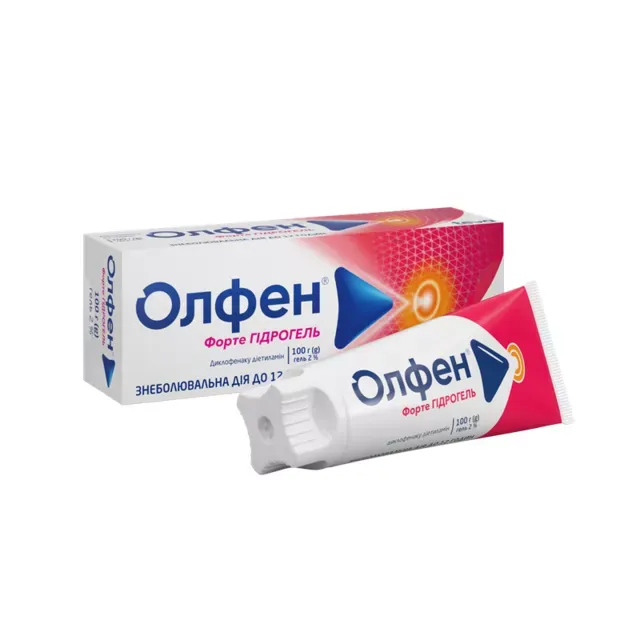
Table of Contents
INSTRUCTIONS FOR MEDICAL USE OF THE MEDICINAL PRODUCT Olfen® Forte HYDROGEL (Olfen® Forte HYDROGEL)
Composition:
Active substance: diclofenac diethylamine;
1 g of gel contains diclofenac diethylamine 23.2 mg, equivalent to 20 mg of sodium diclofenac;
Excipients: isopropyl alcohol, propylene glycol (E 1520), coco-caprylocaprate, mineral oil, carbomer 974P, ceteareth-22, diethylamine, flavoring (camphor, eucalyptol, ambroxide, citronellol, benzyl alcohol, citral, coumarin, eugenol, farnesol, geraniol, limonene, linalool), oleic acid (E 570), butylated hydroxytoluene (E 321), purified water.
Pharmaceutical form. Gel.
Main physicochemical properties: homogeneous cream-like gel, white to almost white in color.
Pharmacotherapeutic group. Agents used locally for joint and muscular pain. Topical non-steroidal anti-inflammatory drugs. Diclofenac.
ATC code M02A A15.
Pharmacological properties.
Pharmacodynamics.
Diclofenac is a non-steroidal anti-inflammatory agent with pronounced anti-rheumatic, analgesic, anti-inflammatory, and antipyretic effects. The main mechanism of action is inhibition of prostaglandin biosynthesis via cyclooxygenase-2.
Diclofenac reduces pain, swelling, and fever associated with inflammation and reversibly inhibits ADP- and collagen-induced platelet aggregation. Clinical studies have demonstrated statistically significant and clinically meaningful reduction in pain on movement within three days of initiating treatment, as well as noticeable improvement in lower limb joint function during the first three days of treatment.
Pharmacokinetics.
Absorption
The amount of diclofenac absorbed through the skin is proportional to the application area and depends on the total dose applied and the degree of skin hydration. After topical application twice daily to a skin surface area of 400 cm², the extent of systemic absorption, as measured by plasma concentration of the active substance, is equivalent to applying a 1.16% diclofenac diethylamine gel four times daily. The relative systemic bioavailability of diclofenac on day 7 of treatment is 4.5% compared to 50 mg tablets (at the same dose of sodium diclofenac). Absorption is not affected by the use of an occlusive or semi-occlusive dressing.
Distribution
Approximately 99.7% of diclofenac is bound to plasma proteins, primarily to albumin (99.4%). After topical application to the skin overlying hand and knee joints, diclofenac is detected in plasma (where its maximum concentration is approximately 100 times lower than after oral administration of the same amount of diclofenac), as well as in synovial membrane and synovial fluid.
Diclofenac accumulates in the skin, which acts as a reservoir from which the substance is gradually released into adjacent tissues. From there, diclofenac primarily penetrates into deeper inflamed tissues such as joints and ligaments. It continues to exert its effect locally and reaches concentrations up to 20 times higher than those in plasma.
Biotransformation
Diclofenac is partially metabolized via glucuronidation and predominantly via hydroxylation, forming several phenolic derivatives, two of which are pharmacologically active but significantly less potent than diclofenac.
Elimination
Diclofenac and its metabolites are primarily excreted in urine. Diclofenac is cleared from plasma at a systemic clearance rate of 263 ± 56 mL/min. The terminal half-life of diclofenac in plasma averages 1–2 hours. Four metabolites, including two active ones, also have short elimination half-lives of 1–3 hours. One metabolite—3´-hydroxy-4´-methoxydiclofenac—has a longer half-life but is pharmacologically inactive.
Special patient groups
In renal impairment, accumulation of diclofenac and its metabolites is not observed. In chronic hepatitis or compensated liver cirrhosis, the kinetics and metabolism of diclofenac remain unchanged.
Clinical characteristics.
Indications.
Treatment of pain, inflammation, and swelling associated with:
- Soft tissue injuries: injuries of tendons, ligaments, muscles, and joints (e.g., due to dislocation, strain, contusion) and back pain (sports injuries);
- Localized forms of soft tissue rheumatism: tendinitis (including "tennis elbow"), bursitis, shoulder syndrome, and periarthropathy.
Symptomatic treatment of osteoarthritis of superficially located small and medium joints, such as finger joints or knee joints.
Contraindications.
- Hypersensitivity to diclofenac or to any of the excipients.
- History of asthma attacks, bronchospasm, angioneurotic edema, urticaria, or acute rhinitis induced by acetylsalicylic acid or other nonsteroidal anti-inflammatory drugs (NSAIDs).
- Do not apply to mucous membranes, open wounds, or in the presence of inflammatory and infectious skin diseases such as eczema.
- Children and adolescents under 14 years of age.
- Last trimester of pregnancy.
Interaction with other medicinal products and other forms of interaction.
Since systemic absorption of diclofenac after topical application is very low, the occurrence of drug interactions is unlikely. Concomitant use of the medicinal product
Olphen® Forte HYDROGEL with systemic NSAIDs and corticosteroids may increase the frequency of adverse effects.
Special precautions for use.
Use with caution in combination with oral nonsteroidal anti-inflammatory drugs.
The possibility of developing systemic adverse reactions (which occur with systemic forms of diclofenac) cannot be excluded when the medicinal product is applied over large skin areas or for longer durations than recommended.
The medicinal product Olfen® Forte HYDROGEL should be applied only to intact, undamaged skin areas, avoiding contact with injured (wounded or infected) skin. Contact of the product with eyes and mucous membranes should be avoided. The medicinal product must not be ingested.
Patients with bronchial asthma, pollenosis, mucosal edema (nasal polyps), chronic obstructive pulmonary disease, or chronic respiratory infections (especially if associated with symptoms resembling allergic rhinitis) are more prone to attacks of bronchial asthma (so-called analgesic intolerance, aspirin-induced asthma), Quincke's edema, and urticaria. Precautionary measures (readiness to provide emergency medical assistance) are recommended for such patients. This also applies to patients with allergies to other substances manifesting as skin reactions, itching, or urticaria.
If any skin rashes occur, use of the medicinal product should be discontinued. Patients should be warned against excessive exposure to sunlight to reduce the likelihood of photosensitivity.
Olfen® Forte HYDROGEL should not be used under an airtight occlusive dressing; however, application under a non-occlusive dressing is permitted.
As a precautionary measure, care should be taken to prevent children from coming into contact with skin areas treated with the gel.
Olfen® Forte HYDROGEL contains propylene glycol (E 1520), which may cause mild localized skin irritation in some individuals, and butylated hydroxytoluene (E 321), which may cause localized skin reactions (e.g., contact dermatitis) or irritation of the eyes and mucous membranes.
The product contains benzyl alcohol (0.15 mg/g), citral, citronellol, coumarin, eugenol, farnesol, geraniol, limonene, linalool, which may cause allergic reactions. Benzyl alcohol may cause moderate local irritation.
Use during pregnancy or breastfeeding.
Pregnancy. There are no clinical data on the use of this medicinal product during pregnancy. Even though systemic exposure after topical application is lower compared to oral administration, it is unknown whether the systemic exposure achieved after topical use could be harmful to the embryo/fetus.
Inhibition of prostaglandin synthesis may adversely affect pregnancy and/or embryonic/fetal development. Epidemiological data suggest an increased risk of miscarriage and of congenital heart defects and gastroschisis following exposure to prostaglandin synthesis inhibitors during early pregnancy. The absolute risk of cardiovascular malformations increased from less than 1% to approximately 1.5%. It is assumed that the risk increases with dose and duration of treatment. In animal studies, administration of prostaglandin synthesis inhibitors has been shown to increase pre- and post-implantation loss and embryotoxicity/fetotoxicity. Furthermore, in animals treated with prostaglandin synthesis inhibitors during organogenesis, an increased incidence of various developmental abnormalities, particularly affecting the cardiovascular system, has been observed.
Diclofenac should be used during the first and second trimesters of pregnancy only if clearly necessary. If diclofenac is used by women attempting to conceive or during the first and second trimesters of pregnancy, the dose should be kept as low as possible and treatment duration as short as possible.
During the third trimester of pregnancy, all prostaglandin synthesis inhibitors, including diclofenac, may affect the fetus as follows:
- Cardio-pulmonary toxicity (with premature closure of the ductus arteriosus and pulmonary hypertension);
- Renal dysfunction, which may progress to renal failure with oligohydramnios; renal toxicity.
Effects on the mother and newborn, particularly at the end of pregnancy:
- Possible prolonged bleeding time, anti-aggregatory effect, which may occur even at very low doses;
- Inhibition of uterine contractions, leading to delayed or prolonged labor.
Therefore, the medicinal product Olfen® Forte HYDROGEL is contraindicated during the third trimester of pregnancy (see section "Contraindications").
Breastfeeding. Like other NSAIDs, diclofenac passes into breast milk in small amounts. When therapeutic doses of diclofenac are used, no adverse effects on the infant are expected. No studies have been conducted in breastfeeding women; therefore, this medicinal product should be used only on medical advice. Hence, if there are strong clinical reasons for using the gel during breastfeeding, it should not be applied to the breasts or large skin areas and should not be used for prolonged periods.
Ability to influence reaction speed when driving or operating machinery.
Topical application of diclofenac does not affect the ability to drive or operate machinery.
Method of Administration and Dosage.
The medicinal product is intended for topical use only.
For adults and children aged 14 years and older, apply the medicinal product twice daily (in the morning and evening), gently rubbing it into the skin at the site of pain. Analgesic effect lasts up to 12 hours.
The amount of medicinal product used depends on the size of the affected area
(for example, 2–4 g of gel, corresponding in size to a cherry or a walnut, is sufficient for application to an area of 400–800 cm²). The maximum daily dose of the medicinal product is 8 g (corresponding to 160 mg of sodium diclofenac).
Hands must be washed after application, except when the hands themselves are the treated area.
Allow the gel to dry for several minutes before applying a dressing.
Duration of treatment depends on the indication and treatment efficacy. The medicinal product should not be used for longer than 14 consecutive days for injuries or soft tissue rheumatism, and no longer than 21 days for arthritic joint pain, unless otherwise directed by a physician.
If the patient's condition does not improve or worsens after 7 days of treatment, medical advice should be sought.
Elderly patients do not require dose adjustment; however, due to the possibility of adverse reactions, they require careful monitoring.
Patients with renal impairment or hepatic impairment do not require dose adjustment of the medicinal product.
Children. The medicinal product Olfen® Forte HYDROGEL is contraindicated for use in children under 14 years of age.
Overdose.
Overdose is unlikely due to the low systemic absorption of diclofenac following topical application. If more gel is applied than recommended, excess should be washed off with water.
In case of accidental ingestion of the medicinal product, adverse effects typical of systemic reactions to diclofenac may occur (the content of one 100 g tube of Olfen® Forte HYDROGEL corresponds to 2000 mg of sodium diclofenac).
In such cases, if significant systemic adverse reactions occur, therapeutic measures for treating NSAID poisoning should be implemented. Following accidental ingestion, gastric lavage should be performed immediately and an adsorbent agent administered. There is no specific antidote.
Side effects
The side effects listed below are classified by organs and systems and by frequency. Frequency: very common (≥ 1/10); common (≥ 1/100, < 1/10); uncommon (≥ 1/1000, < 1/100); rare (≥ 1/10000, < 1/1000); very rare (< 1/10000); frequency not known (cannot be estimated from the available data).
Infections and parasitic diseases. Very rare: pustular eruptions.
Immune system disorders. Very rare: hypersensitivity reactions (including urticaria), angioedema.
Respiratory system disorders. Very rare: bronchial asthma.
Gastrointestinal disorders. Very rare: gastrointestinal complaints.
Skin and subcutaneous tissue disorders. Common: dermatitis (including contact dermatitis), rash, erythema, eczema, pruritus. Uncommon: desquamation, skin dryness, edema. Rare: bullous dermatitis. Very rare: photosensitization. Frequency not known: burning sensation at the application site, dry skin.
When applying the gel to large areas of skin and for prolonged periods, systemic side effects of diclofenac cannot be excluded (e.g. affecting the kidneys, liver or gastrointestinal tract, systemic hypersensitivity reactions).
Reporting of suspected adverse reactions.
Reporting suspected adverse reactions after medicine authorization is important. It allows ongoing monitoring of the benefit-risk balance of the medicine. Healthcare and pharmaceutical professionals, as well as patients or their legal representatives, should report all suspected adverse reactions and lack of efficacy via the Automated Pharmacovigilance Information System at the following link: https://aisf.dec.gov.ua.
Shelf life. 2 years.
Do not use the opened tube after the expiry date stated on the packaging.
Storage conditions.
The medicinal product does not require special storage conditions. Store in the original packaging to protect from light. Keep out of reach of children.
Packaging. 30 g, 50 g, or 100 g of gel in a tube; 1 tube in a cardboard box.
Supply category. Over-the-counter.
Manufacturer. Merckle GmbH.
Manufacturer's address and location of operations.
Graf-Arco-Strasse 3, 89079 Ulm, Germany.