Olazol
Ukraine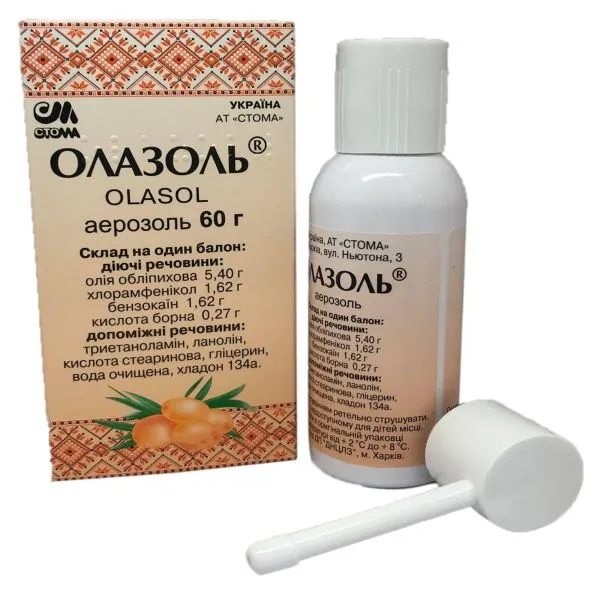
Table of Contents
INSTRUCTIONS FOR MEDICAL USE OF THE MEDICINAL PRODUCT OLASOL®
Composition:
Active substances: sea buckthorn oil, chloramphenicol, benzocaine, boric acid;
1 can contains: sea buckthorn oil – 5.40 g; chloramphenicol – 1.62 g; benzocaine – 1.62 g; boric acid – 0.27 g;
Excipients: triethanolamine, lanolin, stearic acid, glycerin, purified water, propellant 134a.
Pharmaceutical form. Aerosol.
Main physicochemical properties: the medicinal product forms a yellow or yellowish foam with a slightly orange tint upon release from the can.
Pharmacotherapeutic group.
Agents for the treatment of wounds and ulcerative lesions. ATC code D03AX.
Pharmacological properties.
Pharmacodynamics.
A combined medicinal product that exerts an anesthetic, antibacterial (active against many Gram-positive and Gram-negative bacteria, pyogenic microorganisms, Haemophilus bacteria, Brucella, Rickettsia, Chlamydia, and spirochetes), and anti-inflammatory effect; reduces exudation, promotes tissue regeneration, and accelerates the process of wound epithelialization.
Pharmacokinetics.
Data not available. The medicinal product has some degree of systemic effect.
Clinical characteristics.
Indications.
For the treatment in adults and children aged 2 years and older of infected wounds, including slow-healing burns, trophic ulcers, as well as in free skin grafting;
in gynecology and proctology: bacterial vaginosis (acute and chronic recurrent), cervical erosion, chronic proctitis of various etiologies, anal fissures.
Contraindications.
Hypersensitivity to any component of the drug, including excipients. Increased individual sensitivity to other amide-type local anesthetics. Allergy and toxic reactions (dyspeptic symptoms, dysbacteriosis, mental disorders) to chloramphenicol in medical history. Psoriasis, eczema, fungal skin diseases, bone marrow suppression, thromboembolic disease, granulocytopenia, pregnancy or lactation. Renal function impairment. Age under 2 years.
Interaction with other medicinal products and other forms of interaction.
Do not use simultaneously with other antimicrobial agents intended for local (intravaginal) application.
Concomitant use with erythromycin, oleandomycin, nystatin, and levorin enhances the antibacterial activity of the drug, whereas concomitant use with benzylpenicillin salts reduces it. It should not be prescribed simultaneously with drugs that suppress hematopoiesis (sulfonamides, pyrazolone derivatives, cytostatics), diphenyl, barbiturates, or ethanol.
It is not recommended to use the drug without clear medical indications and physician supervision in patients regularly taking monoamine oxidase inhibitors (MAOIs), antidepressants, or antihypertensive agents, due to the theoretical possibility of reduced MAOI efficacy or enhanced antihypertensive effects resulting from interaction with benzocaine, particularly in cases of significant overdose or prolonged use beyond recommended duration.
Special precautions for use.
The contents of the canister are under pressure; therefore, the medicinal product should be used with caution. Do not spray near open flames. It is not permissible to disassemble either a full or an empty canister.
The use of topical antibacterial agents may lead to skin sensitization, resulting in hypersensitivity reactions (upon further topical or systemic use of this medicinal product).
Antibacterial activity of the medicinal product is preserved in the presence of pus or necrotic tissue. Avoid contact of the medicinal product with the mucous membranes of the eyes.
Unless otherwise directed by a physician, the recommended daily dose should not be exceeded in order to minimize the risk of systemic adverse reactions.
Do not violate the recommended usage instructions for the medicinal product.
Prolonged use may lead to genital candidiasis.
With prolonged use (longer than 1 month), monitoring of peripheral blood parameters is necessary; if leukopenia occurs, the medicinal product should be discontinued.
Unsupervised use of the medicinal product in pediatric practice must be avoided—use only under medical supervision.
In case of heavy bloody discharge from the rectum, or if symptoms do not resolve within 7 days of treatment or worsen, additional consultation with a proctologist is required.
Use with caution and only under medical supervision in the following conditions: severe arterial hypertension, severe cardiac arrhythmias, clinically manifest thyrotoxicosis, and urinary retention.
There have been reports that products containing benzocaine may cause methemoglobinemia. Symptoms such as cyanosis of the skin, lips, and nail beds, headache, dizziness, dyspnea (difficulty breathing), weakness, and tachycardia, which may occur during treatment, could indicate potentially life-threatening methemoglobinemia requiring immediate medical intervention.
The medicinal product contains lanolin and may therefore cause local skin reactions (e.g., contact dermatitis).
Use during pregnancy or breastfeeding.
The medicinal product should not be used during pregnancy or breastfeeding.
Ability to influence reaction speed when driving or operating machinery.
Not established.
Method of Administration and Dosage.
Before use, shake the aerosol can 10–15 times, remove the protective cap, attach the spray nozzle to the valve stem, and slowly press down on its head to release the medicinal product from the can as foam. The spray nozzle must be rinsed with boiled water before and after each use of the medicinal product.
For external use. Clean the wound surface from pus and necrotic tissue as thoroughly as possible, then cover it with an even layer (1–1.5 cm) of foam. Apply daily or every other day. For open wound and burn treatment in adults — 1–4 times daily; in children aged 2 years and older — 1–2 times daily, depending on the nature of inflammation and stage of damaged tissue regeneration. To cover the entire wound surface, apply the foam from a distance of 1–5 cm. Press the spray nozzle head fully down and immediately release — this releases 7 ml of foam (approximately 1.4 g of the medicinal product), sufficient to cover a wound surface area of about 100 cm². The duration of treatment is determined and monitored individually by a physician.
For administration into body cavities. In gynecological conditions (bacterial vaginosis, cervical erosion), prior to administering the medicinal product into the vagina, perform douching with an antiseptic solution (chamomile infusion or furacilin 1 : 5000 solution, 0.02 % chlorhexidine bigluconate solution, 2 % sodium bicarbonate solution) to remove mucus. Afterwards, insert the free end of the spray nozzle into the vagina to a depth of 1.5–2 cm, press the nozzle head fully down and immediately release. In gynecological conditions, repeat this procedure twice daily. The treatment course lasts 7–10 days.
In cases of proctitis, first administer a cleansing enema using chamomine or calendula infusion. Then insert the free end of the spray nozzle into the rectum to a depth of 2–4 cm, press the nozzle head fully down and immediately release. Perform this procedure once daily. The treatment course lasts up to 2 weeks.
Children.
For external use in children aged 2 years and older.
Treatment of children should be conducted under medical supervision.
There is no experience with use in pediatric gynecology or proctology; therefore, the medicinal product should not be used in children for these indications.
Overdose.
External application of the medicinal product at recommended doses does not cause overdose.
Prolonged and frequent use of medicinal products containing chloramphenicol may lead to contact sensitization, which may result in hypersensitivity reactions upon subsequent use of the product externally or in dosage forms for systemic administration.
Symptoms of overdose due to systemic absorption of benzocaine may include: drowsiness, anxiety, cardiac arrhythmias, excitation. In severe cases — seizures, coma, reduced respiratory rate or respiratory failure. There have been reports that use of products containing benzocaine may cause methemoglobinemia. Symptoms such as cyanosis of the skin, lips, and nail beds, headache, dizziness, dyspnea (difficulty breathing), weakness, and tachycardia observed during treatment may indicate potentially life-threatening methemoglobinemia requiring immediate medical intervention. Emergency treatment for overdose and development of methemoglobinemia consists of intravenous administration of methylene blue.
Symptoms of overdose due to systemic absorption of boric acid may include: nausea, vomiting, diarrhea, circulatory disturbances, central nervous system depression, decreased body temperature, shock, coma, and erythematous rash. In cases of severe poisoning, measures should be taken to support vital functions, hemodialysis or peritoneal dialysis should be performed, and blood transfusion may be required. With prolonged use of the medicinal product on large skin areas, symptoms of chronic intoxication may develop: tissue edema, exhaustion, stomatitis, eczema, menstrual cycle disturbances in women, anemia, seizures, and alopecia.
Symptoms of overdose require immediate discontinuation of the medicinal product and symptomatic treatment.
Adverse reactions.
Local reactions: slight temporary (2–3 minutes) increase in discomfort in the anal area after administration of the medicinal product.
Immune system disorders: possible allergic reactions, including angioedema, other signs of irritation not observed prior to treatment, skin rashes, pruritus, burning sensation, hyperemia, swelling. Prolonged topical use may often lead to contact sensitization.
Gastrointestinal disorders: possible defecation urges, dyspeptic symptoms (nausea, vomiting, diarrhea). In such cases, the use of the drug should be discontinued.
Hematological disorders: leukopenia, thrombocytopenia, reticulocytopenia, decreased hemoglobin levels in blood.
Shelf life. 2 years.
Storage conditions.
Store out of reach of children. Store in the original packaging at a temperature between +2 °C and +8 °C.
Packaging.
60 g in aerosol containers with continuous-action valves, equipped with applicators and protective caps.
Availability category. Over-the-counter.
Manufacturer: JSC "STOMA".
Manufacturer's name and address of the place of business.
3, Newton Street, Kharkiv, 61105, Ukraine.