Octostim
Ukraine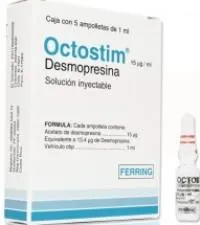
Table of Contents
INSTRUCTION FOR MEDICAL USE OF THE MEDICINAL PRODUCT OCTOSTIM (OCTOSTIM)
Composition:
Active substance: desmopressin acetate;
1 ml of injection solution contains 15 mcg of desmopressin acetate, equivalent to 13.4 mcg of desmopressin base;
Excipients: sodium chloride, diluted hydrochloric acid, water for injections.
Pharmaceutical form. Injection solution.
Main physicochemical properties: clear, colorless solution.
Pharmacotherapeutic group.
Hormonal preparations for systemic use. Posterior pituitary hormones.
ATC code H01BA02.
Pharmacological Properties
Pharmacodynamics
Octostim contains desmopressin, which is a structural analogue of the natural posterior pituitary hormone arginine vasopressin (AVP). The difference lies in the deamination of cysteine and substitution of L-arginine with D-arginine. This results in a significant prolongation of action and virtually eliminates the pressor effect at doses used in clinical practice.
At high doses (0.3 mcg/kg body weight) administered intravenously, desmopressin increases the coagulant activity of factor VIII (VIII:C) by 2–4 times. The concentration of von Willebrand factor antigen (vWF:Ag) also increases, although to a lesser extent. At the same time, tissue plasminogen activator (t-PA) is released.
Administration of desmopressin leads to shortening or normalization of bleeding time in patients with prolonged bleeding time due to uremia, liver cirrhosis, congenital or drug-induced platelet dysfunction, and in patients with prolonged bleeding time of unknown etiology.
When desmopressin is used instead of factor VIII, there is no risk of transmission of HIV infection or viral hepatitis.
Pharmacokinetics
The half-life in plasma ranges from 3 to 4 hours. The duration of the hemostatic effect depends on the half-life of factor VIII:C, which is 8–12 hours. The bioavailability after subcutaneous administration, compared to intravenous administration, is approximately 85%. The maximum plasma concentration after administration of 0.3 mcg/kg is reached in approximately 60 minutes and averages 600 pg/mL.
Clinical characteristics.
Indications.
- Reduction or normalization of prolonged bleeding time prior to invasive therapeutic and diagnostic procedures or for conservative treatment of bleeding in patients with prolonged bleeding time due to congenital or drug-induced platelet dysfunction, uremia, liver cirrhosis, or in patients with prolonged bleeding time of unknown etiology.
- Conservative treatment and prevention of bleeding associated with minor surgical procedures in patients with mild hemophilia A or von Willebrand's disease who have responded positively to a test dose. Treatment may also be possible in moderately severe forms of the disease.
Contraindications.
- Hypersensitivity to the active substance or to any of the excipients.
- Habitual or psychogenic polydipsia (leading to urine output exceeding 40 mL/kg/24 hours) or polydipsia in patients with alcoholism.
- Unstable angina in medical history and/or known history or suspected heart failure and conditions requiring diuretic therapy.
- History of hyponatremia.
- von Willebrand's disease type IIB.
- Severe renal insufficiency (creatinine clearance below 30 mL/min).
Interaction with other medicinal products and other types of interactions.
Concomitant use of drugs capable of inducing syndrome of inappropriate antidiuretic hormone secretion, such as tricyclic antidepressants, selective serotonin reuptake inhibitors, chlorpromazine, and carbamazepine, may cause an additive antidiuretic effect. Indomethacin and clofibrate may also enhance the antidiuretic effect. This leads to an increased risk of water retention/hyponatremia.
When oxytocin is used concomitantly, an increased antidiuretic effect and reduced uterine perfusion should be considered.
NSAIDs may cause fluid retention/hyponatremia.
Glibenclamide and lithium may reduce the antidiuretic effect.
If the above-mentioned medicinal products are used concomitantly, monitoring of blood pressure, plasma sodium levels, and urine excretion is required.
Special precautions for use
Octostim solution should be used with caution:
- in children and elderly patients;
- in situations characterized by water and/or electrolyte imbalance;
- in patients at risk of increased intracranial pressure;
- in patients with cardiovascular diseases;
- in patients with elevated arterial pressure;
- in patients with cystic fibrosis;
- in patients at risk of thrombosis;
- in patients with mild to moderate renal impairment.
Measures to prevent fluid overload should be applied in patients requiring treatment with diuretics.
Patients with mild to moderate renal impairment should be monitored for sodium levels to prevent hyponatremia.
To reduce the risk of water intoxication, an appropriate fluid balance should be maintained.
Special warnings
Particular attention should be paid to the risk of water retention/hyponatremia. Secondary symptoms include weight gain, headache, nausea, and edema. In severe cases, cerebral edema, seizures, and coma may occur. Children under 5 years of age and elderly patients are at increased risk of water and electrolyte imbalance. Fluid intake should be minimized, and body weight should be monitored regularly. If body weight increases progressively, serum sodium concentration decreases to 130 mmol/L, or plasma osmolality falls below 270 mOsm/kg body weight, fluid intake should be drastically reduced and administration of Octostim discontinued.
Desmopressin treatment should be discontinued in cases of nausea, diarrhea, systemic infections, or fever until water balance is normalized.
Organic causes of polyuria, increased frequency of urination, or nocturia—such as benign prostatic hyperplasia (BPH), urinary tract infections, bladder stones or tumors, bladder dysfunction, polydipsia, or inadequate treatment of diabetes mellitus—should be ruled out or appropriately treated. Any adrenal or thyroid insufficiency must be excluded before initiating desmopressin therapy.
Octostim does not correct prolonged bleeding time associated with thrombocytopenia.
There are no data on reduction of bleeding duration with Octostim in congenital defects of platelet membrane receptors (e.g., Glanzmann's thrombasthenia or Bernard-Soulier syndrome).
Special warnings
The need for desmopressin therapy should be re-evaluated during acute intercurrent illnesses, and fluid and electrolyte balance should be carefully monitored, especially in situations involving excessive bleeding.
Octostim, injection solution, contains less than 1 mmol (23 mg) of sodium per dose.
Use during pregnancy or breastfeeding
Pregnancy
Data from studies involving a limited number of pregnant patients (n=53) with diabetes insipidus have not shown any adverse effects of desmopressin on pregnancy or on fetal or neonatal health. Currently, no other epidemiological data are available. Animal studies have not revealed any direct or indirect adverse effects on pregnancy, embryonal/fetal development, parturition, or postnatal development.
Breastfeeding
Analysis of breast milk from women receiving high doses of desmopressin (300 µg intranasally) indicates that the amount of desmopressin transferred to the infant is considerably lower than the dose likely to affect diuresis.
Ability to affect reaction speed when driving or operating machinery
No effect.
Administration and Dosage
Administered subcutaneously or intravenously.
0.3 mcg/kg body weight is diluted in physiological saline to a total volume of 10 ml and administered as an intravenous infusion over 10 minutes, or 0.3 mcg/kg is administered as a subcutaneous injection.
Dose calculation of Octostim for individual patients according to body weight.
______________________________________________________________________________
Dose 0.3 mcg/kg body weight
______________________________________________________________________________
Body weight (kg) 15 20 25 30 35 40 45 50 55 60
Dose (ml) 0.3 0.4 0.5 0.6 0.7 0.8 0.9 1.0 1.1 1.2
______________________________________________________________________________
Body weight (kg) 65 70 75 80 85 90 95 100
Dose (ml) 1.3 1.4 1.5 1.6 1.7 1.8 1.9 2.0
______________________________________________________________________________
If a positive effect is achieved, Octostim administration may be repeated 1–2 times at intervals of 6–12 hours. Further dose repetition may lead to reduced efficacy.
In the treatment of patients with hemophilia A, the desired increase in factor VIII should be evaluated by the same criteria as used during treatment with factor VIII concentrate.
If administration of Octostim does not lead to the desired increase in plasma factor VIII:C concentration, treatment may be supplemented with administration of factor VIII concentrate. Treatment of patients with hemophilia should be conducted under laboratory monitoring of coagulation parameters according to national standards.
Assessment of coagulation factors and bleeding time prior to Octostim administration: plasma levels of factor VIII:C and von Willebrand factor antigen increase significantly after desmopressin administration. However, no correlation can be established between plasma concentrations of these factors and bleeding time, either before or after desmopressin administration. The effect of desmopressin on bleeding time should be evaluated, if possible, individually for each patient. Bleeding time assessment should be standardized as much as possible, e.g., using Simplate II. Determination of bleeding time and plasma coagulation factors should be performed under laboratory monitoring of coagulation parameters according to national standards.
Treatment Monitoring
Plasma factor VIII:C concentration should be monitored, as reduced response after repeated doses has been observed in some cases.
Careful monitoring of arterial blood pressure is required during Octostim administration.
Children. The drug should be used with caution in children with body weight of 15 kg or more.
Overdose.
Overdose may lead to fluid retention and hyponatremia. Although treatment of hyponatremia should be individualized, the following general recommendations may apply: discontinuation of desmopressin therapy, restriction of fluid intake, and symptomatic treatment if necessary.
Overdose may occur under the following conditions:
- administration of a very high dose;
- excessive fluid intake simultaneously or shortly after administration of Octostim.
Symptoms include weight gain (fluid retention), headache, nausea, moderate hypertension, tachycardia, flushing, and in severe cases, water intoxication with seizures. Isolated cases of cerebral edema have been reported. Overdose is particularly possible in infants due to incorrect dose selection.
In case of overdose, the dose should be reduced or the frequency of administration decreased. In cases of cerebral edema, immediate intensive therapy is required. Seizures in children also require intensive management. There is no specific antidote for Octostim. If significant fluid retention causes concern, increased diuresis may be achieved by administration of a diuretic, e.g., furosemide.
Adverse Reactions
Treatment without concomitant fluid intake restriction may lead to water retention/hyponatremia with or without development of associated symptoms and signs (headache, nausea/vomiting, decreased serum sodium, weight gain). In severe cases – seizures, sometimes associated with impaired consciousness up to prolonged loss of consciousness.
Adverse reactions are categorized by frequency as follows: common (≥ 1/100 to < 1/10), uncommon (≥ 1/1000 to < 1/100), rare (< 1/10000).
Gastrointestinal disorders: common – abdominal pain, nausea, vomiting.
Cardiovascular system: common – transient drop in arterial pressure with reflex tachycardia and facial flushing during drug administration; uncommon – dizziness (at high doses).
Nervous system: common – headache, fatigue at high doses; uncommon – cerebral edema, hyponatremic seizures.
Skin and subcutaneous tissue disorders / General disorders and administration site reactions: rare – allergic reactions, hypersensitivity reactions (pruritus, exanthema, fever, bronchospasm, anaphylaxis).
Metabolism and nutrition disorders: rare – hyponatremia.
Cardiovascular diseases
Due to increased water reabsorption, arterial pressure may rise and, in some cases, arterial hypertension may develop. Angina pectoris may occur in patients with ischemic heart disease.
These adverse reactions, except for allergic reactions, can be prevented or resolved by reducing the dose.
Post-marketing experience: uncommon cases of skin allergic reactions, as well as more severe systemic allergic reactions.
Shelf life. 4 years.
Storage conditions.
Store at 2–8 °C in the original packaging, in a place inaccessible to children.
Incompatibilities.
Do not mix with other medicinal products.
Packaging.
1 ml of solution in a vial; 10 vials in a cardboard pack.
Prescription category. Prescription only.
Manufacturer.
Ferring GmbH / Ferring GmbH.
Manufacturer's address and place of business.
Wittland 11, 24109 Kiel, Germany / Wittland 11, 24109 Kiel, Germany.