Octenisept
Ukraine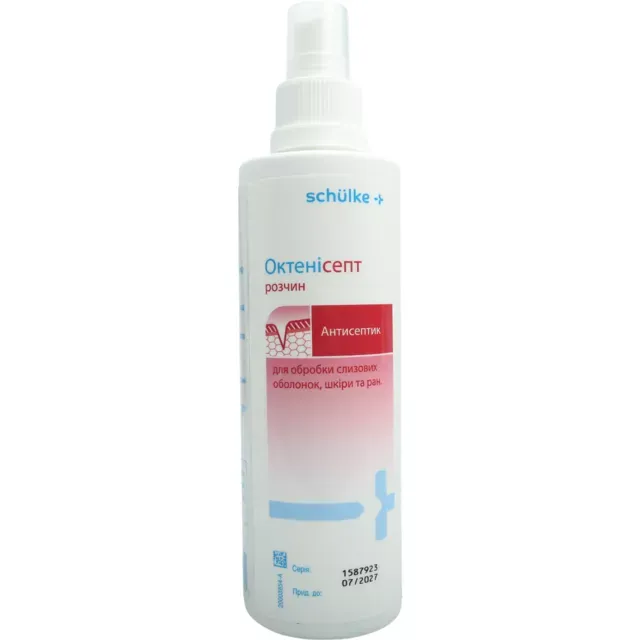
Table of Contents
INSTRUCTIONS FOR MEDICAL USE OF THE MEDICINAL PRODUCT OKTENISEPT (OCTENISEPT®)
Composition:
Active substances: 100 g of solution contains octenidine dihydrochloride 0.10 g,
phenoxyethanol 2.00 g;
Excipients: cocamidopropyl betaine; sodium gluconate; glycerol 85 %; sodium hydroxide; purified water.
Pharmaceutical form. Solution.
Main physicochemical properties: clear or almost clear, colorless liquid, almost odorless.
Pharmacotherapeutic group. Antiseptics and disinfectants / quaternary ammonium compounds / octenidine, combinations.
ATC code D08AJ57.
Pharmacological Properties
Pharmacodynamics
OCTENISEPT is an antiseptic for the treatment of mucous membranes, skin, and wounds.
Mechanism of Action
Octenidine dihydrochloride is a cationic compound and, due to its two cationic centers, exhibits pronounced surface-active properties. It interacts with components of the microbial cell wall and membrane, leading to disruption of cellular function.
The antimicrobial mechanism of action of phenoxyethanol involves, among other factors, increased permeability of the cell membrane to potassium ions.
Pharmacodynamic Properties
Antimicrobial activity includes bactericidal and fungicidal effects, as well as activity against lipophilic viruses and hepatitis B virus. The efficacy spectra of phenoxyethanol and octenidine dihydrochloride complement each other.
In quantitative and qualitative in vitro studies without protein load, the medicinal product OCTENISEPT, applied for 1 minute, demonstrated bactericidal and antifungal activity against bacteria and Candida albicans with a reduction factor (RF) of 6–7 lg.
Under conditions of added 10% defibrinated sheep blood, 10% bovine albumin, 1% mucin, or a mixture of 4.5% defibrinated sheep blood, 4.5% bovine albumin, and 1% mucin, the medicinal product OCTENISEPT caused a reduction in bacterial counts with an RF of 6–7 lg and in Candida albicans counts of > 3 lg after exposure for at least 1 minute.
In quantitative and qualitative in vitro studies in the presence of 0.1% albumin, good activity was observed within 1 minute of contact with gram-positive and gram-negative bacteria, yeasts, and fungi when 50% and 75% solutions of OCTENISEPT were used.
In vitro studies evaluated the activity of OCTENISEPT against specific viruses. Efficacy was demonstrated against lipophilic viruses, such as herpes simplex virus, HIV, and hepatitis B virus.
Primary resistance to OCTENISEPT is not expected, nor is secondary resistance with prolonged use, due to its non-specific mode of action.
Clinical studies on efficacy at vaginal and oral mucous membranes have demonstrated a significant reduction in microbial counts, both with short-term and long-term use.
Paediatric Population
Efficacy and tolerability of OCTENISEPT have been demonstrated in 347 children aged from 6 days to 12 years, as well as in 73 preterm infants with a gestational age of less than 36 weeks.
A study on umbilical cord stump treatment with OCTENISEPT in 1725 newborns demonstrated its good tolerability.
Pharmacokinetics
Absorption
Animal studies with 14C-labeled material demonstrated that octenidine dihydrochloride is not absorbed via the gastrointestinal tract, skin, or mucous membranes.
Following oral administration, radiolabeled octenidine dihydrochloride was absorbed through the gastrointestinal mucosa in mice, rats, and dogs only to a very small extent (0–6%). It was established that in mice, topical application of octenidine dihydrochloride for 24 hours under occlusive dressing did not result in systemic absorption.
Based on in vitro data, placental passage of octenidine dihydrochloride can be ruled out.
In rat studies, orally administered 14C-labeled phenoxyethanol was almost completely absorbed and excreted in urine as phenoxyacetic acid.
Octenidine dihydrochloride from OCTENISEPT was not absorbed through the vaginal mucosa (in rabbits) or through wounds (in humans and rats).
Paediatric Population
The oxidative metabolism of 2-phenoxyethanol was studied in 4 infants aged from 1 week to 11 months, and in 24 preterm infants with a gestational age of less than 36 weeks. This study demonstrated that 2-phenoxyethanol is absorbed through the skin and is completely or nearly completely metabolized via oxidation to phenoxyacetic acid and excreted by the kidneys, confirming the safety of OCTENISEPT application.
Clinical characteristics.
Indications.
Used for single, short-term disinfection of mucous membranes and surrounding skin prior to diagnostic and surgical procedures in the anogenital area: vagina, vulva, glans penis, prior to urinary bladder catheterization; for oral cavity disinfection; for antiseptic treatment of local bacterial and fungal infections in the vaginal area. The medicinal product is indicated for short-term supportive therapy of interdigital mycosis and for antiseptic treatment of wounds and burns of various origins.
Use for the treatment of local bacterial and fungal infections in the vaginal area is restricted to adults and children aged 8 years and older. For all other indications, OCTENISEPT may be used in adults and children without age restrictions.
Contraindications.
Hypersensitivity to the active substances or to any of the excipients of the product.
Do not use in the nose, for peritoneal cavity irrigation (e.g., during surgery), in the area of the tympanic membrane, or for instillation into the urinary bladder.
When used in the vaginal area: do not use during the first trimester of pregnancy; do not use in children under 8 years of age.
Interaction with other medicinal products and other forms of interactions.
Do not apply OCTENISEPT to adjacent skin areas treated with antiseptics based on PVP-iodine, due to the possibility of pronounced color change of the skin at contiguous sites, ranging from brown to purple.
Special precautions for use
Swallowing of OCTENISEPT or its entry into the bloodstream, for example as a result of accidental injection, should be avoided.
Contact of the medicinal product OCTENISEPT with eyes should be avoided. In case of accidental contact with eyes, they should be immediately rinsed with large amounts of water.
Use of aqueous solutions of octenidine (0.1% with/without phenoxyethanol) for skin disinfection prior to invasive procedures has been associated with serious skin reactions in premature newborns with low body weight.
Before application, any wet materials, cloths or clothing should be removed. Do not use excessive amounts and avoid accumulation of the solution in skin folds or under the patient, or dripping onto bed linen or other materials in direct contact with the patient. When an occlusive dressing is required on areas previously treated with OCTENISEPT, caution should be exercised to ensure that no excess medicinal product remains before applying the dressing.
Persistent swelling, erythema, and tissue necrosis have been observed after irrigation of deep wounds using a syringe, which in some cases required surgical revision (see section "Side effects").
| To prevent tissue damage, the drug must not be injected deeply into tissues using a syringe. The drug is intended only for topical application (application with a swab or spray device). |
Use during pregnancy or breastfeeding.
Fertility
No negative effect of octenidine dihydrochloride on fertility was observed in rats.
There are no data available on the effect of phenoxyethanol on fertility.
Pregnancy
Moderate data obtained from pregnant women (from 300 to 1000 pregnancy outcomes, gestational age ≥ 12 weeks) indicate no influence of OCTENISEPT on the development of congenital abnormalities and no embryotoxicity/fetotoxicity.
Animal studies did not reveal signs of reproductive toxicity.
OCTENISEPT may be used during pregnancy if necessary. Since clinical data for the first trimester of pregnancy are lacking, as a precautionary measure, the OCTENISEPT solution should not be applied to the vaginal area during the first 3 months of pregnancy.
Breastfeeding
Comprehensive data on the use of the drug during lactation from experimental animal and clinical studies are lacking. Since octenidine dihydrochloride is absorbed in very small amounts or not absorbed at all, it is expected not to reach breast milk.
Phenoxyethanol is rapidly and almost completely absorbed and excreted almost entirely via the kidneys as oxidized metabolites. Therefore, accumulation in breast milk is unlikely.
As a precautionary measure, OCTENISEPT should not be applied to the area of the mammary glands during breastfeeding.
Ability to influence reaction speed when driving vehicles or operating machinery.
The drug does not affect reaction speed when driving vehicles or operating machinery.
Method of Administration and Dosage
The solution is intended for topical use only and must not be injected into tissues, for example, using a syringe.
OCTENISEPT is applied undiluted, by thoroughly wetting the affected area. The medicinal product OCTENISEPT is applied once daily to the area to be treated, using swabs saturated with the preparation or by spraying hard-to-reach skin surfaces. Application using a swab is preferred.
Further procedures, such as applying a surgical dressing, may be performed no sooner than 2 minutes after application of the product. Mouth rinsing is also possible, but this method of application is limited to cases where the entire oral cavity needs to be treated. In such cases, 20 mL of the product should be used for 20 seconds.
For maintenance therapy in cases of interdigital mycosis, the medicinal product should be sprayed onto the affected areas in the morning and evening.
To achieve the desired effect, these instructions must be strictly followed.
Since experience with continuous use does not exceed 14 days, OCTENISEPT should be used for a limited treatment duration only.
Treatment of Local Bacterial and Fungal Infections of the Vaginal Area
Before first use, remove the applicator from its packaging and attach it to the bottle after removing the transparent protective seal and spray nozzle. The spray mechanism can operate with the bottle held in various positions (upright or inverted). For deep vaginal insertion, it is recommended to sit on a toilet or lie in bed. Press the applicator cap 10 times with the index finger to distribute the product deeply into the vagina. After use, wipe the applicator and press the spray nozzle one or two times with the applicator pointing downward, for example, over a sink. The treatment duration should be 7 days: on the first day, apply the product in the morning and evening, then once daily in the evening thereafter. Before each subsequent use, press the spray nozzle one or two times with the applicator pointing downward, and proceed as described. The applicator may be used throughout the entire course of treatment. After completion of treatment for vaginal infection, the applicator should be discarded.
To prevent recurrent infection, the patient’s partner should also be included in the treatment. After removing the applicator from the bottle, replace it with the spray nozzle. Spray the male genital organs until completely moistened.
To achieve the desired effect, these instructions must be strictly followed.
In cases of persistent or recurrent symptoms, a gynecological examination including microbiological diagnostics is mandatory. If necessary, appropriate antibacterial therapy should be initiated.
Children
The dosage of OCTENISEPT is identical for adults and children.
For the treatment of local bacterial and fungal infections in the vaginal area, use is restricted to adults and children aged 8 years and older.
For all other indications, OCTENISEPT may be used in adults and children without age restrictions.
Overdose
There is no reported experience of overdose. However, the likelihood of overdose with topical application is very low. In case of local overdose, the affected area may be rinsed with a large amount of Ringer's solution.
Accidental ingestion of OCTENISEPT is not considered dangerous. Octenidine dihydrochloride is not absorbed and is excreted in feces. However, oral ingestion of a large quantity of OCTENISEPT cannot exclude irritation of the gastrointestinal mucosa.
Octenidine dihydrochloride is more toxic when administered intravenously than orally. Therefore, contact of large amounts of OCTENISEPT with the bloodstream, for example due to accidental injection, should be avoided. Nevertheless, since OCTENISEPT contains octenidine dihydrochloride at a concentration of only 0.1%, the occurrence of intoxication is highly unlikely.
Side effects
The assessment of adverse effects is based on the following frequency of occurrence: very common (≥ 1/10), common (≥ 1/100 to < 1/10), uncommon (≥ 1/1000 to < 1/100), rare (≥ 1/10,000 to < 1/1000), very rare (< 1/10,000), frequency not known (cannot be estimated from the available data).
General disorders and administration site reactions
Rare: burning, redness, itching, sensation of warmth at the application site.
Very rare: allergic contact reaction, e.g. temporary redness at the application site.
Frequency not known: following irrigation of deep wounds using a syringe, persistent swelling, erythema, and tissue necrosis have been observed, which in some cases required surgical revision (see section "Special precautions for use").
A bitter taste may occur after mouth rinsing.
Other possible adverse effects include swelling, induration, pain, blisters, and eczema at the application site.
Paediatric population
The frequency, type and severity of adverse reactions in children are the same as in adults.
Reporting of suspected adverse reactions
Reporting suspected adverse reactions after authorization of the medicinal product is important. This allows continued monitoring of the benefit-risk balance of the medicinal product. Healthcare professionals are asked to report any suspected adverse reactions via the national pharmacovigilance system.
Shelf life
3 years for 50 ml bottles; 5 years for 250 ml or 1000 ml bottles.
After opening the bottle, the solution remains stable for 3 years.
Storage conditions
Store in a dry, light-protected place, out of reach of children, at a temperature not exceeding 25 °C.
Packaging
50 ml in a bottle with spray pump; 1 bottle in a cardboard box.
50 ml in a bottle with vaginal applicator; 1 bottle in a cardboard box.
250 ml in a bottle with spray pump.
250 ml or 1000 ml in bottles.
Availability category: Over-the-counter (without prescription)
Manufacturer
Schülke & Mayr GmbH
Manufacturer's address and place of business
Robert-Koch-Straße 2, 22851 Norderstedt, Germany