Octaplex 500 iu
Ukraine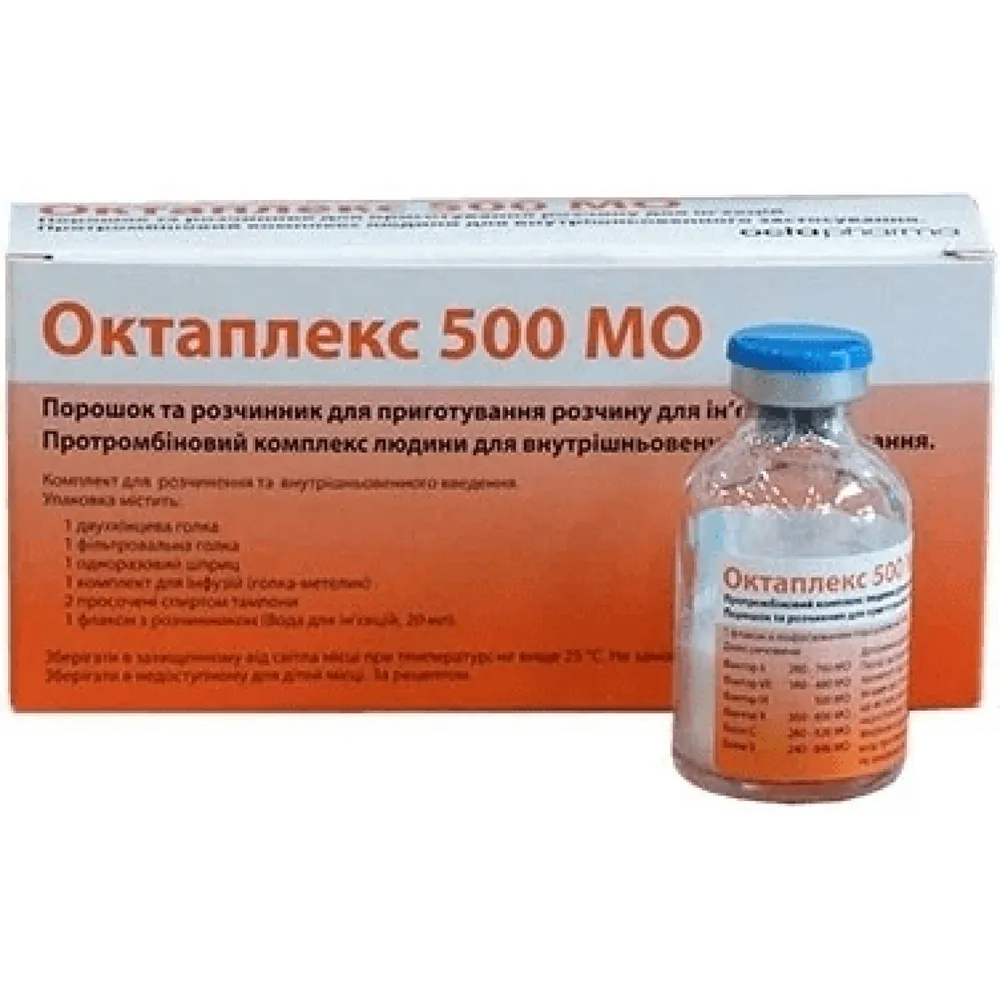
Table of Contents
INSTRUCTIONS for medical use of the medicinal product OCTAPLEX 500 IU (OCTAPLEX 500 IU)
Composition:
International Nonproprietary Name: blood coagulation factors IX, II, VII and X in combination (human prothrombin complex), 4-factors PCC.
| Active substances: |
Content |
|
| per 20 ml vial |
per 1 ml of prepared solution |
|
| Total protein |
260-820 IU |
13-41 IU |
| Human blood coagulation factor II |
280 - 760 IU |
14 - 38 IU |
| Human blood coagulation factor VII |
180 - 480 IU |
9 - 24 IU |
| Human blood coagulation factor IX |
500 IU |
25 IU |
| Human blood coagulation factor X |
360 - 600 IU |
18 - 30 IU |
| Protein C |
260 - 620 IU |
13 - 31 IU |
| Protein S |
240 - 640 IU |
12 - 32 IU |
total protein content per vial: 260–820 mg.
The specific activity of the product is ≥ 0.6 IU/mg protein, expressed as Factor IX activity;
excipients have a certain action or effect: sodium (75–125 mg per vial), heparin (100–250 IU per vial, corresponding to 0.2–0.5 IU/IU of Factor IX);
Excipients: heparin (5–12.5 IU/ml), sodium citrate (6.5 mg/ml).
Pharmaceutical form. Powder and solvent for solution for infusion in vials together with a set for dissolution and intravenous administration.
Main physicochemical properties: white or slightly coloured, brittle, very hygroscopic powder.
Pharmacotherapeutic group. Antihemorrhagics, combination of coagulation factors IX, II, VII, and X. ATC code B02BD01.
Pharmacological properties.
Pharmacodynamics.
Blood coagulation factors IX, II, VII, and X, which are synthesized in the liver with the participation of vitamin K, are commonly referred to as the prothrombin complex.
Factor VII is a zymogen of the active serine protease factor VIIa, through which it is activated in the extrinsic coagulation system. The tissue factor–factor VIIa complex activates coagulation factors X and IX, resulting in the formation of factors IXa and Xa. During further activation of the coagulation system, prothrombin (factor II) is activated and converted into thrombin. Under the influence of thrombin, fibrinogen is transformed into fibrin, and a thrombus is formed. Normal thrombin generation is also crucial for platelet function as a component of primary hemostasis.
Isolated severe deficiency of factor VII leads to reduced thrombin generation and a tendency to bleeding due to impaired fibrin formation and disrupted primary hemostasis. Isolated deficiency of factor IX is one of the classical hemophilias (hemophilia B). Isolated deficiencies of factor II or factor X are very rare but, in severe forms, cause a bleeding tendency similar to that observed in classical hemophilia.
Acquired deficiency of vitamin K–dependent coagulation factors occurs during treatment with vitamin K antagonists. If the deficiency becomes severe, it results in a predisposition to severe bleeding, characterized more often by retroperitoneal or cerebral hemorrhages than by muscle or joint bleeding. Severe liver failure also ultimately leads to markedly reduced levels of vitamin K–dependent coagulation factors and a tendency to clinical bleeding, which, however, is often complicated by concurrent continuous mild intravascular coagulation, low platelet counts, deficiency of coagulation inhibitors, and impaired fibrinolysis.
Administration of human prothrombin complex concentrate increases plasma levels of vitamin K–dependent coagulation factors and can temporarily correct coagulation disorders in patients with deficiency of one or more of these factors.
Pharmacokinetics.
Plasma half-life periods are as follows:
| Blood clotting factor |
half-life period |
| Factor II |
48 – 60 hours |
| Factor VII |
1.5 – 6 hours |
| Factor IX |
20 – 24 hours |
| Factor X |
24 - 48 hours |
Octaplex is administered intravenously and, therefore, immediately enters the body.
Clinical characteristics.
Indications.
Treatment and perioperative prevention of bleeding in acquired deficiencies of vitamin K-dependent clotting factors of the prothrombin complex, such as deficiency caused by vitamin K antagonist therapy or overdose of vitamin K antagonists, when rapid correction of the deficiency is required.
Treatment and perioperative prevention of bleeding in congenital deficiencies of vitamin K-dependent blood clotting factors II and X, when a purified specific coagulation factor preparation is unavailable.
Contraindications.
Hypersensitivity to the active substance or to any of the excipients of the medicinal product.
Known allergy to heparin or heparin-induced thrombocytopenia in medical history.
Patients with IgA deficiency and known anti-IgA antibodies.
Interaction with other medicinal products and other forms of interaction.
Prothrombin complex preparations neutralize the effect of vitamin K antagonists; however, no interactions with other medicinal products are known.
Effect on biological investigations:
When performing coagulation tests sensitive to heparin in patients receiving high doses of human prothrombin complex, heparin as a component of the administered preparation should be taken into account.
Special precautions for use.
Treatment should be administered under the supervision of a physician experienced in managing coagulation disorders.
In patients with acquired vitamin K-dependent coagulation factor deficiency (e.g., due to anticoagulant therapy with vitamin K antagonists), Octaplex should be used only when rapid correction of the prothrombin complex level is required, such as in cases of major bleeding or emergency surgery. In other situations, reducing the dose of the vitamin K antagonist and/or administering vitamin K is usually sufficient.
Patients receiving vitamin K antagonists may have a hypercoagulable state, and administration of prothrombin complex concentrate may exacerbate this condition.
In congenital deficiency of any vitamin K-dependent clotting factor, specific factor replacement may be used as needed.
If allergic or anaphylactic reactions occur, the injection/infusion must be stopped immediately. If shock develops, standard treatment for such conditions should be initiated.
Standard measures to prevent infections from medicinal products derived from human blood or plasma include donor selection, testing of individual donations and pooled plasma for specific infectious markers, and inclusion of effective viral inactivation/removal steps during manufacturing. Nevertheless, the possibility of transmitting infections through administration of products derived from human blood or plasma cannot be completely excluded. This also applies to unknown or emerging viruses and other pathogens.
The measures applied are considered effective against enveloped viruses such as HIV, HBV (hepatitis B virus), and HCV (hepatitis C virus). However, these measures may have limited effectiveness against non-enveloped viruses such as hepatitis A virus and parvovirus B19. Parvovirus B19 infection may have serious consequences for pregnant women (fetal infection) and individuals with immunodeficiency or increased erythropoiesis (e.g., hemolytic anemia).
It is strongly recommended that the product name and batch number be recorded each time a patient receives Octaplex.
For patients who regularly or repeatedly receive prothrombin complex products derived from human plasma, appropriate vaccination (e.g., against hepatitis A and B) should be considered.
Thrombosis may occur following treatment with plasma-derived medicinal products containing factors II, VII, IX, and X.
The use of human prothrombin complex concentrates containing factor IX may pose a potential risk of thrombosis or disseminated intravascular coagulation (DIC), particularly with repeated administration, especially in patients with inherited or acquired coagulation factor deficiencies. Patients receiving human prothrombin complex should be closely monitored for signs of intravascular coagulation or thrombosis. Due to the risk of thromboembolic complications during administration of human prothrombin complex, careful monitoring is required in patients with ischemic heart disease, liver disease, peri- and postoperative patients, newborns, or patients at risk of thromboembolism or DIC. In each of these cases, the benefit-risk ratio should be carefully evaluated.
There are no data on the use of Octaplex in perinatal bleeding due to vitamin K deficiency in newborns.
Octaplex contains 75–125 mg of sodium per vial. This should be taken into account in patients on a sodium-restricted diet.
The product should not be used in patients with recent myocardial infarction and high risk of thrombosis, or in patients with angina pectoris, except in life-threatening bleeding due to overdose of oral anticoagulants, or when urgent surgical intervention is indicated in patients taking vitamin K antagonists and with an INR greater than 3.
Administration of Octaplex in patients with disseminated intravascular coagulation (DIC) is recommended only in life-threatening situations when fresh frozen plasma (FFP) is insufficiently effective or cannot be administered due to the risk of hypervolemia. Octaplex should be administered only after correction of the underlying cause of DIC. In such cases, administration of antithrombin and heparin prior to FFP is recommended.
In patients who have received treatment for coagulation disorders due to chronic liver disease or liver transplantation, antithrombin levels should be monitored, and antithrombin concentrate should be administered concomitantly if deficiency is present.
There are no clinical data on the use of Octaplex for the treatment of coagulation disorders due to parenchymal liver disease, esophageal varices, or major liver surgery.
Discontinuation of vitamin K antagonists exposes patients to the risk of thromboembolism related to the underlying condition. Reinitiation of anticoagulant therapy should be considered as soon as possible.
Before initiating treatment, it is necessary to discuss with the patient the risks related to infection transmission and the benefits of using the product.
Special handling and disposal instructions.
Unused product and waste material should be disposed of in accordance with local regulations.
Use during pregnancy or breastfeeding.
The safety of human prothrombin complex use during pregnancy and lactation has not been established. Animal studies are not adequate to assess the safety of the product regarding pregnancy, embryo/fetal development, delivery, or postnatal development. Therefore, human prothrombin complex should be used during pregnancy and lactation only if clearly indicated.
Effect on ability to drive and operate machinery.
No studies have been conducted on the effect of Octaplex on the ability to drive or operate machinery.
Method of Administration and Dosage
Dosage
The following are general dosage guidelines only. Treatment should be initiated under the supervision of a physician experienced in the management of coagulation disorders. The dosage and duration of replacement therapy depend on the severity of the coagulation factor deficiency, the location and extent of bleeding, as well as the patient's clinical condition.
The amount and frequency of administration should be individually adjusted for each patient. The intervals between administrations should be determined based on the different half-lives in blood of the various coagulation factors contained in the prothrombin complex (see section "Pharmacokinetics"). Individual dosage requirements can only be determined by regular monitoring of individual plasma levels of the relevant coagulation factors, or by global tests of prothrombin complex activity (prothrombin time, international normalized ratio/INR), along with continuous monitoring of the patient's clinical status.
In the case of major surgical procedures, precise monitoring of replacement therapy using coagulation assays (specific coagulation factor assays and/or global tests of prothrombin complex levels) is essential.
Bleeding and Perioperative Bleeding Prophylaxis during Vitamin K Antagonist Therapy:
The required dose depends on the pre-treatment INR and the target INR. The table below provides approximate doses (mL/kg body weight of the reconstituted product) required to normalize INR (≤ 1.2 within 1 hour) at various initial INR levels.
| Initial INR |
2 – 2.5 |
2.5 – 3 |
3 – 3.5 |
> 3.5 |
| Approximate dose* (ml of Octaplex®/kg body weight) |
0.9 – 1.3 |
1.3 – 1.6 |
1.6 – 1.9 |
> 1.9 |
*The single dose should not exceed 3,000 IU (120 mL of Octaplex).
Correction of coagulation disorders caused by vitamin K antagonists lasts approximately 6–8 hours. However, the effect of vitamin K, when administered concomitantly, is usually achieved within 4–6 hours. Therefore, repeat treatment with human prothrombin complex concentrate is generally not required if vitamin K has been administered.
All these recommendations are empirical (based on experience), and recovery and duration of effect may vary; monitoring of INR during treatment is mandatory.
Bleeding and perioperative prevention of bleeding in congenital deficiency of vitamin K-dependent clotting factors II and X, when specific coagulation factor concentrate is unavailable:
The calculated required dose for treatment is based on empirical data indicating that approximately 1 IU of factor II or X per 1 kg body weight increases plasma activity of factor II or X by 0.02 and 0.017 IU/mL, respectively.
The dose of specific coagulation factor administered is expressed in International Units (IU), as defined by the current WHO standard for each factor. Plasma activity of specific coagulation factors is expressed either as a percentage (relative to normal plasma) or in International Units (relative to the international standard for the specific coagulation factor).
One International Unit (IU) of coagulation factor activity is equivalent to the amount of factor present in 1 mL of normal human plasma.
For example, the calculation of the required dose of factor X is based on empirical data indicating that 1 International Unit (IU) of factor X per 1 kg body weight increases plasma factor X activity by 0.017 IU/mL. The required dose is determined using the following formula:
Required IU = body weight (kg) × desired increase in factor X (IU/mL) × 60
where 60 (mL/kg) is the reciprocal of the expected recovery (normalization).
Required dose for factor II:
Required IU = body weight (kg) × desired increase in factor II (IU/mL) × 50
If individual recovery is known, this value should be used for calculation.
Method of administration
Octaplex must be administered intravenously. Infusion should begin at a rate of 1 mL per minute, then increased to 2–3 mL per minute, using an aseptic technique.
Carefully read all instructions and strictly follow them!
The procedure described below must be performed under aseptic conditions!
The preparation dissolves rapidly at room temperature.
The solution should be clear or slightly milky-white. Solutions that have become cloudy or contain sediment must not be used. Reconstituted preparations should be visually inspected for particulate matter and discoloration before administration.
After reconstitution, the solution must be used immediately.
Any unused medicinal product or waste material must be disposed of in accordance with local regulations.
Reconstitution instructions:
- If necessary, warm the solvent (water for injection) and the powder in their closed vials to room temperature. This temperature must be maintained during reconstitution. If a water bath is used for warming, care must be taken to avoid contact of water with the rubber stoppers or caps of the vials. The water bath temperature must not exceed 37 °C.
- Remove the caps from the vial containing the powder and the vial containing water, and disinfect the rubber stoppers with an alcohol-soaked swab.
- Remove the protective cap from the short end of the double-ended needle, ensuring not to touch the exposed (unprotected) tip of the needle. Then pierce the center of the rubber stopper on the vial containing water with the needle held in a vertical position. To ensure complete transfer of liquid from the water vial, the needle should be inserted through the stopper so that its tip is visible inside the vial.
- Remove the protective cap from the other, longer end of the double-ended needle, ensuring not to touch the exposed (unprotected) end of the needle. Hold the vial containing water upside down over the vial containing powder, which is placed upright, and quickly pierce the center of the rubber stopper on the powder vial with the needle. The vacuum inside the powder vial will draw in the water.
- Remove the double-ended needle with the empty water vial from the powder vial, then slowly rotate the vial containing the powder until the concentrate is completely dissolved. Octaplex reconstitutes rapidly at room temperature into a clear or slightly opalescent solution.
If the powder does not dissolve completely or particles are present, the product must not be used.
Injection administration instructions:
As a precaution, patients should have their pulse rate measured before and during administration of factor IX. If an increase in pulse rate is observed, the infusion rate should be reduced or administration stopped completely.
- After reconstituting the powder as described above, remove the protective cap from the filter needle and pierce the rubber stopper of the vial containing the powder.
- Remove the cap from the filter needle, then attach and secure a 20 mL syringe.
- Turn the vial with the attached syringe upside down and draw the solution into the syringe.
- Disinfect the intended injection site with an alcohol-soaked swab.
- Remove the filter needle from the syringe and replace it with an infusion needle, then begin administering the solution intravenously slowly at a low rate: initially 1 mL per minute, then not more than 2–3 mL per minute.
The filter needle is intended for single use only. Always use a filter needle to draw the product into the syringe. Blood must not enter the syringe due to the risk of fibrin clot formation.
Children.
Experience with use in children is limited.
Overdose.
The use of high doses of human prothrombin complex concentrates has been associated with cases of myocardial infarction, disseminated intravascular coagulation (DIC), venous thrombosis, and pulmonary embolism. Therefore, in the event of overdose, the risk of thromboembolic complications or disseminated intravascular coagulation (DIC) increases.
Adverse reactions.
Summary of safety profile
Replacement therapy may lead to the formation of circulating antibodies that inhibit one or more factors of the human prothrombin complex. If such inhibitors develop, this condition will be associated with a poor clinical response.
Allergic or anaphylactoid reactions (from ≥ 1/10,000 to < 1/1,000) may rarely occur, as well as severe anaphylactic reactions.
Very rarely, an increase in body temperature has been observed (< 1/10,000).
There is a risk of thromboembolic complications following administration of human prothrombin complex (see section "Special precautions for use").
Immune system disorders
Hypersensitivity or allergic-type reactions (which may include Quincke's edema, injection site reactions, chills, flushing, headache, changes in blood pressure, anxiety, nausea, vomiting, sweating, tachycardia, dyspnea, or bronchospasm) may occur rarely (≥ 1/10,000 to < 1/1,000).
In some cases, these reactions may progress to severe anaphylaxis.
Vascular disorders
Following administration of human prothrombin complex, there is a risk of thromboembolic events (see section "Special precautions for use").
General disorders and administration site conditions
In some cases, these reactions may progress to severe anaphylaxis.
Investigations:
In rare cases, transient elevations in liver transaminase levels have been observed (≥ 1/10,000 to < 1/1,000).
List of adverse reactions to Octaplex in tabular form
The table below follows the MedDRA (Medical Dictionary for Regulatory Activities) system organ classification (SOC and preferred terms). Frequency of occurrence was assessed based on clinical trial data, according to the following conventional categories: very common (≥ 1/10); common (≥ 1/100 to < 1/10); uncommon (≥ 1/1,000 to < 1/100); rare (≥ 1/10,000 to < 1/1,000); very rare (< 1/10,000); or not known (cannot be estimated from available data).
| MedDRA System Organ Class |
Adverse Reactions |
Frequency |
| Psychiatric disorders |
Anxiety |
uncommon |
| Vascular disorders |
Deep vein thrombosis Thrombosis Hypertension |
common uncommon uncommon |
| Respiratory, thoracic and mediastinal disorders |
Pulmonary embolism Bronchospasm Haemoptysis (coughing up blood) Nosebleed |
uncommon uncommon uncommon uncommon |
| General disorders and administration site conditions |
Burning sensation at injection site |
uncommon |
| Investigations |
Increased fibrin D-dimer Increased blood thrombin Altered liver function test results |
uncommon uncommon uncommon |
| Injury, poisoning and procedural complications |
Device-related thrombosis |
uncommon |
The following adverse reactions have been reported during post-marketing use of Octaplex. Because post-marketing reports of adverse reactions are voluntary and come from a population of uncertain size, it is not possible to reliably and accurately estimate the frequency of these reactions.
| Immune system disorders Anaphylactic shock, anaphylactic reactions, hypersensitivity |
| Nervous system disorders Tremor |
| Cardiac disorders Cardiac arrest, tachycardia |
| Vascular disorders Thromboembolic complications*, vascular failure (collapse), hypotension, hypotonia |
| Respiratory, thoracic and mediastinal disorders Dyspnea (difficulty breathing), respiratory distress |
| Gastrointestinal disorders Nausea |
| Skin and subcutaneous tissue disorders Urticaria, rash |
| General disorders and administration site conditions Fever, chills |
*Including myocardial infarction, cerebral infarction, ischemic stroke, (pulmonary) embolism, deep vein thrombosis, peripheral venous thrombosis, or ischemia. Octaplex contains heparin; therefore, in rare cases, a decrease in platelet count below 100,000/µL or by 50% from baseline (Type II heparin-induced thrombocytopenia) may occur due to an immediate allergic reaction.
Octaplex contains heparin. Therefore, a rapid, allergy-induced decrease in platelet count below 100,000/µL or by 50% from baseline (Type II thrombocytopenia) may rarely occur.
In patients who previously had no hypersensitivity to heparin, such a decrease in platelets may occur 6–14 days after starting treatment. In patients with prior hypersensitivity to heparin, this decrease may begin within several hours after treatment. Treatment with Octaplex must be immediately discontinued in patients who develop such an allergic reaction. These patients should not receive heparin-containing medicinal products in the future.
Cases of possible development of disseminated intravascular coagulation have been reported.
Lack of effect is generally considered a declared/expected adverse reaction for any medicinal product. Cases of lack of effect have been reported with Octaplex.
Replacement therapy may rarely (≥1/10,000 to <1/1,000) lead to the formation of circulating antibodies that inhibit one or more components of the human prothrombin complex. If such inhibitors develop, this phenomenon will be considered as a lack of clinical response.
For safety measures regarding transmissible infectious agents, see section "Special instructions for use".
Reporting of suspected adverse reactions
Reporting of suspected adverse reactions after medicinal product authorization is important. It allows continuous monitoring of the benefit-risk balance of the medicinal product. Healthcare professionals are requested to report any suspected adverse reactions.
Incompatibilities
This medicinal product must not be mixed with other medicinal products.
Shelf life
3 years.
Chemical and physical in-use stability has been demonstrated for 8 hours at +25°C.
From a microbiological point of view, the product should be used immediately to prevent the risk of microbial contamination during reconstitution/dilution. If not used immediately, the user is fully responsible for the storage duration and conditions of use.
Storage conditions
Store below 25°C.
Do not freeze.
Store in the outer packaging to protect from light.
For storage conditions after reconstitution of the medicinal product, see section "Shelf life".
Packaging
Carton box No. 1: 1 vial of powder for solution for infusion and package leaflet.
Carton box No. 2: 1 vial of solvent (water for injections, 20 mL) in a carton box together with a reconstitution and intravenous administration set.
The reconstitution and intravenous administration set consists of:
1 single-use syringe;
1 transfer set (1 double-ended needle, 1 filter needle);
1 infusion set (butterfly needle);
2 alcohol-impregnated swabs.
Two boxes are combined together with a plastic film.
Prescription status Prescription only.
Manufacturer
- Octapharma Pharmazeutika Produktionsges.m.b.H., Austria
- Octapharma, France
Manufacturer's address and location of operations
- Oberlaaer Strasse 235, 1100 Vienna, Austria
- 72 rue du Maréchal Foch, 67380 Lingolsheim, France