Oxytocin-biolik
Ukraine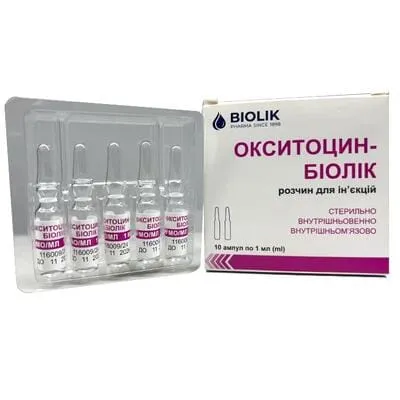
Table of Contents
INSTRUCTIONS FOR MEDICAL USE OF THE MEDICINAL PRODUCT OXYTOCIN-BIOLIK (OXYTOCIN-BIOLIK)
Composition:
Active substance: 1 ml of solution contains 5 IU of oxytocin;
Excipients: chlorobutanol hemihydrate, water for injections.
Pharmaceutical form. Solution for injection.
Main physicochemical properties: clear, colorless liquid.
Pharmacotherapeutic group. Hormones for systemic use, excluding sex hormones and insulins. Posterior pituitary hormones. Oxytocin and analogues.
ATC code H01B B02.
Pharmacological properties.
Pharmacodynamics.
The clinical and pharmacological properties of oxytocin are similar to those of endogenous oxytocin from the posterior pituitary. The uterine musculature contains oxytocin-sensitive receptors belonging to the family of G-protein-coupled receptors. As pregnancy progresses, the number of oxytocin receptors and uterine sensitivity to oxytocin increase, reaching their maximum by the end of pregnancy.
Oxytocin induces contractions of the uterine smooth muscle by increasing intracellular calcium concentration. As the amplitude and duration of muscle contractions increase, cervical dilation and effacement occur. Oxytocin causes intermittent contractions, temporarily reducing uterine blood flow. In certain doses, oxytocin can enhance uterine contractility to a level characteristic of normal labor activity, and in some cases, even to a tetanic state.
Oxytocin causes contraction of myoepithelial cells adjacent to mammary alveoli, thereby promoting milk ejection.
By acting on vascular smooth muscle, oxytocin induces vasodilation, increasing blood flow to the kidneys, coronary vessels, and cerebral vessels. Arterial pressure usually remains unchanged; however, with intravenous administration of larger doses of concentrated oxytocin, arterial pressure may temporarily decrease, leading to reflex tachycardia and reflex increase in cardiac output. After an initial transient drop in pressure, a prolonged, albeit slight, increase in arterial pressure may occur.
Unlike vasopressin, oxytocin has weak antidiuretic activity. Hyperhydration is possible when oxytocin is used concomitantly with large volumes of electrolyte-free fluids and/or when administered rapidly.
Pharmacokinetics.
After intravenous administration, the effect of oxytocin on the uterus appears almost immediately and lasts about 1 hour. After intramuscular administration, the myotonic effect begins within the first 3–7 minutes and lasts for 2–3 hours.
Like vasopressin, oxytocin is distributed throughout the extracellular space. Small amounts of oxytocin likely enter the fetal circulation.
The elimination half-life of oxytocin is 1–6 minutes and is shorter in the late stages of pregnancy and during lactation. The majority of the drug is metabolized in the liver and kidneys. During enzymatic hydrolysis, oxytocin is primarily inactivated by tissue oxytocinase (oxytocinase is also present in the placenta and blood plasma). Only a small amount of oxytocin is excreted unchanged in urine.
Renal impairment
Studies in patients with renal impairment have not been conducted. However, considering the route of elimination and reduced renal excretion of oxytocin due to its antidiuretic effect, there is a possibility of oxytocin accumulation and prolonged action.
Hepatic impairment
Studies in patients with hepatic impairment have not been conducted. A change in the pharmacokinetics of the drug in patients with impaired liver function is unlikely, since the enzyme responsible for oxytocin metabolism (oxytocinase) is present not only in the liver, but also its activity in the placenta increases significantly at the time of delivery. Thus, oxytocin biotransformation under conditions of impaired liver function is not expected to cause a significant change in metabolic clearance.
Clinical characteristics.
Indications.
Oxytocin is used to initiate and stimulate uterine contractile activity.
Indications for use during the antepartum period.
Induction of labor.
Induction of labor with oxytocin is indicated at term or near-term gestation in cases of arterial hypertension (e.g., preeclampsia, eclampsia, or presence of cardiovascular or renal disease), fetal erythroblastosis, maternal or gestational diabetes mellitus, antepartum hemorrhage, or when early delivery is required, as well as in cases of premature rupture of membranes without spontaneous onset of uterine contractions. Planned induction of uterine contractions with oxytocin may be indicated in post-term pregnancy (beyond 42 weeks). Induction of uterine contractile activity may also be indicated in cases of intrauterine fetal death or intrauterine growth restriction.
Augmentation of uterine contractile activity.
During the first or second stage of labor, oxytocin may be administered intravenously by infusion to augment labor in cases of prolonged labor or in the absence of, or weak, uterine contractions.
Indications for use during the postpartum period.
In cases of uterine atony, for the control of postpartum hemorrhage.
Other indications for use.
As an adjunctive therapy in cases of incomplete abortion or inevitable abortion.
Diagnostic use.
For assessment of embryonic-placental respiratory capacity of the fetus (oxytocin challenge test).
Contraindications.
The use of oxytocin for injection is contraindicated in the following cases:
- Clinically narrow pelvis;
- Unfavorable fetal position or presentation that prevents vaginal delivery without prior intervention (e.g., transverse fetal position);
- Obstetric emergencies requiring immediate cesarean section due to risk-benefit considerations for the mother or fetus;
- Fetal distress occurring prior to the onset of labor;
- Prolonged use in the absence of uterine contractile activity or in the presence of severe toxemia;
- Hypertonic uterine contractions;
- Hypersensitivity to the components of the drug;
- Induction of labor or augmentation of uterine contractility when vaginal delivery is contraindicated (e.g., placenta previa, prolapsed umbilical cord, vasa previa);
- Severe cardiovascular disease.
Interaction with other medicinal products and other types of interactions.
There have been reports of severe arterial hypertension when oxytocin was administered 3–4 hours after prophylactic administration of vasoconstrictors in combination with caudal anesthesia.
Anesthesia with cyclopropane, enflurane, halothane, or isoflurane may alter the effects of oxytocin on the cardiovascular system, leading to unexpected outcomes such as arterial hypotension. Concurrent use of oxytocin and cyclopropane anesthesia may also cause sinus bradycardia and atrioventricular rhythm.
Oxytocin should be administered with caution to patients taking medications that may prolong the QTc interval.
Prostaglandins have been shown to enhance the effect of oxytocin; therefore, their concomitant use is not recommended. Due to increased uterine contractility, caution should be exercised when prostaglandins and oxytocin are used sequentially.
Concomitant use of oxytocin with other labor inducers or abortifacients may lead to uterine hypertonia (increased tone), uterine rupture, or cervical trauma. For example, the use of prostaglandins may increase stimulation of labor and uterine musculature.
Therefore, during administration of the drug, strict monitoring of the following parameters is required:
- Acid-base balance;
- Frequency, duration, and strength of uterine contractions;
- Fetal heart rate;
- Maternal heart rate and arterial pressure;
- Uterine tone;
- Fluid balance.
Special precautions for use.
Except in special cases, oxytocin is not recommended in the following situations:
- Premature labor;
- Borderline degree of clinically narrow pelvis (disproportion between fetal head size and maternal pelvis);
- Previous major surgical interventions on the cervix or body of the uterus, including cesarean section;
- Excessive uterine distension;
- Multiple pregnancies;
- Invasive cervical cancer.
Oxytocin must not be administered before engagement of the fetal head or breech into the pelvic inlet.
Identification of special cases caused by combinations of various factors is the responsibility of the physician. The potential beneficial effects of oxytocin therapy should be carefully weighed against the risk of rare but serious adverse events such as uterine hypertonus or tetany.
For the purpose of labor induction or augmentation of uterine contractility, oxytocin must be administered exclusively by intravenous infusion, in a hospital setting, and under appropriate medical supervision. Each patient receiving oxytocin infusion must be under continuous supervision by a physician experienced in the use of this drug.
To prevent complications during oxytocin administration, continuous monitoring of the following parameters is required:
- Uterine contractile activity;
- Maternal and fetal heart rate;
- Maternal arterial blood pressure.
In case of uterine hyperactivity, oxytocin administration must be discontinued immediately; oxytocin-induced uterine contractions usually diminish shortly after stopping the drug.
When properly used, oxytocin induces uterine contractions similar to those observed in normal labor. Excessive stimulation due to incorrect use of the drug is dangerous for both the mother and the fetus.
In cases of hypersensitivity to oxytocin, development of hypertonic uterine contractions is possible even with appropriate dosing and adequate medical supervision.
When administering the drug, one should consider the potential for increased blood loss and development of afibrinogenemia.
Labor stimulation should be avoided in cases of intrauterine fetal demise and/or presence of meconium in amniotic fluid, as this may lead to amniotic fluid embolism.
Oxytocin should not be used in severe cardiovascular diseases, nor for prolonged periods in cases of oxytocin-resistant uterine inertia or in severe pre-eclamptic toxemia.
Intravenous bolus injection of oxytocin is contraindicated, as it may cause acute transient hypotension leading to hyperemia and reflex tachycardia.
Oxytocin should be used with particular caution in patients with cardiovascular disorders (e.g., hypertrophic cardiomyopathy, valvular heart disease and/or ischemic heart disease, including coronary artery spasm) and those predisposed to myocardial ischemia, to avoid significant changes in arterial blood pressure and heart rate.
Oxytocin should be administered cautiously in patients with QT interval prolongation syndrome or associated symptoms, as well as in patients taking drugs known to prolong the QT interval.
Fatal maternal outcomes have been reported during parenteral administration of oxytocin for labor induction or augmentation of uterine contractility in the first and second stages of labor, due to hypersensitivity reactions, subarachnoid hemorrhage, uterine rupture, and fetal death from various causes.
Disseminated intravascular coagulation (DIC)
Rarely, pharmacological labor induction using uterotonics, including oxytocin, is associated with an increased risk of developing disseminated intravascular coagulation (DIC) in the postpartum period. This risk is directly related to pharmacological induction itself, rather than to the use of a specific agent. The risk is primarily increased in women with additional risk factors for DIC: age over 35 years, complicated pregnancy (e.g., gestational diabetes, arterial hypertension, hypothyroidism), gestational age over 40 weeks. In such women, oxytocin and alternative medicinal products should be used with caution, and the physician must consider the possibility of DIC development.
Water intoxication (hyponatremia)
Since oxytocin has a weak antidiuretic effect, prolonged intravenous (IV) infusion of high doses combined with administration of large volumes of fluids may lead to water intoxication associated with hyponatremia. When oxytocin is administered together with IV fluids, a combined antidiuretic effect may occur, resulting in hypervolemia and subsequent development of hemodynamic pulmonary edema even without hyponatremia. To prevent these rare complications, the following safety measures should be observed when administering high doses of oxytocin over a prolonged period: use an electrolyte-containing diluent (not dextrose); IV fluid infusions should be administered in small volumes (during induction or stimulation of labor at late gestational stages, oxytocin concentrations exceeding the recommended levels may be used); oral fluid intake should be restricted; fluid balance must be recorded; laboratory testing of electrolyte levels is indicated if electrolyte imbalance is suspected.
Oxytocin is contraindicated in patients with a history of hypersensitivity to the drug.
Different routes of oxytocin administration must not be used simultaneously.
Oxytocin may be administered by only one route at a time (either intravenous or intramuscular).
Use during pregnancy or breastfeeding.
Pregnancy
During the first trimester of pregnancy, the drug is used only in cases of spontaneous or induced abortion; no other established indications exist. Based on extensive clinical experience, chemical structure, and pharmacological properties of the drug, administration of oxytocin for approved indications is not expected to increase the risk of fetal malformations.
Breastfeeding period
Oxytocin is excreted in small amounts in breast milk.
When oxytocin is prescribed to control postpartum uterine bleeding, initiation of breastfeeding should be delayed until completion of the treatment course.
Ability to affect reaction rate when driving or operating machinery.
Oxytocin does not affect the ability to drive or operate machinery.
Dosage and Administration
Determine the dose according to individual sensitivity of the pregnant woman and fetus.
For induction or stimulation of labor: oxytocin must be administered exclusively as an intravenous infusion. Adherence to the recommended infusion rate is mandatory. For safe administration of oxytocin, an infusion pump or similar device must be used, along with continuous monitoring of uterine contractions and fetal heart activity. In case of excessive intensification of uterine contractility, the infusion must be stopped immediately; as a result, excessive uterine muscle activity rapidly subsides.
Oxytocin infusion must not be administered within the first 6 hours after vaginal prostaglandin administration.
- Before initiating drug administration, begin infusion of 0.9% sodium chloride solution not containing oxytocin.
- To prepare the standard infusion solution: under aseptic conditions, dilute the contents of 1 ampoule – 1 mL (5 IU) of oxytocin in 1000 mL of diluent (0.9% sodium chloride solution, 5% glucose solution), and mix thoroughly by rotating the container. Each mL of the prepared solution contains 5 mIU of oxytocin. For accurate dosing of the infusion solution, an infusion pump or similar device should be used.
- The initial infusion rate must not exceed 0.5–4 mIU/min. This rate may be increased every 20–40 minutes by 1–2 mIU/min until the desired degree of uterine contractility is achieved. After achieving the desired frequency of uterine contractions corresponding to normal labor activity, in the absence of signs of fetal distress and with cervical dilation of 4–6 cm, the infusion rate may be gradually reduced at a pace similar to the rate of increase. During late pregnancy, higher infusion rates require caution; only in rare cases may rates of 8–9 mIU/min be required. In preterm labor, accelerated oxytocin administration may be necessary; in isolated cases, the rate may exceed 20 mIU/min.
If adequate uterine contractility has not been achieved after a total dose of 5 IU of oxytocin administered by infusion in women at or near term, stimulation of labor should be discontinued. Labor stimulation may be resumed the following day, starting with a dose of 0.5–4 mIU/min.
- Fetal heart rate, uterine tone at rest, and frequency, duration, and strength of contractions should be monitored.
- In case of uterine hyperactivity or fetal distress, oxytocin administration must be stopped immediately. The patient should be provided with oxygen therapy. The condition of both mother and fetus must remain under the supervision of a qualified physician.
Control of postpartum uterine bleeding:
a) Intravenous infusion (drip method): dissolve 10–40 IU of oxytocin in 1000 mL of diluent (0.9% sodium chloride solution, 5% glucose solution); for prevention of uterine atony, a dose of 20–40 mIU/min of oxytocin is usually required;
b) Intramuscular administration: 1 mL (5 IU) of oxytocin after placental delivery.
Adjuvant therapy in incomplete or missed abortion.
Intravenous infusion of 10 IU of oxytocin in 500 mL of 0.9% sodium chloride solution or a mixture of 5% glucose with 0.9% sodium chloride solution at a rate of 20–40 drops/min.
Diagnosis of uteroplacental insufficiency (oxytocin challenge test).
Begin intravenous infusion at a rate of 0.5 mIU/min and double the rate every 20 minutes until the effective dose is reached, usually 5–6 mIU/min, maximum 20 mIU/min. After three moderate contractions of 40–60 seconds duration occur within a 10-minute period, discontinue oxytocin infusion and observe for changes, i.e., deceleration of fetal heart rate.
Route of Administration
Intravenous drip infusions or intramuscular injections.
Oxytocin may be administered only by parenteral route (either intravenously or intramuscularly).
Special patient groups
Elderly patients
Studies in elderly patients (over 65 years of age) have not been conducted.
Renal and hepatic impairment
Studies in patients with renal or hepatic impairment have not been conducted.
Children
Do not use in children.
Overdose
Symptoms of overdose depend primarily on the degree of uterine sensitivity to oxytocin and are not related to hypersensitivity to the drug. In cases of hyperstimulation, strong (hypertonic) or prolonged (tetanic) contractions occur, or resting uterine tone (between contractions) increases to 15–20 mm Hg or more, leading to disordered labor, rupture of the uterine body or cervix, vaginal lacerations, postpartum hemorrhage, uteroplacental insufficiency, fetal bradycardia, fetal hypoxia, hypercapnia, and fetal death.
As a severe adverse reaction, seizures may occur due to water intoxication caused by the inherent antidiuretic effect of oxytocin, which may occur when large doses (40–50 mL/h) are administered over a prolonged period. Management of water intoxication includes the following: discontinuation of oxytocin, restriction of fluid intake, administration of diuretics, intravenous infusion of hypertonic sodium chloride solution, restoration of electrolyte balance, control of seizures with appropriate doses of barbiturates, and provision of professional care for the comatose patient.
Adverse reactions.
Adverse reactions in nursing mothers
| System organ class |
Adverse reactions |
| Blood and lymphatic system |
factor I deficiency, hypoprothrombinemia, thrombocytopenia |
| Immune system |
hypersensitivity reactions, including anaphylactic reactions/anaphylaxis, dyspnea, hypotension, shock, urticaria, respiratory distress, swelling, skin hyperemia, itching, rash, fever, chills. |
| Metabolism and nutrition disorders |
hyperhydration |
| Nervous system |
headache, dizziness, seizures |
| Cardiac |
arrhythmia, bradycardia, reflex tachycardia, ventricular extrasystoles |
| Vascular |
arterial hypotension followed by development of arterial hypertension |
| Gastrointestinal |
nausea, vomiting |
| Pregnancy, puerperium and perinatal complications |
fatal outcome of delivery, postpartum hemorrhage, uterine hypertonus |
| Reproductive system and breast |
hemorrhage into pelvic organs, uterine spasms, tetanic uterine contractions |
| Injury, poisoning and procedural complications |
uterine rupture |
| General disorders and administration site reactions |
administration site reactions, including redness, itching |
Adverse reactions in the fetus or newborn
| Organ system class |
Adverse reactions |
| Eye disorders |
retinal haemorrhage in newborns |
| Cardiac disorders |
arrhythmia, sinus bradycardia, tachycardia, ventricular extrasystoles |
| Respiratory, thoracic and mediastinal disorders |
asphyxia |
| Pregnancy, puerperium and perinatal period complications |
fetal death due to asphyxia, neonatal jaundice, brain damage |
| Investigations |
low Apgar score at 5 minutes after birth |
It is known that during cesarean section under spinal anesthesia, intravenous bolus administration of oxytocin at a dose of 10 IU may cause ST–T segment depression on ECG. There is insufficient data for accurate assessment of the degree of risk, and the reasons for the increased risk are unknown.
Shelf life. 2 years.
Storage conditions.
Store in the original packaging at a temperature between 2 °C and 8 °C.
Keep out of reach of children.
Incompatibility.
The medicinal product can be diluted in 0.9 % sodium chloride solution for infusions, 5 % glucose solution, or sodium lactate solutions. The prepared solution is physically and chemically stable for 8 hours after preparation. From a microbiological standpoint, the preparation should be used immediately. Do not mix in the same container with other medicinal products.
Packaging.
1 ml in an ampoule; 10 ampoules per pack, or 5 ampoules per blister, 2 blisters per pack.
Prescription status. Prescription only.
Manufacturer.
LLC "BIOLIK PHARMA".
Manufacturer's location and address of business activity.
Legal entity location:
70 Pomirky, Kharkiv, Kharkiv region, 61070, Ukraine.
Address of business activity:
Pomirky-70, building without number, Kharkiv, Kharkiv region, 61070, Ukraine.