Oxinex
Ukraine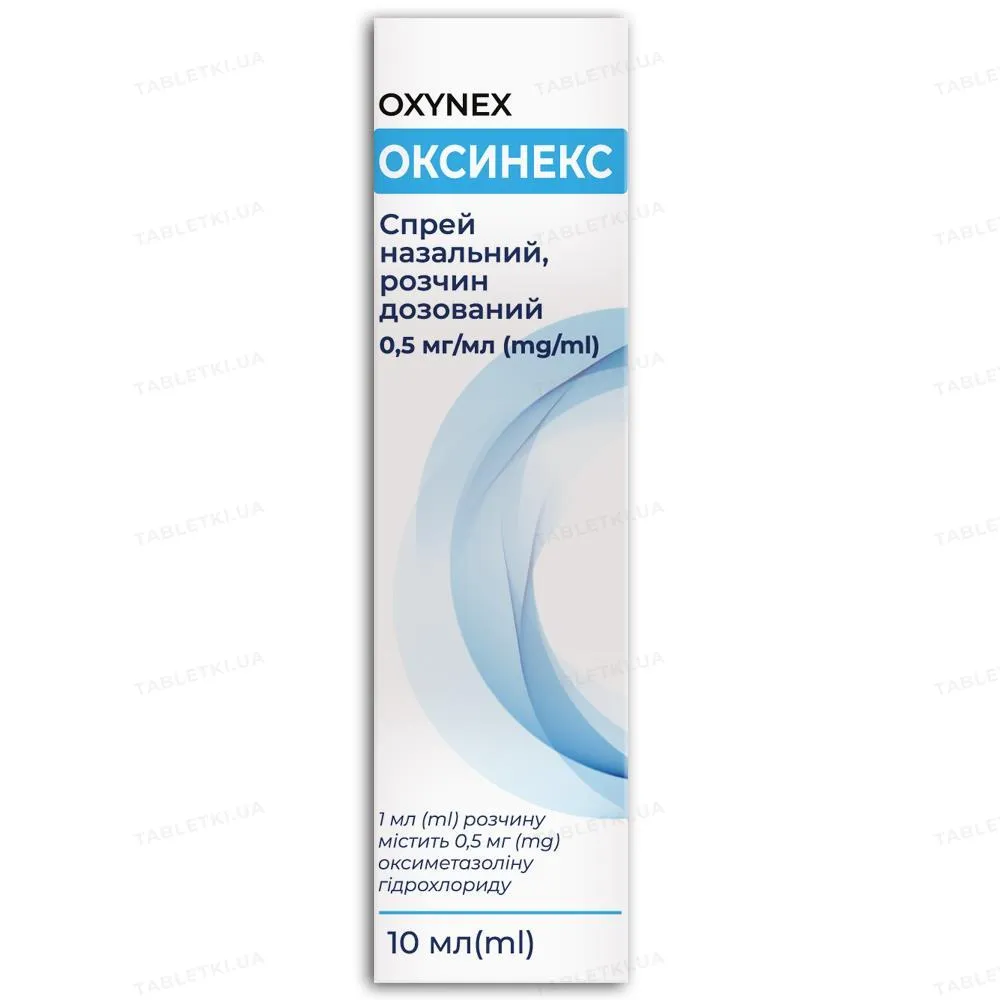
Table of Contents
INSTRUCTIONS FOR MEDICAL USE OF THE MEDICINAL PRODUCT OXYNEX (OXYNEX)
Composition:
active substance: oxymetazoline;
1 ml of solution contains oxymetazoline hydrochloride 0.5 mg;
excipients: benzalkonium chloride; glycerin; citric acid monohydrate; sodium citrate; purified water.
Pharmaceutical form. Nasal spray, metered solution.
Main physicochemical properties: almost clear, colorless to slightly yellowish liquid.
Pharmacotherapeutic group. Decongestants and other locally applied drugs for nasal cavity disorders. Simple sympathomimetics. Oxymetazoline. ATC Code R01A A05.
Pharmacological properties.
Pharmacodynamics.
The active ingredient of the nasal spray has sympathomimetic and vasoconstrictive effects, thereby reducing mucosal swelling. It relieves nasal mucosal edema and restores nasal breathing. Reduction of nasal mucosal swelling promotes restoration of aeration of the paranasal sinuses and the middle ear cavity through the unblocked Eustachian tube.
Antiviral effects of solutions containing oxymetazoline have been demonstrated in studies conducted on virus-infected cultured cells (therapeutic approach). This mechanism of action was demonstrated by inhibition of activity of viruses causing common colds, using a plaque reduction assay, determination of residual infectivity (virus titration), and zpE inhibition test.
Anti-inflammatory and antioxidant effects of oxymetazoline have been demonstrated in various studies. Oxymetazoline significantly affects the production of lipid mediators from arachidonic acid in stimulated ex vivo alveolar macrophages. In particular, oxymetazoline-induced inhibition of 5-lipoxygenase enzyme activity suppresses the formation of pro-inflammatory signaling molecules (LTB4), while increasing the parallel synthesis of anti-inflammatory messenger substances (PGE2, 15-HETE). Oxymetazoline also inhibits inducible nitric oxide synthase (iNOS) in long-term cultured alveolar macrophages.
Oxymetazoline significantly inhibits oxidative stress induced by ultraviolet carbon particles in primary alveolar macrophages. Oxymetazoline also inhibits lipid peroxidation in microsomes in the iron/ascorbate system (antioxidant effect).
Immunomodulatory effects of oxymetazoline have been demonstrated in human peripheral blood mononuclear cells. In this context, oxymetazoline significantly reduces the formation of inflammatory cytokines (IL-1β, IL-6, TNF-α). Furthermore, oxymetazoline suppresses the immunostimulatory properties of dendritic cells.
A double-blind, parallel-group comparative study involving 247 patients demonstrated faster and greater improvement in typical symptoms of acute rhinitis (nasal congestion, rhinorrhea, sneezing, impaired general condition) (p < 0.05), attributable to the combined vasoconstrictive, antiviral, anti-inflammatory, and antioxidant effects of oxymetazoline. Thus, treatment with 0.05% oxymetazoline nasal spray, compared to physiological saline, significantly reduced the duration of common colds from an average of 6 days to 4 days (p < 0.001).
Pharmacokinetics.
The effect of oxymetazoline develops within several seconds.
The effect of 0.05% oxymetazoline from nasal spray was measured in an open-label observational study. It occurred on average within 20.6 seconds. This finding was confirmed in a double-blind, parallel-group comparative study with isotonic saline solution involving 247 patients: the average onset of effect was observed within 25 seconds.
The effect lasts up to 12 hours.
Occasionally, the amount of absorbed oxymetazoline after intranasal administration may be sufficient to produce systemic effects, for example, on the central nervous system or the cardiovascular system.
Further pharmacokinetic data from human studies are not available.
Safety preclinical data
Repeated-dose toxicity studies of intranasal oxymetazoline in dogs revealed no risks to human health. The in vitro bacterial mutagenicity test was negative. There are no data on carcinogenicity. Teratogenic effects were not observed in rats and rabbits. Doses exceeding the therapeutic range caused embryolethal effects or delayed fetal growth. Lactation was inhibited in rats. There are no data on fertility impairment.
Preclinical studies indicate that benzalkonium chloride, depending on concentration and exposure time, may have an inhibitory effect on ciliary motility, leading to irreversible ciliary arrest, as well as histopathological changes in the nasal mucosa.
Clinical characteristics.
Indications.
- Acute rhinitis.
- Allergic rhinitis.
- Spastic vasomotor rhinitis.
- For restoration of drainage and nasal breathing in paranasal sinusitis, as well as in Eustachian tube dysfunction associated with rhinitis.
- For relief of edema prior to diagnostic procedures in nasal passages.
Contraindications.
- Hypersensitivity to the active substance or to any of the excipients.
- Dry rhinitis.
- After transsphenoidal hypophysectomy or other surgical interventions involving the dura mater.
- Pediatric use under 6 years of age.
Interaction with other medicinal products and other forms of interaction.
Concomitant use of oxymetazoline and:
- tricyclic antidepressants;
- monoamine oxidase inhibitors of the tranycypromine type;
- agents that increase blood pressure
may lead to elevated arterial pressure. Therefore, if possible, combination therapy should be avoided.
Special precautions for use.
The medicinal product should be used only after a careful benefit-risk assessment in the following cases:
- increased intraocular pressure, particularly in angle-closure glaucoma;
- severe cardiovascular disorders (e.g., ischemic heart disease) and hypertension;
- pheochromocytoma;
- metabolic disorders (e.g., hyperthyroidism, diabetes mellitus);
- benign prostatic hyperplasia;
- porphyria;
- concomitant use of monoamine oxidase inhibitors (MAO inhibitors) and other agents that potentially increase blood pressure.
Prolonged use or overdose of the nasal decongestant may lead to reduced effectiveness of the drug. Misuse of this product may result in:
- reactive hyperemia of the nasal mucosa (rebound effect);
- chronic swelling of the nasal mucosa (rhinitis medicamentosa);
- atrophy of the nasal mucosa.
The preservative (benzalkonium chloride) contained in Oxynex nasal spray, metered-dose solution, may cause nasal mucosal swelling, especially with prolonged use. If such a reaction is suspected (chronic nasal congestion), another intranasal medicinal product without preservatives should be used. If a preservative-free nasal formulation is not available, an alternative dosage form should be considered.
Use during pregnancy or breastfeeding.
Pregnancy.
Data from a limited number of pregnant women exposed to this medicinal product during the first trimester do not indicate adverse effects of oxymetazoline on pregnancy or on fetal and neonatal health. Currently, there are no adequate epidemiological data available. Animal studies have shown reproductive toxicity at doses exceeding the therapeutic range.
The product should be used during pregnancy only with particular caution, following a careful benefit-risk assessment. Exceeding the recommended dosage is not recommended, as overdose may impair fetal blood supply.
Breastfeeding.
It is unknown whether oxymetazoline passes into human breast milk. Oxynex nasal spray, metered-dose solution, should be used during breastfeeding only after a careful benefit-risk assessment. Exceeding the recommended dosage is not recommended, as it may reduce breast milk production.
Ability to affect reaction speed when driving or operating machinery.
Oxynex nasal spray, metered-dose solution, has no effect or has a negligible effect on the ability to drive or operate machinery. However, after prolonged use of the drug at doses exceeding the recommended levels, a general effect on the cardiovascular system cannot be excluded. In such cases, the ability to drive may be reduced.
Method of Administration and Dosage
Adults and children aged 6 years and older
Use 2–3 times daily, administering 1 spray into each nostril at a time.
Apply the specified single dose of Oxynex, nasal dosed spray, no more than 3 times a day.
Do not use the medication for longer than 7 days. Do not exceed the recommended doses.
Method of Administration
The spray mechanism operates by pressing the finger rest. Before first use, remove the protective cap, hold the nasal spray in hand, and press the pump several times until a consistent aerosol mist is produced. Position the spray nozzle at the entrance of each nostril and administer one spray. After use, clean the spray nozzle and, if necessary, the protective cap.
Children
Do not use the medication in children under 6 years of age.
Overdose
Overdose may occur following nasal or accidental oral administration. The clinical picture of intoxication with imidazole derivatives may be variable, as periods of hyperactivity may alternate with periods of central nervous system, cardiovascular, and pulmonary depression.
Stimulation of the central nervous system may manifest as anxiety, excitation, hallucinations, and seizures.
Depression of the central nervous system may present as decreased body temperature, lethargy, drowsiness, and coma.
Other symptoms may include miosis, mydriasis, fever, sweating, pallor, cyanosis, palpitations, tachycardia, bradycardia, cardiac arrhythmia, cardiac arrest, arterial hypertension, shock hypotension, nausea and vomiting, respiratory depression, and apnea, as well as psychogenic disorders.
In children, overdose often leads to predominant central nervous system effects, including seizures and coma, bradycardia, apnea, and arterial hypertension, which may follow an initial phase of hypotension.
In cases of severe overdose, intensive in-hospital therapy is indicated. Activated charcoal (adsorbent), sodium sulfate (laxative), or gastric lavage (in case of large quantities of the drug) should be administered immediately, as oxymetazoline may be rapidly absorbed. Vasopressor agents are contraindicated. Non-selective α-blockers may be used as antidotes. If necessary, anticonvulsant therapy, lung ventilation, and measures to reduce body temperature should be implemented.
Adverse Reactions
The frequency of adverse reactions is classified as follows: very common (≥1/10), common (≥1/100 to <1/10), uncommon (≥1/1,000 to <1/100), rare (≥1/10,000 to <1/1,000), very rare (<1/10,000), not known (cannot be estimated from available data).
From the nervous system:
Very rare: restlessness, insomnia, increased fatigue (drowsiness, sedative effect, weakness), headache, dizziness, hallucinations (especially in children).
From the cardiovascular system:
Rare: palpitations, tachycardia, arterial hypertension;
Very rare: arrhythmias.
From the respiratory system, thoracic organs and mediastinum:
Common: burning and dryness of nasal mucosa, sneezing;
Uncommon: rebound effect, increased swelling of the mucous membrane, epistaxis after discontinuation;
Very rare: apnea in infants and newborns.
From the musculoskeletal system and connective tissue:
Very rare: convulsions (mainly in children).
From the immune system:
Uncommon: hypersensitivity reactions (angioedema, rash, pruritus).
Reporting of suspected adverse reactions
Reporting suspected adverse reactions after medicine authorization is highly important. It allows continuous monitoring of the benefit-risk balance of the medicine. Healthcare and pharmacy professionals, as well as patients or their legal representatives, are encouraged to report all suspected adverse reactions and lack of efficacy through the Automated Pharmacovigilance Information System at the following link: https://aisf.dec.gov.ua.
Shelf life. 2 years.
After first opening of the bottle, do not store for more than 6 months.
Storage conditions.
Store in original packaging at a temperature not exceeding 25 °C. Keep out of reach and sight of children.
Packaging. 10 ml in a polymer bottle with a nasal spray pump; 1 bottle per cardboard box.
Dispensing category. Over-the-counter (without prescription).
Manufacturer. LLC "Micropharm".
Manufacturer's address and location of business activity.
20 Shevchenka Street, Kharkiv, 61013, Ukraine.