Oxicort
Ukraine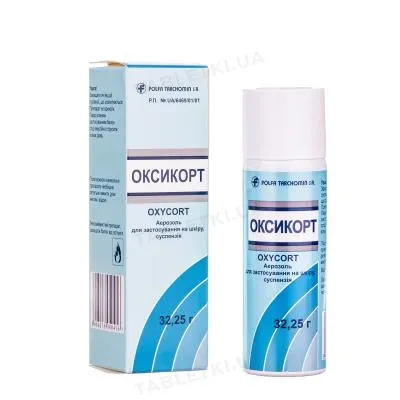
Table of Contents
INSTRUCTIONS FOR MEDICAL USE OF THE MEDICINAL PRODUCT OXICORT (OXYCORT)
Composition:
Active substances: oxytetracycline hydrochloride, hydrocortisone;
1 g of suspension contains oxytetracycline hydrochloride 9.30 mg and hydrocortisone 3.10 mg;
Excipients: sorbitan trioleate, lecithin, isopropyl myristate, propellant (propane, butane, isobutane).
Pharmaceutical form. Cutaneous aerosol, suspension.
Main physicochemical characteristics: a homogeneous suspension of yellow to beige color with a characteristic odor.
Pharmacotherapeutic group. Low-potency corticosteroids in combination with antibiotics. ATC code D07CA01.
Pharmacological properties.
Pharmacodynamics.
The combination drug contains two active substances – oxytetracycline and hydrocortisone.
Oxytetracycline is a broad-spectrum antibiotic effective against both gram-positive and gram-negative bacteria.
Hydrocortisone is a corticosteroid that exerts anti-inflammatory, antipruritic, and vasoconstrictive effects.
The drug acts on oxytetracycline-sensitive bacteria present in skin inflammatory lesions and also limits local inflammatory processes, reducing erythema and itching.
Pharmacokinetics.
Oxytetracycline acts locally when applied to intact skin and practically does not penetrate into the systemic circulation. When applied to wounded or damaged skin, the substance may penetrate into the bloodstream and produce systemic effects.
Hydrocortisone may penetrate into the bloodstream when applied topically, especially over large skin areas. Inflammatory processes and/or other skin diseases accelerate absorption of the substance. Use of an occlusive dressing significantly enhances skin absorption. After entering the bloodstream, hydrocortisone is metabolized in the liver and subsequently excreted by the kidneys.
Clinical characteristics.
Indications.
For local treatment of inflammatory skin conditions complicated by bacterial infection, such as impetigo, folliculitis; allergic skin diseases (urticaria, eczema, pruritus); first-degree burns and frostbite; reactions following insect bites; seborrheic dermatitis.
Contraindications.
Hypersensitivity to oxytetracycline, hydrocortisone, or to any excipient of the medicinal product.
Fungal, tuberculosis, or viral skin infections (e.g., herpes, varicella).
Parasitic infections (e.g., scabies).
Adverse reactions caused by corticosteroids (e.g., perioral dermatitis, striae).
Skin neoplasms and precancerous conditions.
Acute purulent skin diseases.
Ichthyosis, juvenile plantar dermatosis, skin vessel fragility, skin atrophy.
Rosacea and common acne.
Application to facial skin, genital and anal areas, or damaged skin and wounds.
Interaction with other medicinal products and other types of interactions.
When applied topically according to the recommended indications and application method, no interactions with other medicinal products have been observed.
Concomitant use of two or more topical agents on the same skin area is not recommended due to possible effects on the concentration of active substances or risk of skin irritation.
Tetracycline should not be used simultaneously with topical agents containing alcohol, or with personal hygiene products that cause pore constriction, as this may reduce tetracycline activity. Tetracycline should not be used concomitantly with strongly drying soaps or with isotretinoin. Tetracycline is incompatible with agents causing skin exfoliation: benzoyl peroxide, resorcinol, salicylic acid, or sulfur.
Special precautions for use.
The medicinal product is intended for topical application to the skin only.
Protect eyes from contact with the product.
Do not inhale the sprayed substance.
Avoid contact of the product with mucous membranes.
If skin irritation occurs at the site of application, discontinue use of the product.
If no improvement is observed after 7 days of treatment, discontinue use of the product, as hydrocortisone may mask symptoms of spreading infection.
Do not bandage the area where the product has been applied and do not use under occlusive dressings, due to the risk of epidermal atrophy, striae, and superinfection. Use of occlusive dressings enhances penetration of the product through the skin into the bloodstream, potentially leading to systemic corticosteroid side effects.
Hydrocortisone may be absorbed into the bloodstream through the skin and exert immunosuppressive effects. Therefore, during treatment, patients should avoid exposure to viral infections (e.g., chickenpox, measles).
Avoid prolonged use of the product or its application to large areas of skin. In such cases, hydrocortisone may be absorbed into the bloodstream and cause systemic adverse effects typical of corticosteroids, including suppression of the hypothalamic-pituitary-adrenal axis (e.g., Cushing's syndrome, glucosuria, hyperglycemia). If systemic corticosteroid adverse effects occur, treatment with the product should be discontinued and urinary cortisol concentration should be monitored.
Prolonged topical use of the product may lead to dilation of blood vessels and skin atrophy.
Avoid exposure to natural or artificial UV radiation (e.g., solarium use) due to the potential for development of photodermatoses associated with the presence of oxytetracycline in the product.
Use of oxytetracycline and other broad-spectrum antibacterial antibiotics may lead to overgrowth of resistant bacterial or fungal strains.
In case of infections caused by bacteria resistant to oxytetracycline or by fungi, appropriate antibacterial or antifungal treatment should be initiated.
Note that topical use of antibacterial agents may lead to sensitization of the organism.
Extremely flammable aerosol.
Pressurized container. Heating may cause explosion.
Keep away from heat sources, hot surfaces, sparks, open flames, and other sources of ignition. Smoking is prohibited.
Do not spray near open flames or other sources of ignition.
Pressurized container. Do not pierce or burn, even after use.
Protect from sunlight. Do not expose to temperatures exceeding 50 °C/122 °F.
Flammable product; keep container away from flames.
Use during pregnancy or breastfeeding.
Do not use during pregnancy or breastfeeding.
Ability to affect reaction speed when driving or operating machinery.
There are no data on the effect of the product on the ability to drive vehicles or operate other machinery.
Method of administration and dosage.
The product is intended for topical use in adults.
Affected skin areas should be sprayed with the suspension while holding the can upright, with the spray nozzle pointing upward, from a distance of 15–20 cm for 1–3 seconds. Apply 2–4 times daily at regular intervals.
Treatment duration should be determined by a physician.
Caution!
Protect eyes from exposure to the sprayed substance; do not inhale.
Shake the can vigorously several times before each use.
After each application, hands should be thoroughly washed with soap and water.
Children.
The product is not recommended for use in children, as there are no data on efficacy and safety in this age group.
Overdose.
If the product is applied over large skin areas, in high doses, under occlusive dressings, or to damaged skin, it may penetrate into the bloodstream and cause systemic effects of corticosteroids or oxytetracycline (see section "Special precautions for use").
In cases of chronic corticosteroid intoxication, gradual discontinuation of the product is recommended.
Adverse reactions.
Hydrocortisone — a steroid component of the medicinal product — may cause local adverse reactions such as burning, itching, irritation at the site of application, excessive drying, skin atrophy, contact dermatitis, eczema, rosacea-like dermatitis, perioral dermatitis, skin maceration, acneiform eruptions, telangiectasia, miliaria, rash, hypertrichosis, skin depigmentation, secondary (recurring) skin infections and folliculitis, rebound effect which may lead to steroid dependence; purpura, striae; delayed wound healing. Increased intraocular pressure and risk of cataract development (with repeated exposure of the product to the conjunctiva).
With prolonged use and/or application to extensive areas of skin, hydrocortisone may penetrate into the bloodstream and cause systemic adverse effects typical of corticosteroids, including suppression of adrenal gland function (see section "Special precautions for use").
Prolonged application of the product to facial skin may lead to skin atrophy and dilation of blood vessels.
Oxytetracycline contained in the product may cause local skin irritation, allergic reactions, photosensitivity reactions, and/or promote growth of yeast fungi or development of resistant bacterial strains.
Reporting of suspected adverse reactions
It is very important to report suspected adverse reactions after marketing authorization of the medicinal product. This enables ongoing monitoring of the benefit/risk balance of the medicinal product. Healthcare professionals should report any suspected adverse reactions to the Department of Monitoring of Adverse Drug Reactions of the Medicinal Products Registration Office.
Shelf life. 3 years.
Do not use the medicinal product after the expiry date stated on the packaging. The expiry date refers to the last day of the stated month.
Storage conditions.
Store out of reach of children at a temperature not exceeding 25°C.
Packaging.
32.25 g of suspension in an aerosol aluminum can with a spray valve and a protective polypropylene cap. 1 can in a cardboard box.
Prescription status. Prescription only.
Manufacturer.
Tarchomin Pharmaceutical Plant "Polfa" Joint Stock Company.
Manufacturer's address and place of business.
2 A. Fleming Street, 03-176 Warsaw, Poland.