Ofloxacin-pharmex
Ukraine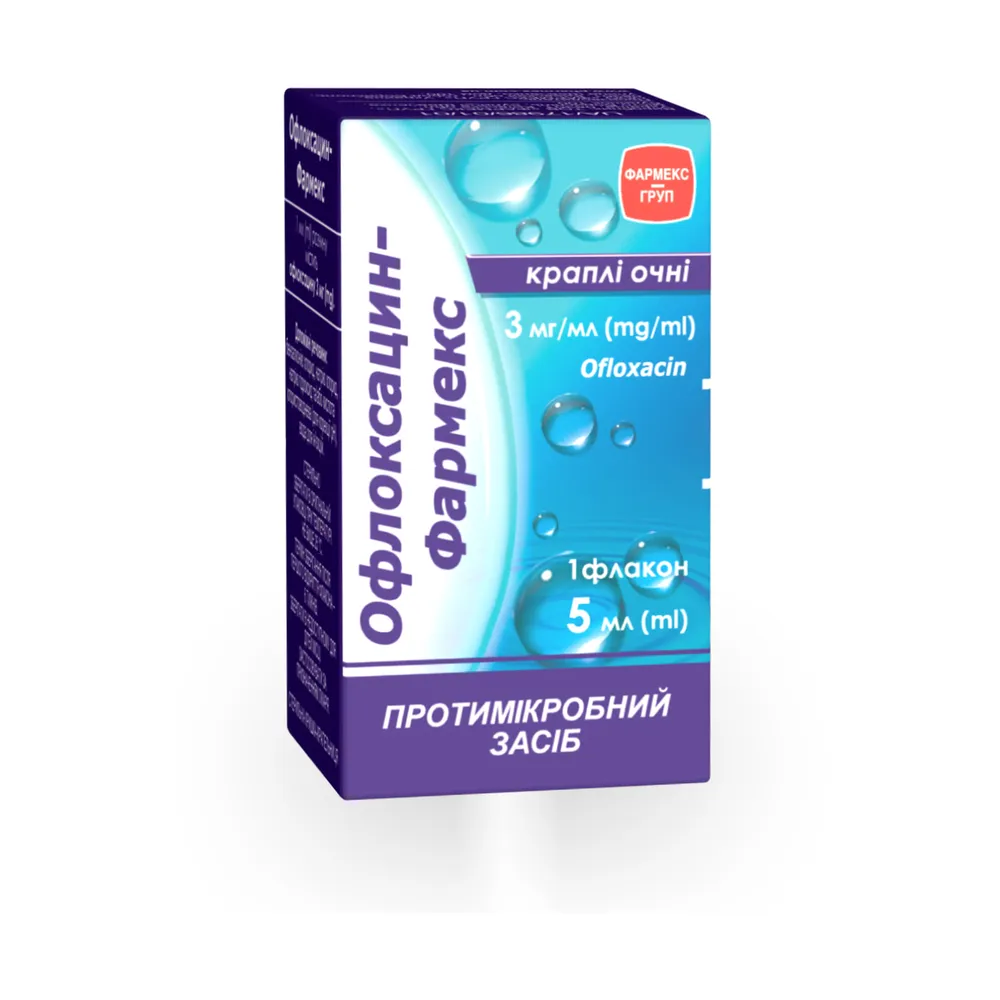
Table of Contents
INSTRUCTION FOR MEDICAL USE OF THE MEDICINAL PRODUCT OFLOXACIN-PHARMEKS
Composition:
active substance: ofloxacin;
1 ml of solution contains ofloxacin 3 mg;
excipients: benzalkonium chloride, sodium chloride, sodium hydroxide and/or hydrochloric acid (for pH adjustment), water for injections.
Pharmaceutical form. Eye drops.
Main physicochemical characteristics: clear greenish-yellow solution.
Pharmacotherapeutic group.
Agents used in ophthalmology. Antimicrobial agents. Ofloxacin.
ATC code S01AE01.
Pharmacological Properties.
Pharmacodynamics.
Ofloxacin is a synthetic antimicrobial agent belonging to the fluoroquinolone group, with high antimicrobial activity against a broad spectrum of Gram-negative microorganisms and a smaller number of Gram-positive microorganisms. Ofloxacin has demonstrated high activity against most strains of these microorganisms in vitro and in clinical practice for the treatment of eye infections. Clinical efficacy data for ofloxacin against Streptococcus pneumoniae are based on a limited number of isolates only.
Ofloxacin is active against the following Gram-negative microorganisms: Acinetobacter calcoaceticus; Enterobacter species, including E. cloacae; Haemophilus species, including H. influenzae and H. aegyptius; Klebsiella species, including K. pneumoniae; Moraxella species; Morganella morganii; Proteus species, including P. mirabilis; Pseudomonas species, including P. aeruginosa, P. cepacia, P. fluorescens; Serratia species, including S. marcescens.
Ofloxacin is active against the following Gram-positive microorganisms: Bacillus species, Corynebacterium, Micrococcus, Staphylococcus species, including S. aureus and S. epidermidis; Streptococcus species, including S. pneumoniae (see above), S. viridans, and S. beta-haemolyticus.
The primary mechanism of action is inhibition of bacterial DNA gyrase, an enzyme responsible for maintaining DNA structure.
Ofloxacin is not hydrolyzed by beta-lactamases and is not modified by chloramphenicol acetyltransferase, aminoglycoside adenylase, or aminoglycoside phosphotransferase.
Pharmacokinetics.
After instillation into the eye, the mean concentration of ofloxacin in tears measured 4 hours after administration (9.2 µg/g) was higher than the minimum concentration required to inhibit 90% of most strains causing eye infections (MIC90) in vitro, which was 2 µg/g.
The maximum concentration of ofloxacin in blood serum after 10 days of topical ophthalmic use was 1000 times lower than the concentration achieved after a standard oral dose of ofloxacin. Systemic adverse reactions following topical ophthalmic use of ofloxacin have not been reported.
Clinical characteristics.
Indications.
Local treatment of external ocular infections (such as conjunctivitis and keratitis) in adults and children, caused by microorganisms sensitive to ofloxacin.
Official guidelines on the appropriate use of antibacterial agents should be taken into account.
Contraindications.
Hypersensitivity to any component of the medicinal product or to other quinolones.
Interaction with other medicinal products and other forms of interaction.
It has been shown that systemic administration of certain quinolones inhibits the clearance of caffeine and theophylline metabolites. Drug interaction studies conducted during systemic administration of ofloxacin have demonstrated that the clearance of caffeine and theophylline metabolites is only slightly affected by ofloxacin.
There have also been reports of increased frequency of toxic effects on the central nervous system following systemic administration of fluoroquinolones together with nonsteroidal anti-inflammatory drugs (NSAIDs); however, such effects have not been reported with concomitant systemic administration of NSAIDs and ofloxacin.
Ofloxacin, like other fluoroquinolones, should be used with caution in patients receiving drugs that prolong the QT interval (e.g., class IA and III antiarrhythmics, tricyclic antidepressants, macrolides, antipsychotic agents).
Special precautions for use
The medicinal product Ofloxacin-Pharmex is not intended for injection. Serious and sometimes fatal hypersensitivity reactions (anaphylactic/anaphylactoid), occasionally occurring after the first dose, have been reported in patients receiving systemic quinolones, including ofloxacin. Some reactions were accompanied by cardiovascular collapse, loss of consciousness, angioedema (including laryngeal, pharyngeal, or facial swelling), airway obstruction, dyspnea, urticaria, and pruritus.
If an allergic reaction to Ofloxacin-Pharmex occurs, the drug should be discontinued. The product should be used with caution in patients who have previously demonstrated hypersensitivity to other quinolone antibacterial agents.
When using Ofloxacin-Pharmex, care should be taken to avoid contamination of the nasopharynx, which may promote the development and spread of bacterial resistance. As with other antimicrobial agents, prolonged use may result in overgrowth of non-susceptible microorganisms.
If infection worsens or no clinical improvement occurs within a reasonable period, treatment should be discontinued and alternative therapy considered.
Stevens–Johnson syndrome has been reported in patients treated with ofloxacin as topical ophthalmic drops; however, a causal relationship has not been established.
Cardiac disorders
Fluoroquinolones, including ofloxacin, should be used with caution in patients with risk factors for QT interval prolongation, such as:
- congenital long QT syndrome;
- concomitant use of medicinal products known to prolong the QT interval (e.g., class IA and III antiarrhythmics, tricyclic antidepressants, macrolides, antipsychotics);
- uncorrected electrolyte imbalances (e.g., hypokalemia, hypomagnesemia);
- cardiac conditions (e.g., heart failure, myocardial infarction, bradycardia).
Elderly patients and younger women may be more sensitive to drugs that prolong the QT interval. Therefore, Ofloxacin-Pharmex should be used with caution in these patient groups.
Children
The safety and efficacy of the product in children under 1 year of age have not been established.
Data on the efficacy and safety of Ofloxacin-Pharmex ophthalmic drops for the treatment of neonatal conjunctivitis are very limited.
Ofloxacin-Pharmex ophthalmic drops are not recommended for the treatment of neonatal ophthalmia caused by Neisseria gonorrhoeae or Chlamydia trachomatis, as its use in these patients has not been evaluated.
Use in elderly patients
There are no data available on the topical use of the product in elderly patients compared to other age groups.
Clinical and preclinical studies have reported cases of corneal perforation in patients with pre-existing corneal epithelial defects or corneal ulcers treated with topically applied fluoroquinolones. However, in many such cases, significant contributing factors were present, including advanced age, presence of large ulcers, concomitant ocular conditions (e.g., severe dry eye), systemic inflammatory diseases (e.g., rheumatoid arthritis), and concomitant use of ophthalmic corticosteroids or NSAIDs. The product should be used with caution in patients with corneal epithelial defects or corneal ulcers due to the risk of corneal perforation.
During treatment with ophthalmic ofloxacin products, corneal deposits have been reported; however, a causal relationship has not been established.
Prolonged high-dose administration of other fluoroquinolones in experimental animals has led to lens opacities. However, this effect has not been observed in humans or in animal studies following topical administration of ofloxacin for up to six months.
During treatment with ofloxacin, exposure to direct sunlight and ultraviolet radiation should be avoided due to the potential for photosensitization.
Ofloxacin-Pharmex contains the preservative benzalkonium chloride, which may cause ocular irritation and may discolor soft contact lenses.
Contact lenses should not be worn during treatment.
When using Ofloxacin-Pharmex ophthalmic drops together with other eye drops or ointments, medicinal products should be administered at least 15 minutes apart. In any case, ophthalmic ointment should be applied last.
Use during pregnancy or breastfeeding
Pregnancy
Adequate and well-controlled studies on the use of Ofloxacin-Pharmex in pregnant women have not been conducted. Since systemic fluoroquinolones can cause arthropathy in sexually immature animals, the product should not be used during pregnancy.
Breastfeeding period
Since ofloxacin and other systemically administered quinolones are excreted in breast milk and there is potential for harm to the infant, a decision should be made whether to discontinue breastfeeding temporarily, taking into account the importance of the drug for the mother.
Fertility
Ofloxacin had no effect on fertility in animals.
Ability to affect reaction speed when driving or operating machinery
The use of Ofloxacin-Pharmex ophthalmic drops does not affect the patient's reaction speed.
After instillation into the conjunctival sac, blurred vision may occur for several minutes. Patients should refrain from driving or operating machinery until vision clears.
Dosage and Administration.
The medicinal product is intended for topical ocular use only.
During the first 2 days, instill 1–2 drops every 2–4 hours, then 4 times daily. The duration of treatment should not exceed 10 days.
Children.
Safety and efficacy in children under 1 year of age have not been established.
Ofloxacin-Farmeks, ophthalmic drops, can be prescribed to children from 1 year of age.
Overdose.
In case of overdose, symptomatic treatment should be administered. Since QT interval prolongation is possible, ECG monitoring should be performed.
Adverse reactions.
General manifestations.
Serious reactions following systemic administration of ofloxacin are rare, and most symptoms are reversible. Since a small amount of ofloxacin is systemically absorbed after topical application, adverse effects associated with systemic administration of the drug may occur.
The following categories are used to classify the frequency of adverse reactions:
Very common (≥1/10), common (from ≥1/100 to <1/10), uncommon (from ≥1/1,000 to <1/100), rare (from ≥1/10,000 to <1/1,000), very rare (<1/10,000), frequency not known (cannot be estimated from the available data).
Immune system disorders.
Frequency not known: hypersensitivity reactions, including allergic symptoms and signs (e.g., itching of the eye and eyelids) and anaphylactic reactions (e.g., angioneurotic edema, dyspnea, anaphylactic shock, oropharyngeal edema, facial and tongue swelling).
Nervous system disorders.
Frequency not known: dizziness.
Eye disorders.
Common: eye irritation, ocular discomfort.
Frequency not known: keratitis, conjunctivitis, blurred vision, photophobia, eye swelling, foreign body sensation, increased lacrimation, dry eye, eye pain, ocular hyperemia, periorbital edema (including eyelid edema).
Cardiovascular system disorders.
Frequency not known: ventricular arrhythmia and torsades de pointes (mainly in patients with risk factors for QT interval prolongation), QT interval prolongation on ECG.
Gastrointestinal disorders.
Frequency not known: nausea.
Skin and subcutaneous tissue disorders.
Frequency not known: Stevens-Johnson syndrome, toxic epidermal necrolysis.
Reporting suspected adverse reactions
Reporting of suspected adverse reactions after drug registration is important. It allows continued monitoring of the benefit/risk balance of the medicinal product. Medical and pharmaceutical professionals, as well as patients or their legal representatives, should report all suspected adverse reactions and lack of efficacy through the Automated Pharmacovigilance Information System at the following link: https://aisf.dec.gov.ua.
Shelf life. 2 years.
Storage period after first opening of the bottle — 6 weeks.
Storage conditions.
Store in the original packaging at a temperature not exceeding 25 °C. Keep out of the reach and sight of children.
Packaging.
5 ml in a bottle, 1 bottle with a dropper cap in a carton.
Prescription status.
Prescription only.
Manufacturer.
LLC "FARMEKS GROUP".
Manufacturer's address and location of its business activities.
100 Shevchenka Street, Boryspil, Kyiv Oblast, 08301, Ukraine.