Oflokain-darnitsa®
Ukraine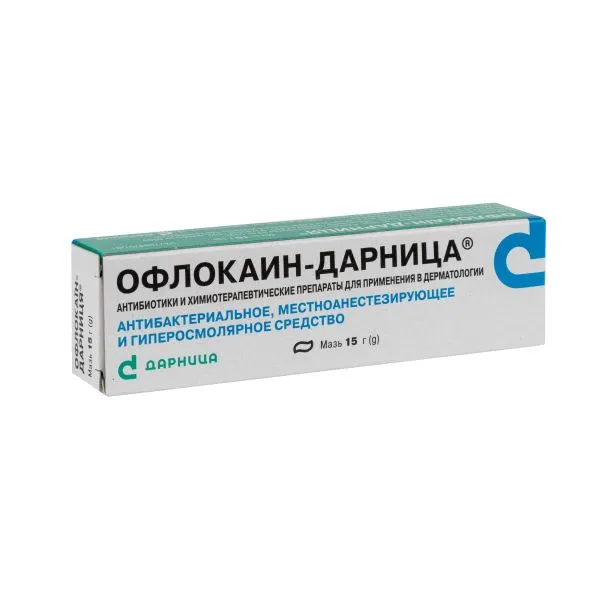
Table of Contents
INSTRUCTIONS FOR MEDICAL USE OF THE MEDICINAL PRODUCT OFLOCAIN-DARNITSA® (OFLOCAIN-DARNITSA)
Composition:
Active substances: lidocaine hydrochloride, ofloxacin;
1 g of ointment contains: ofloxacin 1 mg, lidocaine hydrochloride 30 mg;
Excipients: propylene glycol, poloxamer, macrogol 400, macrogol 1500, macrogol 6000.
Pharmaceutical form. Ointment.
Main physicochemical properties: homogeneous white ointment with a faint specific odor.
Pharmacotherapeutic group. Antibiotics and chemotherapeutic agents for dermatological use. Chemotherapeutic agents for topical use.
ATC code D06B X.
Pharmacological properties.
Pharmacodynamics.
Ofloxacine-Darnytsia® is a combination of the antimicrobial agent ofloxacin from the fluoroquinolone group and lidocaine, a local anesthetic, in a hydrophilic, hyperosmolar, and water-soluble base. The pharmacological effects of the ointment are determined by the properties of its active ingredients.
Ofloxacin acts on the bacterial enzyme DNA gyrase and bacterial topoisomerase IV, exerting a bactericidal effect by destabilizing bacterial DNA strands.
Ofloxacin provides antimicrobial activity of the ointment against Gram-positive and, to a greater extent, Gram-negative bacteria, as well as aerobic and anaerobic, spore-forming and non-spore-forming microflora, both as monocultures and microbial associations. Ofloxacin is also effective against hospital strains resistant to antibiotics and sulfonamides.
The hyperosmolar, polymeric ointment base of the medicinal product promotes movement of water from the wound toward the ointment base. As a result, edema of the tissues surrounding the wound is reduced, and purulent-necrotic wound contents are absorbed. The excipients in the ointment base facilitate penetration of ofloxacin into the surrounding wound tissues, thus ensuring an effect on both superficial and deep wound infections.
The mechanism of lidocaine's local anesthetic action involves stabilization of the neuronal membrane by decreasing its permeability to sodium ions, thereby preventing the generation of action potentials and impulse conduction along nerve fibers. Calcium ion antagonism is possible. Lidocaine suppresses conduction not only of pain impulses but also of impulses of other modalities. It is rapidly hydrolyzed in the slightly alkaline tissue environment and, after a short latent period, exerts its effect for 60–90 minutes. The anesthetic effect of lidocaine is 2–6 times stronger than that of procaine. When applied locally, it dilates blood vessels and does not produce local irritation. Under inflammatory conditions (tissue acidosis), the anesthetic activity is reduced. It is effective for all types of local anesthesia. It dilates blood vessels and does not irritate tissues.
Pharmacokinetics.
Ofloxacin and lidocaine practically do not enter the systemic circulation when the ointment is applied to healthy skin. After application to a wound surface, where the skin's barrier functions are impaired, approximately 3% of the applied dose of ofloxacin reaches the systemic circulation. Peak blood concentrations of the substances are observed within 3–4 hours. Six hours after ointment application, ofloxacin is no longer detectable in the blood.
Clinical characteristics.
Indications.
Complicated infected wounds in the first phase of the wound process of various localization and origin: amputation stumps of limbs, wounds after surgical treatment of purulent foci. Pressure sores, trophic ulcers, postoperative complicated wounds and fistulas, abscesses and phlegmons of the maxillofacial region after their surgical treatment.
Prevention and treatment of suppuration of burn wounds.
Purulent-inflammatory skin diseases caused by bacterial microflora sensitive to ofloxacin.
Contraindications.
Hypersensitivity to ofloxacin or to other quinolone derivatives; hypersensitivity to lidocaine hydrochloride or to other amide-type local anesthetics (e.g., bupivacaine, etidocaine, mepivacaine, and prilocaine); hypersensitivity to other components of the medicinal product.
Interaction with other medicinal products and other forms of interaction.
Absorption of lidocaine through the skin is usually low; however, the medicinal product should be used with caution in patients taking Class I antiarrhythmic agents (tocainide, mexiletine) or other local anesthetics, since there is a risk of cumulative systemic effects.
Monoamine oxidase inhibitors enhance the local anesthetic effect of lidocaine.
Instructions for use.
Before applying the medicinal product to the wound surface, it is advisable to clean the wound with an antiseptic solution.
Use during pregnancy or breastfeeding.
The medicinal product should not be used during pregnancy or breastfeeding.
Ability to influence reaction rate when driving or operating machinery.
The medicinal product does not affect the speed of neuromuscular conduction; therefore, it can be used by individuals who drive vehicles or operate complex machinery, when used at recommended doses.
Method of Administration and Dosage
Oflokain-Darnitsya® is for topical use only.
After standard surgical treatment of wounds and burns, apply the ointment directly to the wound surface, then cover with a sterile gauze dressing. Alternatively, the ointment may first be applied to the dressing material, which is then placed on the wound surface.
Cavities of purulent wounds after surgical treatment may be filled with swabs soaked in the ointment; gauze pledgets containing the oint游戏副本 should be inserted into fistulous tracts.
For the treatment of purulent wounds, apply the ointment once daily. For the treatment of burns, apply daily or 2–3 times per week, depending on the intensity of purulent exudation.
The amount of ointment used should be determined by the size of the wound surface (the ointment must cover the entire affected area) and the degree of purulent exudation.
The duration of treatment is determined by the physician according to the dynamics of wound cleansing from purulent exudate and the time required to suppress the inflammatory process.
For the treatment of dermatological conditions, apply a thin layer of ointment to the affected skin areas 1–2 times daily, either directly or onto a gauze dressing for subsequent application.
Children
This medicinal product should not be used in children.
Overdose
No cases of overdose have been reported.
Side effects.
The following reactions may occur during the use of the ointment: itching, burning sensation, rash, hyperemia, weeping, allergic reactions including dermatitis, urticaria, and Quincke's edema. Propylene glycol, an ingredient of the medicinal product, may cause skin irritation.
Shelf life. 2 years.
Storage conditions.
Store in the original packaging at a temperature not exceeding 15 °C.
Keep out of reach of children.
Incompatibility.
Concomitant use of other medicinal products at the application sites of Oflokain-Darnytsia® is not recommended.
Packaging.
15 g or 30 g in a tube; 1 tube per carton.
Prescription status. Prescription only.
Manufacturer: JSC "Pharmaceutical Company "Darnitsa".
Manufacturer's address and place of business.
13, Borispilska Street, Kyiv, 02093, Ukraine.