Nutriflex lipid special novo
Ukraine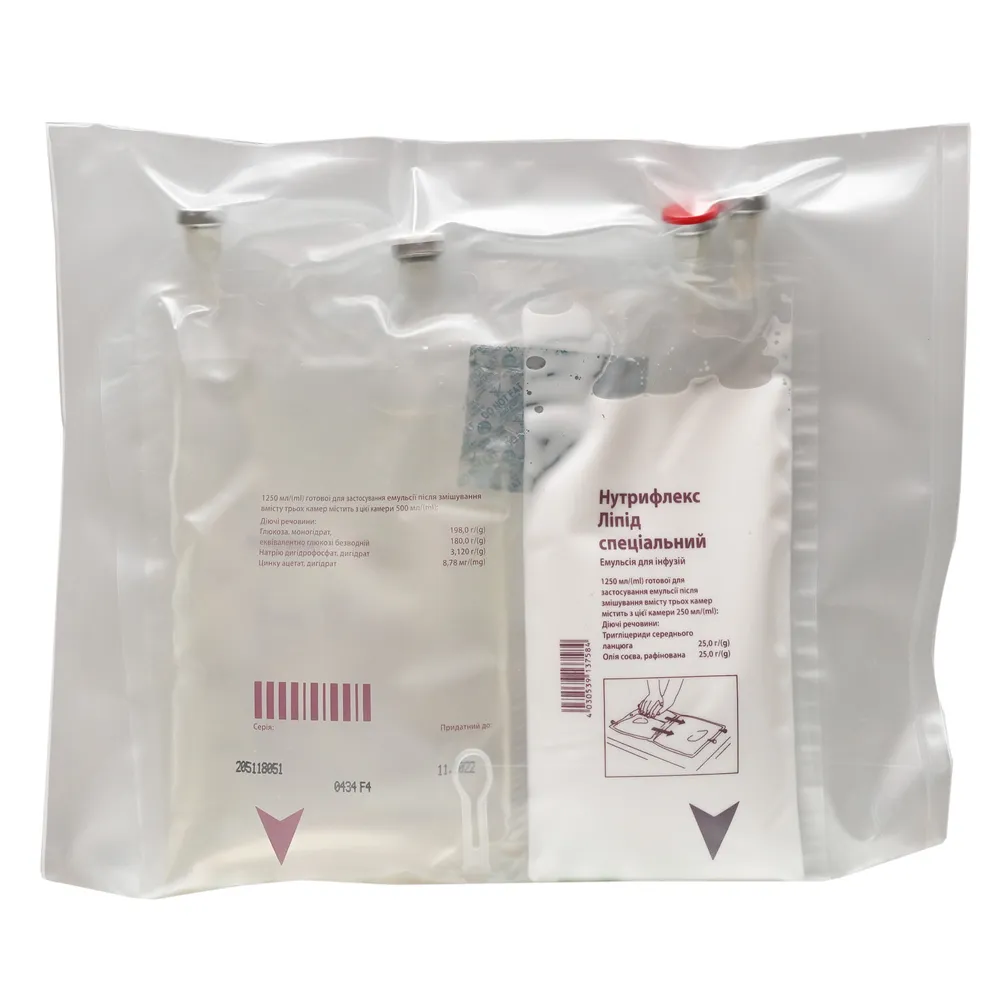
Table of Contents
INSTRUCTIONS FOR MEDICAL USE OF THE MEDICINAL PRODUCT NUTRIFLEX LIPID SPECIAL NOVO (NUTRIFLEX LIPID SPECIAL NOVO)
Composition:
Active ingredients: the ready-to-use emulsion after mixing the contents of the chambers contains:
| From upper chamber (glucose solution) |
in 1000 ml |
in 625 ml |
in 1250 ml |
in 1875 ml |
| Glucose monohydrate, equivalent to anhydrous glucose |
158.4 g 144.0 g |
99.00 g 90.00 g |
198.0 g 180.0 g |
297.0 g 270.0 g |
| Sodium dihydrogen phosphate dihydrate |
2.496 g |
1.560 g |
3.120 g |
4.680 g |
| Zinc acetate dihydrate |
7.024 mg |
4.390 mg |
8.780 mg |
13.17 mg |
| From middle chamber (lipid emulsion) |
in 1000 ml |
in 625 ml |
in 1250 ml |
in 1875 ml |
| Refined soybean oil |
20.00 g |
12.50 g |
25.00 g |
37.50 g |
| Medium-chain triglycerides |
20.00 g |
12.50 g |
25.00 g |
37.50 g |
| From lower chamber (amino acid solution) |
in 1000 ml |
in 625 ml |
in 1250 ml |
in 1875 ml |
| Isoleucine |
3.284 g |
2.053 g |
4.105 g |
6.158 g |
| Leucine |
4.384 g |
2.740 g |
5.480 g |
8.220 g |
| Lysine hydrochloride, equivalent to lysine |
3.980 g 3.186 g |
2.488 g 1.991 g |
4.975 g 3.982 g |
7.463 g 5.973 g |
| Methionine |
2.736 g |
1.710 g |
3.420 g |
5.130 g |
| Phenylalanine |
4.916 g |
3.073 g |
6.145 g |
9.218 g |
| Threonine |
2.540 g |
1.588 g |
3.175 g |
4.763 g |
| Tryptophan |
0.800 g |
0.500 g |
1.000 g |
1.500 g |
| Valine |
3.604 g |
2.253 g |
4.505 g |
6.758 g |
| Arginine |
3.780 g |
2.363 g |
4.725 g |
7.088 g |
| Histidine hydrochloride monohydrate, equivalent to histidine |
2.368 g 1.753 g |
1.480 g 1.095 g |
2.960 g 2.191 g |
4.440 g 3.286 g |
| Alanine |
6.792 g |
4.245 g |
8.490 g |
12.73 g |
| Aspartic acid |
2.100 g |
1.313 g |
2.625 g |
3.938 g |
| Glutamic acid |
4.908 g |
3.068 g |
6.135 g |
9.203 g |
| Glycine |
2.312 g |
1.445 g |
2.890 g |
4.335 g |
| Proline |
4.760 g |
2.975 g |
5.950 g |
8.925 g |
| Serine |
4.200 g |
2.625 g |
5.250 g |
7.875 g |
| Sodium hydroxide |
1.171 g |
0.732 g |
1.464 g |
2.196 g |
| Sodium chloride |
0.378 g |
0.237 g |
0.473 g |
0.710 g |
| Sodium acetate trihydrate |
0.250 g |
0.157 g |
0.313 g |
0.470 g |
| Potassium acetate |
3.689 g |
2.306 g |
4.611 g |
6.917 g |
| Magnesium acetate tetrahydrate |
0.910 g |
0.569 g |
1.137 g |
1.706 g |
| Calcium chloride dihydrate |
0.623 g |
0.390 g |
0.779 g |
1.169 g |
| Electrolytes (mmol) |
in 1000 ml |
in 625 ml |
in 1250 ml |
in 1875 ml |
| Sodium |
53.6 |
33.5 |
67 |
100.5 |
| Potassium |
37.6 |
23.5 |
47 |
70.5 |
| Magnesium |
4.2 |
2.65 |
5.3 |
7.95 |
| Calcium |
4.2 |
2.65 |
5.3 |
7.95 |
| Zinc |
0.03 |
0.02 |
0.04 |
0.06 |
| Chloride |
48 |
30 |
60 |
90 |
| Acetate |
48 |
30 |
60 |
90 |
| Phosphate |
16 |
10 |
20 |
30 |
| in 1000 ml |
in 625 ml |
in 1250 ml |
in 1875 ml |
|
| Amino acids |
56.0 g |
35.0 g |
70.1 g |
105.1 g |
| Nitrogen |
8 g |
5 g |
10 g |
15 g |
| Carbohydrates |
144 g |
90 g |
180 g |
270 g |
| Lipids |
40 g |
25 g |
50 g |
75 g |
| in 1000 ml |
in 625 ml |
in 1250 ml |
in 1875 ml |
|
| Energy in the form of lipids [kJ (kcal)] |
1590 (380) |
995 (240) |
1990 (475) |
2985 (715) |
| Energy in the form of carbohydrates [kJ (kcal)] |
2415 (575) |
1510 (360) |
3015 (720) |
4520 (1080) |
| Energy in the form of amino acids [kJ (kcal)] |
940 (225) |
585 (140) |
1170 (280) |
1755 (420) |
| Non-protein energy [kJ (kcal)] |
4005 (955) |
2505 (600) |
5005 (1195) |
7505 (1795) |
| Total energy [kJ (kcal)] |
4945 (1180) |
3090 (740) |
6175 (1475) |
9260 (2215) |
| Osmolality [mOsm/kg] |
2115 |
2115 |
2115 |
2115 |
| Theoretical osmolarity [mOsm/L] |
1545 |
1545 |
1545 |
1545 |
| pH |
5.0 – 6.0 |
5.0 – 6.0 |
5.0 – 6.0 |
5.0 – 6.0 |
Excipients: citric acid monohydrate; glycerol; egg lecithin; sodium oleate; alpha-tocopherol; water for injections.
Pharmaceutical form. Infusion emulsion.
Main physicochemical properties:
amino acid chamber: clear solution, colorless to pale yellow, free from particles;
glucose chamber: clear solution, colorless to pale yellow, free from particles;
lipid emulsion chamber: white, milk-like emulsion.
Pharmacotherapeutic group. Solutions for parenteral nutrition. Combinations.
ATC code B05B A10.
Pharmacological properties.
Pharmacodynamics.
Mechanism of action
The goal of parenteral nutrition is to supply all necessary nutrients and energy for growth and/or tissue regeneration, as well as for maintaining all bodily functions.
Amino acids are particularly important in this regard, as some of them are essential components for protein synthesis. Concurrent administration of energy sources (carbohydrates/lipids) is necessary to spare amino acids for tissue regeneration and anabolism, and to prevent their use as an energy source.
Glucose is metabolized throughout the body. Certain tissues and organs, such as the central nervous system, bone marrow, erythrocytes, and tubular epithelium, meet their energy requirements exclusively from glucose. In addition, glucose acts as a structural component of various cellular substances.
Due to their high energy density, lipids are an efficient source of energy supply. Long-chain triglycerides provide the body with essential fatty acids required for the synthesis of cellular components. For this purpose, the lipid emulsion contains both medium- and long-chain triglycerides (soybean oil).
Medium-chain triglycerides are hydrolyzed, cleared from the bloodstream, and completely oxidized more rapidly than long-chain triglycerides. They serve as a preferred energy source, particularly in cases of impaired breakdown and/or utilization of long-chain triglycerides, for example, in lipoprotein lipase deficiency and/or deficiency of its cofactors.
Unsaturated fatty acids derived from the long-chain triglyceride fraction are primarily used for the prevention and treatment of essential fatty acid deficiency.
No preclinical studies have been conducted specifically with Nutriflex Lipid Special New.
Toxic effects of nutrient mixtures used as replacement therapy at recommended doses are not expected.
Pharmacokinetics.
Absorption. The medicinal product Nutriflex Lipid Special New is administered intravenously. All substrates are immediately incorporated into metabolism.
Distribution. The dose, infusion rate, metabolic status, and patient-specific factors (e.g., degree of depletion) are decisive for achieving maximum triglyceride concentration. When used according to recommended dosing, triglyceride concentration generally does not exceed 4.6 mmol/L (400 mg/dL).
Medium-chain fatty acids have low affinity for albumin. Animal experiments with pure medium-chain triglyceride emulsions have shown that medium-chain fatty acids may cross the blood-brain barrier in cases of overdose. However, no adverse reactions have been observed with the emulsion containing a mixture of medium- and long-chain triglycerides, as long-chain triglycerides inhibit the hydrolysis of medium-chain triglycerides. Therefore, toxic effects on the brain after administration of Nutriflex Lipid Special New can be excluded.
Amino acids are components of a wide range of proteins in various organs of the body. In addition, each amino acid is present in free form in blood and within cells.
Since glucose is water-soluble, it is distributed throughout the body via the bloodstream. Initially, the glucose solution distributes in the intravascular space, then transfers into the intracellular space.
There are no available data on the passage of components/metabolites of Nutriflex Lipid Special New across the placental barrier or into breast milk.
Biotransformation. Amino acids not involved in protein synthesis are metabolized via the pathways described below. The amino group is removed from the carbon skeleton through transamination. The carbon chain is either directly oxidized to CO₂ or used by the liver as a substrate for gluconeogenesis. The amino group is also metabolized in the liver to urea.
Glucose is metabolized to CO₂ and H₂O via well-known metabolic pathways. Some glucose is used for lipid synthesis.
After infusion, triglycerides are hydrolyzed to glycerol and fatty acids. Both groups of compounds participate in physiological processes of energy production, synthesis of biologically active molecules, gluconeogenesis, and re-synthesis of lipids.
Elimination. Only a small amount of amino acids is excreted unchanged in urine.
Excess glucose is excreted in urine only if the renal threshold for glucose is exceeded.
Both soybean oil-derived triglycerides and medium-chain triglycerides are completely metabolized to CO₂ and H₂O. Small amounts of lipids are lost only through desquamation of skin cells and other epithelial membranes. Renal excretion does not occur in practice.
Clinical characteristics.
Indications.
For providing energy, essential fatty acids, amino acids, electrolytes, and fluid during parenteral nutrition of patients with moderate to severe catabolism when oral or enteral nutrition is impossible, inadequate, or contraindicated.
Nutriflex Lipid Special novo is indicated for adults, adolescents, and children aged 2 years and older.
Contraindications.
- Hypersensitivity to the active substances, egg, peanut or soy proteins, or to any other component of the medicinal product;
- congenital disorders of amino acid metabolism;
- hyperglycemia unresponsive to insulin doses up to 6 units of insulin/hour;
- intrahepatic cholestasis;
- severe hepatic insufficiency;
- severe renal insufficiency in the absence of renal replacement therapy;
- hemorrhagic diathesis during an acute phase;
- acute thromboembolic events, fat embolism;
- severe hypertriglyceridemia (≥ 1000 mg/dL, or 11.4 mmol/L);
- severe coagulopathy;
- acidosis.
Nutriflex Lipid Special Novo should not be used in newborns, infants, and children under 2 years of age due to its composition.
General contraindications for parenteral nutrition:
- unstable circulatory status with life-threatening risk (state of collapse or shock);
- acute phase of myocardial infarction and stroke;
- unstable metabolic status (e.g., severe post-aggressive syndrome, coma of unknown origin);
- inadequate oxygen supply to cells;
- disturbances in electrolyte and fluid balance;
- acute pulmonary edema;
- decompensated heart failure.
Interaction with other medicinal products and other forms of interactions.
Solutions containing potassium should be used with caution in patients receiving medicinal products that increase serum potassium concentrations, such as potassium-sparing diuretics (triamterene, amiloride, spironolactone), ACE inhibitors (e.g., captopril, enalapril), angiotensin-II-receptor antagonists (e.g., losartan, valsartan), cyclosporine, and tacrolimus.
Soybean oil contains natural levels of vitamin K1. This may influence the therapeutic effect of coumarin derivatives, which should be closely monitored in patients receiving such agents.
The use of corticosteroids and adrenocorticotropic hormone is associated with sodium and fluid retention.
Some drugs, such as insulin, may interfere with the body's lipase system. However, this type of interaction has only limited clinical significance.
Heparin at clinical doses causes a temporary release of lipoprotein lipase into the bloodstream. This may initially lead to increased plasma lipolysis, followed by a temporary reduction in triglyceride clearance.
The product should not be administered simultaneously with blood through the same infusion set due to the risk of pseudoagglutination (see also section "Special precautions").
Special precautions for use.
In the event of any signs or symptoms of an anaphylactic reaction (such as fever, chills, rash, or dyspnea), the infusion must be stopped immediately.
Caution should be exercised in cases of increased serum osmolarity.
Fluid, electrolyte, and acid-base imbalances should be corrected prior to initiating the infusion.
Too rapid infusion may lead to fluid overload, resulting in abnormal electrolyte concentrations, hyperhydration, and pulmonary edema.
When administering Nutriflex Lipid Special novo, serum triglyceride concentrations should be monitored.
Depending on the patient's metabolic status, hypertriglyceridemia may occasionally occur. If plasma triglyceride concentration exceeds 4.6 mmol/L (400 mg/dL) during lipid administration, the infusion rate should be reduced. The infusion must be interrupted if plasma triglyceride concentration exceeds 11.4 mmol/L (1000 mg/dL), as such levels are associated with acute pancreatitis.
Patients with lipid metabolism disorders
Nutriflex Lipid Special novo should be administered with caution to patients with lipid metabolism disorders and elevated serum triglyceride levels, such as those with renal insufficiency, diabetes mellitus, pancreatitis, hepatic dysfunction, hypothyroidism (with hypertriglyceridemia), sepsis, or metabolic syndrome. When Nutriflex Lipid Special novo is administered to patients in these conditions, careful monitoring of serum triglyceride levels is mandatory to ensure adequate triglyceride clearance and to maintain stable triglyceride levels below 11.4 mmol/L (1000 mg/dL).
In combined hyperlipidemia and metabolic syndrome, triglyceride levels are sensitive to glucose, lipids, and excessive food intake. Dose adjustments are required. Other sources of lipids and glucose, as well as medications interfering with their metabolism, should be evaluated and controlled.
Persistent hypertriglyceridemia 12 hours after lipid administration also indicates a lipid metabolism disorder.
Infusion should also be discontinued if blood glucose concentration exceeds 14 mmol/L (250 mg/dL) during administration.
Administration of Nutriflex Lipid Special novo, like all carbohydrate-containing solutions, may lead to hyperglycemia. Blood glucose levels should be monitored regularly. In case of hyperglycemia, the infusion rate should be reduced or insulin administered. If the patient is simultaneously receiving other intravenous glucose solutions, the amount of additional glucose administered should be taken into account.
Refeeding or resumption of nutrition in malnourished patients or those who have been poorly nourished may cause hypokalemia, hypophosphatemia, or hypomagnesemia. Adequate supplementation of electrolytes according to deviations from normal values is mandatory.
Monitoring of serum electrolyte concentrations, fluid balance, acid-base balance, blood count, coagulation status, and liver and kidney function is required.
Vitamins and trace elements should be administered according to individual needs.
Since Nutriflex Lipid Special novo contains zinc and magnesium, calcium, and phosphates, caution is required when administering it simultaneously with other solutions containing these elements.
As with all intravenous solutions, especially those used for parenteral nutrition, strict aseptic techniques must be observed during infusion of Nutriflex Lipid Special novo. The medicinal product should not be administered simultaneously with blood using the same infusion set, due to the risk of pseudoagglutination (see section "Interaction with other medicinal products and other forms of interaction").
Nutriflex Lipid Special novo is a multi-component preparation. Therefore, it is not recommended to add other solutions to it unless compatibility has been demonstrated (see section "Incompatibilities").
Elderly patients
Generally, the same dose as for adults is used; however, caution is required in patients with cardiac or renal insufficiency, which may be associated with advanced age.
Patients with diabetes mellitus, cardiac or renal insufficiency
Nutriflex Lipid Special novo should be administered with caution to patients with cardiac or renal insufficiency, as with all infusion solutions.
Experience with the use of this product in patients with diabetes mellitus or renal insufficiency is limited.
This medicinal product contains 771 mg of sodium per 625 mL bag, equivalent to 39% of the WHO recommended maximum daily intake of 2 g sodium for an adult.
The maximum daily dose of this medicinal product for a 70 kg adult is equivalent to 151% of the WHO recommended maximum daily sodium intake.
Nutriflex Lipid Special novo is considered a sodium-rich preparation. This should be particularly considered if the patient is on a low-salt diet.
Effect on laboratory test results
Lipid content may interfere with certain laboratory tests (e.g., bilirubin, lactate dehydrogenase, oxygen saturation) if blood is sampled before lipids have sufficiently cleared from the bloodstream.
Use during pregnancy or breastfeeding.
Pregnancy. Data on the use of Nutriflex Lipid Special novo during pregnancy are limited. Animal studies are insufficient with respect to reproductive toxicity (see section "Pharmacodynamics"). Parenteral nutrition may be necessary during pregnancy. The physician must weigh the benefit-risk ratio before administering the product to pregnant women.
Breastfeeding. Components/metabolites of Nutriflex Lipid Special novo may pass into breast milk; however, when used at therapeutic doses, no effect on breastfed newborns/infants is expected. Nevertheless, breastfeeding is not recommended for women receiving parenteral nutrition.
Fertility
There are no data on the effect of Nutriflex Lipid Special novo on fertility.
Ability to affect reaction speed while driving or operating machinery.
Nutriflex Lipid Special novo has no effect or negligible effect on the ability to drive or operate machinery.
Method of Administration and Dosage
Dosage
Dosage should be adjusted according to individual patient requirements.
Nutriflex Lipid Special novo is recommended to be administered continuously. Gradual increase in infusion rate during the first 30 minutes helps prevent possible complications.
Adults and children aged 14 years and older
Maximum daily dose is 35 mL/kg body weight, corresponding to:
2.0 g amino acids/kg body weight per day;
5.04 g glucose/kg body weight per day;
1.4 g lipids/kg body weight per day.
Maximum infusion rate is 1.7 mL/kg body weight per hour, corresponding to:
0.1 g amino acids/kg body weight per hour;
0.24 g glucose/kg body weight per hour;
0.07 g lipids/kg body weight per hour.
For a patient weighing 70 kg, this corresponds to an infusion rate of 119 mL per hour. Thus, the infused substrate amounts to 6.8 g amino acids per hour, 17.1 g glucose per hour, and 4.8 g lipids per hour.
Children aged 2 to 13 years
The dosage recommendations provided are based on average requirements. Dosage should be individually adjusted according to age, stage of development, and type of illness. Hydration status of the child should be considered when calculating dosage.
In children, it may be appropriate to initiate therapeutic nutrition at half the target dose. The dose should be gradually increased according to the individual's metabolic capacity until the maximum dose is reached.
Daily dose for children aged 2–4 years is 25 mL/kg body weight, corresponding to:
1.43 g amino acids/kg body weight per day;
3.60 g glucose/kg body weight per day;
1.0 g lipids/kg body weight per day.
Daily dose for children aged 5–13 years is 17.5 mL/kg body weight, corresponding to:
1.0 g amino acids/kg body weight per day;
2.52 g glucose/kg body weight per day;
0.7 g lipids/kg body weight per day.
Maximum infusion rate is 1.7 mL/kg body weight per hour, corresponding to:
0.1 g amino acids/kg body weight per hour;
0.24 g glucose/kg body weight per hour;
0.07 g lipids/kg body weight per hour.
Depending on individual requirements, Nutriflex Lipid Special novo may not sufficiently meet total energy and fluid needs. In such cases, additional carbohydrates, lipids, and fluids may be required as clinically indicated.
Elderly patients
Metabolic rate and metabolism may differ in elderly patients; therefore, careful monitoring is always recommended in this population.
Patients with hepatic or renal impairment
Dosage should be individually adjusted in patients with hepatic or renal impairment (see section "Special Warnings and Precautions for Use"). In special clinical situations, such as parenteral nutrition during hemodialysis to compensate for nutrient losses associated with dialysis, a higher infusion rate may be required.
Treatment duration
Duration of treatment for the recommended indications is not limited. When Nutriflex Lipid Special novo is used long-term, patients must receive adequate amounts of trace elements and vitamins.
Infusion duration from one bag
Recommended infusion duration from one bag of parenteral nutrition is a maximum of 24 hours.
Route of administration
Intravenous administration. For infusion into a central vein only.
Preparation of the mixed emulsion
Strict adherence to aseptic techniques is required.
Opening
Before opening the protective film of the bag, check the color of the oxygen indicator. Do not use if the oxygen indicator has turned pink. Use only if the oxygen indicator is yellow.
Tear the outer bag's protective film along the perforation line.
Remove the bag from the outer packaging.
Dispose of the outer bag, oxygen indicator, and oxygen absorber.
Visually inspect the primary bag for leaks. Discard any leaking bag, as sterility cannot be guaranteed.
To open the chambers and mix their contents sequentially, twist the bag with both hands, starting from the perforation line separating the upper chamber (glucose) and lower chamber (amino acids). Then continue pressing to open the seal between the middle chamber (lipids) and lower chamber.
Addition of additives
After mixing the contents of all chambers and removing the aluminum seal, compatible additives (e.g., electrolytes, trace elements, vitamins) may be added via the medication port.
Information on compatibility of various additives and their corresponding shelf life upon addition can be provided by the manufacturer upon request.
Thoroughly mix the bag contents and visually inspect the mixture. There should be no signs of emulsion phase separation.
The mixture is a white, milky "oil-in-water" emulsion.
Preparation for infusion
Before infusion, the emulsion should always be warmed to room temperature.
Remove the protective aluminum foil from the infusion port and connect the infusion set.
Use an infusion set without a venting valve, or close the venting port if using a set with a venting valve.
Hang the infusion bag on a stand and administer by standard infusion technique.
For single use only.
The bag and any unused portions of the medicinal product must be discarded after use.
Do not reconnect a bag containing partially used medicinal product.
If filters are used, they must be lipid-permeable (pore size ≥ 1.2 µm).
Parenteral nutrition preparations should always be visually inspected before use for packaging damage, color change, and emulsion instability.
Do not use a damaged bag. The outer bag's film, primary bag, and seals between chambers must be intact. Use only if the amino acid and glucose solutions are clear and colorless to pale straw-colored, and the lipid emulsion is white and milky. Do not use if the solutions contain particulate matter.
After mixing the three chambers, do not use the medicinal product if the emulsion has changed color or shows signs of phase separation (oil droplets, oil layer). If color change or phase separation occurs, discontinue infusion immediately.
Before opening the protective film, check the color of the oxygen indicator. Do not use if the oxygen indicator has turned pink. Use only if the oxygen indicator is yellow.
No special requirements for disposal.
Children
Nutriflex Lipid Special novo is contraindicated in newborns, infants, and children under 2 years of age (see section "Contraindications").
Overdose
Symptoms of fluid and electrolyte overdose
Hypervolemia, electrolyte imbalance, and pulmonary edema.
Symptoms of amino acid overdose
Renal excretion of amino acids leading to amino acid imbalance, nausea, vomiting, and tremor.
Symptoms of glucose overdose
Hyperglycemia, glucosuria, dehydration, hyperosmolarity, hyperglycemic-hyperosmolar coma.
Symptoms of lipid overdose
Described in the section "Adverse Reactions".
Treatment
In case of overdose, immediate discontinuation of infusion is indicated. Further therapeutic measures depend on the specific symptoms and their severity. If re-initiation of infusion is necessary after symptom resolution, it is recommended to gradually increase the infusion rate with frequent monitoring.
Adverse Reactions
Even with correct use, adherence to safety rules and instructions for use, adverse reactions may still occur. Below is a list of systemic reactions that may be associated with the use of Nutriflex Lipid Special Neo.
Adverse reactions are listed according to their frequency of occurrence:
Very common (≥ 1/10);
Common (≥ 1/100 to < 1/10);
Uncommon (≥ 1/1000 to < 1/100);
Rare (≥ 1/10000 to < 1/1000);
Very rare (< 1/10000);
Not known (frequency cannot be estimated from available data).
Blood and lymphatic system disorders
Rare: Hypercoagulation
Not known: Leukopenia, thrombocytopenia
Immune system disorders
Rare: Allergic reactions (including anaphylactic reactions, skin rashes, angioedema of laryngeal, oral, facial and soft tissues)
Metabolism and nutrition disorders
Uncommon: Loss of appetite
Very rare: Hyperlipidemia, hyperglycemia, metabolic acidosis. The frequency of these adverse reactions is dose-dependent and may increase under conditions of absolute or relative lipid overdose.
Nervous system disorders
Rare: Headache, somnolence
Vascular disorders
Rare: Arterial hypertension or hypotension, flushing
Respiratory system disorders
Rare: Dyspnea, cyanosis
Gastrointestinal disorders
Uncommon: Nausea, vomiting
Hepatobiliary disorders
Not known: Cholestasis
Skin and subcutaneous tissue disorders
Rare: Erythema, sweating
Musculoskeletal and connective tissue disorders
Rare: Back, bone, shoulder and lumbar pain
General disorders and administration site conditions
Rare: Increased body temperature, cold sensation, chills
Very rare: Fat overload syndrome (detailed information provided below)
If any of these adverse reactions occur, the infusion should be stopped.
If serum triglyceride levels rise to 11.4 mmol/L (1000 mg/dL) during infusion, the infusion must be stopped. Infusion may continue at lower doses when levels are above 4.6 mmol/L (400 mg/dL) (see section "Special precautions for use").
If the infusion is restarted, the patient must be closely monitored, especially at the beginning, with frequent determination of serum triglyceride concentrations.
Information on specific adverse reactions
Nausea, vomiting, loss of appetite – these symptoms are often associated with conditions requiring parenteral nutrition, but they may also be related to parenteral nutrition itself.
Fat overload syndrome
Reduced ability to clear triglycerides may lead to fat overload syndrome, which may be caused by overdose. Possible signs of metabolic overload should be monitored. Causes may include genetic disorders (individual metabolic differences), or existing or previous diseases affecting fat metabolism. This syndrome may also occur in severe hypertriglyceridemia, even when the recommended infusion rate is followed, and in association with sudden changes in the patient's clinical status, such as renal dysfunction or infection. Fat overload syndrome is characterized by hyperlipidemia, fever, fatty infiltration, hepatomegaly with or without jaundice, splenomegaly, anemia, leukopenia, thrombocytopenia, coagulation disorders, hemolysis, reticulocytosis, abnormal liver function tests, and coma. These symptoms are usually reversible after discontinuation of the fat emulsion infusion.
If symptoms of fat overload syndrome occur, administration of Nutriflex Lipid Special Neo must be stopped immediately.
Reporting suspected adverse reactions
Reporting of suspected adverse reactions after marketing authorization of the medicinal product is of great importance. It allows continuous monitoring of the benefit-risk balance of the medicinal product. Healthcare professionals, pharmacists, patients, and their legal representatives should report all suspected adverse reactions and lack of efficacy via the Automated Pharmacovigilance Information System at: https://aisf.dec.gov.ua.
Shelf life
Unopened bag: 2 years
After first opening (puncture of the infusion port): The emulsion should be used immediately after first opening of the packaging.
After removal of the protective film from the outer pouch and after mixing the contents of the chambers: Chemical and physical stability of the mixture of amino acids, glucose and fat has been demonstrated for 7 days at 2–8 °C and an additional 2 days at 25 °C.
After addition of compatible additives: From a microbiological standpoint, the medicinal product should be administered immediately after addition of compatible additives. If not administered immediately, the responsibility for storage conditions and duration prior to use lies with the user.
Storage conditions
Store at a temperature not exceeding 25 °C. Do not freeze. If the contents of the bag freeze accidentally, the product must be discarded.
Store the bag in its outer packaging, protected from light and out of reach of children.
Incompatibilities
Nutriflex Lipid Special Neo must not be mixed with other medicinal products whose compatibility has not been documented (see section "Instructions for use and dosage").
Nutriflex Lipid Special Neo must not be administered simultaneously with blood products (see sections "Special precautions for use" and "Interaction with other medicinal products and other forms of interaction").
Packaging
625 ml (250 ml amino acid solution + 125 ml fat emulsion + 250 ml glucose solution) in a flexible multi-chamber bag made of multilayer foil; 5 bags per cardboard box.
1250 ml (500 ml amino acid solution + 250 ml fat emulsion + 500 ml glucose solution) in a flexible multi-chamber bag made of multilayer foil; 5 bags per cardboard box.
1875 ml (750 ml amino acid solution + 375 ml fat emulsion + 750 ml glucose solution) in a flexible multi-chamber bag made of multilayer foil; 5 bags per cardboard box.
Prescription category: Prescription only
Manufacturer
B. Braun Melsungen AG / B. Braun Melsungen AG
Manufacturer's address and place of business
Am Schwerzelshof 1, 34212 Melsungen, Germany / Am Schwerzelshof 1, 34212 Melsungen, Germany