Nosolin® plus
Ukraine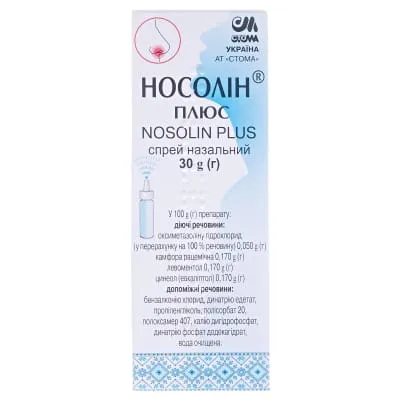
Table of Contents
INSTRUCTION FOR MEDICAL USE OF THE MEDICINAL PRODUCT NOSOLINE® PLUS
Composition:
Active substances: oxymetazoline hydrochloride; racemic camphor; levomenthol; cineole (eucalyptol);
1 g of the preparation contains: oxymetazoline hydrochloride (calculated as 100 % substance) 0.5 mg; racemic camphor 1.7 mg; levomenthol 1.7 mg; cineole (eucalyptol) 1.7 mg;
Excipients: benzalkonium chloride, disodium edetate, propylene glycol, polysorbate 20, poloxamer 407, potassium dihydrogen phosphate, disodium phosphate dodecahydrate, purified water.
Pharmaceutical form. Nasal spray.
Main physicochemical properties: clear, colorless or pale yellow liquid with a characteristic odor; upon pressing the pump, the preparation is sprayed as an aerosol jet.
Pharmacotherapeutic group.
Anti-edematous and other preparations for local use in nasal cavity disorders. Sympathomimetics in combination with other agents. Oxymetazoline.
ATC code R01A B07.
Pharmacological properties.
Pharmacodynamics.
A vasoconstrictor and anti-edematous agent. Oxymetazoline hydrochloride stimulates α1-adrenergic receptors of the sympathetic nervous system. It constricts blood vessels at the site of application, thereby reducing swelling of the mucous membrane of the upper respiratory tract, facilitating nasal breathing, and decreasing blood flow to the venous sinuses. The effect begins within 5–10 minutes after spraying the drug into the nasal cavity. Duration of action lasts up to 12 hours.
Levomenthol, racemic camphor, and cineole (eucalyptol) exert a mild local anti-inflammatory, anti-edematous, and antiseptic effect, and facilitate mucus clearance.
Propylene glycol, an ingredient of the preparation, prevents excessive drying of the mucous membrane.
Pharmacokinetics.
The elimination half-life of oxymetazoline hydrochloride is 5–8 hours. It is excreted mainly in unchanged form in urine and feces. Camphor, menthol, and eucalyptol gradually evaporate from the mucous membrane of the respiratory tract. A small amount of these substances that enters the systemic circulation easily penetrates through the alveolar-capillary membrane and rapidly evaporates from the lung surface.
Clinical characteristics.
Indications.
Symptomatic treatment of colds, influenza, and acute respiratory viral infections accompanied by acute rhinitis, sinusitis, and other types of sinus inflammation (frontitis, ethmoiditis).
Contraindications.
Hypersensitivity to oxymetazoline, other adrenergic agents, or any component of the drug; severe cardiovascular disorders (e.g., ischemic heart disease, arterial hypertension); advanced atherosclerosis; acute cardiovascular conditions or cardiac asthma; tachysystolic cardiac arrhythmias; angina pectoris; renal insufficiency; marked prostatic hyperplasia; pheochromocytoma; metabolic disorders (hyperthyroidism, diabetes mellitus, porphyria); atrophic rhinitis; elevated intraocular pressure, particularly in closed-angle glaucoma; following transsphenoidal hypophysectomy or other surgical interventions involving opening of the dura mater; skin inflammation or injury around nasal passages or nasal mucosa; use of agents that increase blood pressure; concomitant use with monoamine oxidase inhibitors (MAOIs), as well as within 2 weeks after discontinuation of MAOI therapy. Predisposition to bronchospasm or seizures.
Interaction with other medicinal products and other forms of interaction.
Prior to initiating treatment with this medicinal product, consultation with a physician is recommended if other medicinal agents are being used. Concomitant use of this drug with other vasoconstricting agents (regardless of route of administration) or with other nasal decongestants, as well as with tricyclic antidepressants or maprotiline, should be undertaken only after consultation with a physician due to the potential for increased blood pressure.
Concomitant use of MAO inhibitors and oxymetazoline may lead to increased blood pressure. Therefore, this drug must not be used simultaneously with MAO inhibitors or within 2 weeks following discontinuation of MAOI therapy.
Concomitant use of oxymetazoline with tricyclic antidepressants may increase the risk of elevated blood pressure and arrhythmias.
Oxymetazoline may reduce the effectiveness of β-adrenergic blockers, methyldopa, or other antihypertensive agents.
Concomitant use of sympathomimetic agents and antiparkinsonian drugs may result in additive toxic effects on the cardiovascular system.
Special precautions for use.
When spraying into the nasal cavity, do not tilt the head back or turn the bottle upside down. It is not recommended that several individuals use the same bottle to avoid the spread of infection.
Persistent nasal congestion after the third day of treatment may indicate the presence of a deviated nasal septum, purulent sinusitis, adenoids, allergic rhinitis, persistent bacterial infection, or other undiagnosed conditions requiring medical consultation and specialized comprehensive therapy.
Medical advice should be sought before starting use of this medication in the following cases: high arterial blood pressure, cardiovascular diseases, liver or kidney disorders, porphyria.
Prolonged use and overdosing should be avoided. Long-term use of decongestants may lead to diminished effectiveness. Misuse of this product may cause atrophy of the mucous membrane and reactive hyperemia, resulting in medicamentosa rhinitis, as well as damage to the mucosal epithelium and inhibition of epithelial activity. Special monitoring is required in patients with chronic rhinitis and after relief of congestion prior to diagnostic procedures. Doses higher than recommended should be used only under medical supervision. Do not exceed the recommended dosage.
Use during pregnancy or breastfeeding.
Oxymetazoline has not been associated with adverse pregnancy outcomes. It should be used with caution in patients with hypertension or signs of reduced placental perfusion. Frequent or prolonged use of high doses may reduce placental blood flow. The use of this medication during pregnancy is permissible only if, in the physician’s opinion, the benefit to the mother outweighs the potential risk to the fetus/child.
It is unknown whether oxymetazoline passes into breast milk. Due to the lack of data, oxymetazoline should not be used during breastfeeding.
Ability to affect reaction speed when driving or operating machinery.
This medication does not affect the ability to drive or operate complex machinery. However, following prolonged use at doses exceeding the recommended levels, a systemic effect on the cardiovascular system cannot be ruled out. In such cases, the ability to drive may be reduced.
Method of Administration and Dosage.
Before use, attach the spray nozzle to the aerosol canister, remove the protective cap, shake the canister several times, then press the base of the spray nozzle fully to deliver a dose of the spray into each nostril.
For adults and children aged 12 years and older: administer 2 sprays into each nostril. For children aged 6 to 12 years: administer 1 spray into each nostril. Repeat the administration no sooner than every 12 hours.
Duration of treatment – no more than 3 days. Prolonged use – up to 7–10 days, 2 sprays per day, under medical supervision.
Children.
The drug is contraindicated in children under 6 years of age.
Overdose.
With topical application, systemic adverse reactions usually do not occur.
In case of overdose or accidental ingestion of oxymetazoline, various symptoms may occur. Stages of hyperexcitability and depression can be distinguished. Stimulation of the central nervous system clinically manifests as fear, agitation, hallucinations, and seizures.
Symptoms of moderate or severe overdose include miosis (pupil constriction), mydriasis (pupil dilation), nausea, vomiting, cyanosis, increased sweating, spasms, tachycardia, arrhythmia, cardiovascular insufficiency, cardiac arrest, elevated blood pressure, pulmonary edema, dyspnea, seizures, physical discomfort, elevated temperature, palpitations, pallor, hyposmia, and psychiatric disturbances.
Depression of the central nervous system clinically manifests as drowsiness, decreased body temperature, bradycardia, arterial hypotension, collapse, shock, respiratory disorders and respiratory arrest, loss of consciousness, and coma.
Clinical manifestations of overdose in children include CNS-related symptoms: seizures and coma, hallucinations, bradycardia, apnea, hypertension progressing to hypotension.
Emergency Measures. In case of suspected oxymetazoline overdose, immediate hospitalization to an intensive care unit is required. Administer activated charcoal and laxatives. Gastric lavage is necessary. To reduce elevated blood pressure, prescribe α-adrenergic blockers (phentolamine). Vasopressor agents should not be used. Anticonvulsant therapy should be administered if necessary. In severe cases, endotracheal intubation and artificial ventilation of the lungs may be required.
Adverse reactions.
With frequent and prolonged use, sensations of burning, tingling in the nose, nasal discomfort, flushing, sneezing, and dryness of the nasal mucosa may occur. Rarely, after the effect of the drug has worn off, a feeling of severe nasal congestion (reactive hyperemia) may occur, as well as apnea in newborns and young children (especially in cases of overdose).
Prolonged continuous use of vasoconstrictive agents may lead to tachyphylaxis or development of drug-induced rhinitis. Overall, severe adverse effects are not expected.
Cardiovascular system. Very rarely, tachycardia, palpitations, increased arterial pressure, and chest pain may occur.
Eye disorders. Rarely, eye irritation, discomfort, redness, or blurred vision may occur.
Gastrointestinal tract. Rarely, nausea may occur.
Immune system. In isolated cases, hypersensitivity reactions may occur, including rash, itching, and Quincke's edema (angioedema).
Respiratory, thoracic and mediastinal disorders. Rarely, discomfort or irritation in the nose, mouth, and throat, dry mouth, and nasal bleeding may occur.
Nervous system. Restlessness, nervousness, anxiety, insomnia, drowsiness, tremor, hallucinations (especially in children), increased fatigue, headache, dizziness.
Skin and subcutaneous tissue. Rash.
Musculoskeletal and connective tissue disorders. Muscle spasms (especially in children).
General disorders. Weakness.
Shelf life. 2 years.
Storage conditions.
Store at a temperature not exceeding 25 °C.
Keep out of reach of children.
Packaging.
30 g in a bottle with a pump-type valve, spray nozzle, and protective cap; 1 bottle per carton.
Category of release. Over-the-counter.
Manufacturer. JSC "STOMA".
Manufacturer's address and location of its business activities.
3, Newtona Street, Kharkiv, Ukraine, 61105.